Exploring Mixtures and their Separation - Class 9 Chemistry Chapter 5 Flash Cards (PDF · 11 pages · Free download) Download the full PDF free
You are looking at pages 1 to 3 of 11. The full PDF is free to download.
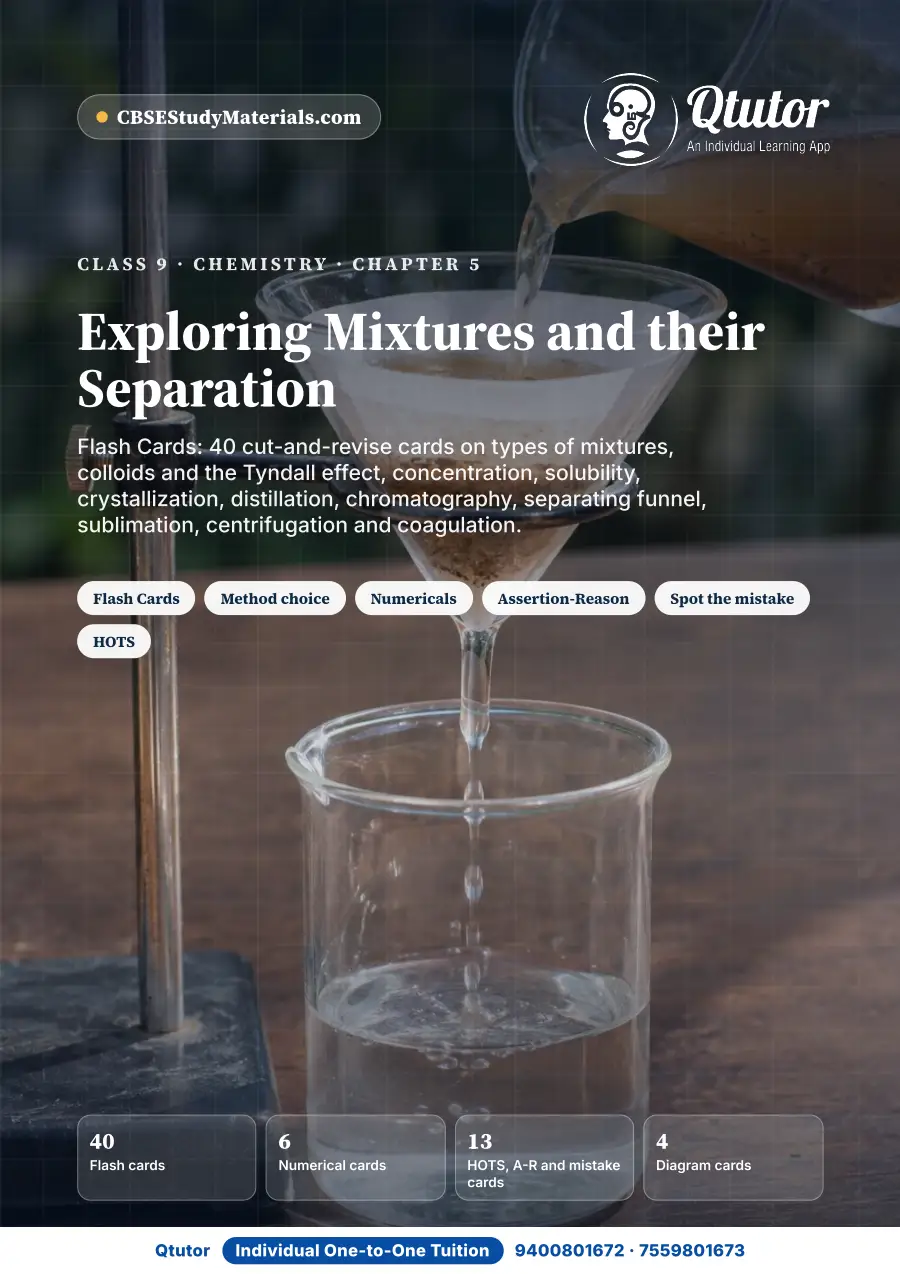
Can you say, without flipping a card, why 100 g of a 10 % salt solution mixed with 50 g of a 25 % one does not give 17.5 %, or why sea salt is made in salt pans and never by cooling hot brine? This free PDF of Exploring Mixtures and their Separation Class 9 Chemistry Chapter 5 flash cards turns the CBSE chapter from the new NCERT Science textbook Exploration into 40 quick question-and-answer cards. It is an 11-page print-and-cut revision set for the CBSE 2026-27 session, free to download, and it is independent study material, not an official CBSE or NCERT publication.
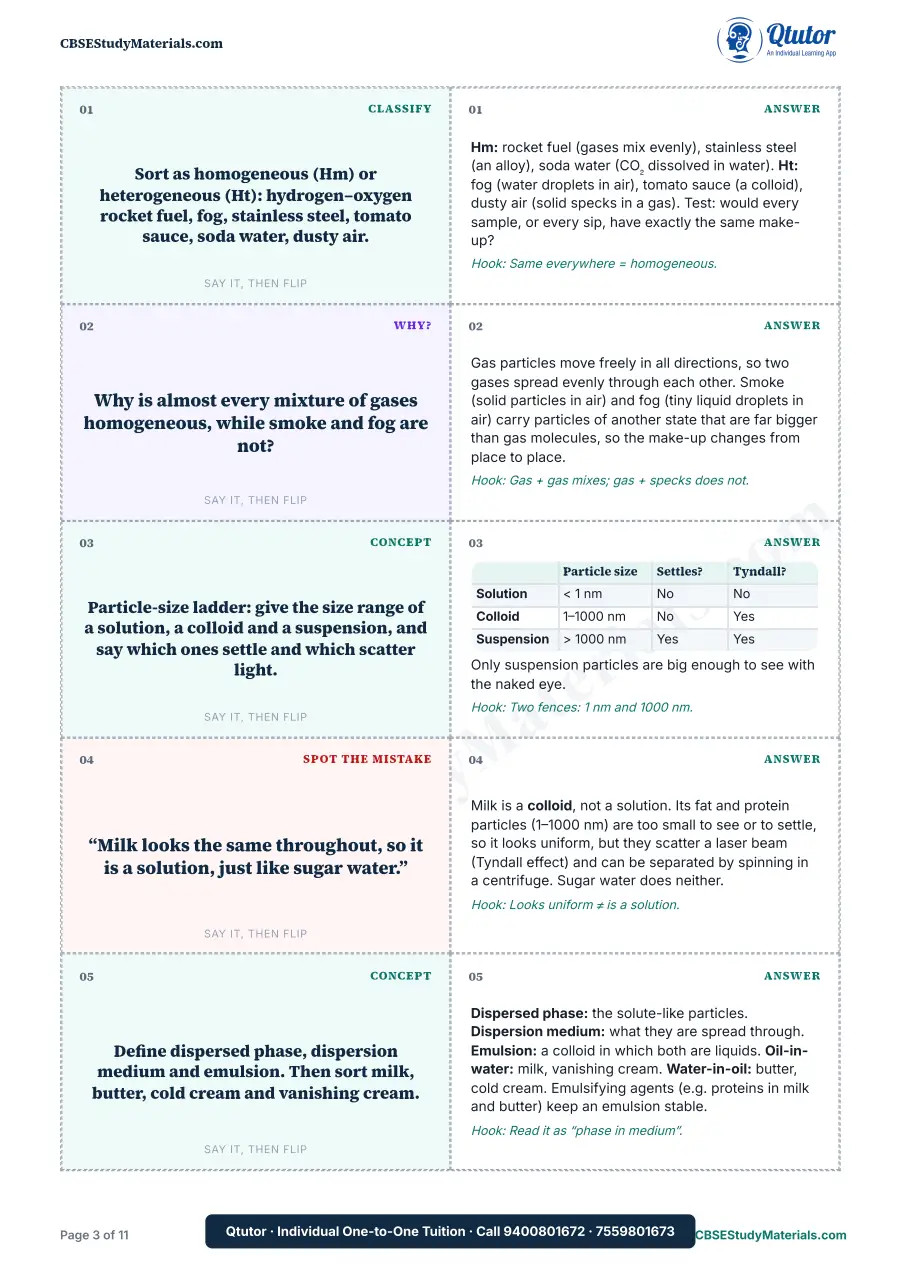
Every card has a front (a question, a statement to correct, an assertion-reason pair or a sketch prompt) and a back (a short answer, a worked number where needed and a one-line memory hook). The deck is NCERT based and works as a fast chapter summary and important-questions drill in one: it is built for the last few days before a unit test, when you need to check what you really know.
Class 9 Chemistry Chapter 5 Exploring Mixtures and their Separation Flash Cards: What Is Included
- 40 flash cards, five to a page, front beside back, with dashed cut lines
- 6 Numerical cards on % m/m, % m/v, % v/v and solubility: an ointment label, the WHO ORS recipe, a floor-cleaner dilution, boiling off water to concentrate a syrup, the chromium and nickel in a stainless-steel cooker, and crystals of ammonium chloride on cooling
- 6 HOTS cards, such as mixing two salt solutions, fish gasping in a warm pond, classifying a cloud, a chromatogram with only one spot, getting both drinking water and salt from muddy seawater, and two immiscible liquids of equal density
- 4 Spot the mistake cards that correct statements students often write in exams
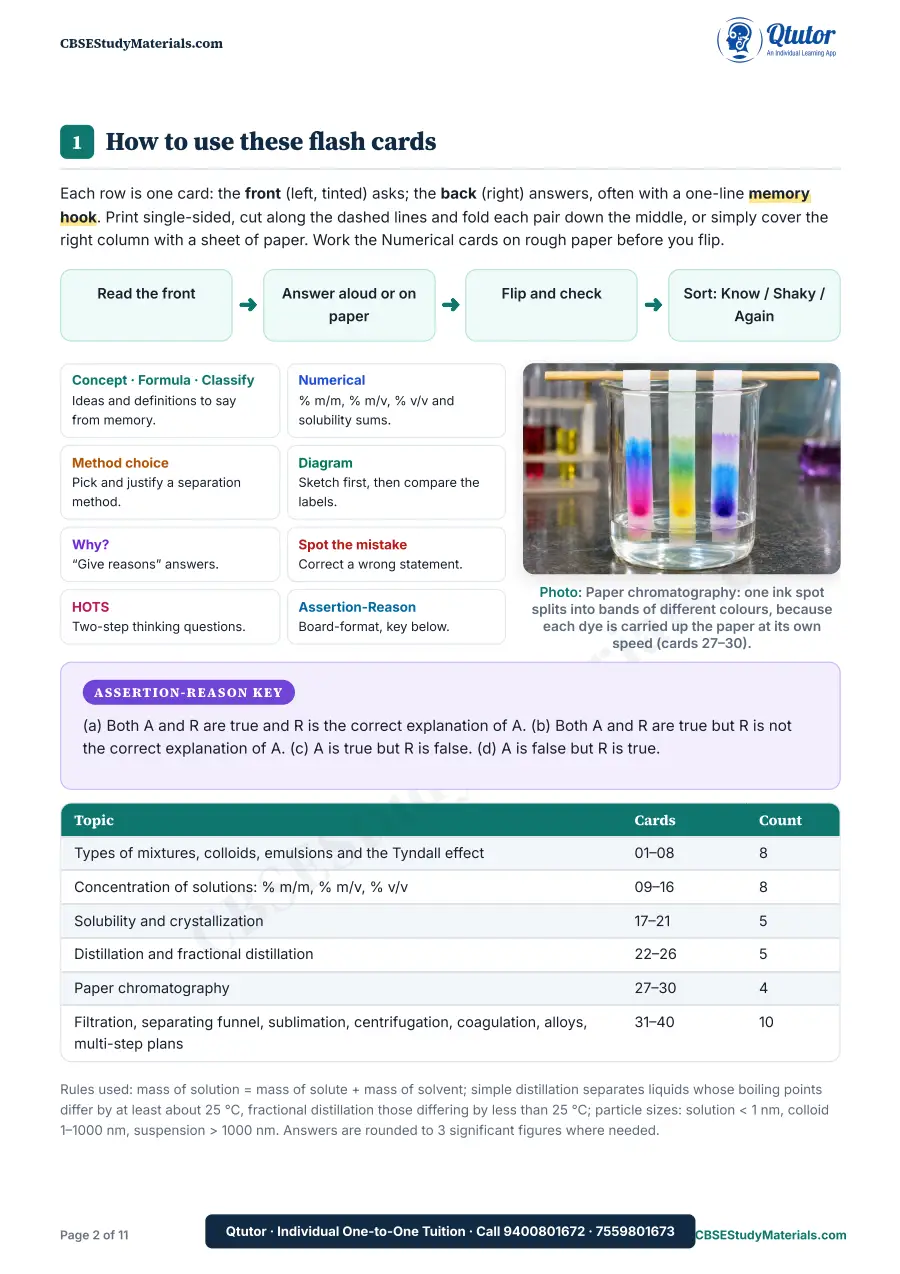
- 3 Assertion-Reason cards in the board format, with the (a) to (d) key on the how-to page
- 4 Diagram cards with original labelled sketches: distillation, paper chromatography (before and after), filtration, and the separating funnel
- 2 Method choice cards, plus Concept, Formula, Classify and Why? cards
- A how-to-use page with a topic index, and a one-page "choose the method" recap with a self-check list
Structure of the PDF
| Pages | What you get |
|---|---|
| 1 | Cover |
| 2 | How to use the cards, card types, Assertion-Reason key, topic index, rules used |
| 3-10 | Cards 01-40 (front and back side by side) |
| 11 | Recap table: which property decides which separation method; self-check list |
Exploring Mixtures and their Separation Class 9 Important Topics Covered
- Homogeneous and heterogeneous mixtures, and why gas mixtures are usually uniform
- Solutions, colloids and suspensions by particle size (below 1 nm, 1-1000 nm, above 1000 nm)
- Dispersed phase, dispersion medium and emulsions (oil-in-water and water-in-oil)
- The Tyndall effect in everyday life
- Concentration of solutions as % m/m, % m/v and % v/v
- Solubility, saturated solutions and the effect of temperature on solids and gases
- Crystallization of copper sulfate and salt from seawater
- Distillation (boiling points at least about 25 °C apart) and fractional distillation (less than 25 °C apart), as for crude oil
- Paper chromatography of inks, food colours and leaf pigments
- Filtration, separating funnel, sublimation and deposition, centrifugation and the paperfuge, coagulation with alum, and why alloys cannot be separated physically
Exploring Mixtures and their Separation Class 9 Important Questions (Sample)
Card 13 (HOTS · Numerical). 100 g of a 10 % m/m salt solution is mixed with 50 g of a 25 % m/m salt solution. Is the new solution 17.5 %? Back: Salt = 10 g + 12.5 g = 22.5 g in 100 + 50 = 150 g of solution, so % m/m = 22.5⁄150 × 100 = 15%. Hook: add the grams, never the percentages.
Card 23 (Method choice). Using the boiling points water 100 °C, benzene 80 °C, chloroform 61 °C and acetone 56 °C, choose a method for each pair:
| Pair | Gap | Method |
|---|---|---|
| Acetone + water | 44 °C | Simple distillation |
| Acetone + chloroform | 5 °C | Fractional distillation |
| Acetone + benzene | 24 °C | Fractional distillation |
| Chloroform + water | - | Separating funnel (they do not mix) |
Card 08 (Assertion-Reason). A: A colloid of starch in water passes through filter paper without leaving a residue. R: Colloidal particles are smaller than 1 nm. Back: (c) A is true, R is false: colloidal particles are 1-1000 nm, small enough to pass the filter but big enough to scatter light.
How the Flash Cards Help
- Active recall: you answer before you see the back, which shows exactly which ideas are shaky
- Exam language: Why? and Spot the mistake cards rehearse "give reasons" and "correct the statement" answers
- Numericals without panic: every concentration sum shows the formula, the substitution and the answer with unit
- Method choice: the cards and the recap table train the one question that decides most answers in this chapter: which property differs?
- Diagrams: sketch first, then compare with the labelled drawing on the back
Who Should Use It
Class 9 students revising Chapter 5 for unit tests, half-yearly exams and the annual exam; students who have read the notes and want a quick self-test; teachers and parents who want a ready set of oral quiz questions. The cards work well in pairs: one reads the front, the other answers.
How to Download the Class 9 Exploring Mixtures and their Separation Flash Cards PDF
Click the button below to get the free PDF download. Print it single-sided on A4, cut along the dashed lines and fold each card, or simply revise on screen by covering the answer column.
Exploring Mixtures and their Separation - Class 9 Chemistry Chapter 5 Flash Cards (PDF · 11 pages · Free download)
Related Resources
- Exploring Mixtures and their Separation Class 9 notes (free)
- Exploring Mixtures and their Separation Class 9 worksheet with answer key
- Exploring Mixtures and their Separation chapter notes and 30-question bank
- Exploring Mixtures and their Separation competency-based model question paper
- Exploring Mixtures and their Separation flash cards (another set)
- All Class 9 Chemistry Chapter 5 resources
- Class 9 Chemistry study material
- Next chemistry chapter: Journey Inside the Atom
FAQs on Class 9 Chemistry Chapter 5 Exploring Mixtures and their Separation
Where can I download Class 9 Chemistry Chapter 5 Exploring Mixtures and their Separation flash cards PDF? On this page. Click the download button to get the 11-page PDF with all 40 cards and answers.
Are the Exploring Mixtures and their Separation Class 9 flash cards free? Yes. This flash-card PDF is free to download.
What are the important topics in Exploring Mixtures and their Separation Class 9? Solutions, colloids and suspensions, the Tyndall effect, concentration in % m/m, % m/v and % v/v, solubility and crystallization, distillation, paper chromatography, the separating funnel, sublimation, centrifugation and coagulation.
Which book is Exploring Mixtures and their Separation Class 9 from? It is Chapter 5 of the new NCERT Class 9 Science textbook Exploration, used for CBSE 2026-27.
Do the flash cards include numericals on concentration? Yes. Six Numerical cards and one HOTS card cover % m/m, % m/v, % v/v and solubility, each with a step-by-step answer.
How should I use flash cards for Class 9 Chemistry revision? Answer each front aloud or on rough paper, flip to check, and sort the cards into Know, Shaky and Again piles. Repeat the Shaky and Again piles the next day.
Study tip: before every separation answer, write one line naming the property that differs; the method then follows almost by itself.