Business, Trade and Commerce - Class 11 Business Studies Ch 1 Notes (PDF · 18 pages · Free download) Download the full PDF free
You are looking at pages 1 to 3 of 18. The full PDF is free to download.
Business, Trade and Commerce is Class 11 Business Studies Chapter 1, and these free CBSE chapter notes cover the whole NCERT chapter for the 2026-27 session in one PDF of 18 pages. This is independent, NCERT based study material, not an official CBSE or NCERT publication, and it works as full notes as well as quick revision notes before a test.
Around 1 AD, India's share of world income was about 32%. By 1973 it was 3.1%. The first chapter of Class 11 Business Studies asks why: how trade made the subcontinent rich, how merchants moved money safely with the Hundi, what changed under colonial rule, and why India chose liberalisation in 1991. Then it moves to the ideas you will use in every later chapter: what counts as business, how industry and commerce are classified, why profit is not the only objective, and what business risk really means. These notes take you through all of it in a clear, exam-ready order.
Class 11 Business Studies Chapter 1 Business, Trade and Commerce Notes: What Is Included
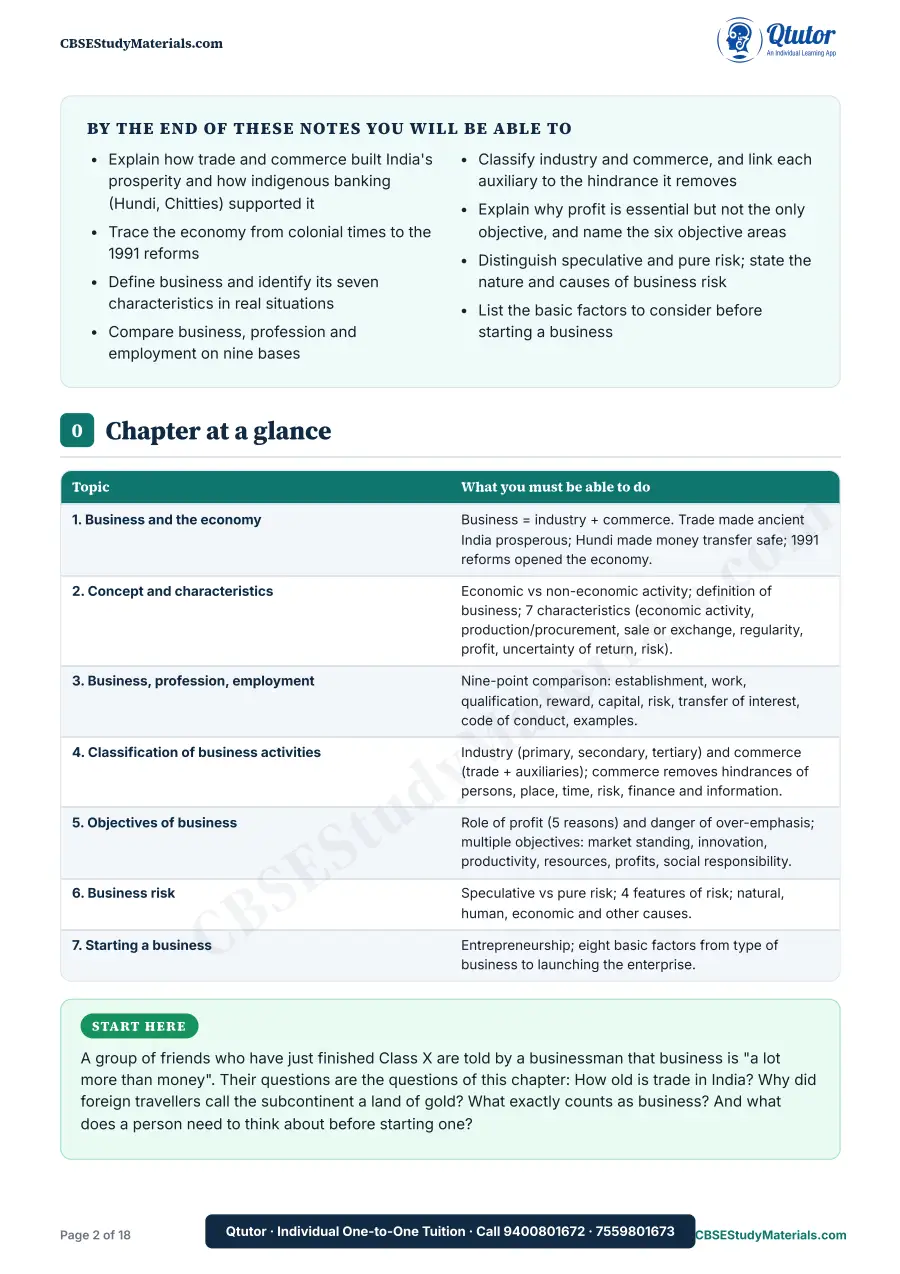
- Learning objectives and a "chapter at a glance" table that works as a quick chapter summary
- Seven numbered topic sections that follow the NCERT chapter from India's trading history to starting a business
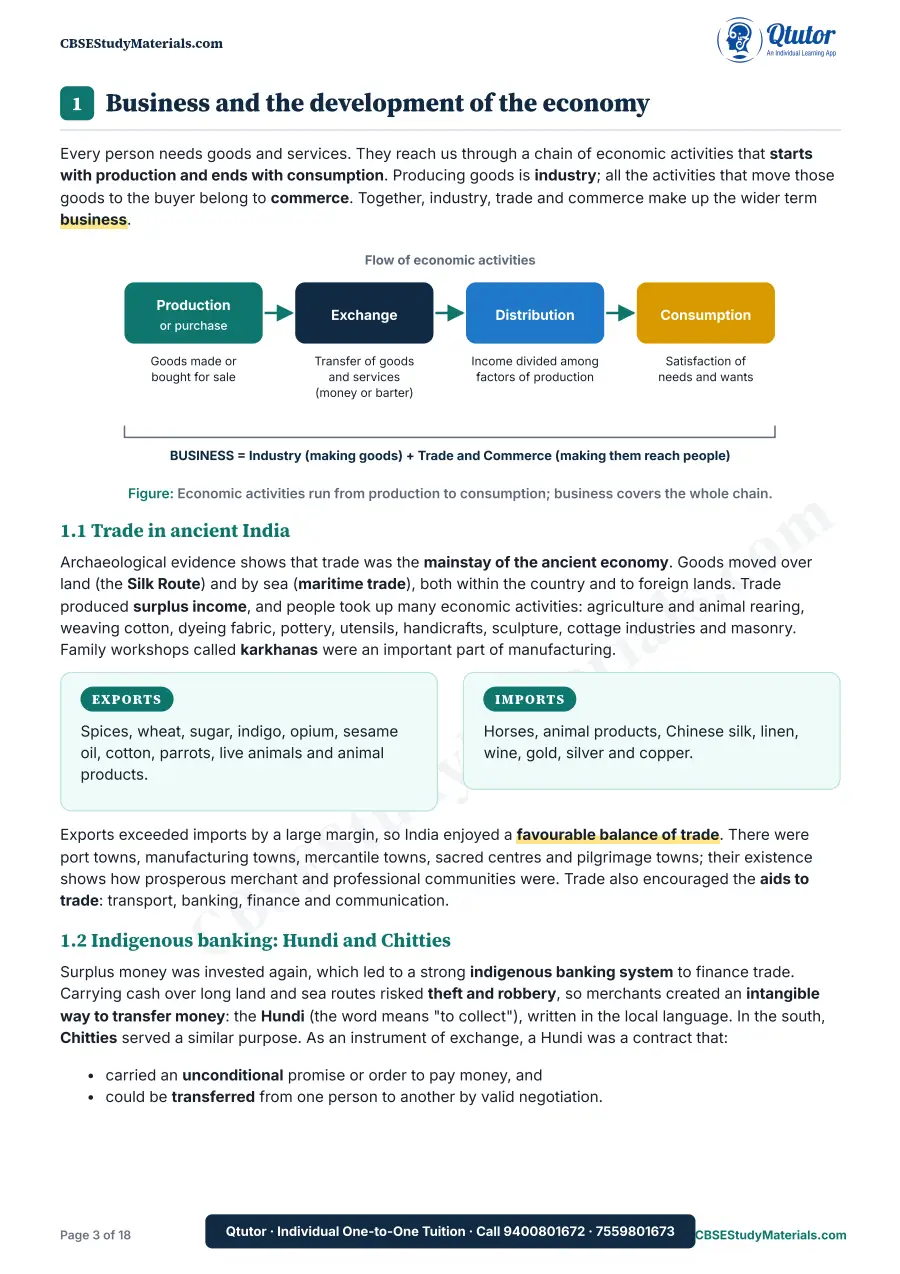
- 9 original diagrams: the flow of economic activities, a bar chart of India's share of world income (figures as printed in the NCERT timeline), the seven characteristics of business, the full chart of business activities, the six hindrances commerce removes, the six objective areas, nature and causes of risk, the eight factors for starting a business, and a chapter mind map
- Tables for the seven types of Hundi, the 14 major ancient trade centres, the nine-point comparison of business, profession and employment, types of industry, auxiliaries to trade, objectives, speculative vs pure risk and the starting-up factors
- Concept, definition, "did you know", real-life, common-mistake and "think deeper" boxes
- Realistic photographs (a wholesale market, a container port and a neighbourhood store) that link the ideas to everyday Indian business
- An 18-term key-terms grid and a one-page summary
- 12 exam-pattern important questions (MCQ, statement-based, assertion-reason, 3, 4 and 6 mark situation-based) with a marking-scheme style answer key
Structure of the Business, Trade and Commerce Class 11 Notes PDF
| Part | What you get |
|---|---|
| Cover, objectives, at a glance | Topic-by-topic summary table |
| 1 Business and the economy | Ancient trade, exports and imports, karkhanas, Hundi and Chitties, trade centres, colonial shift, 1991 reforms |
| 2 Concept and characteristics | Economic vs non-economic activities, definition, 7 characteristics with tests |
| 3 Business, profession, employment | Nine-basis comparison table |
| 4 Classification of business activities | Primary, secondary, tertiary industry; trade and auxiliaries; six hindrances |
| 5 Objectives of business | Role of profit, danger of over-emphasis, six objective areas |
| 6 Business risk | Speculative vs pure risk, nature and causes |
| 7 Starting a business | Entrepreneurship and eight basic factors |
| Key terms, mind map, summary | Last-day revision pages |
| Check yourself | 12 questions (32 marks) with answers |
Business, Trade and Commerce Class 11 Important Topics
- History of trade and commerce in India: Silk Route and maritime trade, favourable balance of trade, aids to trade, travellers who called India Swaran Bhoomi, and the estimated share of world income from 1 AD to 1973
- Indigenous banking: why the Hundi ("to collect") was needed, its two legal features, and the Darshani and Muddati types including the Jokhmi hundi
- Indian economy after independence: planned development, the balance-of-payments crisis and the three-pronged 1991 approach of stabilisation, restructuring and globalisation
- Concept and characteristics of business: economic activity, production or procurement, sale or exchange, regularity, profit, uncertainty of return and risk
- Business vs profession vs employment on establishment, nature of work, qualification, reward, capital, risk, transfer of interest and code of conduct
- Classification of business activities: extractive and genetic industries; analytical, synthetical, processing and assembling manufacturing; construction; tertiary industries; trade and auxiliaries to trade
- Objectives of business: market standing, innovation, productivity, physical and financial resources, earning profits and social responsibility
- Business risk: speculative and pure risk, its nature, and natural, human, economic and other causes
- Starting a business: type, size, location, finance, physical facilities, workforce, tax planning and launching
Business, Trade and Commerce Class 11 Important Questions (Sample)
Sample 1: classification table from the notes
| Type | Meaning | Examples |
|---|---|---|
| Primary: Genetic | Breed plants and animals for further reproduction | Seed and nursery companies, poultry farms, fish hatcheries |
| Secondary: Manufacturing | Process raw or partly finished materials into finished goods, creating form utility | Steel from iron ore |
Sample 2: assertion-reason (1 mark)
Assertion (A): A large-scale business generally faces a higher degree of risk than a small one. Reason (R): A business can eliminate risk completely by taking insurance. Answer: (C) A is true, R is false. Risk can be minimised but never eliminated.
Sample 3: situation-based (3 marks)
Ravi runs a garment shop. (a) Sales of winter jackets may rise or fall depending on how cold the season turns out. (b) A short circuit could start a fire in his godown. Identify the type of risk in each and state one difference. Answer: (a) speculative risk, gain or loss possible; (b) pure risk, only loss or no loss; speculative risk carries a chance of gain, pure risk never does.
How These Business Studies Notes Help
- The history section is kept short and organised into tables, so dates, centres and Hundi types are easy to revise
- Every list in the chapter (characteristics, objectives, causes of risk, starting-up factors) is turned into a diagram you can redraw in an answer
- Common-mistake boxes tackle the usual confusions: fishing vs fish hatchery, a salaried doctor vs a practising doctor, Darshani vs Muddati hundi
- Questions follow the CBSE Business Studies pattern of situation-based items where you identify the concept and quote the line, with value points showing how marks are given
Who Should Use It
Class 11 Commerce students starting Business Studies in CBSE 2026-27, students who want one clean set of notes and important questions for unit tests and half-yearly exams, and teachers or parents looking for printable chapter-wise study material for Chapter 1.
Business, Trade and Commerce - Class 11 Business Studies Ch 1 Notes (PDF · 18 pages · Free download)
How to Download the Class 11 Business, Trade and Commerce Notes PDF
Use the download button above. The PDF is free, has 18 pages and prints well on A4, so you can keep it in your Business Studies file and revise from the summary page before tests.
Related resources
- Class 11 Business Studies Chapter 1 Business, Trade and Commerce: chapter page
- All Class 11 Business Studies study material
FAQs on Class 11 Business Studies Chapter 1 Business, Trade and Commerce
Where can I download Class 11 Business Studies Chapter 1 Business, Trade and Commerce notes PDF? You can download the 18-page notes PDF free from the button on this page.
What are the important topics in Business, Trade and Commerce Class 11? The history of trade and indigenous banking in India, the concept and characteristics of business, business vs profession vs employment, classification of industry and commerce, objectives of business, business risk and the factors for starting a business.
Is the Business, Trade and Commerce notes PDF free? Yes. Chapter 1 notes are free.
Which book is Business, Trade and Commerce Class 11 from? It is Chapter 1 of the NCERT Class 11 Business Studies textbook (Part I, Foundations of Business). These notes are based on the 2026-27 reprint.
Does the PDF include important questions with answers? Yes. It has 12 exam-pattern questions worth 32 marks, from MCQs and assertion-reason to 6-mark situation-based questions, followed by an answer key with value points.
What is the difference between speculative and pure risk in Class 11 Business Studies? Speculative risk can bring either gain or loss (for example, changes in demand or fashion), while pure risk can bring only loss or no loss (for example, fire or theft).
Study tip: learn each list through its diagram, then practise 4 and 6 mark answers by identifying the concept and explaining one line per point.