Understanding the Weather - Class 7 Social Science Chapter 2 Model Question Paper (PDF · 15 pages · ₹49) Unlock the full PDF for ₹49
Free sample: pages 1 to 3 of 15. The full PDF costs ₹49.
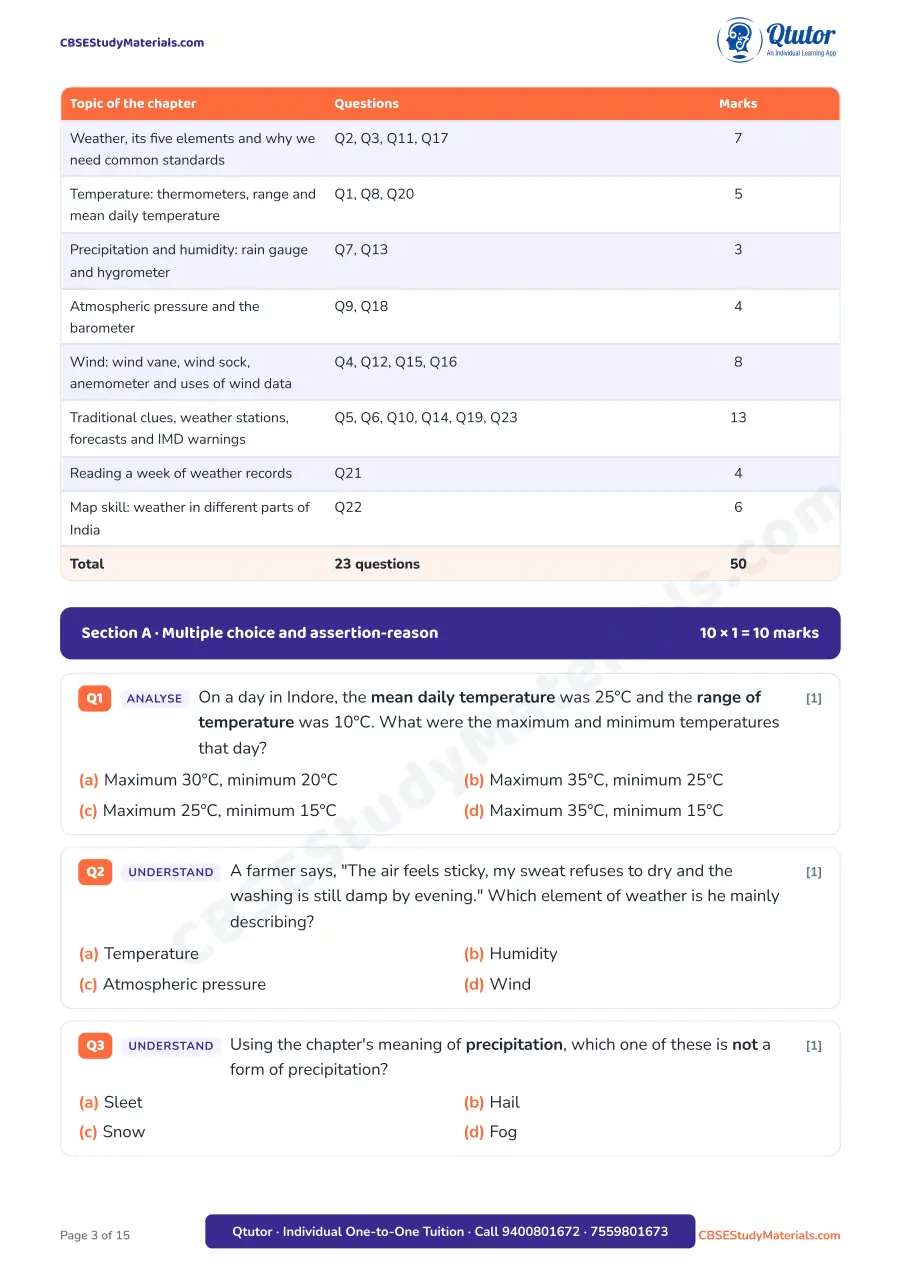
If the mean daily temperature in Indore is 25°C and the range is 10°C, what were the day's maximum and minimum? This Understanding the Weather model question paper for CBSE Class 7 Social Science Chapter 2 opens with puzzles like that, and it is a 15-page chapter test based on the NCERT textbook Exploring Society: India and Beyond (Part 1), with a full marking scheme. It is a premium PDF priced at ₹49, an independent practice paper and not an official CBSE or NCERT publication.
The paper is set for 50 marks and 2 hours, the way a school runs a chapter-wise unit test. Most questions ask students to apply what they know to real situations, read data, interpret diagrams and judge, so it works as a final check after reading the chapter and revising from notes. Every question is original and different from the ones in our notes, NCERT solutions and question bank for this chapter.
Class 7 Social Science Chapter 2 Model Question Paper: What Is Included
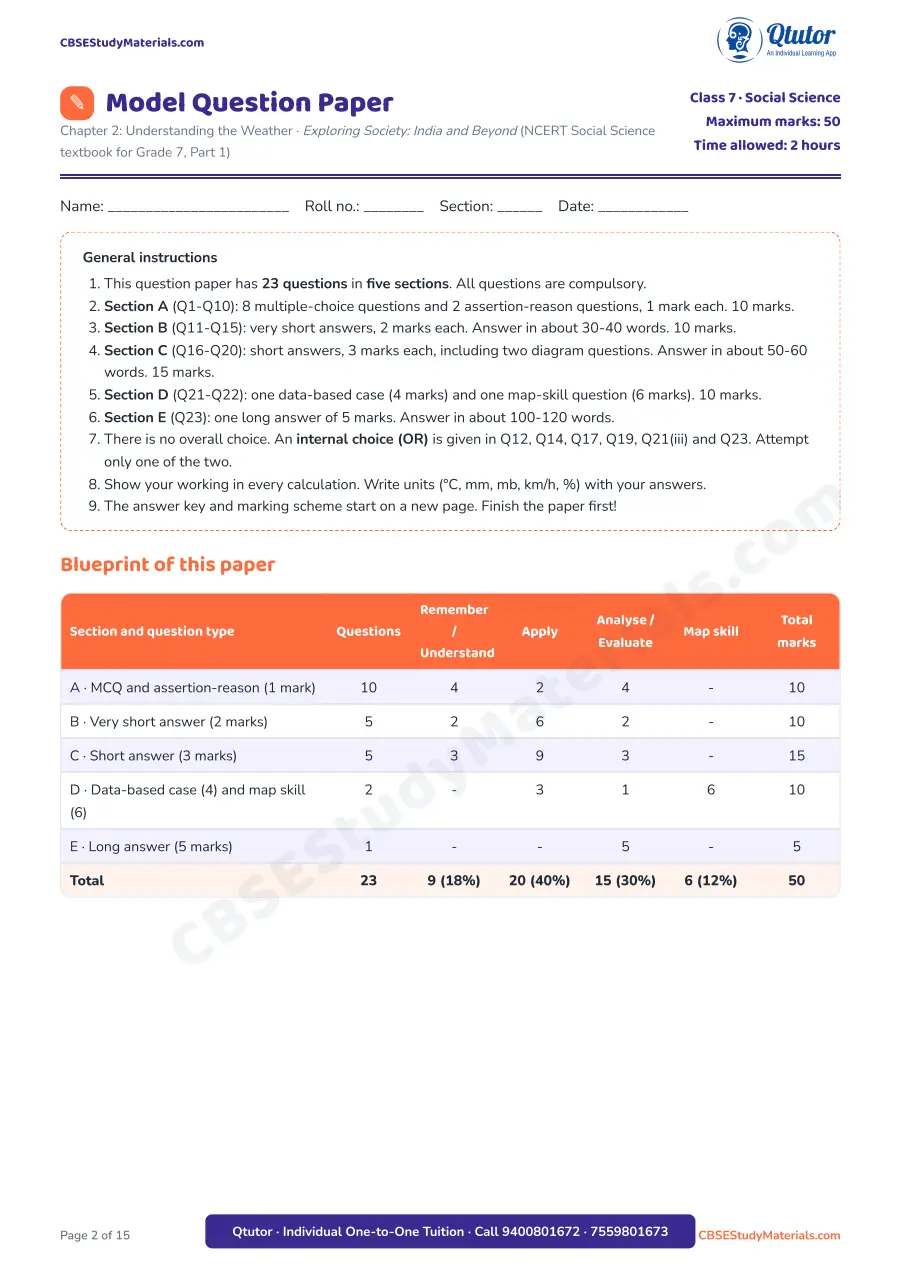
- A paper header with class, subject, chapter, maximum marks (50) and time (2 hours), plus a name and roll-number line
- Nine general instructions, written the way a school exam paper gives them
- A blueprint table showing marks by question type and by thinking level (remember and understand, apply, analyse and evaluate, map skill)
- A second blueprint table showing which topics of the chapter carry how many marks
- 23 original questions in five sections, with internal choice (OR) in six questions
- A labelled diagram of a weather instrument to identify and explain
- A two-town barometer diagram for reasoning about wind direction
- A data-based case on a school weather club's week of temperature, humidity and rainfall records
- A map-skill question on an outline map of India showing India's complete official boundary, with six lettered places and six weather reports to match
- Three photos: storm clouds over a lake on the cover, a rooftop wind vane and a rain gauge after rain, each linked to questions
- A "My score card" table for self-assessment
- A complete answer key and marking scheme with value points, half marks and worked calculations
Structure of the Paper
| Section | Question type | Questions | Marks |
|---|---|---|---|
| A | MCQ (8) and assertion-reason (2) | Q1-Q10 | 10 |
| B | Very short answer, 2 marks each | Q11-Q15 | 10 |
| C | Short answer, 3 marks each (incl. two diagram questions) | Q16-Q20 | 15 |
| D | Data-based case (4) and map skill (6) | Q21-Q22 | 10 |
| E | Long answer | Q23 | 5 |
| Total | 23 | 50 |
Only 9 of the 50 marks are for remembering and understanding. Application carries 20 marks, analysis and evaluation 15 marks, and map skill 6 marks.
Understanding the Weather Class 7 Important Topics Covered
- What weather is and the five elements of weather: temperature, precipitation, atmospheric pressure, wind and humidity
- Why we need common standards such as °C instead of words like "chilly"
- Traditional clues from nature: ants, frogs, birds and pine cones
- Thermometers, the range of temperature and the mean daily temperature
- The rain gauge, including how to measure snow
- Atmospheric pressure, the barometer, millibars, depressions and high altitude
- Wind: the wind vane, wind sock and anemometer, and why pilots, sailors, farmers and factories need wind data
- Humidity, relative humidity and the hygrometer
- Weather stations, Automated Weather Stations and forecasting
- The India Meteorological Department's colour-coded warnings (green, yellow, orange, red) and how warnings protect people
Understanding the Weather Class 7 Important Questions (Sample)
Q4 (MCQ, Apply). The meter of an anemometer at an airport counts 120 turns a minute at 9 a.m. and 300 turns a minute at 3 p.m. What can the airport staff conclude? (Answer: the wind was blowing faster at 3 p.m., because the stronger the wind, the faster the cups spin.)
Q20 (Short answer, 3 marks). Town X records a maximum of 30°C and a minimum of 20°C; Town Y records 38°C and 12°C. The marking scheme works it out step by step:
| Town | Range | Mean daily temperature |
|---|---|---|
| X | 30 − 20 = 10°C | (30 + 20) ÷ 2 = 25°C |
| Y | 38 − 12 = 26°C | (38 + 12) ÷ 2 = 25°C |
The same mean hides very different days, so a traveller to Town Y needs warm clothes for the night too.
Q18 (Analyse). Town P reads 1015 mb and Town R reads 998 mb, about 100 km apart. Which way will the wind tend to blow, and what happens if both later read 1008 mb? (Answer: from P towards R, because air moves from high to low pressure; with equal pressure there is little or no wind.)
How This Model Question Paper Helps
- Exam practice under real conditions: the 50-mark, 2-hour format lets students time themselves before a unit test or half-yearly exam.
- Thinking, not cramming: questions ask students to read tables, interpret diagrams, match weather reports to places on a map and give advice for real situations such as a heat-wave warning.
- Honest self-checking: the marking scheme shows the value points and half marks a teacher looks for, so students can see exactly where marks are lost.
- Calculations made clear: range, mean daily temperature, weekly rainfall totals and averages are all worked out in full.
- Revision map: the topic blueprint shows which parts of the chapter carry more marks, so revision time goes where it matters.
Who Should Use It
- Class 7 students who have finished Chapter 2 and want a full-length test
- Parents who want a ready test paper with answers to check their child's preparation
- Teachers looking for a chapter-wise unit test with a blueprint and marking scheme
- Tutors who want indirect, competency-based questions in the CBSE 2026-27 style for practice
How to Download the Class 7 Understanding the Weather Model Question Paper PDF
Use the download button below. The PDF is A4 and print-ready, with writing lines for every answer, so students can attempt it on paper and then check against the answer key at the end.
Understanding the Weather - Class 7 Social Science Chapter 2 Model Question Paper (PDF · 15 pages · ₹49)
Related Resources
- Class 7 Social Science Chapter 2 Understanding the Weather chapter page
- Understanding the Weather Class 7 Notes PDF: revision notes and chapter summary
- Understanding the Weather Class 7 NCERT Solutions PDF
- Understanding the Weather Class 7 Question Bank PDF: more important questions with answers
- All Class 7 Social Science study material
- Previous chapter: Chapter 1 Geographical Diversity of India
- Next chapter: Chapter 3 Climates of India
FAQs on Class 7 Social Science Chapter 2 Understanding the Weather
Where can I download the Class 7 Social Science Chapter 2 Understanding the Weather model question paper PDF? On this page. Use the download button above to get the 15-page PDF with the question paper, blueprint and full marking scheme.
What is the price of the Understanding the Weather Class 7 question paper? It is a premium PDF priced at ₹49. It includes 23 original questions and a complete answer key with value points.
What are the important topics in Understanding the Weather Class 7? The five elements of weather, the instruments that measure them (thermometer, rain gauge, barometer, wind vane, anemometer, hygrometer), range and mean daily temperature, weather stations, forecasting and the IMD's colour-coded warnings.
Which book is Understanding the Weather Class 7 from? It is Chapter 2 of the NCERT Social Science textbook Exploring Society: India and Beyond, Grade 7 Part 1, used in CBSE schools in 2026-27.
Does the paper have a map question? Yes. Q22 uses an outline map of India with six lettered places. Students identify the places and match six weather reports, such as a 650 mb barometer reading or a hygrometer above 80%, to the right place.
Is this an official CBSE sample paper? No. It is an independent, NCERT-based practice paper that follows a CBSE-style pattern for Class 7.
Study tip: before you check your answers, say aloud which instrument and which unit each question is really about; most weather marks are won there.