Electricity: Circuits - Class 7 Science Chapter 3 NCERT Solutions (PDF · 18 pages · ₹49) Unlock the full PDF for ₹49
Free sample: pages 1 to 3 of 18. The full PDF costs ₹49.
Why does a torch stay dark when just one of its two cells is put in the wrong way round? This Class 7 Science Chapter 3 Electricity: Circuits and their Components NCERT Solutions PDF answers that question and every other question in the chapter, for CBSE students using the NCERT Curiosity textbook. It is an 18-page premium PDF (₹49) with step-by-step answers and neat circuit diagrams drawn with the standard symbols. It is an independent study resource written by our team; it is not an official CBSE or NCERT publication.
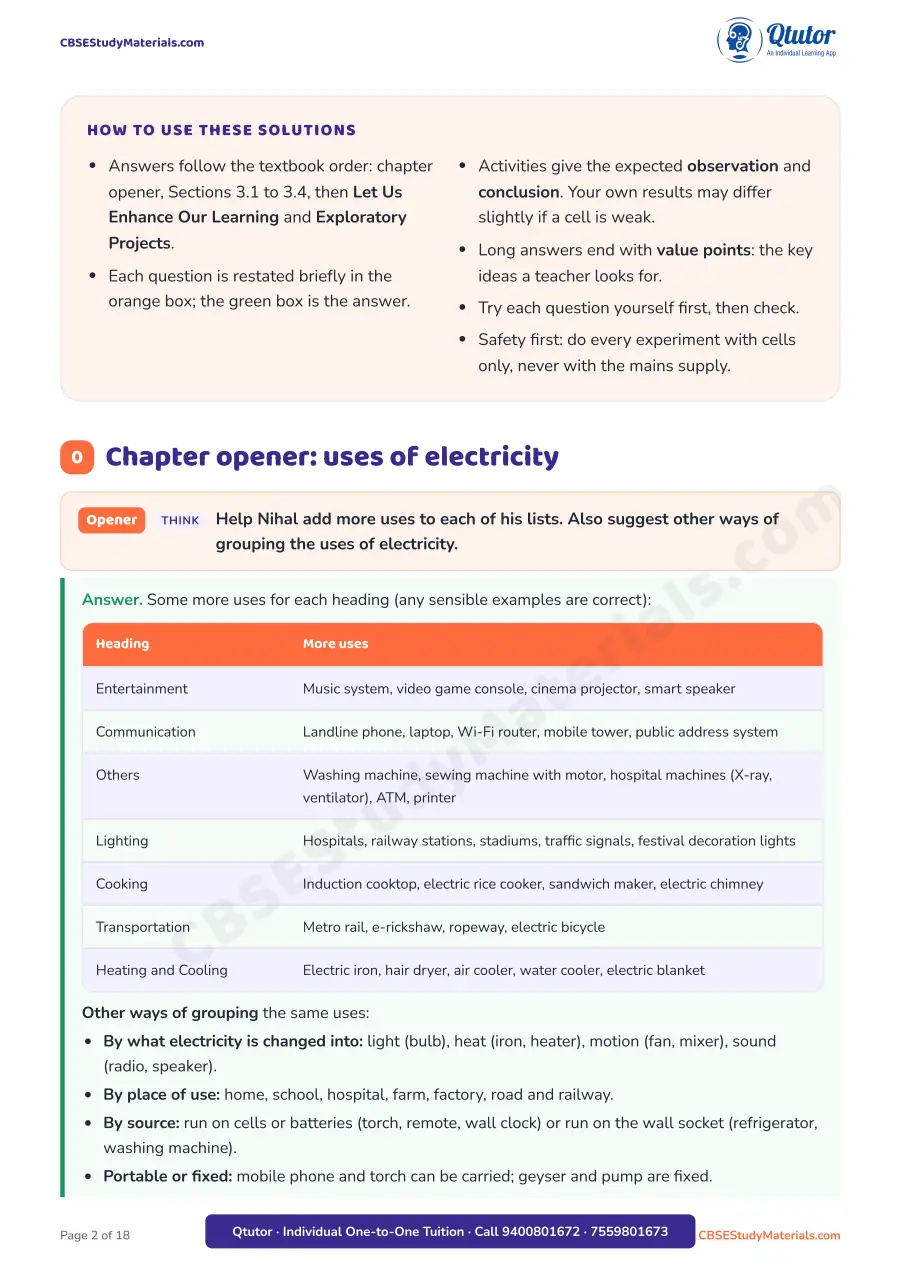
The solutions follow the textbook page by page, so you can keep the book open beside the PDF and find each answer in seconds. Each question is restated briefly in an orange box, and the answer sits right below it in a green box. Activities get the expected observation and the conclusion, and long or open questions get a model answer plus value points.
Class 7 Science Chapter 3 NCERT Solutions: What Is Included
- 24 in-text answers covering the chapter opener (Nihal's uses-of-electricity lists), the "think" questions in the margins, the Dive Deeper boxes and all eleven activities, from Activity 3.1 (exploring a torch) to Activity 3.11 (the conduction tester).
- All 11 questions of "Let Us Enhance Our Learning", numbered exactly as in the book, with reasons, not just one-word answers.
- Guided answers to all 4 Exploratory Projects: the two-day power cut list, the solar-panel toy fan, the shop survey of cells and the home list of conductors and insulators.
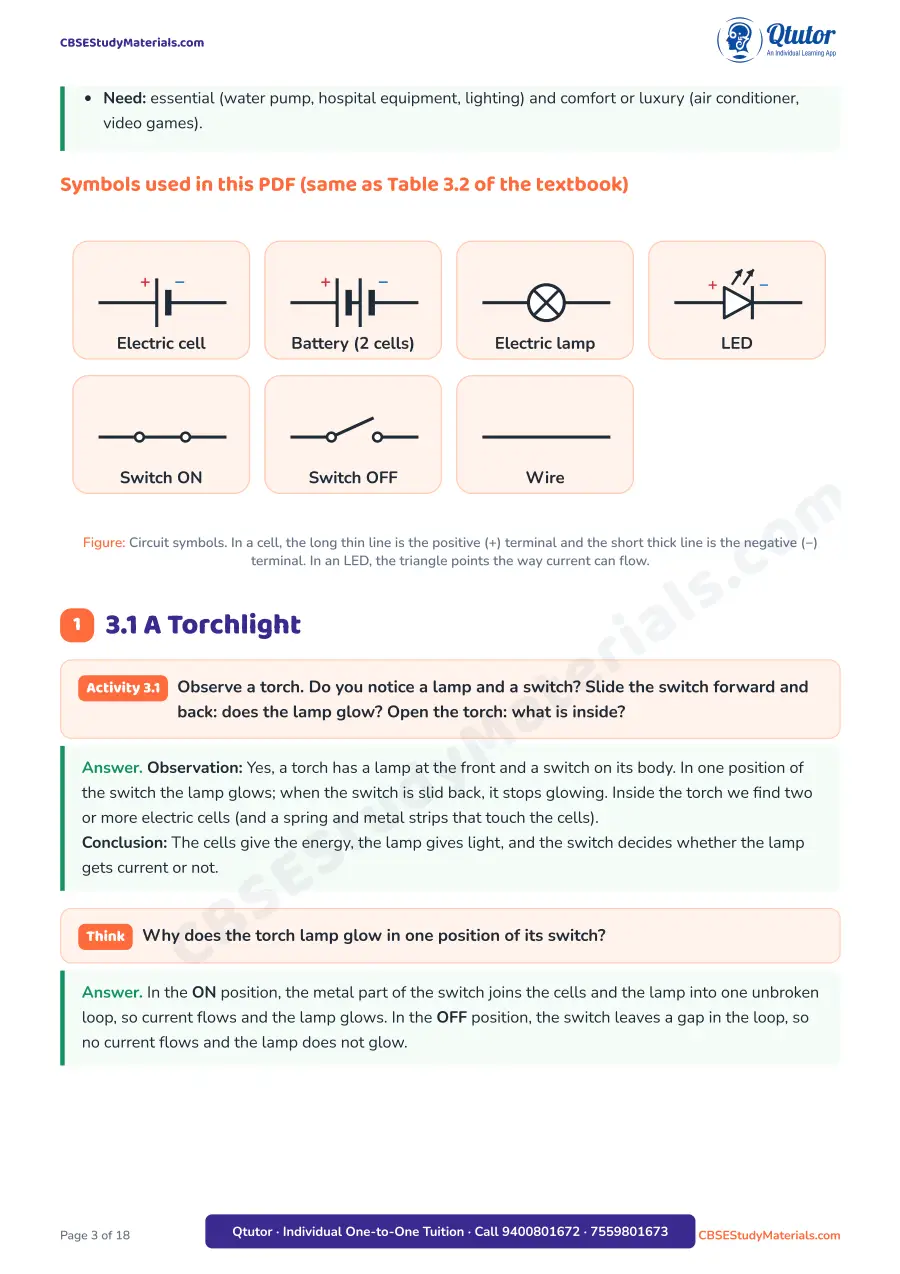
- 15 original drawings, including a symbols chart (cell, battery, lamp, LED, switch ON and OFF, wire), circuit diagrams for Activity 3.10 and Question 5, and redrawn versions of Figs. 3.17, 3.18, 3.20 and 3.21.
- Filled-in tables: Table 3.1 (six ways of joining a cell and a lamp) and Table 3.3 (conductors and insulators).
- A one-page "Remember for the exam" box with the key rules of the chapter.
Structure of the Electricity: Circuits and their Components Solutions PDF
| Part | What you get | Pages |
|---|---|---|
| How to use + chapter opener | Reading guide, more uses of electricity, other ways to group them | 2-3 |
| Symbols chart | All seven symbols from Table 3.2, redrawn | 3 |
| 3.1 A Torchlight | Activity 3.1 and why the switch matters | 3 |
| 3.2 A Simple Electrical Circuit | Cell, battery, incandescent lamp, LED, Table 3.1, LED direction, switch (Activities 3.2-3.9) | 4-7 |
| 3.3 Circuit Diagrams | Activity 3.10 with two circuit diagrams | 8 |
| 3.4 Conductors and Insulators | Activity 3.11, Table 3.3 filled in, why wires are covered, DC and AC | 8-10 |
| Let Us Enhance Our Learning | Q1 to Q11 with diagrams | 11-16 |
| Exploratory Projects | Four guided project answers | 16-18 |
| Revision box | Key rules for the exam | 18 |
Electricity: Circuits and their Components Class 7 Important Topics
- Electric cell: positive terminal (metal cap) and negative terminal (flat metal disc)
- Battery: two or more cells joined so that + of one touches − of the next
- Incandescent lamp: filament, its supports, and the two terminals on the base
- LED: longer leg is positive, shorter leg is negative; current passes in one direction only
- Electrical circuit: a complete, closed path from the + terminal back to the − terminal
- Electric switch: ON means closed circuit, OFF means open circuit with an air gap
- Circuit diagrams and the symbols for cell, battery, lamp, LED, switch and wire
- Conductors and insulators, why copper is used for wires, and electrical safety
Electricity Class 7 Important Questions (Sample from this PDF)
Exercise Q6 (Fig. 3.18): Two lamps L1 and L2, two switches S1 and S2 and a battery are all in one loop. Which lamps glow?
| Case | S1 | S2 | Lamps that glow |
|---|---|---|---|
| (i) | OFF | ON | None |
| (ii) | ON | OFF | None |
| (iii) | ON | ON | Both L1 and L2 |
| (iv) | OFF | OFF | None |
Reason: there is only one path for the current, so any one switch in the OFF position opens the whole circuit.
Exercise Q8 (Fig. 3.20): In which case will the lamp or LED not glow when the switch is closed? Only in case (c). A filament lamp glows whichever way the cell faces, so (a) and (b) glow. In (c), the battery's positive terminal sends current into the bar (negative) end of the LED, against the direction its triangle points, so the LED stays dark. In (d) the current enters at the triangle end and the LED glows.
Exercise Q11 (Tanya's LED circuit): The LED will not glow, because the connecting wire joins the negative terminal of one cell to the negative terminal of the other, so the cells are not in series. The PDF shows the corrected wiring, both as a drawing of the cells and as a circuit diagram: join + of one cell to − of the other, then take the remaining + terminal to the LED's longer leg and the remaining − terminal to its shorter leg.
How These NCERT Solutions Help
- Saves time on homework: every in-text and exercise question is in one place, in textbook order.
- Builds understanding, not rote answers: each answer explains why, for example why a broken filament switches off the other lamp too.
- Teaches you to draw: the diagrams show how to draw circuit diagrams cleanly, with the long line of the cell as + and the LED triangle pointing the right way.
- Helps with activities: if your experiment did not work, the expected observations and the fault-finding steps in Q7 show what to check.
- Quick revision before tests: the symbols chart and the "Remember for the exam" box work as a chapter summary.
Who Should Use It
Class 7 students studying Science from the NCERT Curiosity textbook in CBSE 2026-27 schools, parents who help with homework, and tutors who want NCERT-based answers with clean diagrams. It also works well alongside the chapter's revision notes and question bank listed below.
How to Download the Class 7 Electricity: Circuits and their Components NCERT Solutions PDF
This is a premium PDF priced at ₹49. Use the button below to buy and download it, then print it or read it on any phone, tablet or computer.
Electricity: Circuits - Class 7 Science Chapter 3 NCERT Solutions (PDF · 18 pages · ₹49)
Related Resources
- Electricity: Circuits and their Components, Class 7 Science Chapter 3 Notes
- Electricity: Circuits and their Components, Class 7 Science Chapter 3 Question Bank
- Class 7 Science Chapter 3 page: Electricity: Circuits and their Components
- All Class 7 Science chapters
- Previous chapter: Exploring Substances: Acidic, Basic and Neutral
- Next chapter: The World of Metals and Non-metals
FAQs on Class 7 Science Chapter 3 Electricity: Circuits and their Components
Where can I download Class 7 Science Chapter 3 NCERT Solutions PDF? You can download it from this page. It is an 18-page premium PDF for ₹49 that covers all in-text questions, activities, exercises and projects of Chapter 3.
Does this PDF answer every question in Class 7 Science Chapter 3? Yes. It answers 24 in-text questions and activities, all 11 questions of "Let Us Enhance Our Learning" and all 4 Exploratory Projects, in the same order and numbering as the textbook.
Which book is Electricity: Circuits and their Components Class 7 from? It is Chapter 3 of Curiosity, the NCERT Science textbook for Grade 7 used in CBSE schools for 2026-27.
Are circuit diagrams included in the Class 7 Electricity solutions? Yes. The PDF has 15 original drawings, including a symbols chart, the circuit diagrams for Activity 3.10 and Question 5, and redrawn figures for Questions 3, 6, 8 and 11.
Why does an LED glow only one way in Class 7 Chapter 3? An LED lets current pass in one direction only. It glows when its longer leg (+) is joined to the positive terminal of the battery and its shorter leg (−) to the negative terminal.
What are the important topics in Electricity: Circuits and their Components Class 7? Electric cells and batteries, incandescent lamps and LEDs, closed and open circuits, switches, circuit symbols and diagrams, and conductors and insulators.
Study tip: before you read an answer, cover it and try to draw the circuit yourself, then trace the current with your finger from + to −.