Reshaping India's Political Map - Class 8 Social Science Chapter 2 Notes (PDF · 18 pages · ₹49) Unlock the full PDF for ₹49
Free sample: pages 1 to 3 of 18. The full PDF costs ₹49.
Why did Muhammad bin Tughlaq march the people of Delhi over 1,000 km to Daulatabad, and how did Lachit Borphukan's 10,000 men beat a Mughal force of 30,000 on the Brahmaputra? This Reshaping India's Political Map Class 8 notes PDF covers CBSE Class 8 Social Science Chapter 2 from the NCERT book Exploring Society: India and Beyond (Grade 8, Part 1) as clear, colourful chapter notes with a timeline, an India map, diagrams and important questions.
It is an 18-page premium PDF (₹49) of revision notes for CBSE 2026-27, NCERT based and written only from the current chapter. It is independent study material and is not an official CBSE or NCERT publication.
Class 8 Social Science Chapter 2 Reshaping India's Political Map Notes: What Is Included
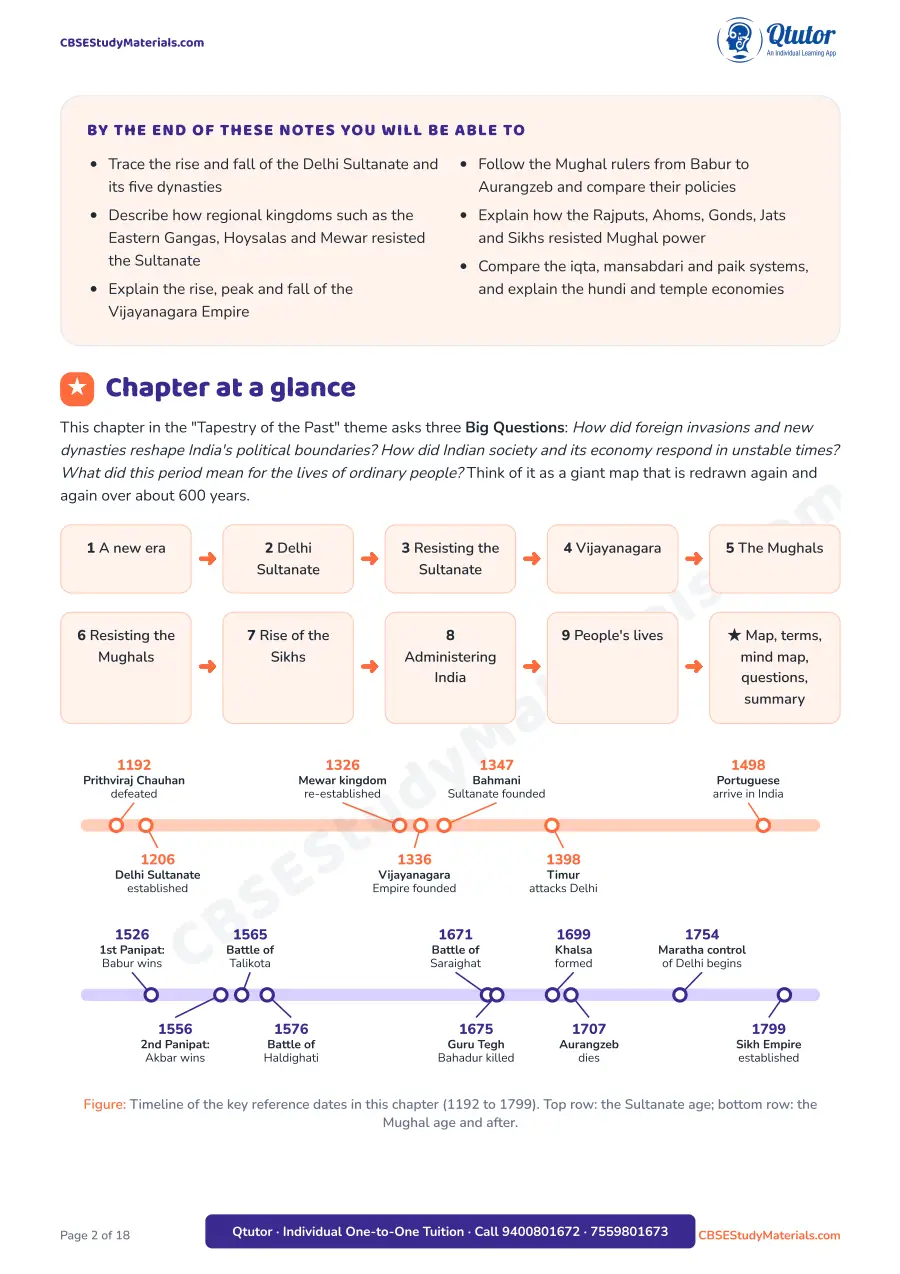
- A cover, learning objectives and a "chapter at a glance" route through all 9 sections
- A two-row timeline SVG of the chapter's reference dates, from Prithviraj Chauhan's defeat in 1192 to the Sikh Empire in 1799
- Concept-first notes on the Delhi Sultanate, the kingdoms that resisted it, the Vijayanagara Empire, the Mughals, resistance to the Mughals, the rise of the Sikhs, administration and people's lives
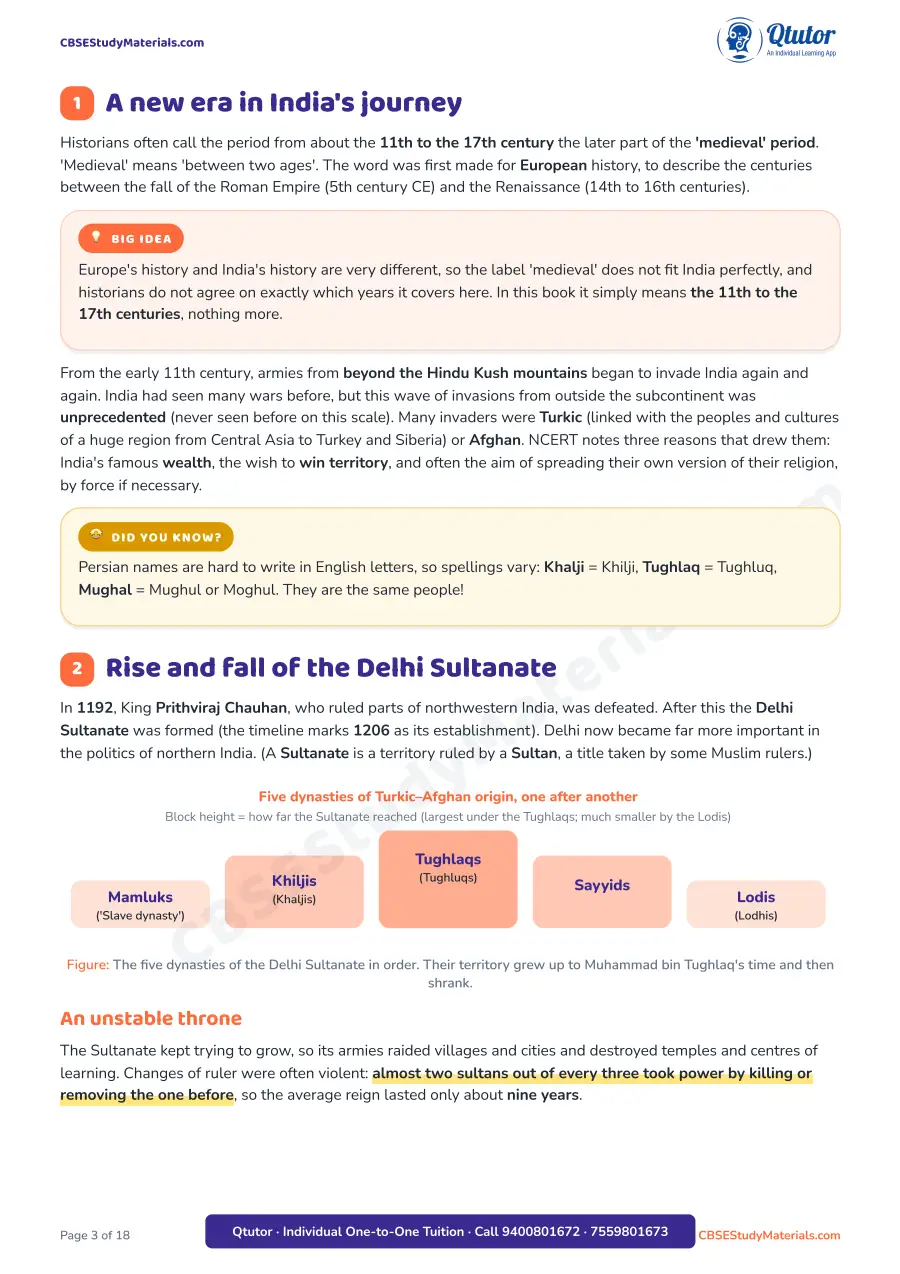
- 9 original diagrams and maps: the timeline, the five Sultanate dynasties, the split of the Bahmani Sultanate into the five Deccan Sultanates, the Mughal rulers from Babur to Aurangzeb, a chart of average reign lengths, Akbar's administration from emperor to village, how a hundi moved money, an India map and a mind map
- An outline map of India (complete official boundary) marking 17 places from the chapter, such as Panipat, Daulatabad, Warangal, Konark, Hampi, Talikota, Haldighati, Saraighat, Surat and Calicut, with a colour-coded legend
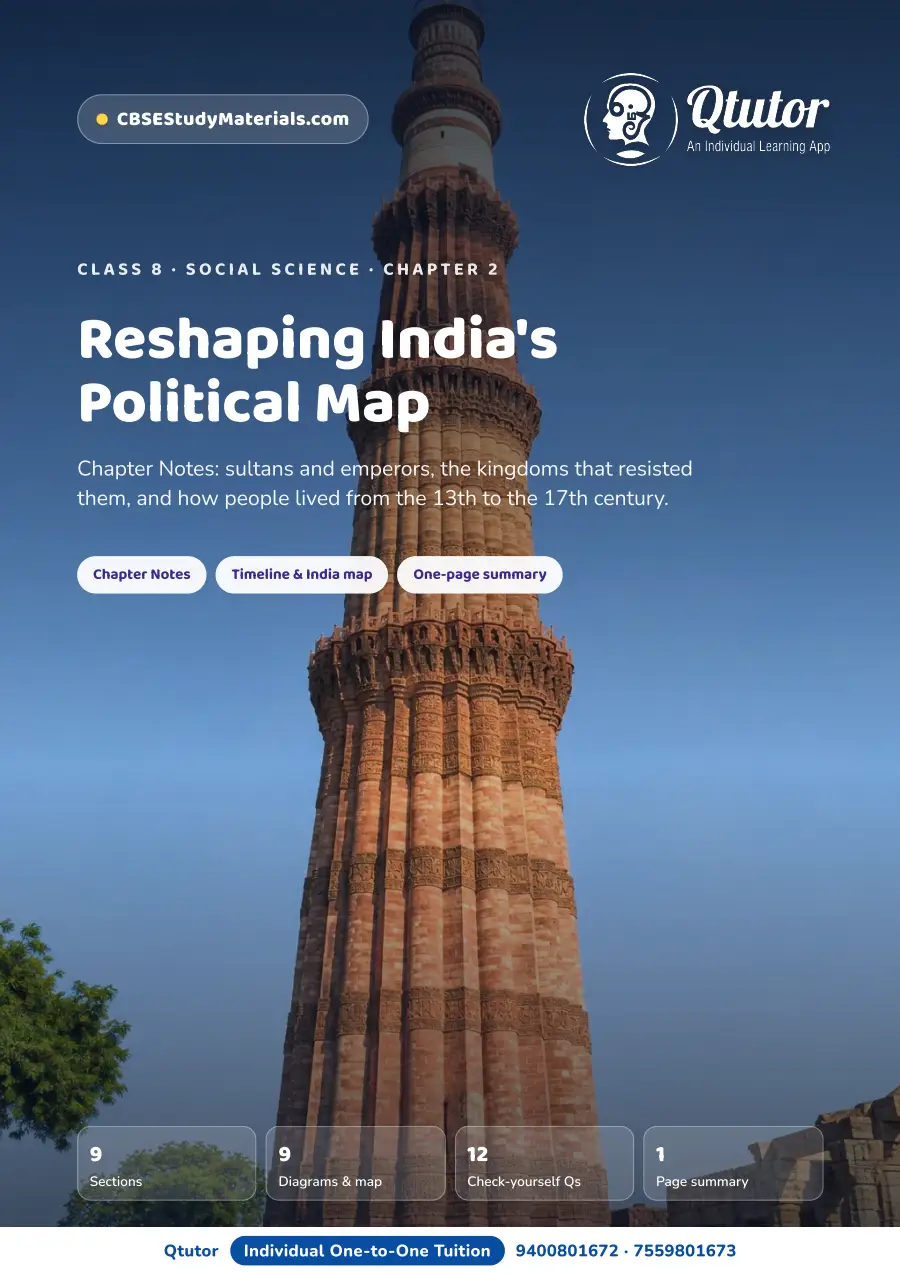
- 3 photos: the Qutub Minar, the stone chariot at Hampi and the red sandstone walls of the Red Fort
- Definition, "Big idea", "Did you know?", eyewitness and primary-source, real-life, "pati" puzzle, "Studying darker chapters" and common-mistake cards
- Comparison tables: Muhammad bin Tughlaq's two schemes, the kingdoms that resisted the Sultanate, Rajput leaders, and iqta vs mansabdari vs paik
- A key-terms grid with 16 terms, a mind map and a one-page summary
- 12 "Check yourself" important questions with a value-point answer key
Structure of the PDF
| Part | What you get |
|---|---|
| Opening | Objectives, chapter at a glance, timeline |
| Sections 1 to 3 | A new era and the word 'medieval', the Delhi Sultanate, resistance to the Sultanate |
| Sections 4 and 5 | The Vijayanagara Empire, the Mughals from Babur to Aurangzeb |
| Sections 6 and 7 | Resistance to the Mughals (Jats, tribes, Rani Durgavati, Rajputs, Ahoms), the rise of the Sikhs |
| Sections 8 and 9 | Administering India, people's lives and the economy |
| Revision | Key terms, India map with 17 places, mind map, one-page summary |
| Practice | 12 questions (sequence, statement, assertion-reason, match, data, source, map, HOTS) with answers |
Reshaping India's Political Map Class 8 Important Topics
- Why 'medieval' is not an ideal label for India, and why the book uses it simply for the 11th to 17th centuries
- The five dynasties of the Delhi Sultanate: Mamluks, Khiljis, Tughlaqs, Sayyids and Lodis; violent successions and reigns averaging about nine years
- Ala-ud-din Khilji, the Mongol invasions and Malik Kafur's campaigns in the south
- Muhammad bin Tughlaq's capital shift to Daulatabad (Devagiri) and his token currency
- Plunder, iconoclasm, the jizya and Timur's attack on Delhi in 1398
- Resistance from the Eastern Gangas (Narasimhadeva I and the Sūrya temple at Konark), the Musunuri Nayakas of Warangal, the Hoysalas and Rana Kumbha of Mewar
- Vijayanagara: Harihara and Bukka, the Bahmani Sultanate and the five Deccan Sultanates, Krishnadevaraya, Domingo Paes, and the Battle of Talikota (1565)
- The Mughals: Babur and the First Battle of Panipat (1526), Sher Shah Suri, Himu, Akbar's conquests and his later policy of sulh-i-kul, Shah Jahan, and Aurangzeb's long Deccan wars
- Resistance: the Jat peasants, Bhils, Gonds, Santhals and Kochs, Rani Durgavati, Rana Sanga, Maharana Pratap at Haldighati (1576), Durga Das Rathore, and the Ahoms at Saraighat (1671)
- The Sikh Gurus, the Khalsa (1699) and Maharaja Ranjit Singh's Sikh Empire
- The iqta system, Akbar's four ministers and 12 subahs, the mansabdari system and Todar Mal's revenue surveys
- Farming, crafts, ports, the hundi, the Marwaris and temples as centres of economic life
Reshaping India's Political Map Class 8 Important Questions (Sample)
From the Mughal administration diagram:
| Minister | Looked after |
|---|---|
| Diwan | Finances |
| Mir Bakhshi | Military matters |
| Khan-i-Saman | Public works, trade, industry, agriculture and the royal household |
| Sadr | Justice, religious and educational matters |
Assertion-reason (from Check yourself): Assertion: An iqtadar's post passed from father to son. Reason: Iqtadars collected taxes from the territories assigned to them. Answer: (d) the assertion is false, because iqta posts were not hereditary, while the reason is true.
Data question: Delhi sultans reigned for about 9 years on average, Mughal emperors up to Aurangzeb for about 27 years. What does the gap suggest? Model answer: Mughal rule (till Aurangzeb) was far more stable; most sultans seized power by removing the one before, so successions were violent and short.
How These Revision Notes Help
The chapter is long and full of rulers, battles and dates. These notes break it into nine short sections, put every key date on one timeline, and place the main sites on a single India map, so you can see how the political map was redrawn over time. Comparison tables show the differences between similar ideas, such as iqta, mansabdari and paik, and the "pati" puzzle, "Studying darker chapters" prompts and questions practise the reasoning that competency-based CBSE questions ask for. On sensitive events, the notes follow NCERT's own facts and tone.
Who Should Use It
- Class 8 students revising NCERT Exploring Society: India and Beyond Part 1, Chapter 2, before a unit test or annual exam
- Students who want a chapter summary and important questions in one place
How to Download the Class 8 Reshaping India's Political Map Notes PDF
Use the download button below. The PDF is A4 and prints well.
Reshaping India's Political Map - Class 8 Social Science Chapter 2 Notes (PDF · 18 pages · ₹49)
Related Resources
- All study material for this chapter: Reshaping India's Political Map, Class 8 Social Science
- Practise more: Reshaping India's Political Map Question Bank with answers and map work
- Previous chapter: Natural Resources and Their Use Class 8 notes, worksheet, flash cards and model question paper
- Next chapter on our site: Universal Franchise and India's Electoral System
- Every Class 8 Social Science chapter: Class 8 Social Science
FAQs on Class 8 Social Science Chapter 2 Reshaping India's Political Map
Where can I download Class 8 Social Science Chapter 2 Reshaping India's Political Map notes PDF? Use the download button on this page. It is an 18-page premium notes PDF priced at ₹49.
What are the important topics in Reshaping India's Political Map Class 8? The Delhi Sultanate and its five dynasties, Muhammad bin Tughlaq's schemes, the Vijayanagara Empire and Talikota, the Mughals from Babur to Aurangzeb, resistance by the Rajputs, Ahoms and others, the Sikh Gurus, the iqta and mansabdari systems, and the hundi and temple economies.
Which book is Reshaping India's Political Map Class 8 from? It is Chapter 2 of the NCERT Social Science textbook Exploring Society: India and Beyond, Grade 8, Part 1 (2026-27 reprint), in the theme "Tapestry of the Past".
What is the price of the Reshaping India's Political Map notes PDF? It is a premium PDF priced at ₹49. It includes the notes, 9 diagrams and maps, 3 photos, a mind map, a one-page summary and 12 questions with answers.
Does the PDF include a map of India for practice? Yes. An outline map of India marks 17 places from the chapter with a colour-coded legend, and one of the Check yourself questions uses it. The map is not to scale and is for practice only.
Are answers given for the questions? Yes. All 12 Check yourself questions have value-point answers, with marks shown for each question.
Study tip: draw the timeline from memory once a week, then add one ruler or battle to each date until you can tell the whole story without the notes.