Exploring Substances: Acidic, Basic, and Neutral - Class 7 Science Chapter 2 Question Bank (PDF · 20 pages · ₹49) Unlock the full PDF for ₹49
Free sample: pages 1 to 3 of 20. The full PDF costs ₹49.
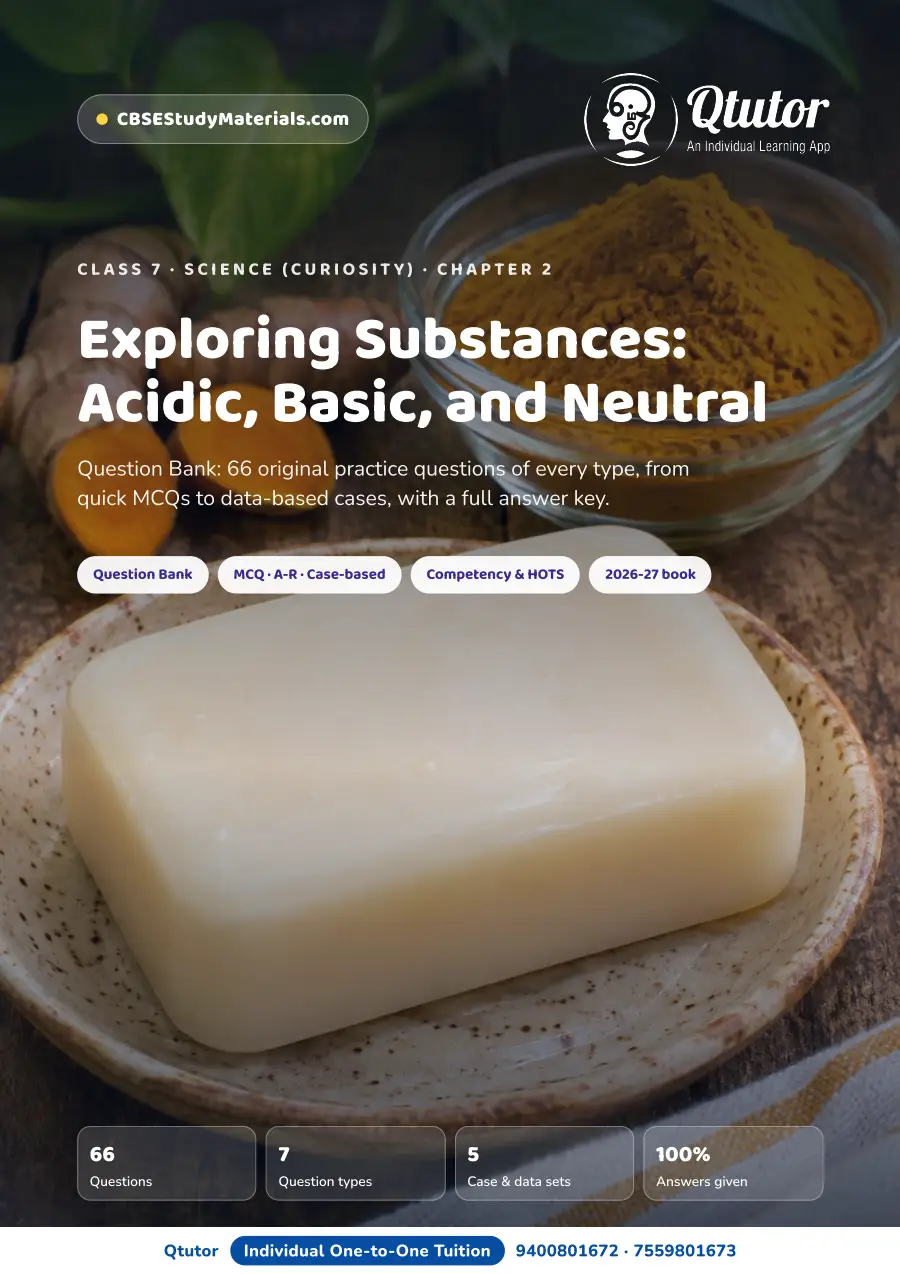
Why does a yellow curry stain on a white kurta suddenly turn red when you scrub it with soap? If you can answer that, you already understand the big idea of Class 7 Science Chapter 2, Exploring Substances: Acidic, Basic, and Neutral. This CBSE question bank turns that idea into 66 practice questions with answers, all NCERT based and written for the new Curiosity textbook (CBSE 2026-27). It is a premium 20-page PDF (₹49), our own study material and not an official CBSE or NCERT publication.
Every question in this Class 7 Science Chapter 2 question bank is original. Instead of repeating the textbook exercise, the questions put the same science into new situations: a gardener in Darjeeling with blue and pink hydrangeas, a farmer reading a soil test, a stall at a science fair, a student counting drops of lime water. That is exactly the kind of thinking that school tests and competency-based questions now ask for.
Class 7 Science Chapter 2 Question Bank: What Is Included
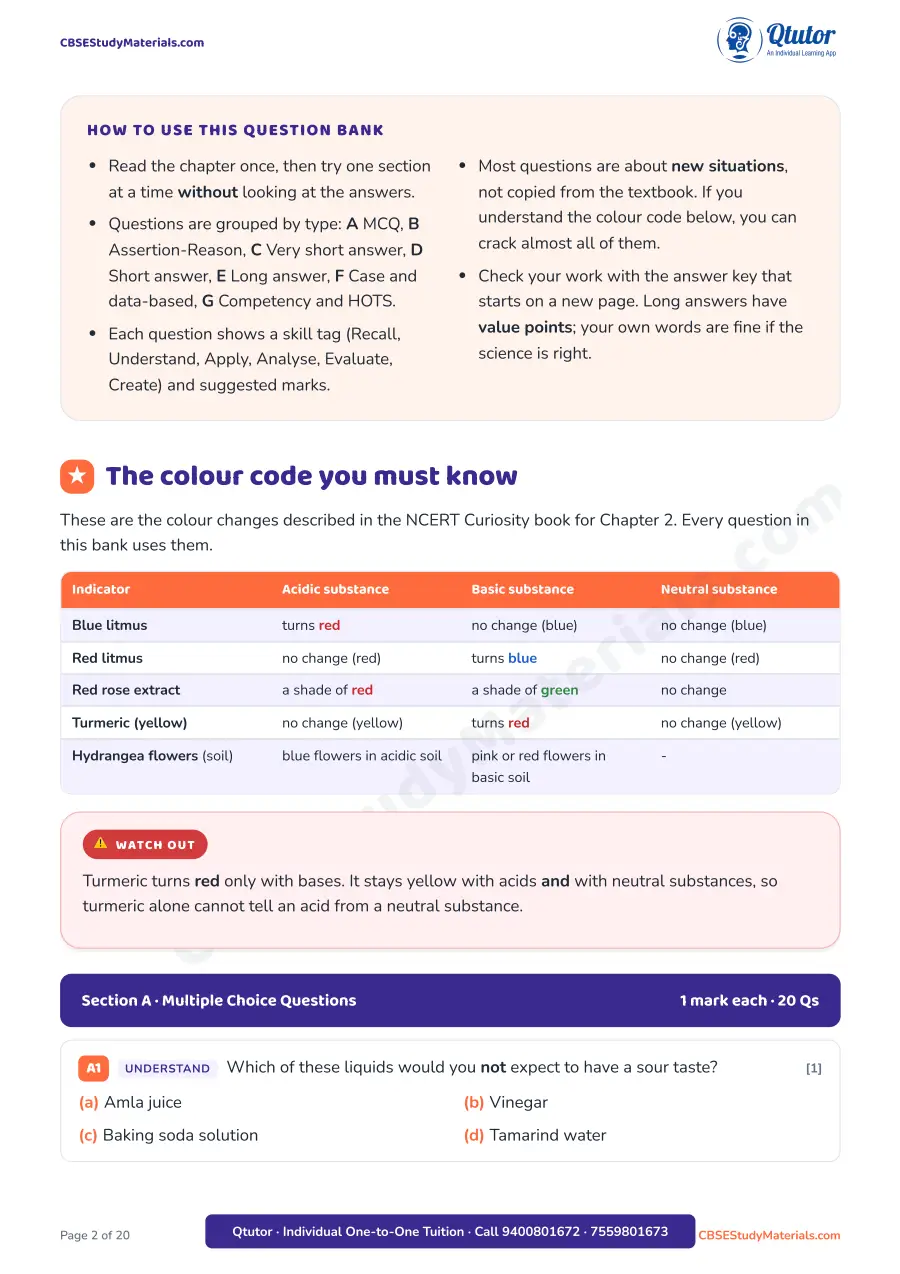
- The colour code page: one table with the colour of blue litmus, red litmus, red rose extract and turmeric in acidic, basic and neutral substances, plus hydrangea flower colours, exactly as described in the NCERT book.
- Section A: 20 MCQs (1 mark each), including statement-based, sequence, "which of (i)-(iv)" and one picture-based question on litmus strips.
- Section B: 9 assertion-reason questions with the standard four options.
- Section C: 10 very short answer questions (2 marks).
- Section D: 10 short answer questions (3 marks).
- Section E: 5 long answer questions (5 marks), including planning an experiment and designing a two-step test to sort five unknown solutions.
- Section F: 5 case-based and data-based sets (4 marks, 1 + 1 + 2), including a results table, a bar graph of neutralisation data and a soil-testing case.
- Section G: 7 competency and HOTS questions: match the columns, odd one out, spot the mistakes in a lab record, complete a flowchart, true or false and "Who am I?" riddles.
- Full answer key on separate pages: MCQ and assertion-reason answer grids with short reasons, and value-point answers with suggested marks for every written question.
- A last-minute checklist to revise the chapter in two minutes.
Structure of the PDF
| Part | What you get | Questions |
|---|---|---|
| Colour code | Indicator colour table and a "watch out" note on turmeric | - |
| Section A | Multiple choice questions | 20 |
| Section B | Assertion-reason | 9 |
| Section C | Very short answer (2 marks) | 10 |
| Section D | Short answer (3 marks) | 10 |
| Section E | Long answer (5 marks) | 5 |
| Section F | Case-based and data-based (4 marks) | 5 sets |
| Section G | Competency-based and HOTS | 7 |
| Answer key | Answers, reasons and value points for all 66 | - |
Exploring Substances Class 7 Important Topics Covered
- Acidic, basic and neutral substances from daily life: lemon juice, amla, tamarind, vinegar, soap, baking soda, lime water, washing powder, sugar and salt solutions
- Litmus as an acid-base indicator and where it comes from (lichens)
- Taste and feel: sour acids, bitter and slippery bases, and why karela is not basic
- Common acids in foods from Fig. 2.4 (citric, ascorbic, tartaric, oxalic), plus the acids in curd and vinegar, clearly marked as beyond the book
- Red rose extract and turmeric paper as natural indicators, and the limit of turmeric
- Onion as an olfactory indicator
- Hydrangea flower colour and soil nature
- Neutralisation: Acid + Base → Salt + Water + Heat
- Neutralisation in daily life: ant bites, acidic and basic soil, acidic factory waste
- Acharya P.C. Ray, the Father of Modern Indian Chemistry
Exploring Substances Class 7 Important Questions (Sample)
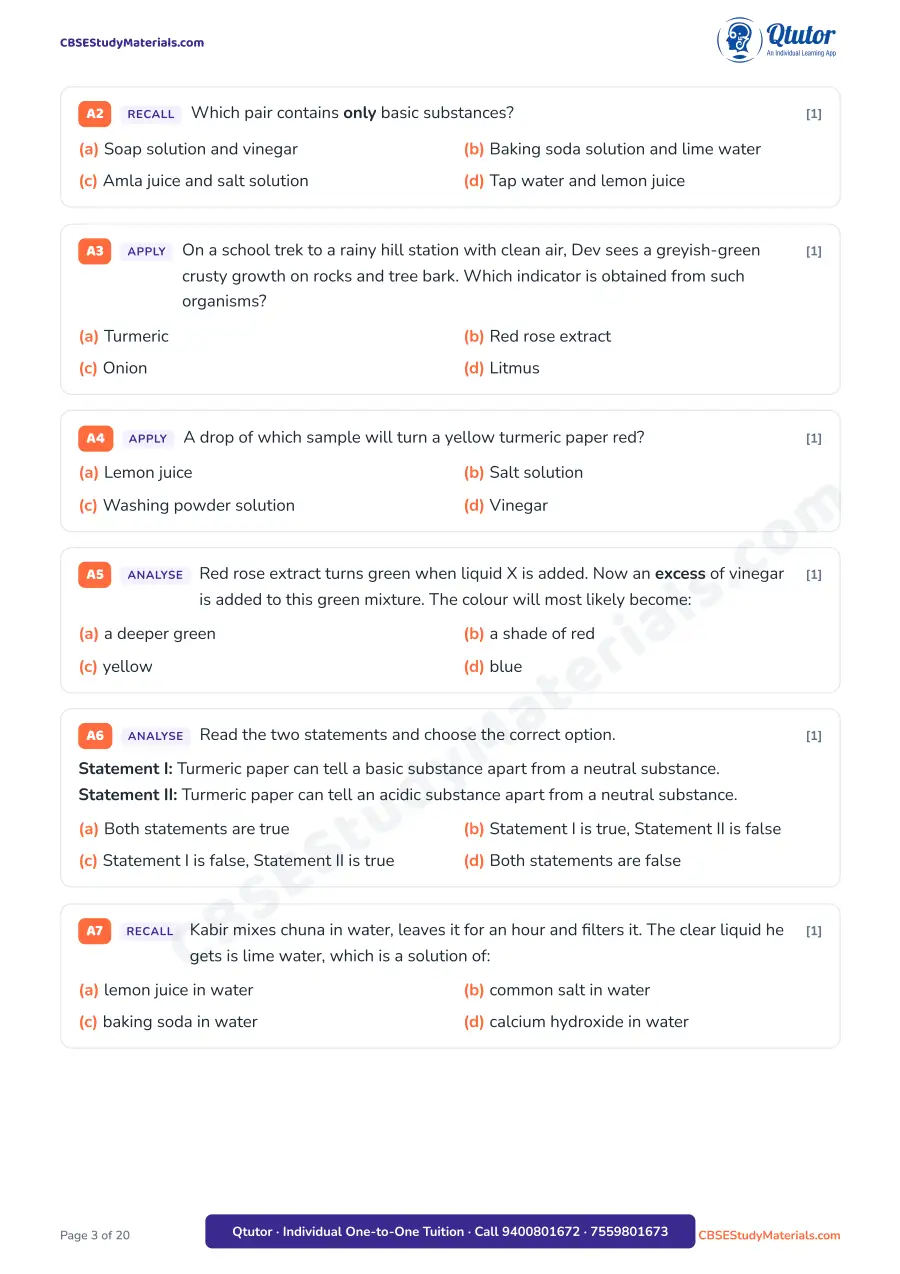
MCQ (A5). Red rose extract turns green when liquid X is added. Now an excess of vinegar is added to the green mixture. The colour will most likely become (a) a deeper green (b) a shade of red (c) yellow (d) blue. Answer: (b). Green shows X is basic; excess vinegar neutralises it and then makes the mixture acidic, so the extract turns a shade of red.
Assertion-Reason (B2). A: Bitter gourd (karela) is basic in nature. R: Bases generally taste bitter. Answer: (d). A is false and R is true: bases are generally bitter, but not everything bitter is a base.
Data-based (F2). Tanya counts the drops of lime water needed to turn red (acidic) litmus solution blue:
| Drops of lemon juice | 1 | 2 | 3 |
|---|---|---|---|
| Drops of lime water needed | 6 | 12 | 18 |
How many drops would 4 drops of lemon juice need? Answer: 4 × 6 = 24 drops. The base neutralises the acid, forming salt and water with heat given out.
How This Question Bank Helps
- Practice in the new style. Most questions ask you to apply, analyse or evaluate, not just recall, so you get used to case-based and competency questions early.
- One colour code, many situations. Once the indicator table is clear, you will see how it answers questions about soil, gardens, ant bites, stains and secret messages.
- Honest self-checking. The answer key gives the reason behind each MCQ and value points with marks for written answers, so you can mark your own work like a teacher would.
- Exam-ready revision. The chapter summary checklist and the variety of question types make it useful for unit tests, half-yearly exams and quick revision before class quizzes.
Who Should Use It
- Class 7 students studying from the NCERT Curiosity science textbook who want important questions for Chapter 2 beyond the textbook exercise.
- Parents who want a ready set of practice questions with answers to check their child's understanding.
- Teachers and tutors looking for MCQs, assertion-reason, case-based and HOTS questions for class tests and worksheets.
How to Download the Class 7 Exploring Substances Question Bank PDF
This is a premium PDF priced at ₹49. Use the button below to buy and download the PDF; you can print it or use it on screen.
Exploring Substances: Acidic, Basic, and Neutral - Class 7 Science Chapter 2 Question Bank (PDF · 20 pages · ₹49)
Related Resources
- Class 7 Science Chapter 2 Exploring Substances Notes: revision notes with diagrams, a mind map and a one-page summary
- Class 7 Science Chapter 2 NCERT Solutions: answers to every activity and exercise question in textbook order
- Exploring Substances: Acidic, Basic, and Neutral chapter page
- All Class 7 Science study material
- Previous chapter: The Ever-Evolving World of Science
- Next chapter: Electricity: Circuits and Their Components
FAQs on Class 7 Science Chapter 2 Exploring Substances Question Bank
Where can I download Class 7 Science Chapter 2 important questions with answers PDF? You can download this 20-page question bank PDF from this page. It has 66 questions on Exploring Substances: Acidic, Basic, and Neutral, all with answers.
What is the price of the Class 7 Exploring Substances question bank PDF? It is a premium PDF priced at ₹49, with 66 questions and a full answer key.
What types of questions are in the Class 7 Science Chapter 2 question bank? 20 MCQs, 9 assertion-reason, 10 very short answer, 10 short answer, 5 long answer, 5 case-based and data-based sets, and 7 competency and HOTS questions.
Are these questions copied from the NCERT textbook? No. The questions are original and set in new situations, but every fact and colour change follows the NCERT Curiosity Class 7 book. The only extra facts (the acids in curd and vinegar, which the book asks you to find out) are clearly marked as beyond the book. For the textbook's own questions, see our NCERT Solutions PDF for this chapter.
Which book is Exploring Substances: Acidic, Basic, and Neutral from? It is Chapter 2 of Curiosity, the NCERT Science textbook for Class 7 used in CBSE schools for 2026-27.
What are the most important topics in Class 7 Science Chapter 2? Acid-base indicators (litmus, red rose extract, turmeric, onion), the colours they show in acidic, basic and neutral substances, and neutralisation with its daily-life uses.
Study tip: learn the colour code table first, then try each section without looking at the answers; every wrong answer usually points to one row of that table.