Climates of India - Class 7 Social Science Chapter 3 NCERT Solutions (PDF · 18 pages · ₹49) Unlock the full PDF for ₹49
Free sample: pages 1 to 3 of 18. The full PDF costs ₹49.
Why is Chennai warm all year while Leh stays cold, even though both are in India? Answering that one question needs latitude, altitude and the sea, and it is exactly the kind of question this Climates of India Class 7 NCERT Solutions PDF walks you through. It gives complete answers for CBSE Class 7 Social Science Chapter 3 from the NCERT book Exploring Society: India and Beyond (Grade 7, Part I), in the same order and numbering as the textbook.
This is an 18-page premium PDF priced at ₹49, written for CBSE 2026-27. It is independent, NCERT based study material prepared from the current chapter and is not an official CBSE or NCERT publication.
Class 7 Social Science Chapter 3 Climates of India NCERT Solutions: What Is Included
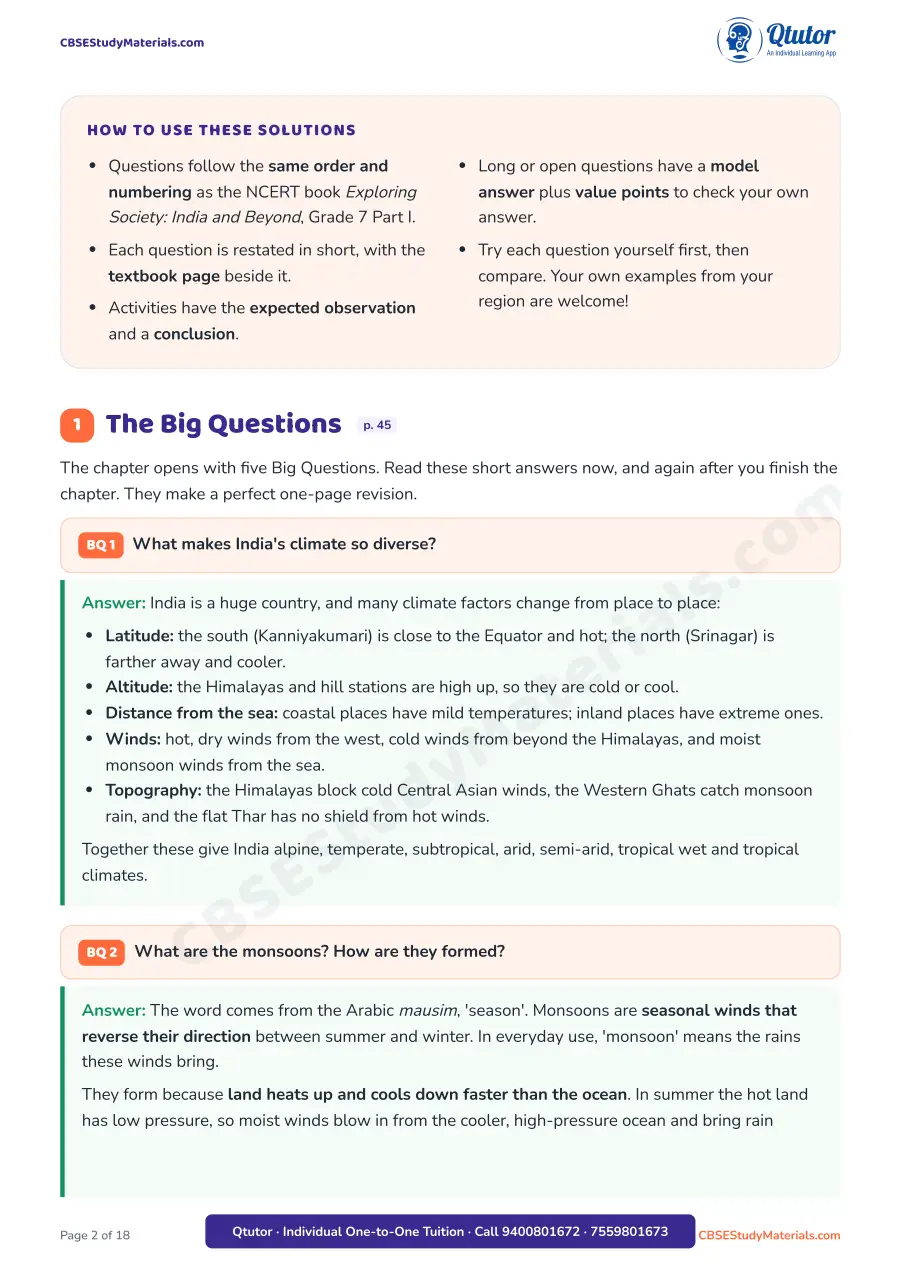
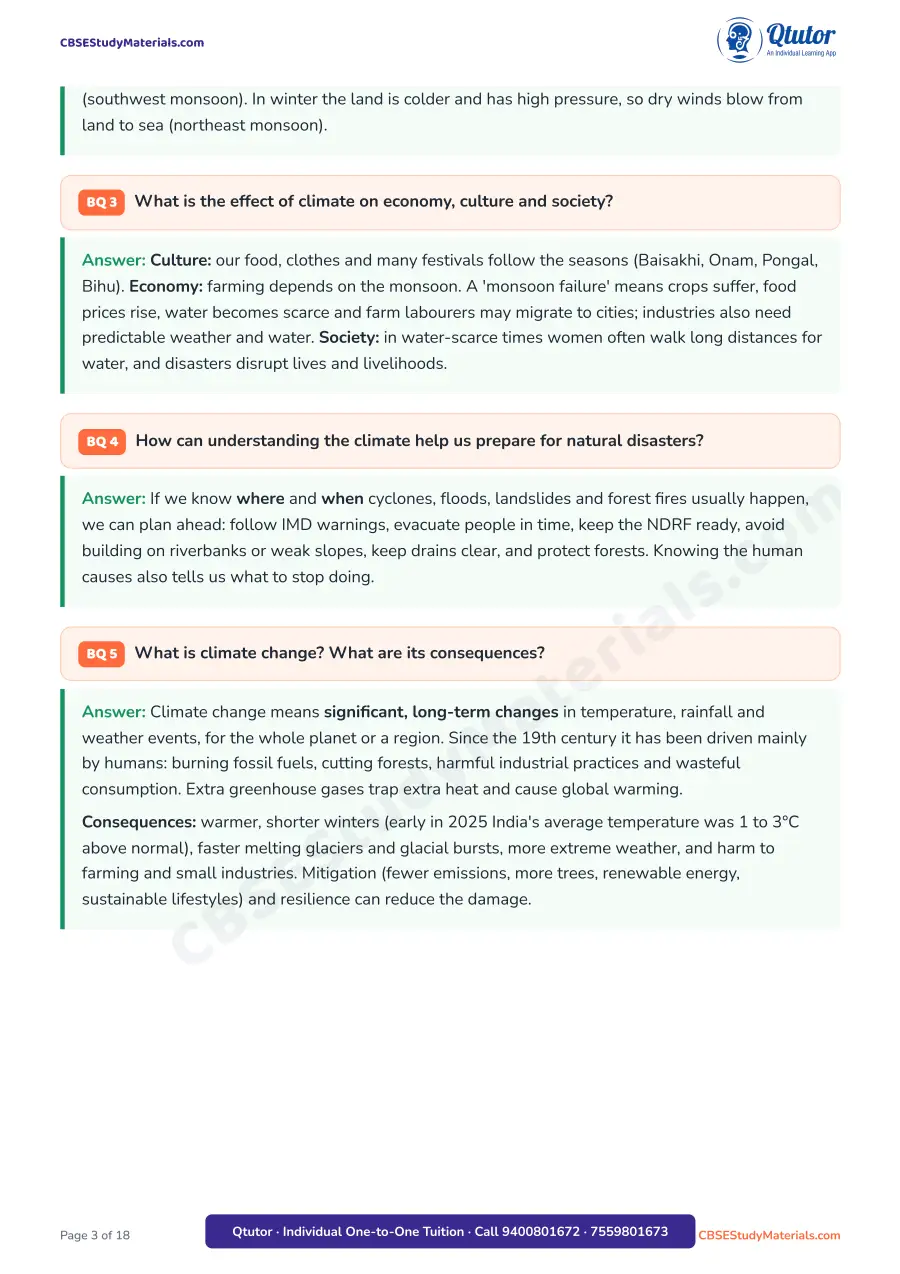
- Short answers to all 5 Big Questions that open the chapter, which double as a one-page chapter summary
- Answers to all 14 in-text questions and activities: every "Let's Explore", "Let's Remember" and "Think About It" box, plus the questions asked inside the text, each with its textbook page number
- Complete answers to all 7 end-of-chapter "Questions and activities", including every part of Question 2
- Expected observations and conclusions for each activity, and model answers with value points for open questions
- 8 maps and figures, including original diagrams of the angle of the Sun's rays at different latitudes, Ooty vs Coimbatore altitude, the Mumbai vs Nagpur temperature range chart, and how monsoon winds reverse
- An outline map of India with Leh, Delhi, Jaipur, Panaji and Chennai marked, and two monsoon maps (summer and winter) showing wind directions and pressure, all with the complete boundary of India
- Comparison tables (weather vs climate, Chennai vs Leh, floods in five states, disasters and their causes)
- A model diary entry, a model essay on floods and a sample festival poster layout
- A quick recap of the chapter at the end
Structure of the PDF
| Part | What you get |
|---|---|
| Section 1 | The 5 Big Questions answered (p. 45 of the textbook) |
| Section 2 | In-text questions IT 1 to IT 14: weather, seasons and climate; climate factors; monsoons and culture; disasters |
| Section 3 | Questions and activities 1 to 7 with maps, tables and model answers |
| Revision | Quick recap of the whole chapter |
Climates of India Class 7 Important Topics
- Weather, seasons and climate, and the six traditional ṛitus
- Types of climate in India: alpine, temperate, subtropical, arid, tropical wet, semi-arid and tropical
- Factors that decide climate: latitude, altitude, proximity to the sea, winds and topography
- Microclimates and urban heat islands
- The monsoons: how land and sea heat differently, the southwest and northeast monsoons
- Climate and our lives: festivals, farming and what a "monsoon failure" does to the economy
- Disasters: cyclones, floods, glacial bursts, landslides and forest fires
- Climate change, greenhouse gases, mitigation and resilience
Climates of India Class 7 Questions and Answers (Sample)
Q1. Match the climatic factors with their effects. Answer: Latitude creates different climates in the north and south; altitude keeps higher places cooler; proximity to the ocean moderates the temperature; monsoon winds bring wet air to India during summer.
Q2 (b). Why do places near the ocean have milder temperatures than places far away from it? Land heats and cools quickly but the sea does so slowly, so the sea cools the coast in summer and warms it in winter. The PDF shows this with a chart:
| City | Approx. winter | Approx. summer | Range |
|---|---|---|---|
| Mumbai (coast) | 18°C | 32°C | 14°C |
| Nagpur (inland) | 10°C | 44°C | 34°C |
In-text (p. 51). Ooty and Coimbatore are at almost the same latitude. Why is Ooty so much cooler? Because of altitude: Ooty lies high in the Nilgiri hills while Coimbatore is in the plains, and air gets cooler as we go higher because it is thinner and farther from the warm ground.
How These NCERT Solutions Help
- You can check your own textbook answers quickly, since every answer follows the book's order and page numbers.
- Map questions (Questions 3 and 4) are shown on proper India outline maps, so you know exactly what to draw and label.
- Value points show what a complete answer should contain, which helps with school tests and projects.
- Activities and projects (festival poster, diary entry, disaster essay) come with ready models you can adapt to your own region.
- The Big Questions and the recap work as quick revision notes and a chapter summary before an exam.
Who Should Use It
Class 7 students studying Social Science from the new NCERT book, parents helping with homework, and teachers who want a reliable answer guide for the Climates of India chapter in class.
How to Download the Class 7 Climates of India NCERT Solutions PDF
Use the download button below to get the premium PDF for ₹49. It prints neatly on A4 paper and is easy to read on a phone or tablet.
Climates of India - Class 7 Social Science Chapter 3 NCERT Solutions (PDF · 18 pages · ₹49)
Related Resources
- Class 7 Social Science Chapter 3 Climates of India: all resources
- Climates of India Class 7 chapter notes
- Climates of India Class 7 question bank with answers
- Previous chapter: Understanding the Weather
- Next chapter: New Beginnings: Cities and States
- Class 7 Social Science study material, all chapters
FAQs on Class 7 Social Science Chapter 3 Climates of India
Where can I download Class 7 Social Science Chapter 3 Climates of India NCERT Solutions PDF? On this page. Use the download button to get the 18-page premium PDF for ₹49.
Does this PDF answer the in-text questions too? Yes. It answers all 14 in-text questions and activities, the 5 Big Questions and all 7 end-of-chapter questions, in textbook order.
What are the important topics in Climates of India Class 7? Weather vs climate, the five factors that decide climate, the southwest and northeast monsoons, climate and festivals, disasters such as cyclones, floods and landslides, and climate change.
Which book is Climates of India Class 7 from? It is Chapter 3 of Exploring Society: India and Beyond, Grade 7 Part I, the NCERT Social Science textbook for CBSE 2026-27.
How do I answer the monsoon map question in Class 7 Chapter 3? Draw two outline maps of India. In summer, show winds blowing from the southwest, from sea to land; in winter, show them blowing from the northeast, from land to sea. The PDF has both maps drawn for you.
What is the price of the Climates of India NCERT Solutions PDF? It is a premium PDF priced at ₹49.
Study tip: before answering any "why is this place hot or cold" question, run through the five factors (latitude, altitude, sea, winds, topography) and use at least two of them.