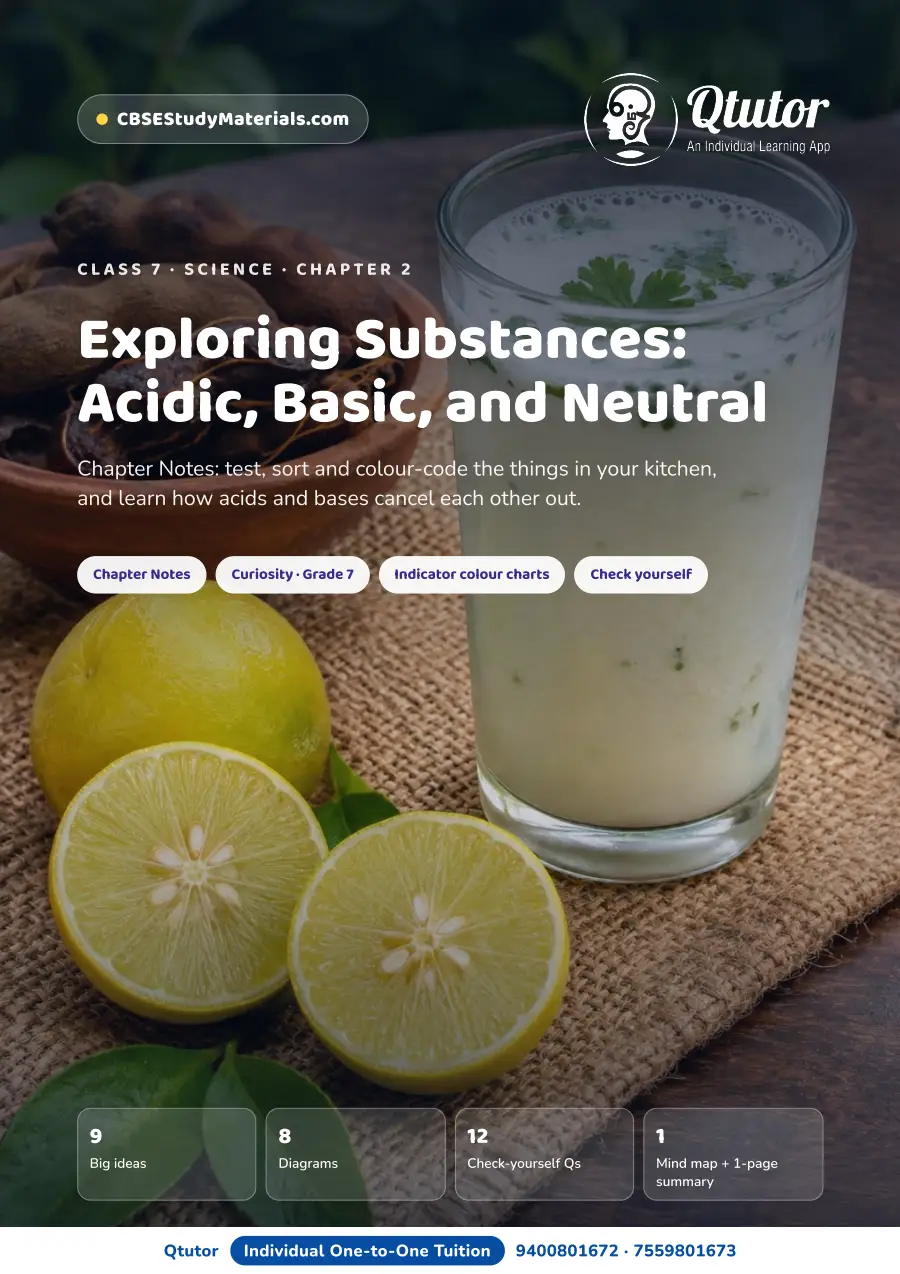
Exploring Substances: Acidic, Basic, and Neutral - Class 7 Science Chapter Notes (PDF · 18 pages · ₹49) Unlock the full PDF for ₹49
Free sample: pages 1 to 3 of 18. The full PDF costs ₹49.
Why does a yellow curry stain turn red when you rub soap on it? Class 7 Science Chapter 2, Exploring Substances: Acidic, Basic, and Neutral, answers that question and many more, and these premium NCERT based CBSE chapter notes turn the whole chapter into a colourful 18-page PDF you can revise from in one sitting.
This is a premium Chapter Notes PDF (₹49) for Class 7 Science, Chapter 2 "Exploring Substances: Acidic, Basic, and Neutral", written for the new NCERT Curiosity textbook (Grade 7, CBSE 2026-27). It is independent study material and is not an official CBSE or NCERT publication. The notes use short sentences, a friendly guide called Bindu the Drop, colour diagrams and "try this" cards, so a Class 7 student can read them alone. They work as revision notes, a chapter summary and a set of important questions with answers in one PDF download.
Class 7 Science Chapter 2 Exploring Substances Notes: What Is Included
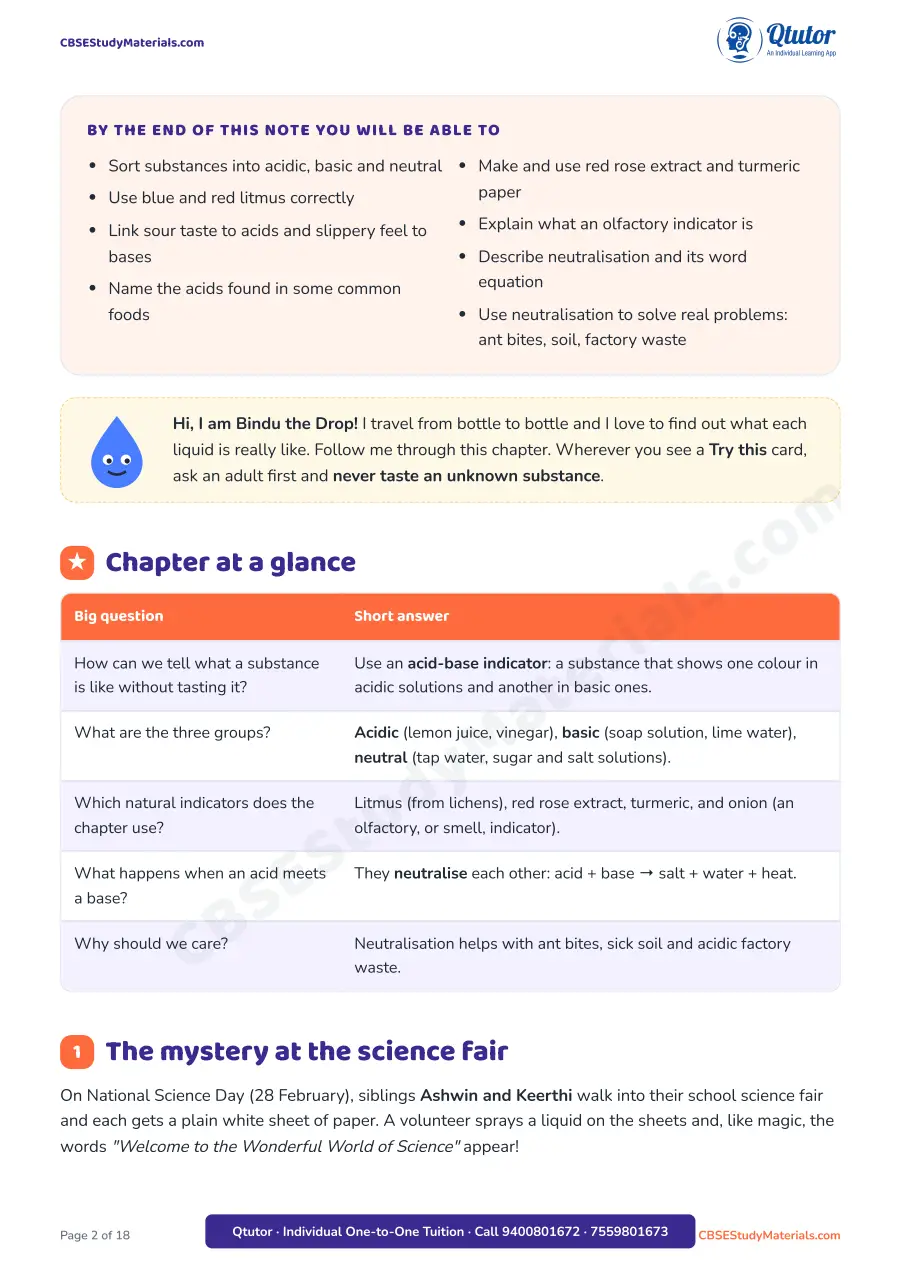
- Learning objectives and a "Chapter at a glance" table that answers five big questions in one line each
- Nine numbered topic sections, from the science-fair mystery to neutralisation in daily life
- Big-idea, definition, did-you-know, common-mistake, real-life, think-deeper and "try this" cards on every topic
- Nine original diagrams: the litmus test with the three groups of samples, acids in common foods, making red rose extract, red rose extract in acid and base, turmeric paper results, the Activity 2.7 colour story, three daily-life uses of neutralisation, the secret-message trick and a full mind map
- A one-table indicator colour chart (blue litmus, red litmus, red rose extract, turmeric and onion) in acidic, basic and neutral solutions
- A key-words grid with 14 terms and their meanings
- A one-page summary for the night before the test
- 12 "Check yourself" important questions (MCQ, assertion-reason, data table, case-based and HOTS) with a full answer key
Structure of the PDF
| Part | What you get |
|---|---|
| Cover, objectives, chapter at a glance | The chapter in five questions |
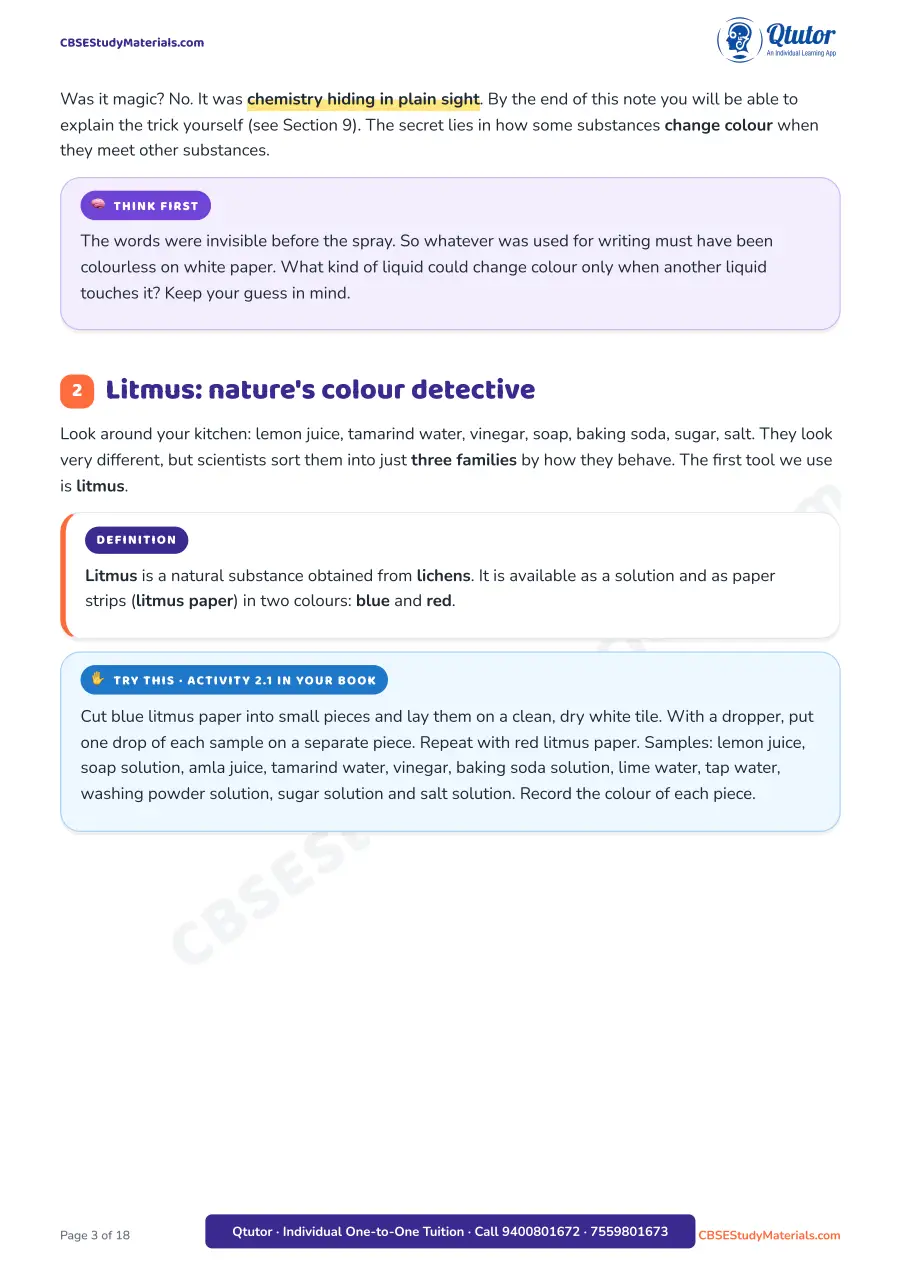
| Sections 1-3 | Science-fair mystery, litmus and the three groups, taste and touch clues |
| Sections 4-6 | Red rose extract, turmeric paper, olfactory indicators |
| Sections 7-9 | Neutralisation, ant bite, soil and factory waste, the mystery solved |
| Revision pages | Indicator colour chart, key words, mind map, one-page summary |
| Check yourself | 12 questions and the answer key |
Exploring Substances Class 7 Important Topics
- Acidic, basic and neutral substances, with the samples used in the textbook activities (lemon juice, tamarind water, vinegar, soap solution, baking soda solution, lime water, sugar and salt solutions)
- Litmus as an acid-base indicator and where it comes from (lichens: a fungus and an alga)
- Sour taste as a clue for acids; slippery feel and bitter taste for bases, and why bitter gourd is not basic
- The common acids in orange, amla, raw mango and tomato
- How to prepare red rose extract and turmeric paper at home
- Other natural indicators: beetroot, purple cabbage, jamun and red hibiscus
- Olfactory indicators (onion)
- Neutralisation and its word equation
- Neutralisation in daily life: a red ant bite, acidic and basic soil, acidic factory waste
- Fascinating facts on hydrangea flowers and turmeric, and Acharya P.C. Ray
Exploring Substances Class 7 Important Questions (Sample)
The indicator colour chart from the notes:
| Indicator | Acidic | Basic | Neutral |
|---|---|---|---|
| Blue litmus | turns red | stays blue | stays blue |
| Red litmus | stays red | turns blue | stays red |
| Red rose extract | red | green | no change |
| Turmeric | stays yellow | turns red | stays yellow |
A sample question from "Check yourself": You have vinegar, soap solution and sugar solution in three unlabelled cups, and only one indicator. Would you pick turmeric paper or red rose extract? The answer key explains why red rose extract wins: it turns red in vinegar, green in soap solution and stays unchanged in sugar solution, while turmeric cannot tell vinegar and sugar solution apart.
The word equation the notes ask you to remember: Acid + Base → Salt + Water + Heat.
How These Class 7 Science Chapter 2 Notes Help
- Every indicator colour change is written exactly as the textbook gives it, so you do not mix up red and blue litmus
- Common-mistake cards catch the traps examiners like, such as "turmeric stayed yellow, so it must be neutral"
- Real-life cards link the chapter to things you see at home: curry stains, ant bites, garden soil
- The mind map and one-page summary make last-minute revision quick
- The 12 questions are mostly application and reasoning, so you practise thinking, not only recall
Who Should Use This Study Material
- Class 7 students studying the NCERT Curiosity science book under the CBSE 2026-27 syllabus
- Students who want a short chapter summary and important questions before a class test
- Parents and tutors who want a clear, picture-rich explanation of acids, bases and indicators
How to Download the Class 7 Exploring Substances Notes PDF
Use the download button below to get the 18-page premium PDF (₹49). It prints well in colour and is easy to read on a phone.
Exploring Substances: Acidic, Basic, and Neutral - Class 7 Science Chapter Notes (PDF · 18 pages · ₹49)
Related Resources
- Class 7 Science Chapter 2 Exploring Substances NCERT Solutions
- Class 7 Science Chapter 2 Exploring Substances Question Bank
- Exploring Substances: Acidic, Basic, and Neutral chapter page
- All Class 7 Science study material
- Previous chapter: The Ever-Evolving World of Science
- Next chapter: Electricity: Circuits and Their Components
FAQs on Class 7 Science Chapter 2 Exploring Substances: Acidic, Basic, and Neutral
Where can I download Class 7 Science Chapter 2 Exploring Substances notes PDF? On this page. Click the download button to get the 18-page notes PDF for Class 7 Science Chapter 2.
What are the important topics in Exploring Substances Class 7? Acidic, basic and neutral substances; litmus, red rose extract, turmeric and olfactory indicators; neutralisation; and its uses for ant bites, soil and factory waste.
What colour does turmeric turn in a base in Class 7 Science? Turmeric is yellow and turns red in a basic solution. It stays yellow in acidic and neutral solutions, so it cannot tell an acid from a neutral substance.
What is the price of the Exploring Substances Class 7 notes PDF? It is a premium PDF priced at ₹49. It includes diagrams, a mind map, a one-page summary and 12 important questions with answers.
Which book is Exploring Substances: Acidic, Basic, and Neutral from? It is Chapter 2 of the NCERT Class 7 Science textbook Curiosity, used in CBSE schools for 2026-27.
Does this PDF include NCERT exercise answers? No. The notes have their own 12 "Check yourself" questions with answers. For the textbook exercise answers, see the NCERT Solutions PDF linked above.
Study tip: make your own red rose or turmeric indicator at home with an adult, and test five kitchen liquids. You will never forget the colours again.