Playing with Constructions Class 6 Maths Chapter 8 Question Bank PDF (PDF · 12 pages · ₹49) Unlock the full PDF for ₹49
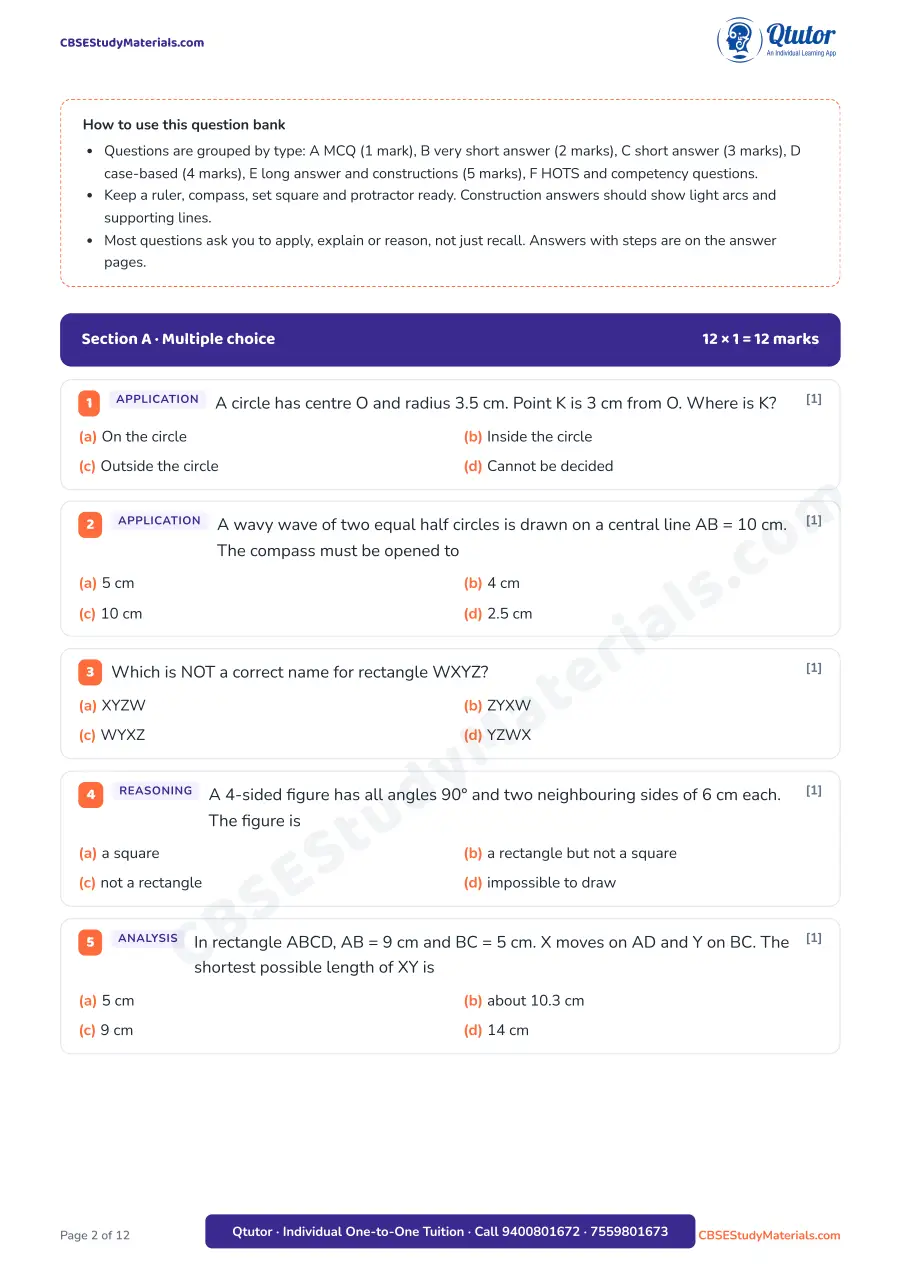
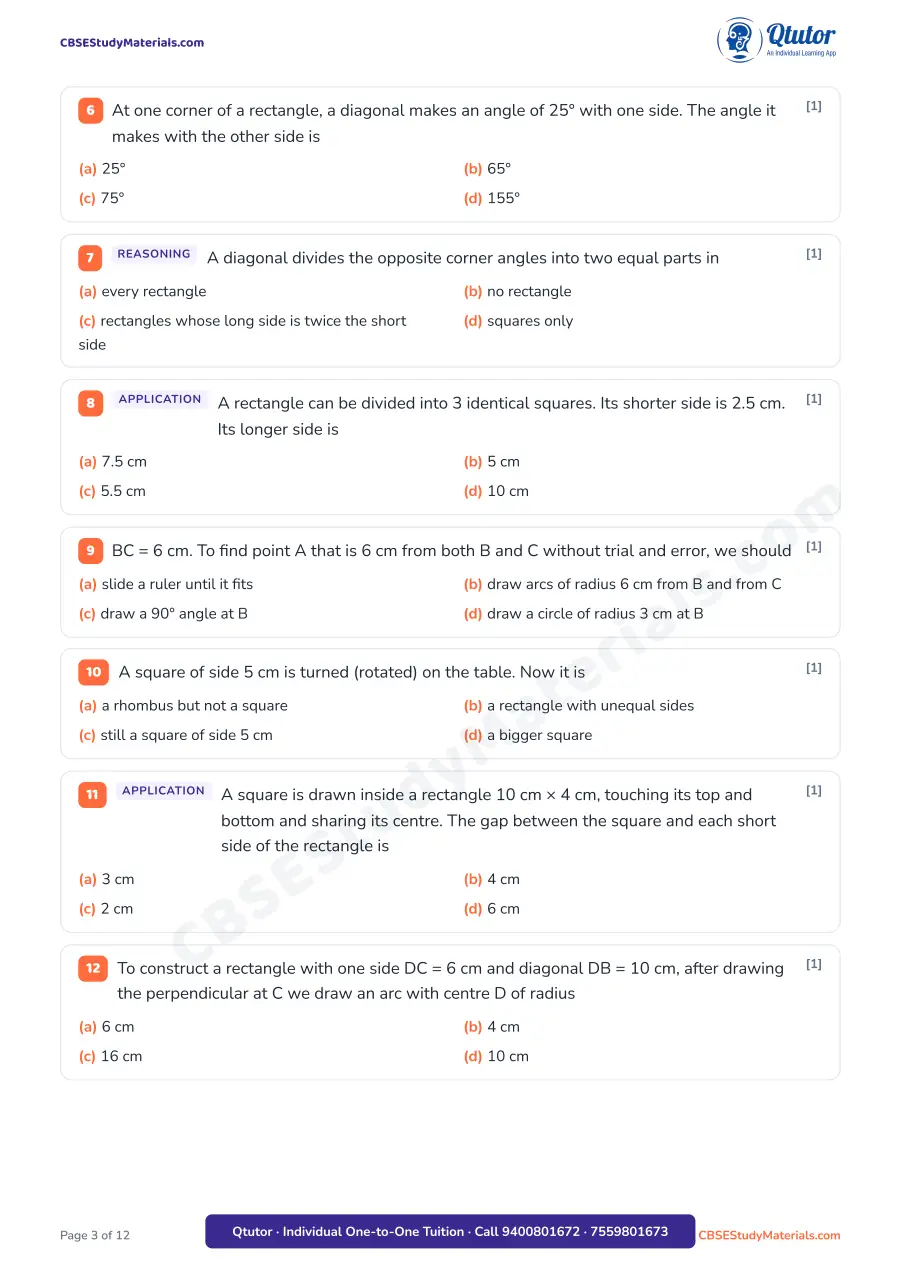
Free sample: pages 1 to 3 of 12. The full PDF costs ₹49.
Can a rectangle with one side 6 cm have a diagonal of only 5 cm? Why do a carpenter's equal diagonals prove that a frame is rectangular? The Playing with Constructions Class 6 Maths Chapter 8 Question Bank is full of such thinking questions, all based on the CBSE NCERT Ganita Prakash chapter and all with worked answers.
This is a premium 12-page Question Bank PDF (₹49) for Class 6 Mathematics, Chapter 8 "Playing with Constructions", for CBSE 2026-27. It is independent study material and is not an official CBSE or NCERT publication. It has 45 original important questions grouped by type, from MCQs to construction tasks and HOTS, followed by answers with marking points.
Class 6 Maths Chapter 8 Playing with Constructions Question Bank: What Is Included
- Instructions for using the question bank and the instruments needed
- Section A: 12 MCQs (1 mark each) on circles, the wavy wave, naming, diagonals and equidistant points
- Section B: 8 very short answer questions (2 marks)
- Section C: 8 short answer questions (3 marks), including a dot-grid figure with four shapes to classify
- Section D: 3 case-based sets (4 marks each): a school banner with a wavy border, a carpenter checking a window frame, and paper houses
- Section E: 4 long answer construction tasks (5 marks)
- Section F: 10 HOTS and competency questions
- Answers for all 45 questions, with steps and marks for each point
Structure of the PDF
| Section | Type | Questions |
|---|---|---|
| A | Multiple choice | 1–12 |
| B | Very short answer | 13–20 |
| C | Short answer | 21–28 |
| D | Case-based | 29–31 |
| E | Long answer and constructions | 32–35 |
| F | HOTS and competency | 36–45 |
| Answers | Key and marking points | All 45 |
Playing with Constructions Class 6 Important Topics Tested
- Points inside, on and outside a circle; centre and radius
- Radius for wavy waves and banner borders
- Naming rectangles and squares; rotated shapes; squares on a dot grid
- Constructing squares and rectangles and checking R1, R2, S1, S2
- Shortest and longest XY in a rectangle
- Rectangles made of two or three identical squares
- Diagonals: equal lengths, angle parts that add to 90°, the square case
- Rectangles from an angle split (60°/30°, 70°/20°) or from a side and a diagonal (6 cm and 10 cm)
- The House construction and four equal sides that are not a square
Playing with Constructions Class 6 Important Questions (Sample)
MCQ: A square is drawn inside a rectangle 10 cm × 4 cm, touching its top and bottom and sharing its centre. The gap on each side is (a) 3 cm (b) 4 cm (c) 2 cm (d) 6 cm. Answer: (a), because (10 − 4) ÷ 2 = 3 cm.
Case-based (school banner): Six equal half circles cover a 24 cm line. Each base is 24 ÷ 6 = 4 cm and the radius is 2 cm. With four half circles the radius becomes 3 cm, with centres at 3, 9, 15 and 21 cm from the start.
HOTS: Two arcs of 5 cm from B and C never meet when BC = 12 cm. Why? Because two points 5 cm from B and from C can be at most 10 cm apart; the arcs first touch when the radius is 6 cm, half of BC.
How It Helps
Most questions ask students to apply, explain or reason, not just recall: why a diagonal cannot be shorter than a side, how a tailor can check a square with string, or where the compass tip must go for curved sides. The case-based sets connect constructions to real situations, and the marking points show how a complete answer is written, so students learn to give steps and reasons in tests.
Who Should Use It
- Class 6 students who have finished Chapter 8 and want practice beyond the textbook
- Students preparing for unit tests and half-yearly exams that include constructions
- Teachers, parents and tutors who need ready worksheets with answers for CBSE 2026-27
How to Download the Class 6 Playing with Constructions Question Bank PDF
This is a premium PDF download priced at ₹49. Click the button below to get the 12-page file.
Playing with Constructions Class 6 Maths Chapter 8 Question Bank PDF (PDF · 12 pages · ₹49)
Related Resources
- Playing with Constructions Class 6 Notes PDF
- Playing with Constructions Class 6 NCERT Solutions PDF
- Class 6 Maths Chapter 8 Playing with Constructions chapter page
- All Class 6 Mathematics study material
- Previous chapter: Fractions (Class 6 Maths Chapter 7)
- Next chapter: Symmetry (Class 6 Maths Chapter 9)
FAQs on Class 6 Maths Chapter 8 Playing with Constructions Question Bank
Where can I download Class 6 Maths Chapter 8 Playing with Constructions important questions with answers? On this page, as a 12-page premium question bank PDF for ₹49 with answers to all 45 questions.
What types of questions are in the Playing with Constructions question bank? MCQs, very short and short answers, three case-based sets, construction tasks and HOTS questions.
Are answers and steps given for the construction questions? Yes. Every construction answer lists the steps in order and what to measure to check the figure.
Is this question bank based on the new NCERT book? Yes. It is based on Chapter 8 of the current NCERT Ganita Prakash book for Class 6 (2026-27), with original questions.
How many questions are there, and how are they marked? There are 45 questions: 12 MCQs of 1 mark, 8 very short answers of 2 marks, 8 short answers of 3 marks, 3 case-based sets of 4 marks, 4 constructions of 5 marks and 10 HOTS questions of 2 or 3 marks. The answer pages show the marks for each step, so students can check their own work like a teacher would.
Can I use it for a quick revision test before the exam? Yes. Section A and Section B together make a short 28-mark test of about 30 minutes, and the answer key on the answer pages lets you mark it at once. Keep the construction tasks of Section E for a separate practice session with instruments.
Does it have assertion-reason questions? No. Class 6 tests usually do not use assertion-reason questions, so this bank uses case-based and HOTS questions instead.
Study tip: before answering a construction question, sketch the final figure roughly and mark what is equal; then write the steps in the order you would draw them.