Accounting for Partnership Class 12 Accountancy Chapter 1 Model Question Paper (PDF · 13 pages · Free download) Download the full PDF free
You are looking at pages 1 to 3 of 13. The full PDF is free to download.
Jaya and Karan run a printing business on a handshake, with no written deed. Jaya wants 12% interest on her loan, Karan wants a commission for handling sales, and the profit is only ₹48,000. Who is right? This free Accounting for Partnership: Basic Concepts Class 12 model question paper for CBSE Class 12 Accountancy Chapter 1 (NCERT Accountancy Part I) asks questions like this one, in the same style and mark bands as the board paper.
The PDF has 13 pages and is free to download. It is an independent NCERT based practice paper for CBSE 2026-27. It is not an official CBSE or NCERT publication. Treat it as a timed chapter test: 40 marks, 1½ hours, followed by a full marking scheme so you can check your own script.
Class 12 Accountancy Chapter 1 Model Question Paper: What Is Included
- Paper head and general instructions with marks, time, the internal choices and the rules for when the deed is silent.
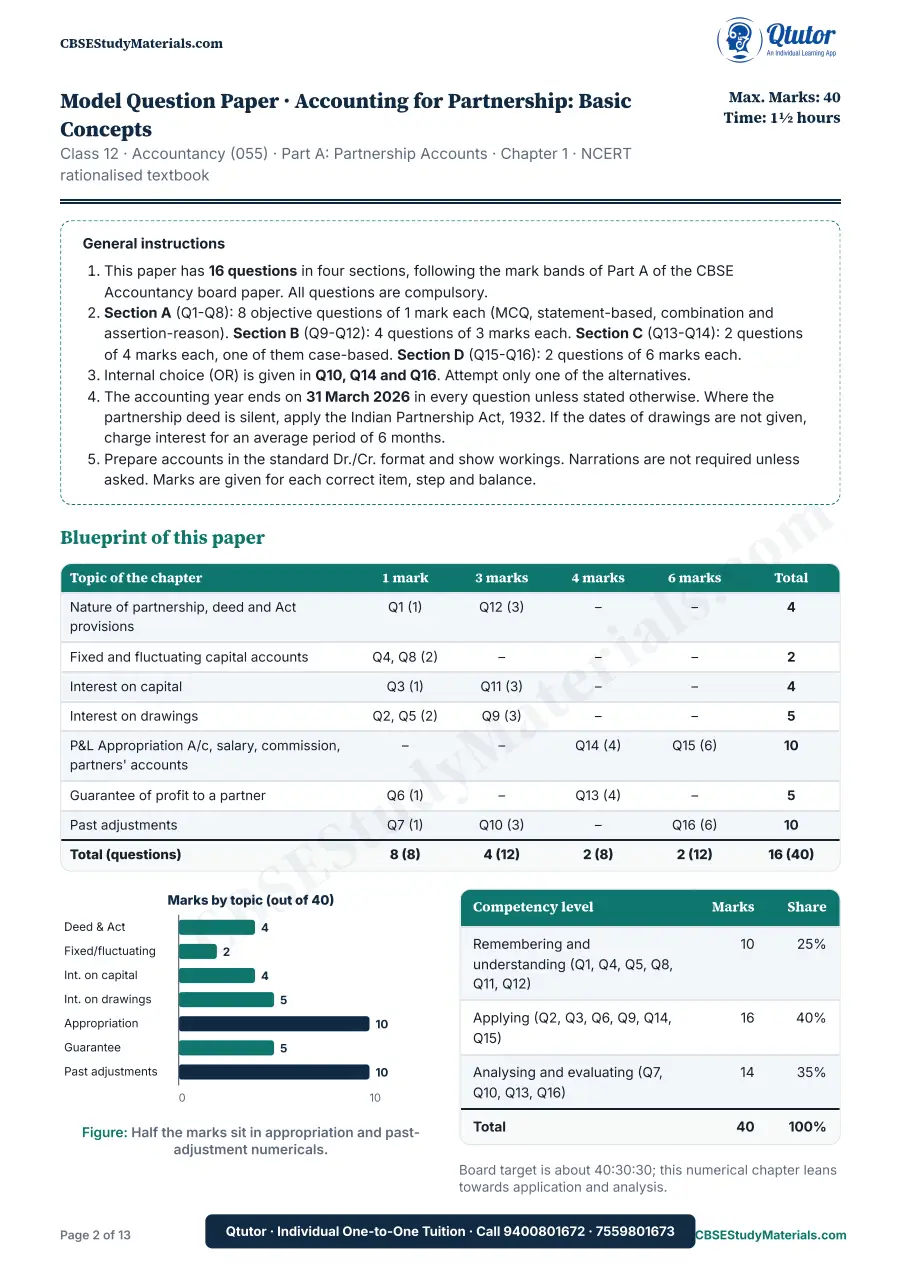
- Blueprint table that maps every question to a topic and a mark band, plus a competency table (understanding, applying, analysing) and a bar chart of marks by topic.
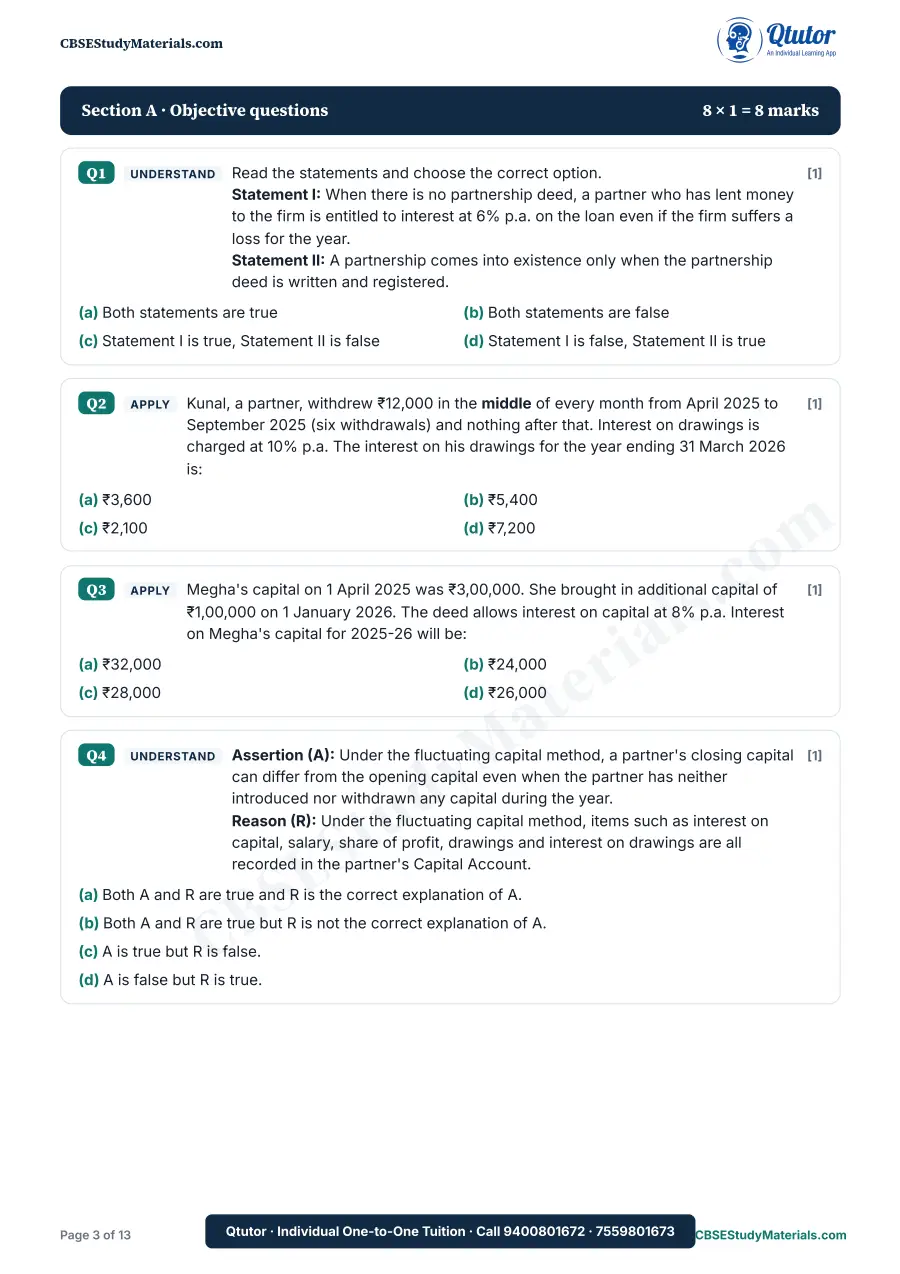
- Section A (8 × 1 mark): a Statement I / Statement II item, two assertion-reason questions, a combination MCQ and four computation MCQs on interest on drawings, interest on capital, guarantee of profit and a past-adjustment entry.
- Section B (4 × 3 marks): interest on drawings in three patterns, a wrong profit-sharing ratio corrected after closing (with an OR on excess interest on capital), interest on capital in a high-profit, low-profit and loss year, and the no-deed printing business case.
- Section C (2 × 4 marks): a case on a general store in Nashik that admits a partner with a guaranteed minimum profit, and a P&L Appropriation Account with commission "after charging such commission" (OR: fluctuating Capital Accounts with additional capital).
- Section D (2 × 6 marks): a full fixed-capital question with a partner's loan, salary, commission and Current Accounts, and a past-adjustments question where the whole deed was ignored (OR: guarantee of profit with fluctuating capitals).
- Answer key and marking scheme on separate pages, with ½-mark and 1-mark steps, 10 solved accounts, statements and journal entries in proper Dr./Cr. format, and every total balanced.
- A short "where marks are lost" box at the end.
Structure of the Partnership Basic Concepts Question Paper PDF
| Part | What you get | Marks |
|---|---|---|
| Paper head, instructions, blueprint | Marks, time, choices, topic-wise and competency-wise split | — |
| Section A | 8 MCQ, statement-based and assertion-reason items | 8 |
| Section B | 4 short numericals and a case (1 with OR) | 12 |
| Section C | 1 case-based question and 1 appropriation question (OR) | 8 |
| Section D | 2 long numericals (1 with OR) | 12 |
| Answer key | Step-marked solutions with formatted accounts | — |
Accounting for Partnership Class 12 Important Topics Tested
- Nature of partnership, the partnership deed and the Indian Partnership Act, 1932 rules that apply without a deed
- Fixed and fluctuating capital methods, Capital and Current Accounts
- Profit and Loss Account versus Profit and Loss Appropriation Account (charge or appropriation)
- Interest on capital, including additional capital during the year and years with low profit or a loss
- Interest on drawings: half-yearly, mid-month for part of the year, dates not given, monthly and quarterly patterns
- Salary and commission to partners, including commission after charging such commission
- Guarantee of minimum profit borne in an agreed ratio or by the firm
- Past adjustments: omitted items, wrong ratio and excess interest, settled with one adjusting entry
Accounting for Partnership Class 12 Important Questions (Sample)
Q14 (4 marks). Vani and Yash share profits 3:2 with fixed capitals of ₹6,00,000 and ₹4,00,000. Interest on capital is 6% p.a., Yash gets ₹2,500 a month, and Vani gets 10% of the net profit after charging such commission. The profit before appropriations is ₹2,20,000. The key step is the commission: 2,20,000 × 10⁄110 = ₹20,000. The divisible profit then comes to ₹1,14,000.
Q16 (6 marks). A profit of ₹1,50,000 was shared equally, but the deed asked for 3:2:1 with interest on capital, a salary to Indu and interest on drawings. The marking scheme works it out in a statement:
| Gita | Hari | Indu | |
|---|---|---|---|
| Should have received | 63,000 | 42,200 | 44,800 |
| Already received | 50,000 | 50,000 | 50,000 |
| Net effect | 13,000 Cr. | 7,800 Dr. | 5,200 Dr. |
One entry fixes it: Hari's and Indu's Current Accounts are debited and Gita's is credited with ₹13,000.
Q13 (case). Tanvi is guaranteed ₹60,000 but her 2/10 share of ₹2,40,000 is only ₹48,000. The paper asks for the final shares, the minimum profit at which the guarantee costs nothing (60,000 ÷ 2⁄10 = ₹3,00,000), and what changes if the firm gives the guarantee instead.
How This Model Paper Helps
The questions are original and mostly indirect. Most of them need a calculation or a judgement, not a definition. The blueprint shows how the 40 marks spread across the chapter, so you can see which topics carry the most weight: appropriation and past adjustments make up half the paper. The marking scheme follows the board style. It gives marks for each item, each step and each balanced total, so you can see exactly where a half mark goes. All figures have been recomputed and every ledger account tallies.
Who Should Use It
- Class 12 Commerce students who have finished Chapter 1 and want a full-length chapter test
- Students revising before unit tests, half-yearly exams or pre-boards in the CBSE 2026-27 session
- Teachers who want a ready chapter-wise paper with a blueprint and a marking scheme
How to Download the Class 12 Partnership Basic Concepts Model Question Paper PDF
Click the button below. The PDF is free and prints well on A4. Write the paper in 1½ hours, then mark it yourself with the answer key.
Accounting for Partnership Class 12 Accountancy Chapter 1 Model Question Paper (PDF · 13 pages · Free download)
Related Resources
- Chapter page: Accounting for Partnership: Basic Concepts
- All Class 12 Accountancy material: Class 12 Accountancy
- Revise first with the Class 12 Accountancy Chapter 1 notes
- Practise more with the Chapter 1 worksheet and the Chapter 1 flash cards
- Another paper on this chapter: Partnership Basic Concepts question paper
- Next chapter: Reconstitution of a Partnership Firm: Admission of a Partner
FAQs on Class 12 Accountancy Chapter 1 Model Question Paper
Where can I download the Class 12 Accountancy Chapter 1 model question paper PDF? On this page. Use the download button above; the 13-page PDF is free.
Is the Accounting for Partnership Class 12 model question paper free? Yes. This chapter-wise model paper costs nothing and includes the full answer key and marking scheme.
What is the pattern of this Class 12 Accountancy Chapter 1 question paper? It has 16 questions for 40 marks: 8 one-mark objective questions, 4 three-mark, 2 four-mark and 2 six-mark questions, with OR choices in Q10, Q14 and Q16, following the mark bands of the CBSE 2026-27 Accountancy paper.
What are the important questions in Accounting for Partnership Class 12? The P&L Appropriation Account with partners' Current or Capital Accounts, interest on drawings, guarantee of profit and past adjustments. Together these carry most of the marks in this paper.
Does the model paper have answers with ledger accounts? Yes. Every numerical has a worked solution, and the accounts (P&L, Appropriation, Capital and Current) are shown in Dr./Cr. format with balanced totals.
Which book is Accounting for Partnership: Basic Concepts from? It is Chapter 1 of the NCERT Class 12 Accountancy Part I textbook (Partnership Accounts), the rationalised edition used for CBSE.
Study tip: write the paper against the clock first, and only then open the marking scheme.