New Beginnings: Cities and States - Class 7 Social Science Chapter 4 Question Bank (PDF · 22 pages · ₹49) Unlock the full PDF for ₹49
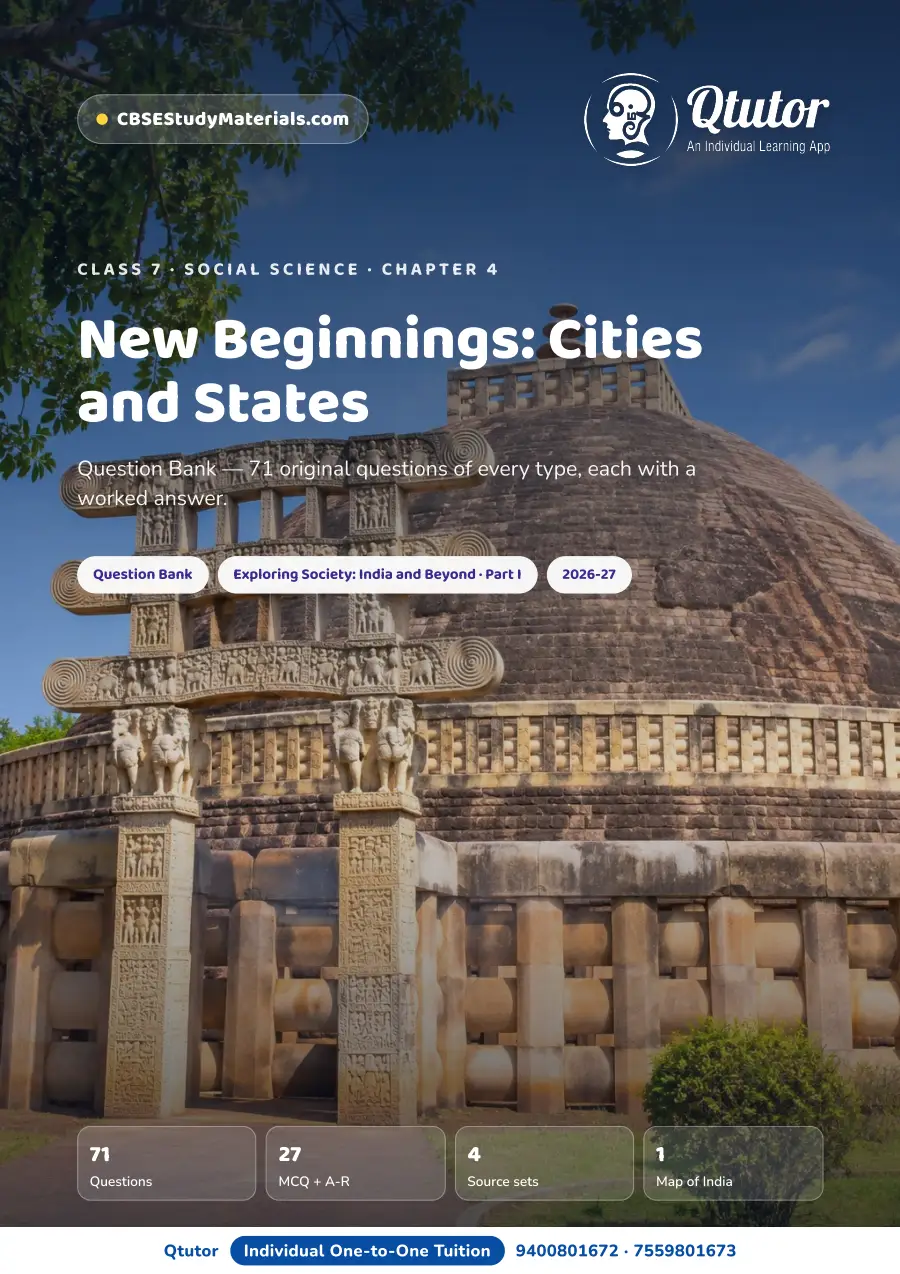
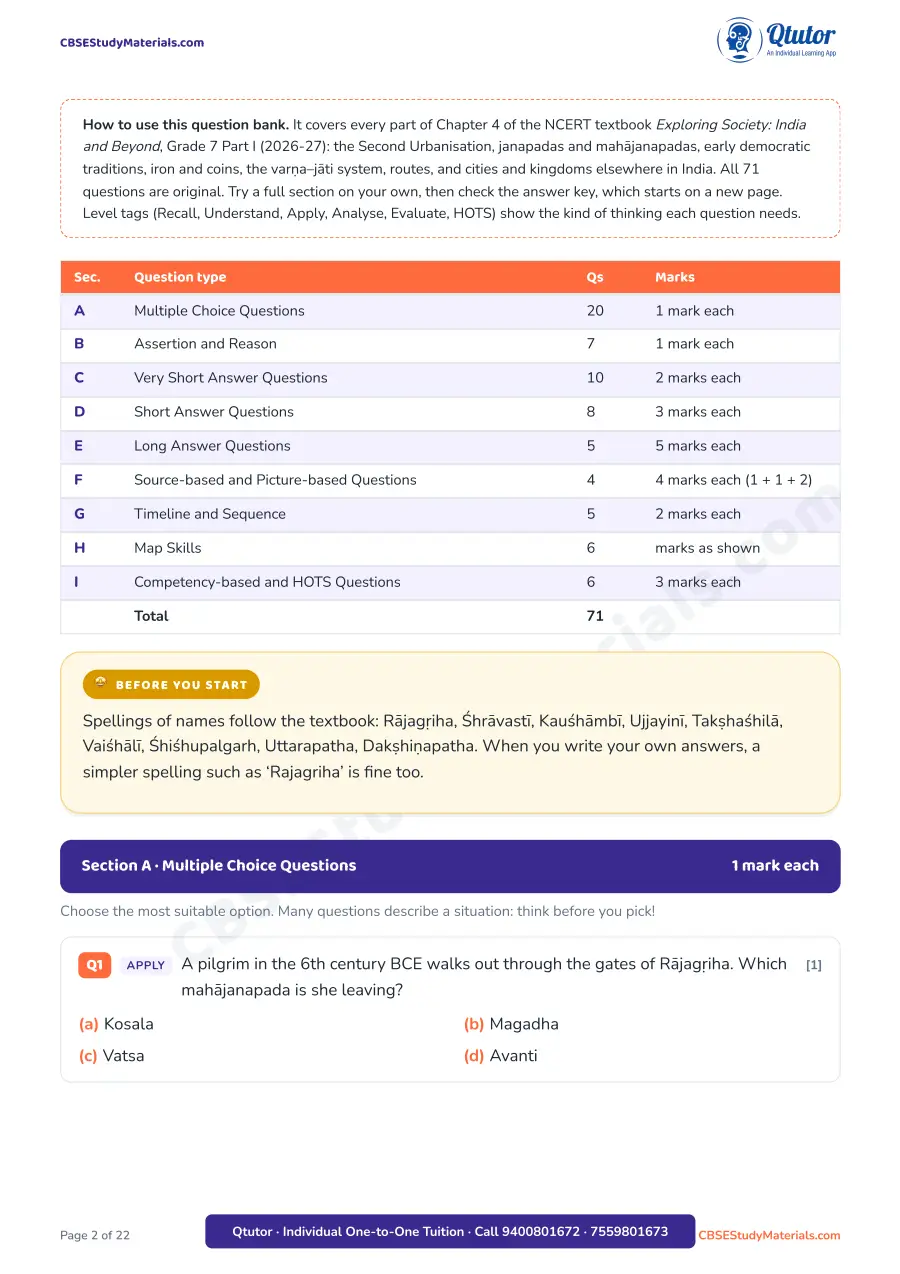
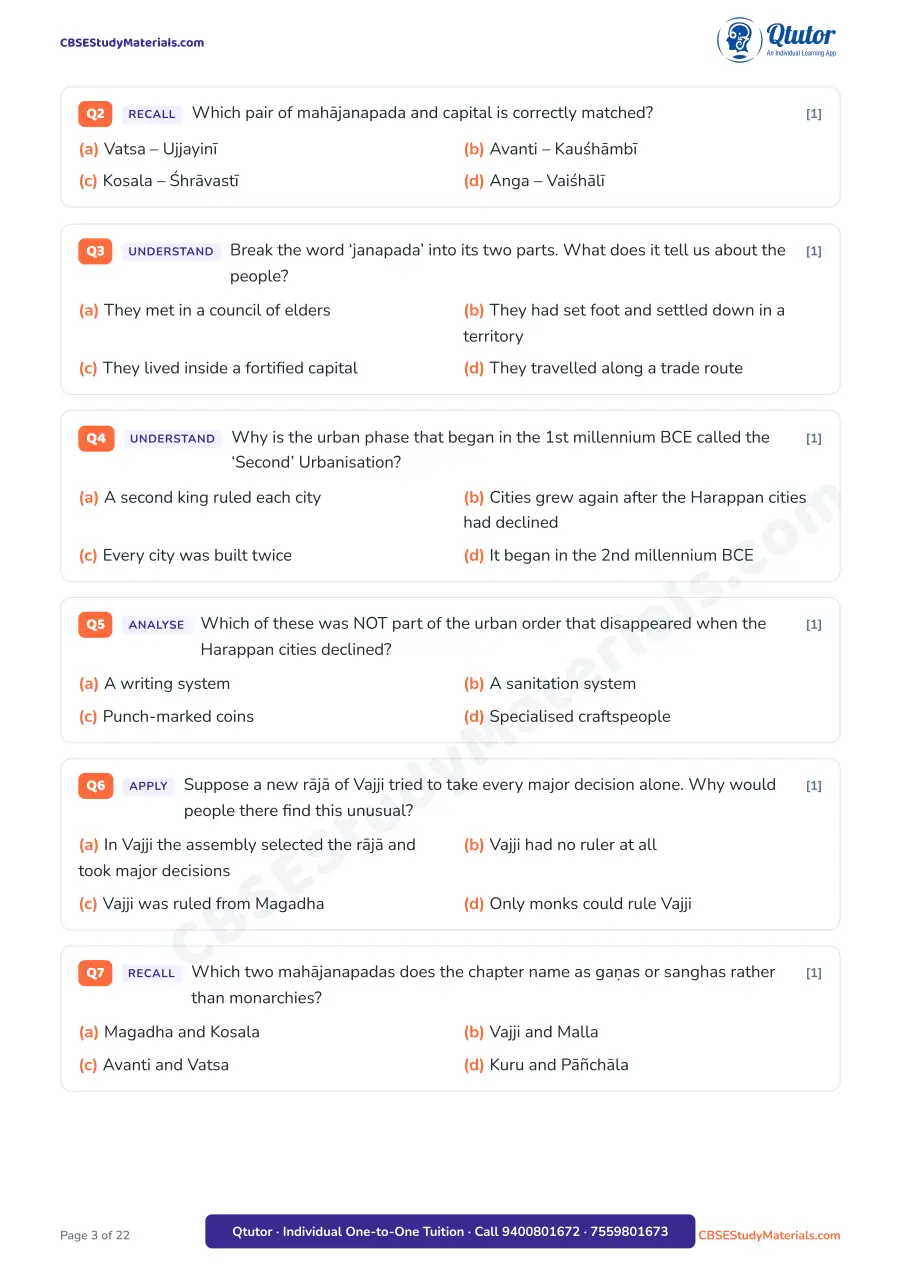
Free sample: pages 1 to 3 of 22. The full PDF costs ₹49.
Which lettered dot on an outline map of India marks Ujjayinī, and which route left Kauśhāmbī to cross the Vindhya Range? Questions like these sit beside MCQs, assertion-reason items and source extracts in this New Beginnings: Cities and States Class 7 Social Science Chapter 4 Question Bank PDF, built for CBSE students who study from the NCERT textbook Exploring Society: India and Beyond (Part I, 2026-27). It gives you 71 original important questions on the chapter, every one with a worked answer.
This is a 22-page premium PDF priced at ₹49. It is NCERT based study material for CBSE 2026-27, written as an independent resource; it is not an official CBSE or NCERT publication.
Class 7 Social Science Chapter 4 Question Bank: What Is Included
- 20 multiple choice questions, mostly set in small situations (a pilgrim leaving Rājagṛiha, a trader on the Dakṣhiṇapatha, a merchant paying with a neighbour's coins).
- 7 assertion-reason questions with all four answer types used, so you learn to judge both the statements and the link between them.
- 10 very short answer (2-mark) and 8 short answer (3-mark) questions on janapadas, moats, coins, the varṇa–jāti system, routes and southern trade.
- 5 long answer (5-mark) questions with value points and marks shown.
- 4 source-based and picture-based sets (1 + 1 + 2 marks): advice retold from Kauṭilya's Arthaśhāstra, a sketch-plan of a fortified capital with a moat and narrow gateway, a drawing of punch-marked silver coins, and a description of the smithy panel on the stūpa at Sanchi.
- 5 timeline and sequence questions, including a fill-in timeline from 1900 BCE to 300 BCE and BCE counting.
- 6 map-skill questions on an original outline map of India (with the complete official boundary of present-day India) marking ten ancient sites, the Uttarapatha, the Dakṣhiṇapatha and the Vindhya Range.
- 6 competency-based and HOTS questions that link the chapter to everyday life: a school election compared with the Vajji assembly, today's rupee compared with local coins, and an "archaeologist's puzzle".
- A complete answer key on separate pages, a one-glance revision box and a score tracker (154 marks in all).
Structure of the Question Bank PDF
| Section | Question type | Questions |
|---|---|---|
| A | Multiple choice | 20 |
| B | Assertion and reason | 7 |
| C | Very short answer (2 marks) | 10 |
| D | Short answer (3 marks) | 8 |
| E | Long answer (5 marks) | 5 |
| F | Source-based and picture-based | 4 sets |
| G | Timeline and sequence | 5 |
| H | Map skills | 6 |
| I | Competency-based and HOTS | 6 |
| Key | Answers with reasons and value points | all 71 |
Every question carries a level tag (Recall, Understand, Apply, Analyse, Evaluate or HOTS). Only about one question in nine is plain recall; the rest ask you to apply, compare or explain.
New Beginnings: Cities and States Class 7 Important Topics
The questions cover the whole chapter as it appears in the current NCERT book:
- The decline of the Harappan cities (the First Urbanisation) and the Second Urbanisation of the 1st millennium BCE, and how archaeology and late Vedic, Buddhist and Jain literature tell us about it.
- Janapadas and the 16 mahājanapadas, from Gandhāra to Anga and Aśhmaka; the powerful states of Magadha, Kosala, Vatsa and Avanti and their capitals.
- Fortified capitals with moats and narrow gateways.
- Early democratic traditions: sabhā and samiti, monarchies, and the gaṇas or sanghas of Vajji and Malla.
- Iron tools and weapons, and the first punch-marked silver coins.
- The varṇa–jāti system, its early flexibility and later rigidity, and the word 'caste'.
- The Uttarapatha and Dakṣhiṇapatha, Śhiśhupalgarh in the Kalinga region, Kodumanal, and the Cholas, Cheras and Pānḍyas.
Class 7 New Beginnings: Cities and States Important Questions (Sample)
MCQ (Analyse): Which of these was NOT part of the urban order that disappeared when the Harappan cities declined? (a) a writing system (b) a sanitation system (c) punch-marked coins (d) specialised craftspeople. Answer: (c). The first use of coins in India belongs to the Second Urbanisation.
Assertion-Reason: A: Vajji and Malla are often called 'early republics'. R: In Vajji and Malla the rājā was always the son of the previous rājā. Answer: (c). A is true but R is false: in these gaṇas the assembly selected the rājā.
Timeline: About how many years passed between the rise of the janapadas (about 1200 BCE) and the end of the mahājanapadas (about 300 BCE)? Answer: counting down in BCE, 1200 − 300 = 900, so about 900 years.
| Short answer: monarchy vs gaṇa | Magadha (monarchy) | Vajji (gaṇa / sangha) |
|---|---|---|
| Final authority | The rājā | The sabhā or samiti |
| How the rājā got power | Usually hereditary | Selected by the assembly |
| Major decisions | Rājā, advised by ministers and elders | Assembly, by discussion and vote |
How This Question Bank Helps
- It turns the chapter summary into practice: you test yourself section by section instead of only re-reading.
- Source, picture, timeline and map questions train the skills that chapter tests and school exams now ask for.
- The answer key explains why an option is right, so a wrong answer becomes a lesson, not just a cross.
- The score tracker shows which question types need another round before a test.
Who Should Use It
- Class 7 students studying CBSE Social Science (History) from the new NCERT book.
- Students who have finished the chapter notes and want important questions for revision before a unit test.
- Parents, tutors and teachers who need a ready set of class tests and worksheets with answers.
How to Download the Class 7 New Beginnings: Cities and States Question Bank PDF
Use the button below. This is a premium PDF priced at ₹49; you can read it on your phone or print it as a practice booklet.
New Beginnings: Cities and States - Class 7 Social Science Chapter 4 Question Bank (PDF · 22 pages · ₹49)
Related Resources
- Chapter page: New Beginnings: Cities and States
- Class 7 Social Science Chapter 4 Notes: revision notes, chapter summary and mind map for this chapter
- Class 7 Social Science Chapter 4 NCERT Solutions: answers to every in-text and end-of-chapter question in textbook order
- All Class 7 Social Science study material
- Previous chapter: Climates of India
- Next chapter: The Rise of Empires
FAQs on Class 7 Social Science Chapter 4 New Beginnings: Cities and States
Where can I download Class 7 Social Science Chapter 4 important questions with answers? On this page. The download button gives you the 22-page Question Bank PDF for ₹49.
How many questions are in the New Beginnings: Cities and States Class 7 question bank? 71 original questions in nine sections, from MCQs and assertion-reason to source-based, map and HOTS questions, all with answers.
Does it have map questions for Class 7 History Chapter 4? Yes. Six questions use an outline map of India marking ancient sites such as Takṣhaśhilā, Rājagṛiha, Ujjayinī and Śhiśhupalgarh, plus the Uttarapatha, the Dakṣhiṇapatha and the Vindhya Range.
Which book is New Beginnings: Cities and States from? It is Chapter 4 of the NCERT textbook Exploring Society: India and Beyond, Grade 7 Part I, used in CBSE schools for 2026-27.
Are these the same as the NCERT textbook questions? No. All questions are newly written on the chapter's content. For answers to the textbook's own questions, see the NCERT Solutions PDF linked above.
Is this an official CBSE or NCERT question bank? No. It is an independent study resource written from the current NCERT textbook and is not published by CBSE or NCERT.
Study tip: attempt one full section without looking, mark it with the key, and redo only the questions you missed two days later.