The Invisible Living World: Beyond Our Naked Eye - Class 8 Science Chapter Notes (PDF · 18 pages · ₹49) Unlock the full PDF for ₹49
Free sample: pages 1 to 3 of 18. The full PDF costs ₹49.
Why does dough with yeast puff up while plain dough stays flat, and why does milk set into curd on a warm shelf but not in the fridge? This premium PDF of The Invisible Living World: Beyond Our Naked Eye Class 8 Science Chapter 2 notes answers questions like these for the CBSE 2026-27 session, based on the new NCERT Curiosity textbook. It is an 18-page set of revision notes priced at ₹49, prepared as independent study material; it is not an official CBSE or NCERT publication.
The notes follow the chapter in the same order as the book: lenses and microscopes, the cell and its parts, how cell shape fits its job, levels of organisation, microorganisms, how microbes help us, microalgae, and why the cell is called the basic unit of life. Every idea is explained in short, friendly sentences with a labelled diagram or a table beside it.
Class 8 Science Chapter 2 The Invisible Living World Notes: What Is Included
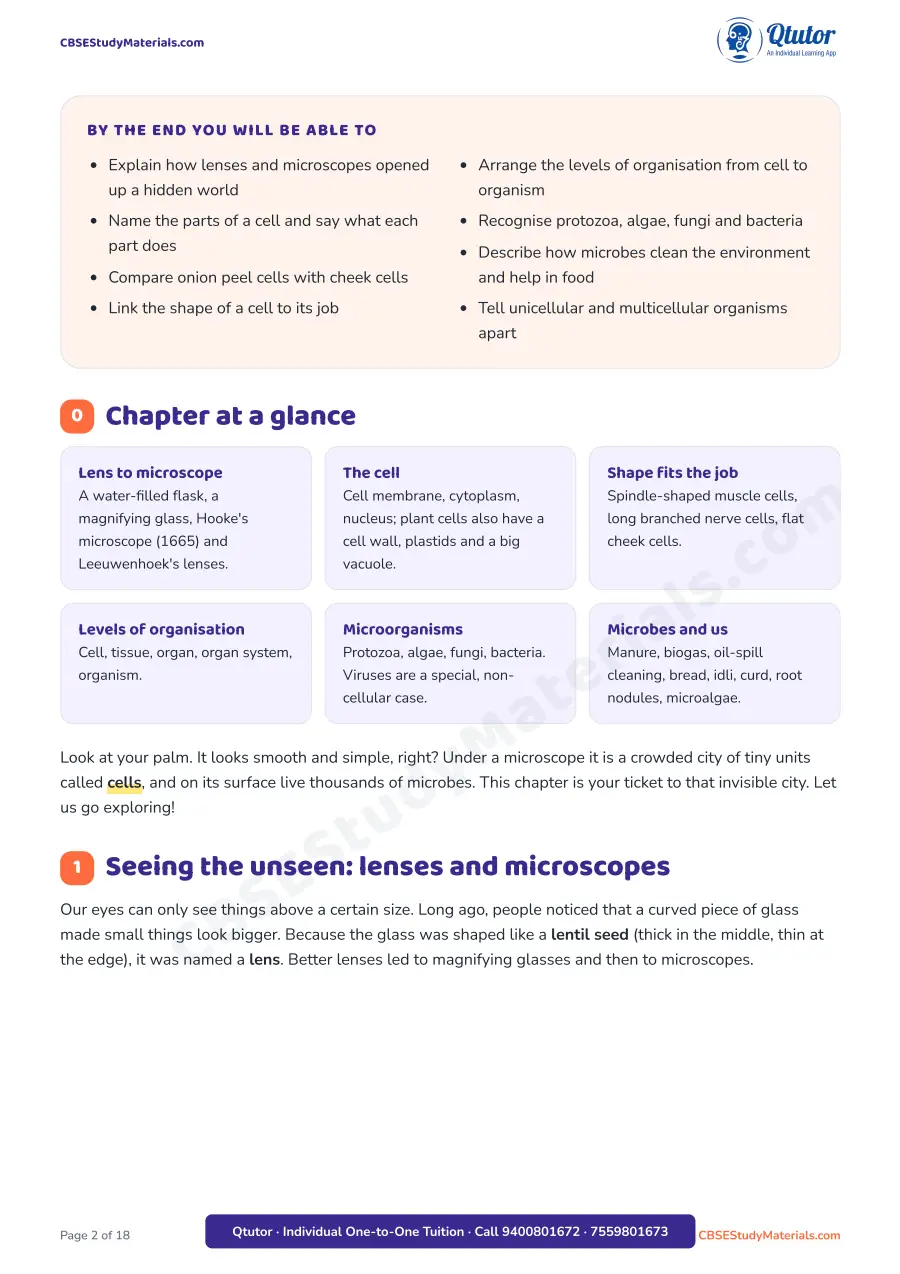
- A cover, learning goals and a "chapter at a glance" panel with the six big ideas
- 9 numbered topic sections written in simple language for Class 8 students
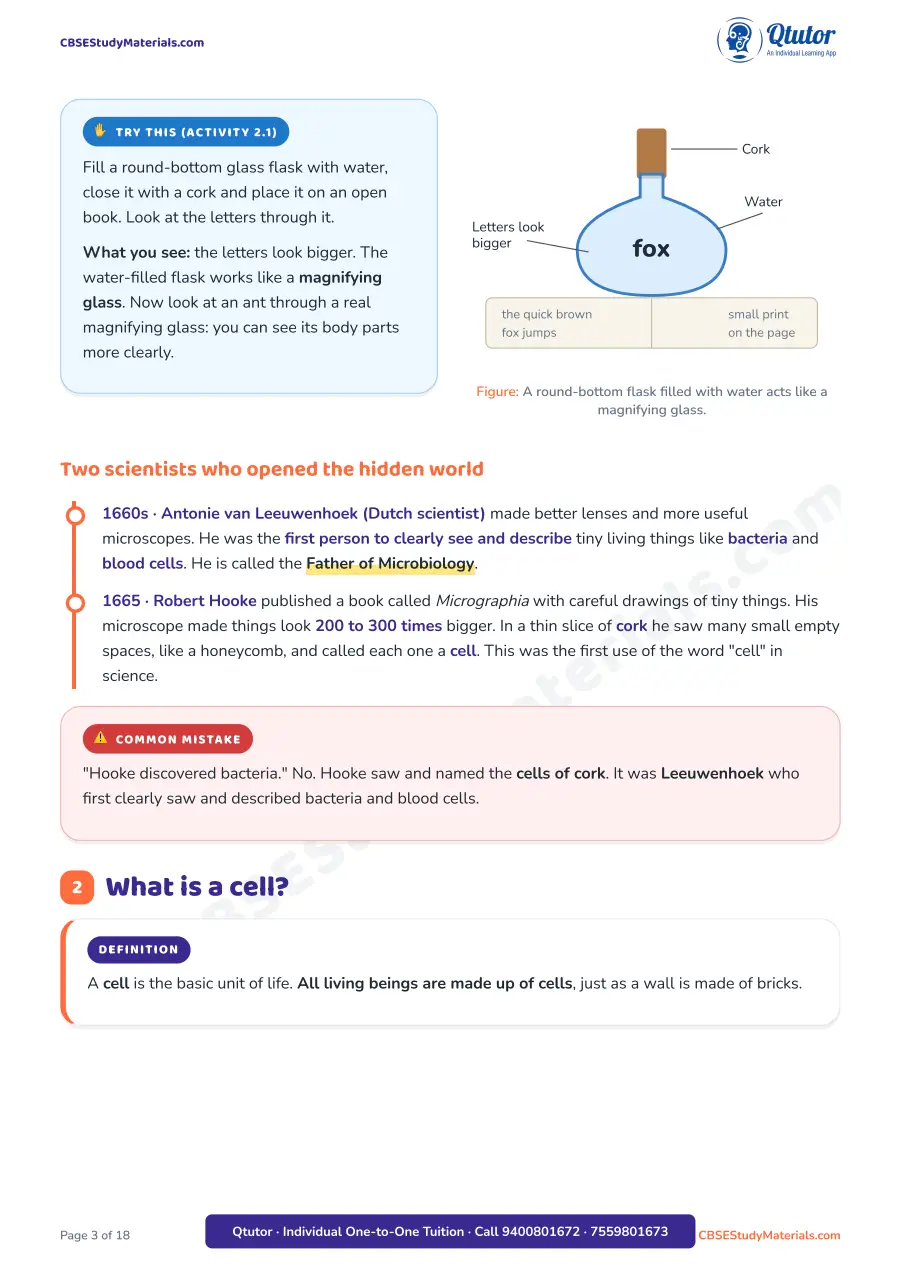
- 12 original labelled diagrams: a water-filled flask magnifier, onion peel and cheek cells, an animal cell and a plant cell, muscle and nerve cells, the levels of organisation, a gallery of pond and soil microbes, the nutrient recycling loop, the yeast dough set-up, root nodules, a bacterial cell with its nucleoid, a Venn diagram of cell parts, and a mind map
- 2 real photos: mould on bread and curd in a clay bowl
- Tables comparing plant and animal cells, unicellular and multicellular organisms, and cell shapes with their jobs
- Concept, definition, "Did you know?", "Common mistake", "Think deeper" and real-life cards
- Every textbook activity (2.1 to 2.9) explained: what to do, what you see and why
- A key-terms grid with 16 keywords and their meanings
- 12 "Check yourself" important questions with a compact answer key
- A one-page summary at the end for last-minute revision
Structure of the PDF
| Part | What you get | Pages |
|---|---|---|
| Cover and goals | Learning goals, chapter at a glance | 1-2 |
| Topics 1-4 | Lenses, the cell, cell shapes, levels of organisation | 2-8 |
| Topics 5-9 | Microorganisms, microbes and us, food, microalgae, the basic unit of life | 8-14 |
| Revision | Key terms, mind map | 14-15 |
| Practice | 12 Check-yourself questions and answer key | 15-17 |
| Summary | One-page summary | 18 |
The Invisible Living World Class 8 Important Topics
- Seeing the unseen: why a lens is named after the lentil seed, Robert Hooke's Micrographia (1665) and the first use of the word "cell", and Leeuwenhoek, the Father of Microbiology.
- The cell: onion peel (safranin) and cheek cell (methylene blue) slides, and the jobs of the cell membrane, cytoplasm, nucleus and cell wall. Plastids, chloroplasts and vacuoles are covered too.
- Shape and function: spindle-shaped muscle cells, long branched nerve cells and flat cheek cells.
- Levels of organisation: cell, tissue, organ, organ system, organism; the ostrich egg yolk as the largest known cell.
- Microorganisms: protozoa, algae, fungi and bacteria seen in pond water and soil suspension, unicellular and multicellular forms, and why viruses are acellular.
- Microbes and us: decomposition and manure, biogas, A. M. Chakrabarty's oil-spill bacterium, yeast in bread, Lactobacillus in curd and idli batter, Rhizobium in root nodules, and microalgae such as Spirulina.
- Microbe cells: fungal cells have a wall but no chloroplasts; bacteria have a nucleoid instead of a true nucleus.
The Invisible Living World Class 8 Important Questions (Sample)
A few excerpts from the PDF:
> Q2 (Assertion-Reason). Assertion: Milk with a spoon of curd sets faster on a kitchen shelf in summer than inside a refrigerator. Reason: Lactobacillus grows well in warm conditions. > Answer: Both are true and the reason explains the assertion.
> Q11 (Numerical). A school microscope magnifies 400 times; an electron microscope about 10,00,000 times. How many times more does the electron microscope magnify? > Answer: 10,00,000 ÷ 400 = 2,500 times.
| Feature | Plant cell | Animal cell |
|---|---|---|
| Cell wall | Present (rigid, gives strength) | Absent |
| Plastids / chloroplasts | Present | Absent |
| Vacuole | One large vacuole | Usually absent; small if present |
How These Revision Notes Help
The chapter mixes biology, kitchen science and farming, which makes it easy to muddle up facts. These notes keep them apart. Yeast is a fungus that makes carbon dioxide and a little alcohol, while Lactobacillus is a bacterium that makes lactic acid. Each activity is explained step by step, with a "why each step?" note, so you understand the method and not just the result. The diagrams use the same parts and labels as the textbook, so you can practise drawing and labelling them. The check-yourself questions are mostly application and reasoning questions, which is the style schools now use for Class 8 tests.
Who Should Use It
- Class 8 students revising Chapter 2 of the NCERT Curiosity book before a unit test or term exam
- Students who missed classes and want a clear chapter summary in simple English
- Parents and tutors who want a ready, printable study material for home revision
How to Download the Class 8 The Invisible Living World Notes PDF
Use the download button below to get the 18-page premium PDF (₹49). It prints well on A4 paper and is easy to read on a phone or tablet.
The Invisible Living World: Beyond Our Naked Eye - Class 8 Science Chapter Notes (PDF · 18 pages · ₹49)
Related Resources
- All study material for this chapter: The Invisible Living World: Beyond Our Naked Eye chapter page
- Answers to every textbook question: Class 8 Science Chapter 2 NCERT Solutions
- Extra practice with answers: Class 8 Science Chapter 2 Question Bank
- Previous chapter: Exploring the Investigative World of Science
- Next chapter: Health: The Ultimate Treasure
- All chapters: Class 8 Science
FAQs on Class 8 Science Chapter 2 The Invisible Living World
Where can I download Class 8 Science Chapter 2 The Invisible Living World notes PDF? On this page. Use the download button to get the 18-page PDF of revision notes with diagrams, a mind map and a one-page summary.
What is the price of The Invisible Living World Class 8 notes PDF? It is a premium PDF priced at ₹49 for the full 18 pages.
What are the important topics in The Invisible Living World Class 8? The parts of a cell, plant and animal cells, cell shape and function, and levels of organisation. The chapter also covers the kinds of microorganisms and how microbes help in decomposition, biogas, bread, curd and root nodules, and why the cell is the basic unit of life.
Which book is The Invisible Living World Class 8 from? It is Chapter 2 of the NCERT Class 8 Science textbook Curiosity, used in CBSE schools for 2026-27.
Does the PDF include important questions with answers? Yes. It has 12 check-yourself questions, including assertion-reason, case-based and numerical questions, with a compact answer key.
Are the diagrams in these notes easy to draw in an exam? Yes. The cell, microbe and root nodule diagrams are simple, clearly labelled drawings that you can copy into your notebook for practice.
Study tip: draw the plant cell and the animal cell side by side from memory once a day this week, and label every part without looking.