Electricity: Magnetic & Heating Effects Class 8 Science Question Bank (PDF · 23 pages · ₹49) Unlock the full PDF for ₹49
Free sample: pages 1 to 3 of 23. The full PDF costs ₹49.
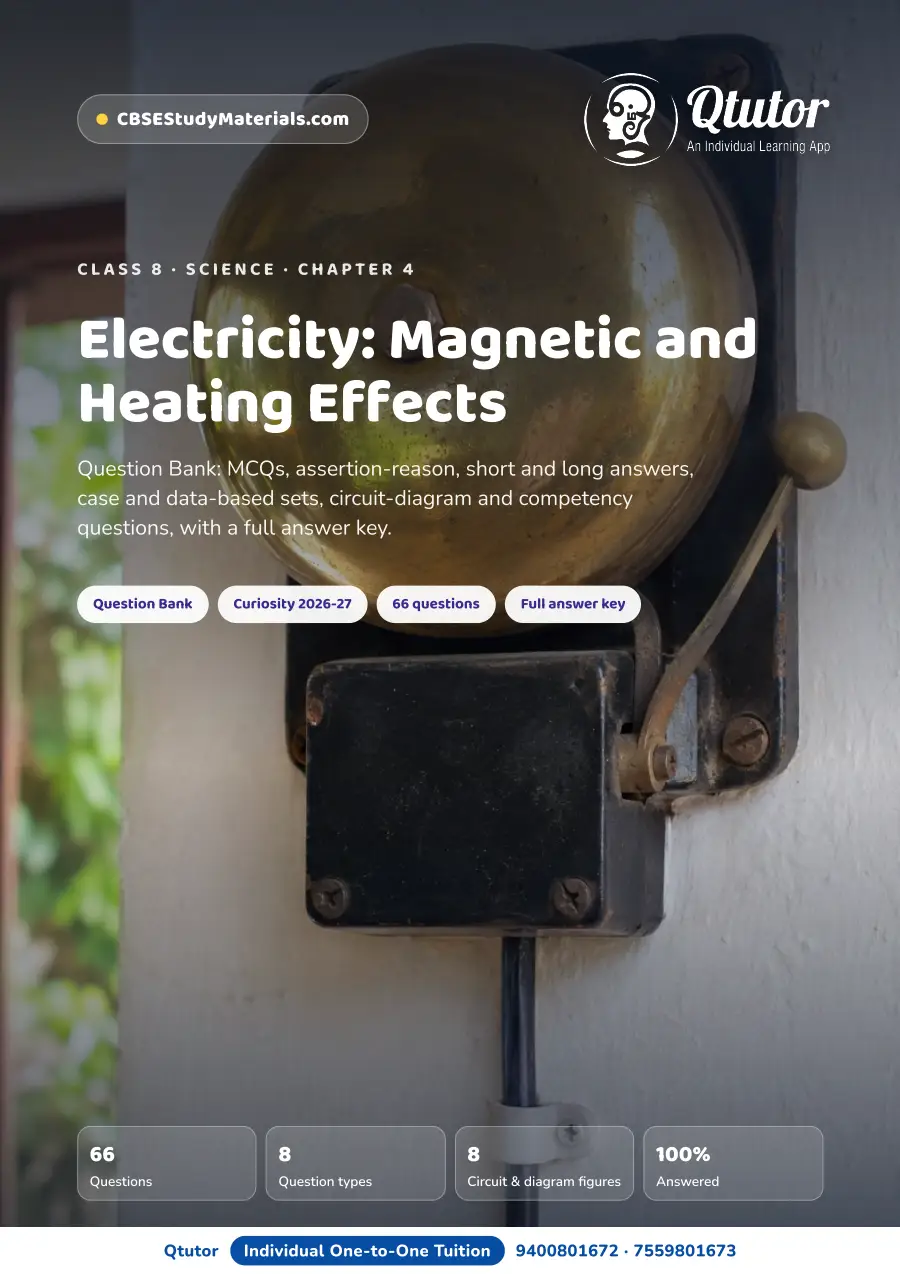
Why does a school bell keep ringing while the button is held down, but would give only one "ding" if its iron core were swapped for a permanent magnet? That is one of the case-based sets in this Electricity: Magnetic and Heating Effects Class 8 Science Chapter 4 Question Bank PDF, an NCERT based set of important questions with answers for CBSE Class 8 students using the Curiosity textbook.
This is a premium 23-page PDF priced at ₹49. It has 66 original questions on Chapter 4, grouped by type and numbered Q1 to Q66, and every question has a worked answer with marking points. It is independent study material written for CBSE 2026-27 students and is not published by CBSE or NCERT. The questions are new, written in the style of school tests, and are not copied from the textbook exercise (for those, see the NCERT Solutions PDF linked below).
Class 8 Science Chapter 4 Question Bank: What Is Included
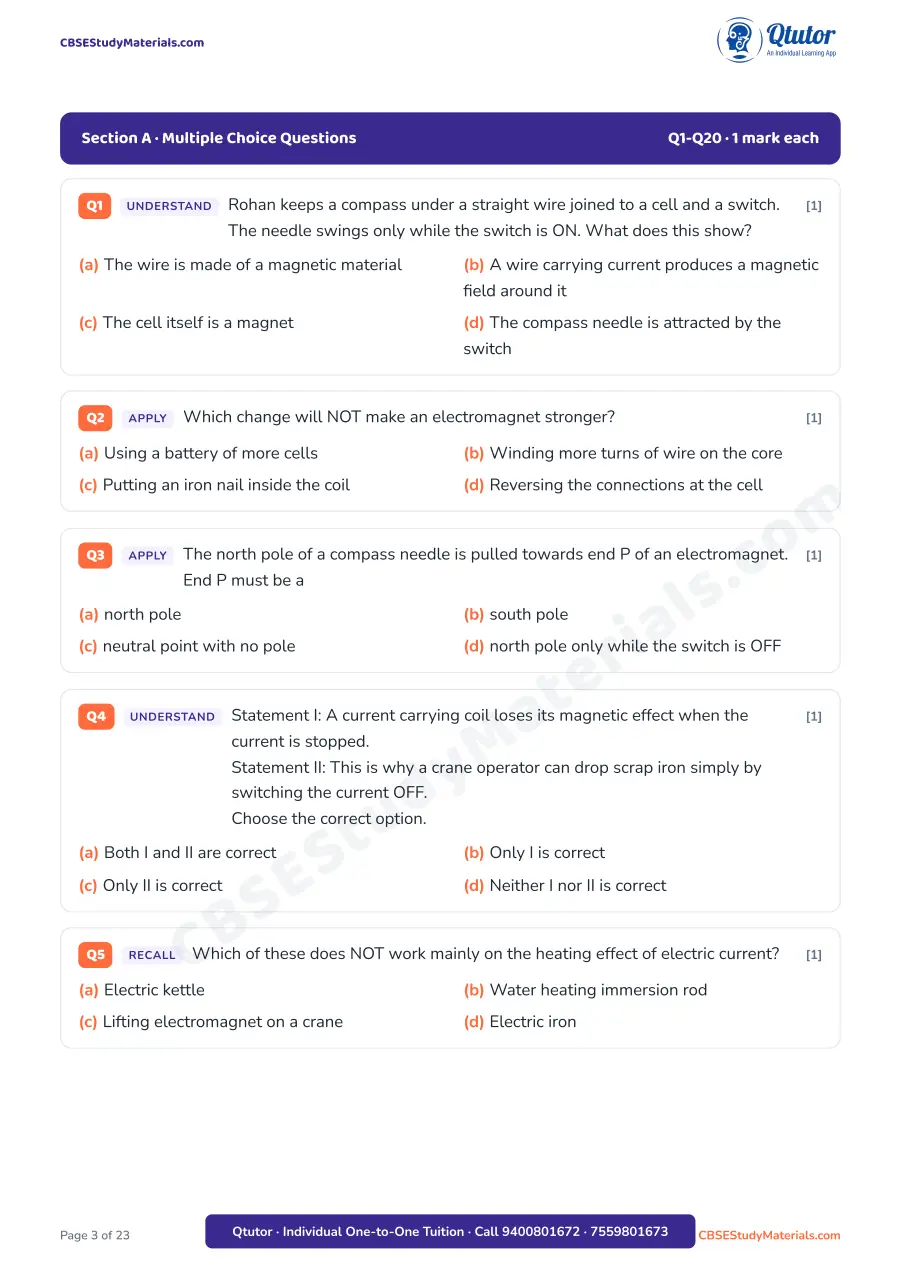
- 20 MCQs (Section A), including statement I/II items, a sequence question on a scrap-yard crane, and a picture-based question with four LED circuits
- 9 Assertion-Reason questions (Section B) with the standard four options, covering all four answer types
- 10 short answer questions of 2 marks and 8 short answer questions of 3 marks (Sections C and D)
- 4 long answer questions of 5 marks (Section E): making an electromagnet and finding its poles, building a lemon battery to light an LED, a magazine note on batteries, and the heating effect in homes and industry
- 4 case and data-based sets (Section F) with 1 + 1 + 2 sub-parts and an internal OR choice: the electric bell, a turns-versus-clips data table, a nichrome wire temperature table, and a family's battery problem
- 6 circuit-diagram questions (Section G): an electromagnet circuit with a compass, four electrode-and-liquid set-ups, a cut-open dry cell to label, a faulty circuit to correct, and a circuit to draw with current arrows
- 5 competency and HOTS questions (Section H) set in real-life situations such as a recycling plant, an overloaded extension board and a toy crane design
- A full answer key: a quick key for Q1 to Q29, then value-point answers with marks shown in brackets, and model circuit diagrams for the drawing questions
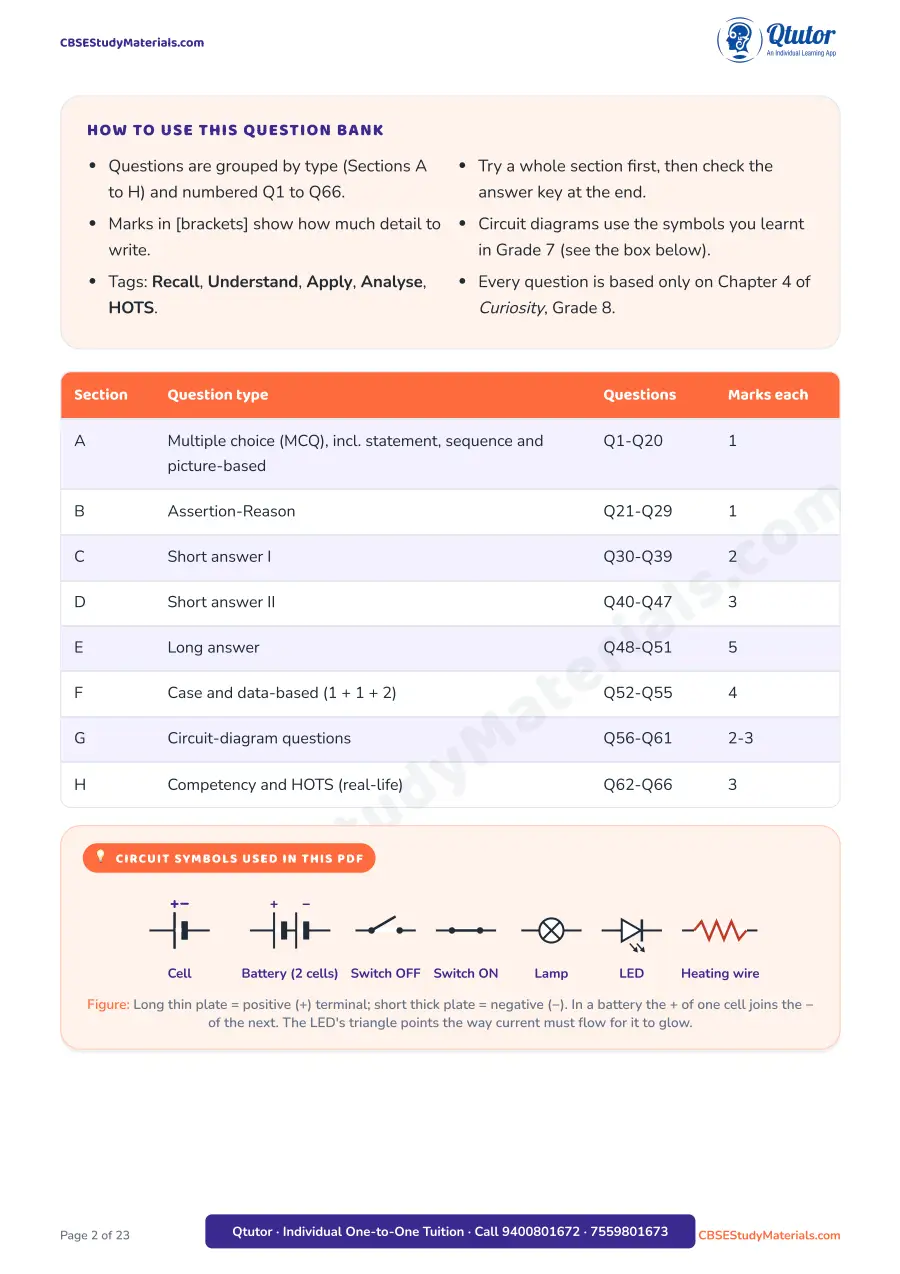
- A page of circuit symbols (cell, battery, switch, lamp, LED, heating wire) and a five-point revision box before the test
Structure of the PDF
| Section | Question type | Questions | Marks each |
|---|---|---|---|
| A | Multiple choice (MCQ) | Q1-Q20 | 1 |
| B | Assertion-Reason | Q21-Q29 | 1 |
| C | Short answer I | Q30-Q39 | 2 |
| D | Short answer II | Q40-Q47 | 3 |
| E | Long answer | Q48-Q51 | 5 |
| F | Case and data-based | Q52-Q55 | 4 |
| G | Circuit-diagram questions | Q56-Q61 | 2-3 |
| H | Competency and HOTS | Q62-Q66 | 3 |
| Key | Answer key and marking points | All 66 | - |
Electricity: Magnetic and Heating Effects Class 8 Important Topics
The question bank covers every part of Chapter 4 in the 2026-27 Curiosity book:
- Magnetic effect of electric current: the compass deflection test, magnetic field, and Oersted's 1820 discovery
- Electromagnets: the iron core, the two poles, how the number of cells and number of turns change the strength, and reversing the poles
- Lifting electromagnets on cranes in factories and scrap yards, and why Earth behaves like a magnet
- Heating effect of electric current: resistance, why nichrome is used in heating elements, the factors that decide how much heat is produced, household appliances, energy loss in wires, overheating and correctly rated plugs and sockets, and the electric furnace for recycling scrap steel
- Cells and batteries: the Voltaic (Galvanic) cell, Galvani and Volta, the lemon cell with copper and iron electrodes, the dry cell and its parts, rechargeable and lithium-ion batteries, and safe e-waste disposal
Electricity: Magnetic and Heating Effects Class 8 Important Questions (Sample)
Sample MCQ (Q2). Which change will NOT make an electromagnet stronger? (a) a battery of more cells (b) more turns of wire (c) an iron nail inside the coil (d) reversing the connections at the cell. Answer: (d). Reversing the connections only reverses the current, so the poles swap; the strength stays the same.
Sample Assertion-Reason (Q23). Assertion: a coil of copper wire with no core can deflect a compass when current flows through it. Reason: copper is a magnetic material. Answer: (c). The assertion is true, because any current carrying conductor makes a magnetic field, but copper is not a magnetic material, so the reason is false.
Sample data-based set (Q54). Kabir passes current through the same nichrome wire for 30 s. Room temperature is 27 °C. (The readings are illustrative, not from the textbook.)
| Source | Time | Temperature of wire |
|---|---|---|
| 1 cell | 30 s | 34 °C |
| Battery of 2 cells | 30 s | 45 °C |
Answer (part i): the rise is 34 − 27 = 7 °C with one cell and 45 − 27 = 18 °C with two cells. Two cells drive a larger current, and a larger current produces more heat.
How It Helps
- Practises the question styles used in school tests: MCQ, assertion-reason, case-based, data-based and diagram questions, not just recall
- Builds circuit skills: reading and drawing correct symbols, spotting a reversed cell or an open switch, and tracing the current from the + terminal round to the − terminal
- Answers show marks for each value point, so students learn how much to write for a 2, 3 or 5 mark answer
- Real-life contexts (a school bell, a recycling plant, an overloaded extension board) show where the science is used
Who Should Use It
- Class 8 students revising Chapter 4 before a unit test, periodic test or half-yearly exam
- Students who have finished the chapter notes and want important questions for practice
- Parents and tutors who need a ready question set with a reliable answer key
How to Download the Class 8 Electricity: Magnetic and Heating Effects Question Bank PDF
Use the download button below to buy and download the 23-page PDF for ₹49. It prints well on A4 paper.
Electricity: Magnetic & Heating Effects Class 8 Science Question Bank (PDF · 23 pages · ₹49)
Related Resources
- Class 8 Science Chapter 4 Electricity: Magnetic and Heating Effects Notes: chapter notes, diagrams, mind map and a one-page summary
- Class 8 Science Chapter 4 NCERT Solutions: answers to every activity and exercise question in textbook order
- Electricity: Magnetic and Heating Effects chapter page
- All Class 8 Science study material
- Previous chapter: Health: The Ultimate Treasure
- Next chapter: Exploring Forces
FAQs on Class 8 Science Chapter 4 Electricity: Magnetic and Heating Effects
Where can I download Class 8 Science Chapter 4 important questions PDF? You can download this 23-page Electricity: Magnetic and Heating Effects question bank from this page using the download button. It contains 66 questions with answers.
What is the price of the Class 8 Electricity: Magnetic and Heating Effects question bank? It is a premium PDF priced at ₹49, with a complete answer key and marking points.
What are the important topics in Electricity: Magnetic and Heating Effects Class 8? The magnetic effect of current, electromagnets and their strength and poles, lifting electromagnets, the heating effect of current and its uses and dangers, the Voltaic cell, the lemon cell, dry cells, and rechargeable batteries.
Which book is Electricity: Magnetic and Heating Effects Class 8 from? It is Chapter 4 of the NCERT Class 8 Science textbook Curiosity (2026-27 edition). All questions in this PDF are based only on that chapter.
Does the question bank include assertion-reason and case-based questions? Yes. It has 9 assertion-reason questions, 4 case and data-based sets with internal choice, and 6 circuit-diagram questions, all answered.
Are the textbook exercise questions included? No. These are new practice questions. The textbook's "Keep the curiosity alive" questions are answered in the separate NCERT Solutions PDF for this chapter.
Study tip: after each section, trace every circuit in the answer key with your finger from the + terminal to the − terminal; if you can do that, you can answer any circuit question.