Chemical Reactions and Equations - Class 10 Chemistry Flash Cards (PDF · 12 pages · Free download) Download the full PDF free
You are looking at pages 1 to 3 of 12. The full PDF is free to download.
When lead nitrate is heated, the brown fumes are easy to remember, but can you write the balanced equation without a slip? This Chemical Reactions and Equations Class 10 Chemistry Chapter 1 flash cards PDF tests that kind of recall in 45 cut-and-revise cards, built on the rationalised NCERT Science textbook for CBSE Class 10. It is a free 12-page PDF of revision flash cards on balancing, reaction types, lab observations, oxidation and reduction, corrosion and rancidity, with important questions and answers on every card.
The PDF is prepared independently by CBSEStudyMaterials.com for the CBSE 2026-27 session. It is not an official CBSE or NCERT publication. Each card has a front that asks and a back that answers, usually with a one-line memory hook, so you test yourself instead of re-reading a chapter summary.
Class 10 Chemistry Chapter 1 Flash Cards: What Is Included
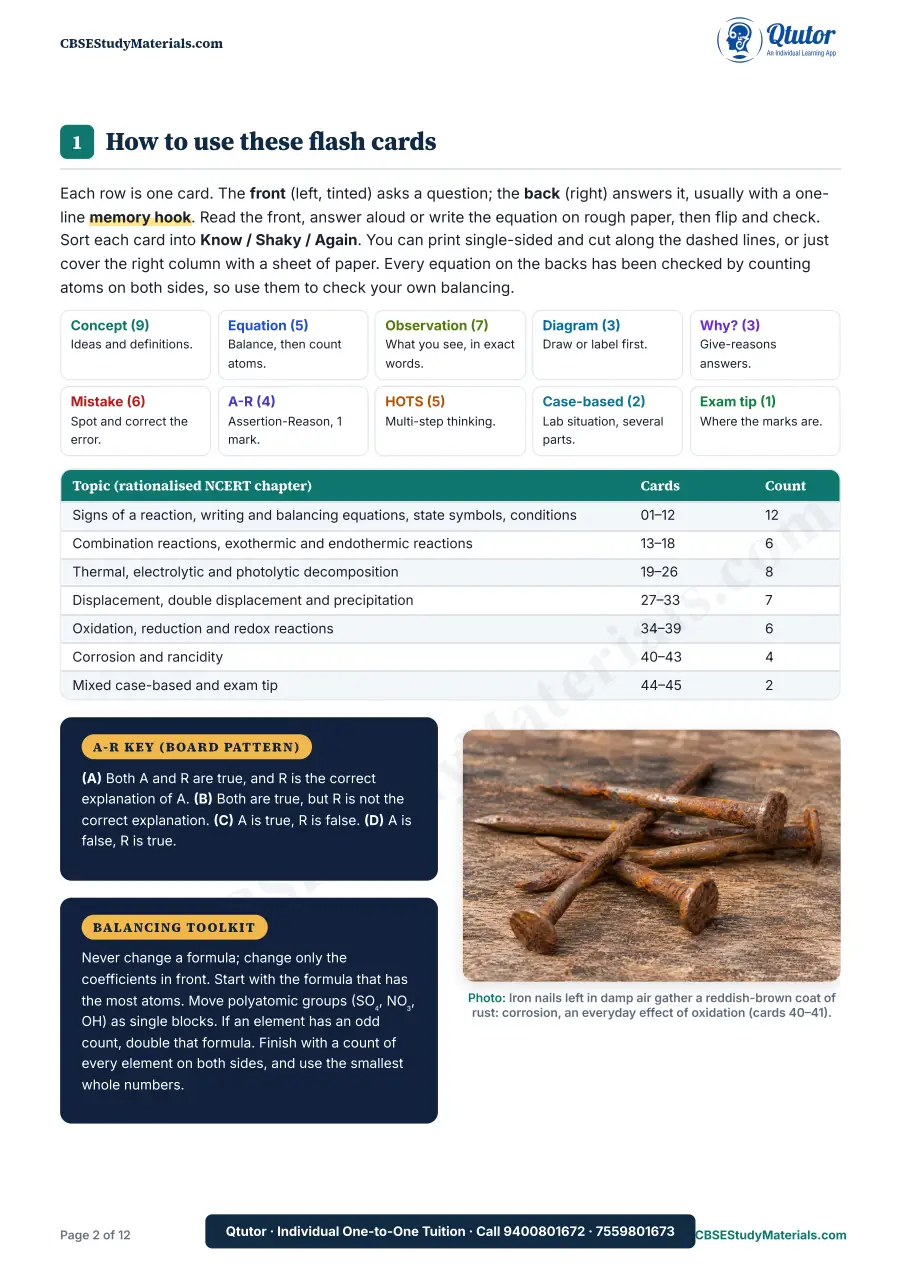
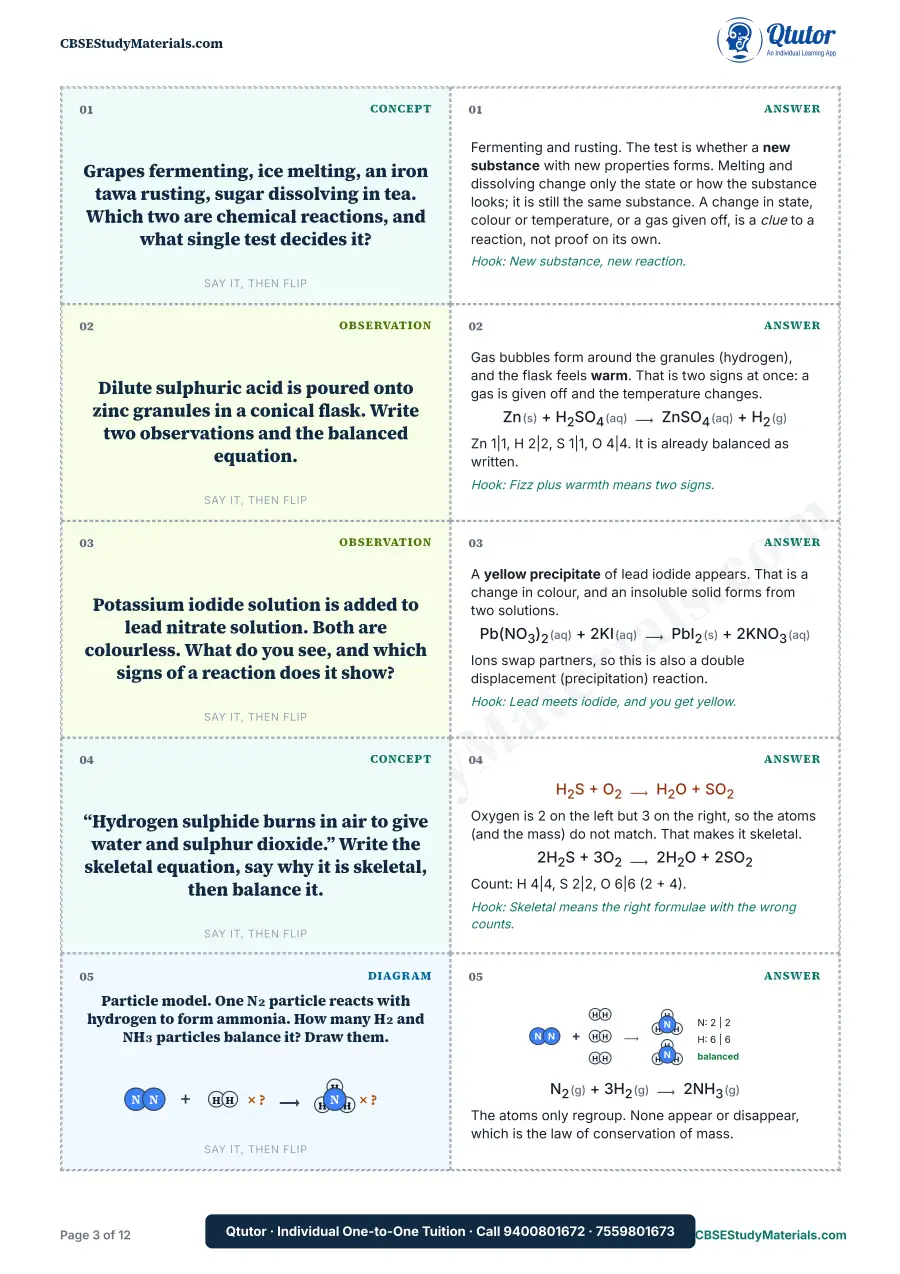
- 45 flash cards in 10 card types: Concept (9), Observation (7), Diagram (3), Equation (5), Mistake (6), HOTS (5), A-R (4), Case-based (2), Why? (3), Exam tip (1).
- 32 different balanced chemical equations, every one checked by counting the atoms of each element on both sides. State symbols and conditions such as heat, sunlight, electricity or 340 atm are shown over the arrow.
- Observation cards for the chapter activities in exact colour words (with magnesium's dazzling white flame and white powder on the HOTS and Mistake cards): the yellow precipitate of lead iodide, the green ferrous sulphate crystals, brown fumes from lead nitrate, silver chloride turning grey, the blue colour fading around an iron nail, and copper's black coat of oxide.
- 6 spot-the-mistake cards, including a wrongly balanced lead nitrate equation and a mixed-up redox statement.
- 4 Assertion-Reason cards in the board format, with answers (A), (B), (C) and (D) all used once.
- 3 diagram cards drawn for this PDF: a particle model of ammonia formation, the electrolysis of water set-up and the iron nail in copper sulphate activity.
- A how-to-use page with a card-type key, topic map, A-R key and a balancing toolkit.
- A one-page summary table of all reaction types with a signature equation and observation for each, plus a self-check list.
Structure of the PDF
| Part | Cards |
|---|---|
| Cover and how-to page (card key, topic map, balancing toolkit) | – |
| Signs of a reaction, writing and balancing equations, state symbols, conditions | 01–12 |
| Combination reactions, exothermic and endothermic reactions | 13–18 |
| Thermal, electrolytic and photolytic decomposition | 19–26 |
| Displacement, double displacement and precipitation | 27–33 |
| Oxidation, reduction and redox reactions | 34–39 |
| Corrosion and rancidity | 40–43 |
| Mixed case-based and exam tip | 44–45 |
| Summary table, 3-pass revision plan, self-check | – |
Chemical Reactions and Equations Class 10 Important Topics
- Signs that a chemical reaction has taken place: change in state, colour or temperature, or a gas given off
- Word equations, skeletal equations and the law of conservation of mass
- Balancing chemical equations by the hit-and-trial method, with polyatomic ions treated as blocks
- State symbols (s), (l), (g), (aq) and reaction conditions written over the arrow
- Combination reactions and the reaction of quick lime with water
- Exothermic and endothermic reactions, including compost, burning natural gas and the barium hydroxide activity
- Thermal, electrolytic and photolytic decomposition, and the electrolysis of water
- Displacement, double displacement and precipitation reactions
- Oxidation, reduction and redox reactions in terms of oxygen and hydrogen
- Corrosion of iron, copper and silver, and rancidity of fats and oils
Chemical Reactions and Equations Class 10 Important Questions (Sample)
Card 07 · Equation. Balance BaCl₂ + Al₂(SO₄)₃ → BaSO₄ + AlCl₃. Treat SO₄ as one block: 3 on the left, so 3BaSO₄ and 3BaCl₂, which gives 6 Cl and so 2AlCl₃. The balanced equation is 3BaCl₂(aq) + Al₂(SO₄)₃(aq) → 3BaSO₄(s) + 2AlCl₃(aq), and a white precipitate of barium sulphate forms.
Card 20 · Spot the mistake. "Pb(NO₃)₂ → PbO + 2NO₂ + O₂." Lead and nitrogen match, but oxygen is 6 on the left and 7 on the right. The correct equation is 2Pb(NO₃)₂(s) → 2PbO(s) + 4NO₂(g) + O₂(g), with 12 oxygen atoms on each side.
Card 32 · Assertion-Reason. Assertion: NaOH(aq) + HCl(aq) → NaCl(aq) + H₂O(l) is a double displacement reaction. Reason: every double displacement reaction produces a precipitate. Answer: (C). The ions are exchanged, so A is true, but no precipitate forms here, so R is false.
| Reaction type | Signature example | What you observe |
|---|---|---|
| Thermal decomposition | 2FeSO₄ → Fe₂O₃ + SO₂ + SO₃ | Green crystals change colour; smell of burning sulphur |
| Photolytic decomposition | 2AgCl → 2Ag + Cl₂ | White turns grey in sunlight |
| Displacement | Fe + CuSO₄ → FeSO₄ + Cu | Blue colour fades; nail turns brownish |
How the Flash Cards Help
Marks in this chapter are usually lost on small things: a changed subscript instead of a coefficient, a missing state symbol, products named instead of reactants in a redox question, or a vague observation such as "colour changes" when the examiner wants "white turns grey". The Equation and Mistake cards make you balance and count atoms before you look at the answer. The Observation cards train you to state the change in exact words. The HOTS cards go beyond the textbook examples: using the law of conservation of mass to find the oxygen used when 2.4 g of magnesium burns (card 12), ranking metals from displacement results (card 28), and identifying an unknown solution from two tests. Short hooks such as "Count the products before you name the type" make the rules easy to recall in the exam hall.
Who Should Use These Flash Cards
- Class 10 CBSE students revising Science Chapter 1 before unit tests, pre-boards or the board exam.
- Students who have read the NCERT chapter and want quick recall practice and important questions in compact study material.
- Teachers and parents who want ready-made quiz cards for a class or home revision session.
How to Download the Class 10 Chemical Reactions and Equations Flash Cards PDF
The flash cards are free. Use the download button below, then print single-sided and cut along the dashed lines, or keep the PDF on your phone and cover the answer column.
Chemical Reactions and Equations - Class 10 Chemistry Flash Cards (PDF · 12 pages · Free download)
Related Resources
- Chemical Reactions and Equations chapter page
- Class 10 Chemistry: all chapters
- Chemical Reactions and Equations Class 10 notes
- Chemical Reactions and Equations Class 10 worksheet
- Chemical Reactions and Equations application questions with answers
- Chemical Reactions and Equations chapter-wise question paper with answer key
- Chemical Reactions and Equations short revision notes
- Next chapter: Acids, Bases and Salts
FAQs on Class 10 Chemistry Chapter 1 Chemical Reactions and Equations
Where can I download Class 10 Chemistry Chapter 1 Chemical Reactions and Equations flash cards PDF? On this page. Use the download button to get the 12-page PDF with 45 flash cards.
Are the Chemical Reactions and Equations flash cards free? Yes. This flash card PDF is free to download.
What are the important topics in Chemical Reactions and Equations Class 10? Balancing chemical equations, the types of reactions (combination, decomposition, displacement, double displacement and redox), exothermic and endothermic reactions, the observations from each activity, and corrosion and rancidity. The cards cover all of these.
Are the equations in the flash cards balanced and checked? Yes. Every balanced equation was checked by counting the atoms of each element on both sides, and the smallest whole-number coefficients are used.
Does the PDF include Assertion-Reason and case-based questions? Yes. There are 4 Assertion-Reason cards in the board format and 2 case-based cards, along with HOTS and spot-the-mistake cards.
Which book is Chemical Reactions and Equations Class 10 from? It is Chapter 1 of the NCERT Class 10 Science textbook (rationalised edition), which CBSE schools follow for the 2026-27 session.
Study tip: when you write any equation in the exam, count every element on both sides before moving on; it takes ten seconds and saves the mark.