Three Days to See - Class 7 English Ch 3 NCERT Solutions (PDF · 11 pages · ₹49) Unlock the full PDF for ₹49
Free sample: pages 1 to 3 of 11. The full PDF costs ₹49.
How does Helen Keller understand a friend's feelings without seeing them? That is one of the questions you answer in Class 7 English Chapter 3 Three Days to See, and these CBSE NCERT Solutions, based on the NCERT Poorvi textbook, answer every question of the chapter in an 11-page PDF.
This is a premium NCERT Solutions PDF (₹49) for Class 7 English, Chapter 3 "Three Days to See" by Helen Keller, from Unit 1 "Learning Together" of the new NCERT Poorvi book (CBSE 2026-27). It is independent study material and is not an official CBSE or NCERT publication. All 30 textbook questions, with their 45 sub-parts and blanks, are answered in the same order and numbering as the book, so the PDF works as a question answer guide and a homework checker.
Class 7 English Chapter 3 Three Days to See NCERT Solutions: What Is Included
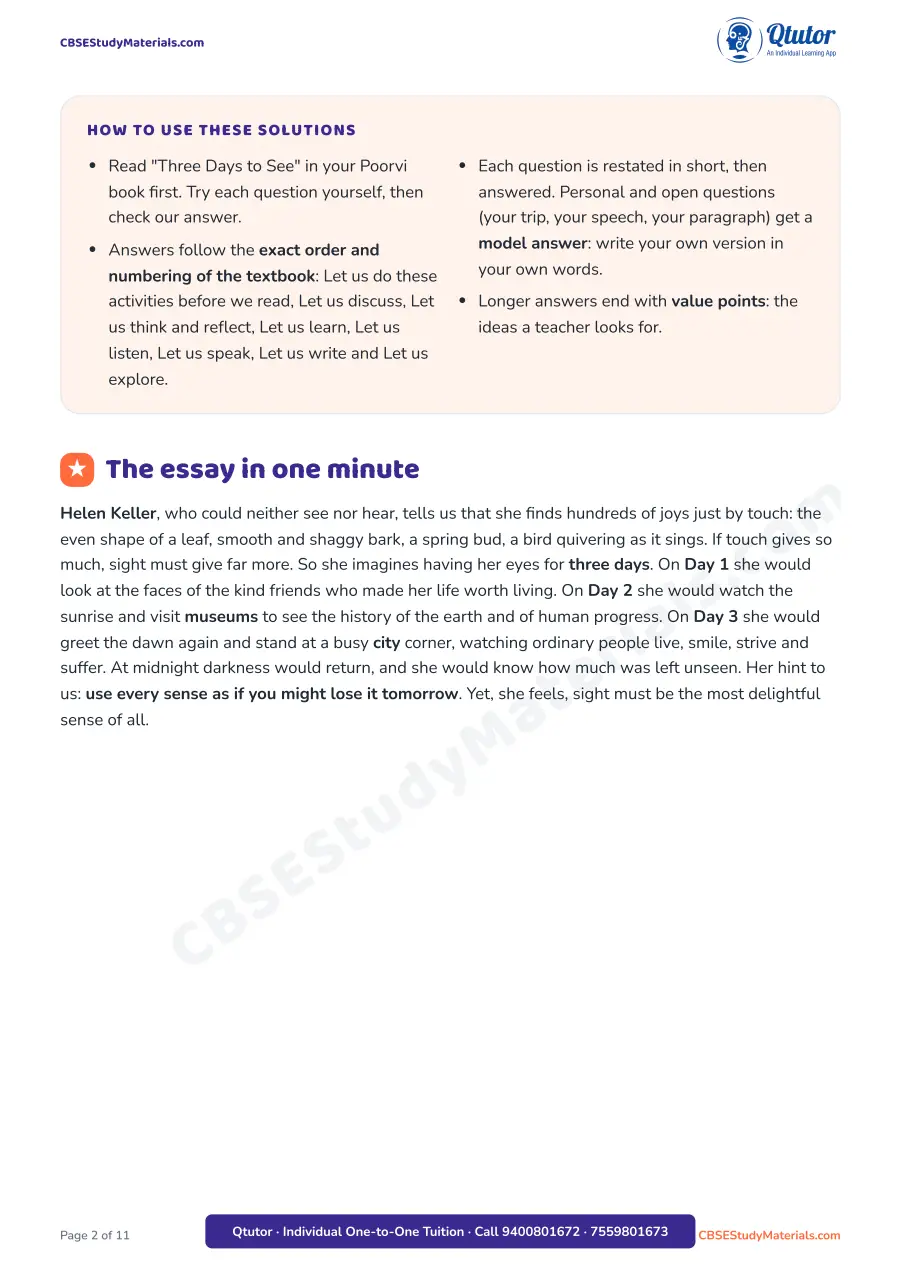
- "The essay in one minute": a short summary to read before you start
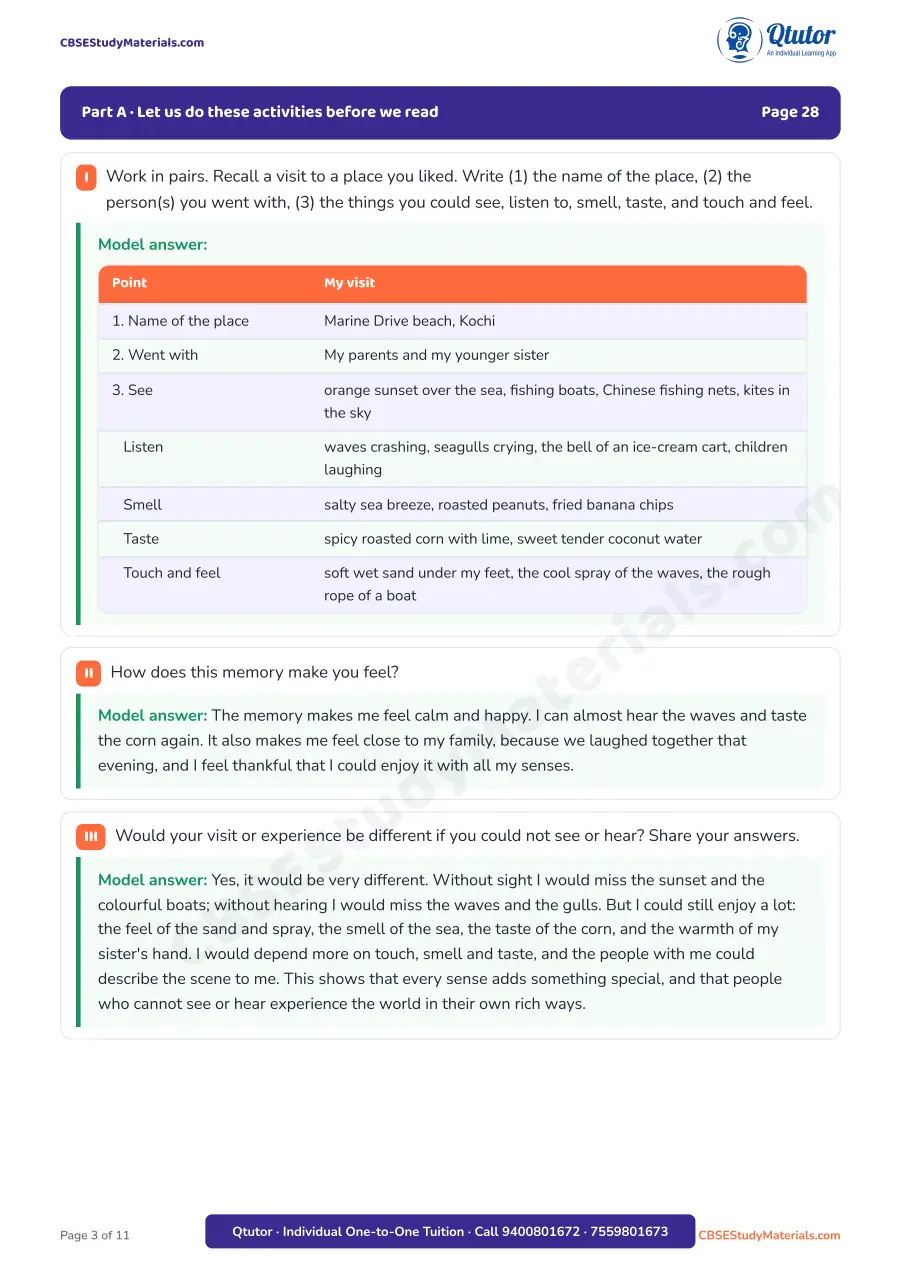
- Let us do these activities before we read: a model answer for the place-and-five-senses table and the two follow-up questions
- Let us discuss: all seven true-or-false statements with reasons, the completed three-days table, and how she understands people's feelings
- Let us think and reflect: both extracts (eight sub-questions, including the tone and "thrilling" options) and all six long questions with value points
- Let us learn: the sensory words table, the underlined modal verbs, five modals with their functions, and all seven blanks of the modal verbs table with explanations
- Let us listen: the seven statements about Anuj, Tara and Digital India, with the four true ones explained
- Let us speak: a one-minute model speech on the sense you value most
- Let us write: a model descriptive paragraph that uses all five senses, with value points
- Let us explore: a Braille example (the name ANU) with a code key, facts on the International Day of Persons with Disabilities, and pointers on Indian Sign Language
Structure of the PDF
| Part | Textbook section | What you get |
|---|---|---|
| A | Before we read | Model answers for I, II and III |
| B | Let us discuss | True/false with reasons, three-days table, "window of the soul" |
| C | Let us think and reflect | Two extracts and six long answers |
| D | Let us learn | Sensory words and modal verbs |
| E-G | Listen, speak, write | Statements, model speech, model paragraph |
| H | Let us explore | Braille, Day of Persons with Disabilities, sign language |
Three Days to See Class 7 Important Questions and Answers (Sample)
From "Let us discuss": the true statements are 3, 4, 6 and 7. Statement 5 is false because Helen Keller says sight, not touch, must be the most delightful sense.
From the modal verbs exercise:
| Sentence | Modal | Function |
|---|---|---|
| They might arrive late due to traffic. | might | possibility |
| They ought to apologise for their mistake. | ought to | moral obligation |
| He would like to have some lassi, please. | would | polite request |
From "Let us think and reflect", the question on why the writer uses "should" many times is answered: it shows that these are imagined plans, not real events, and gives the passage the feel of a careful timetable for her three precious days.
Three Days to See Class 7 Important Topics Covered
- Touch as Helen Keller's way of "seeing" nature and people
- The eye as the "window of the soul"
- Her plan: friends, the dawn and the museums, and the busy city
- Her hint to use every sense as if you might lose it tomorrow
- Sensory words and modal verbs with their functions
- Braille, screen readers and inclusion
How These NCERT Solutions Help
- Each question is restated in short, so you can study without the book open
- Long answers end with value points, the ideas a teacher looks for
- Model answers for personal questions show the length and style expected, while you write your own version
- The listening answers explain why each statement is true or false
Who Should Use It
Class 7 students using the Poorvi English textbook, parents who help with homework, and tutors who want a clean answer key for Unit 1, Learning Together. Read the essay in your book first, try each question on your own, and then compare.
How to Download the Class 7 Three Days to See NCERT Solutions PDF
This is a premium PDF priced at ₹49. Use the download button below to save all 11 pages on your phone or computer and print the pages you need.
Three Days to See - Class 7 English Ch 3 NCERT Solutions (PDF · 11 pages · ₹49)
Related Resources
- Three Days to See Class 7 notes: revision notes with the three days explained, word meanings, modal verbs, a mind map and a one-page summary
- Three Days to See Class 7 question bank: 48 extra important questions with a full answer key
- Chapter page: Three Days to See, Class 7 English
- Subject page: Class 7 English study material
- Previous chapter: Try Again, Class 7 English
- Next chapter: Animals, Birds, and Dr. Dolittle, Class 7 English
FAQs on Class 7 English Chapter 3 Three Days to See
Where can I download Class 7 English Chapter 3 Three Days to See NCERT Solutions PDF? On this page. Use the download button to get the 11-page premium PDF for ₹49 with every question of the chapter answered.
Does the PDF answer every question in the chapter? Yes. It covers all 30 questions from "Let us do these activities before we read" to "Let us explore", in the textbook's order and numbering.
Which statements are true in "Let us discuss" for Three Days to See? Statements 3, 4, 6 and 7. The PDF gives a reason for each false one.
Which book is Three Days to See Class 7 from? It is from Poorvi, the NCERT English textbook for Class 7, Unit 1, Learning Together. It is an adapted extract of an essay by Helen Keller.
Why does Helen Keller call the eye the "window of the soul"? Because, like a window into a house, the eyes let us look into a person's true thoughts and feelings, which she can only partly sense by touching faces.
Is this an official NCERT solutions PDF? No. It is our own study material based on the NCERT Poorvi chapter and is not an official CBSE or NCERT publication.
Study tip: answer each question aloud in one sentence before you read our answer; if you can say it, you can write it.