A Friend’s Prayer Class 6 English Chapter 5 Notes PDF (PDF · 15 pages · ₹49) Unlock the full PDF for ₹49
Free sample: pages 1 to 3 of 15. The full PDF costs ₹49.
Why does a short, twelve-line poem about friends count as a prayer, and what does it mean to "make no judgements from afar"? These A Friend’s Prayer notes for Class 6 English Chapter 5 (CBSE, NCERT Poorvi textbook 2026-27) explain the whole poem in simple words, part by part. This 15-page premium PDF costs ₹49. It is NCERT based study material prepared by our team and is not an official CBSE or NCERT publication.
A Friend’s Prayer, by Jill Wolf, is the poem in Unit 2 (Friendship) of Poorvi, the Grade 6 English book. It comes after the story "The Unlikely Best Friends" and before "The Chair". These revision notes are written in a warm, friendly voice for Class 6, with a study buddy, colourful cards and seven original diagrams.
Class 6 English Chapter 5 A Friend’s Prayer Notes: What Is Included
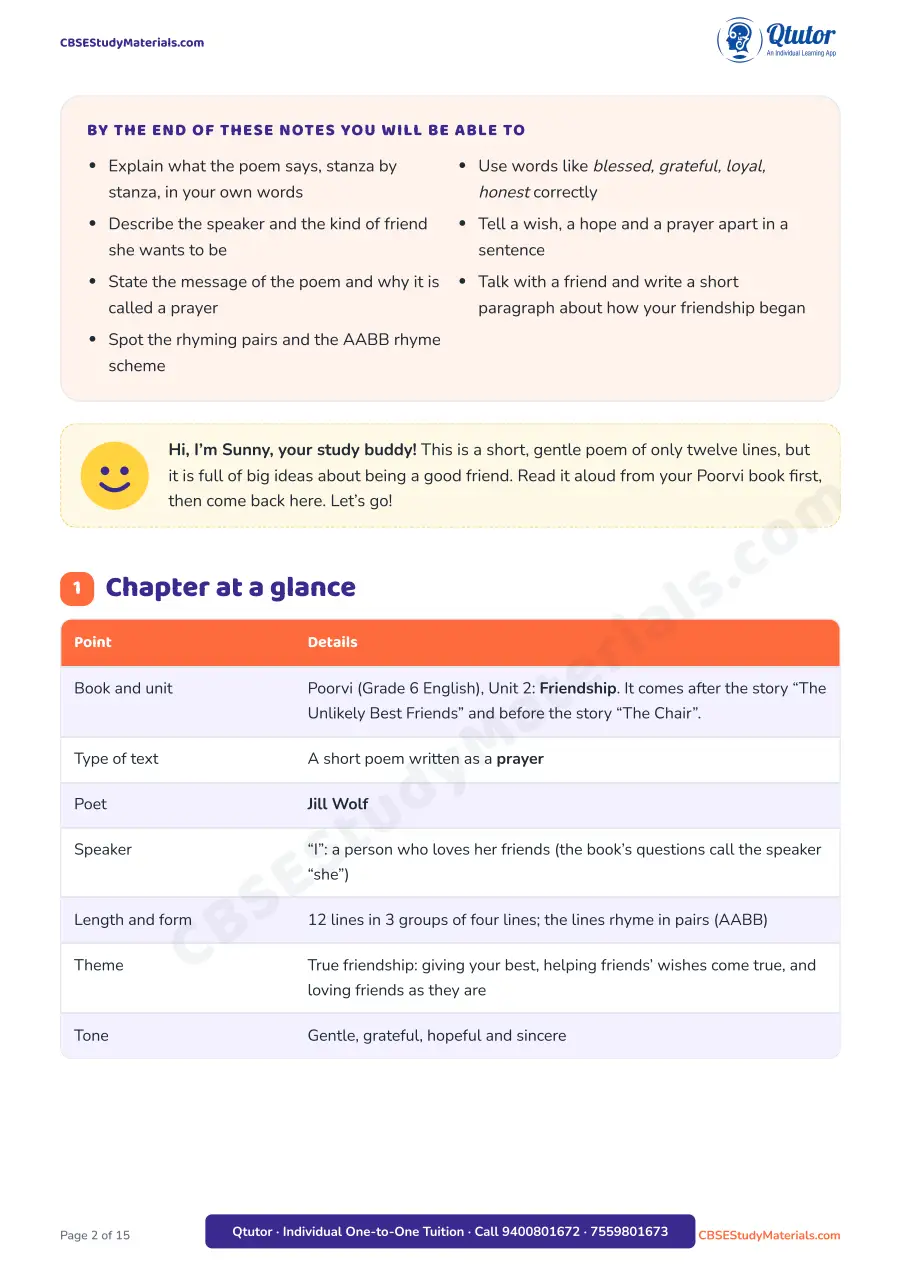
- Chapter at a glance: book, unit, poet, speaker, form, theme and tone in one table.
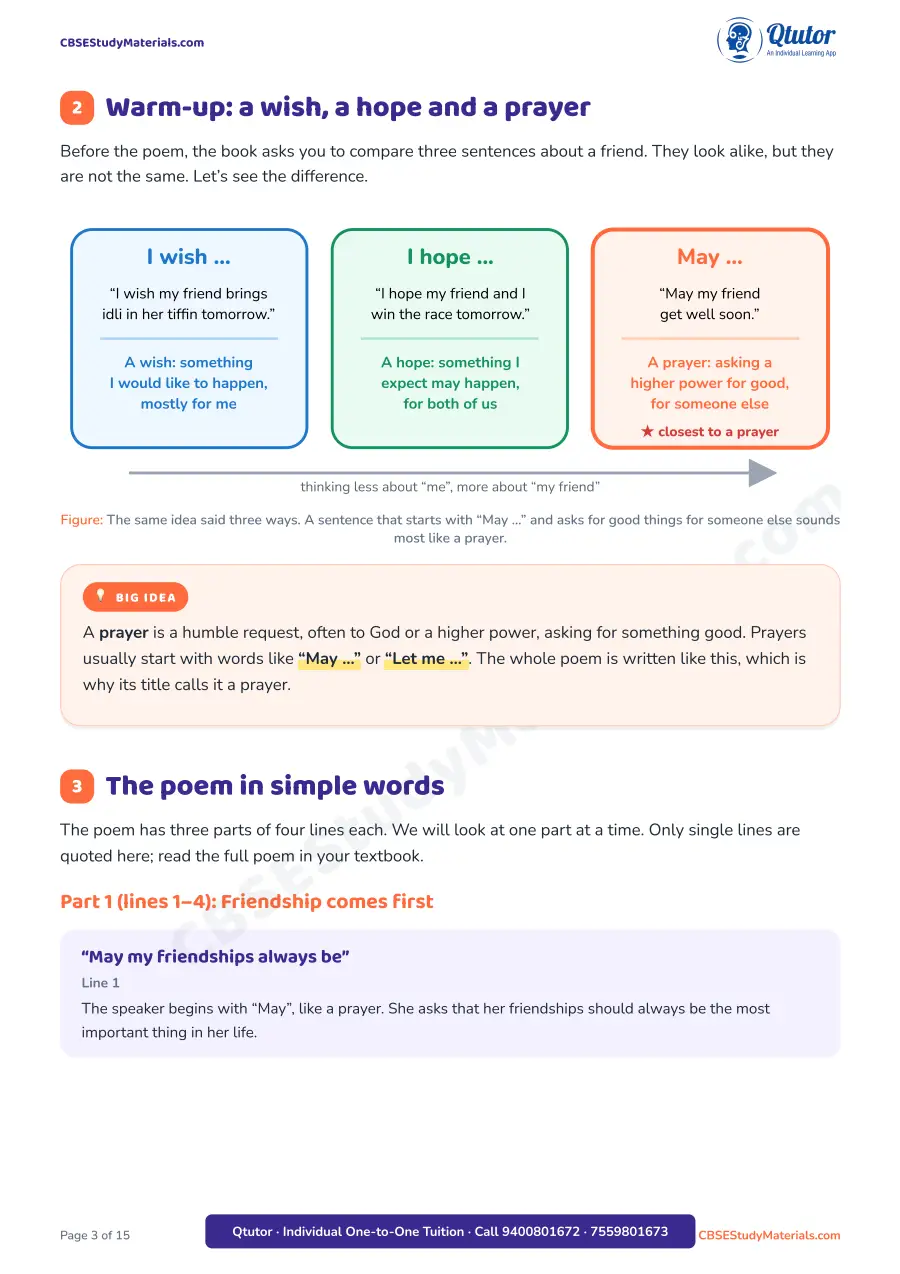
- Warm-up on wish, hope and prayer: a diagram that compares "I wish…", "I hope…" and "May…", the same sentences the book uses before the poem.
- The poem in simple words: each part of four lines explained with one quoted line, a retelling and the feeling behind it.
- A flow diagram showing how the poem grows from valuing friends, to helping them, to accepting them.
- The speaker: character notes with proof from the poem (grateful, generous, caring, thoughtful, accepting, humble).
- The message: a diagram of five qualities of a true friend (loyal, helpful, kind, caring, honest).
- Why the poem is a prayer: four clues in a table.
- Rhyme: a diagram of all six rhyming pairs and the AABB pattern of rhyming couplets.
- Words to know: ten key words and phrases with meanings.
- Language corner: synonyms of blessed, adjective-to-noun table (loyal–loyalty, honest–honesty), a and an, and turning a wish into a prayer.
- Listen, speak and write: what Ajay and Dhiraj do together, two model conversations, a When-Where-How planner and a sample paragraph.
- The two friendship quotations from the book, explained.
- Mind map of the whole chapter on one page.
- Check yourself: 12 practice questions, mostly inference and application, with answers.
- One-page summary for last-minute revision.
Structure of the Notes PDF
| Part | What you get |
|---|---|
| Pages 1-2 | Cover, learning goals, chapter at a glance |
| Pages 3-5 | Wish, hope and prayer; the poem in simple words; the speaker |
| Pages 6-9 | Message, why it is a prayer, rhyme, words to know, language corner |
| Pages 10-12 | Listening, speaking, writing, quotations, mind map |
| Pages 13-14 | Check yourself: 12 questions and answers |
| Page 15 | One-page summary |
A Friend’s Prayer Class 6 Important Topics
- The meaning of each part of the poem: friends come first, help in action, love friends as they are
- Why the poem is a prayer ("May…", "Let me…", feeling blessed)
- The speaker's qualities, with proof from the poem
- The message: value, help and accept friends without judging
- Rhyming couplets and the AABB rhyme scheme
- Words such as blessed, realise, judgement, from afar
- Qualities of a good friend and their noun forms
- Wish, hope and prayer sentences
A Friend’s Prayer Class 6 Notes: Sample from the PDF
The poem in simple words (lines 5-8). It is easy to just listen when caring friends tell us their hopes and plans. The speaker wants to do much more than that. She promises to try everything a friend can do to help make her friends' wishes come true.
Why is it called a prayer?
| Clue | How it makes the poem a prayer |
|---|---|
| Opening word "May" | Prayers often begin with "May…", asking for something good to happen. |
| "Let me…" | The speaker humbly asks for the chance and strength to be a good friend. |
| Wishing good for others | She asks for good for her friends, not for herself. |
Common mistake. "From afar" does not mean a friend who lives far away. It means judging someone from a distance, without knowing them properly.
How These Notes Help
- Clear chapter summary: every part of the poem retold in plain English, so you understand it before the exam.
- Picture-based learning: seven original diagrams, including a mind map, make revision quick.
- Exam-ready points: poet, rhyme scheme, message and the speaker's qualities are listed with proof.
- Language practice linked to the chapter, so grammar and vocabulary are revised along with the poem.
- Important questions with answers in the Check yourself section, mostly "why" and "what if" questions.
Who Should Use This Study Material
- Class 6 students reading the NCERT Poorvi English book under the CBSE 2026-27 syllabus
- Students who want a chapter summary, word meanings, rhyming words and important questions in one place
- Parents and tutors who want a simple, picture-rich explanation of the poem
How to Download the Class 6 A Friend’s Prayer Notes PDF
This is a premium PDF priced at ₹49. Use the download button below to get all 15 pages. It prints well in colour and is easy to read on a phone.
A Friend’s Prayer Class 6 English Chapter 5 Notes PDF (PDF · 15 pages · ₹49)
Related Resources
- Class 6 English Chapter 5 A Friend’s Prayer NCERT Solutions: every textbook question answered in order
- Class 6 English Chapter 5 A Friend’s Prayer Question Bank: 46 practice questions with a full answer key
- A Friend’s Prayer chapter page
- All Class 6 English study material
- Previous chapter: The Unlikely Best Friends
- Next chapter: The Chair
FAQs on Class 6 English Chapter 5 A Friend’s Prayer
Where can I download Class 6 English Chapter 5 A Friend’s Prayer notes PDF? On this page. Use the download button to get the 15-page premium notes PDF for ₹49.
What is the message of A Friend’s Prayer Class 6? True friendship means valuing your friends, helping them in action and loving them just as they are, without judging them.
Who wrote A Friend’s Prayer in the Class 6 Poorvi book? The poem is by Jill Wolf. It is in Unit 2, Friendship, of Poorvi.
What is the rhyme scheme of A Friend’s Prayer? The lines rhyme in pairs (rhyming couplets), so the pattern is AABB: be–me, blessed–best, share–care, do–true, see–be, afar–are.
Why is A Friend’s Prayer called a prayer? It begins with "May", the speaker humbly says "Let me…", and she asks for good things for her friends rather than for herself.
Do these notes include the textbook exercise answers? The notes explain every topic the exercises test. Full answers to every textbook question are in our separate A Friend’s Prayer NCERT Solutions PDF.
Study tip: after reading the notes, say the message of each four-line part in one sentence without looking; if you can, you know the poem.