Power Play - Class 8 Maths Chapter Notes (PDF · 18 pages · ₹49) Unlock the full PDF for ₹49
Free sample: pages 1 to 3 of 18. The full PDF costs ₹49.
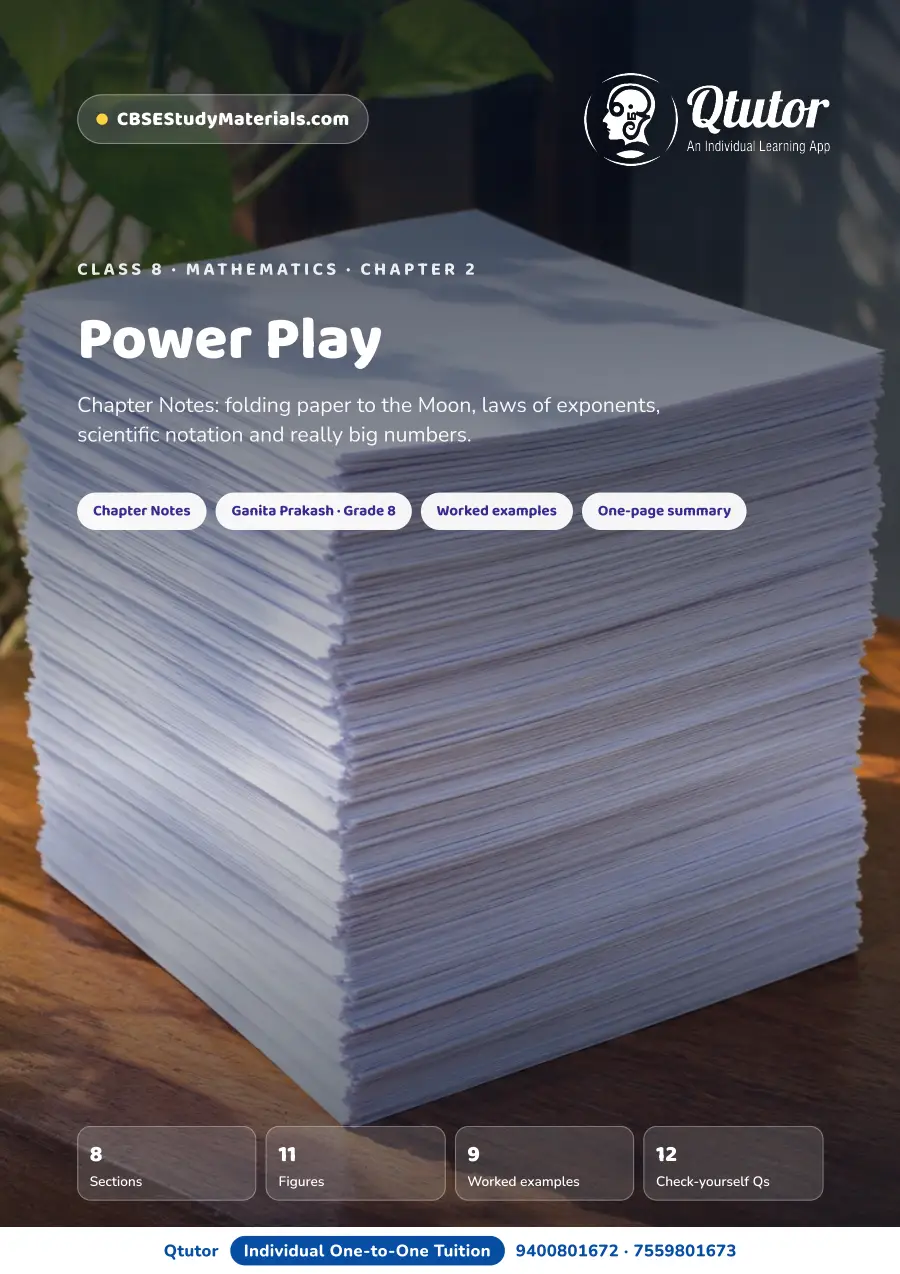
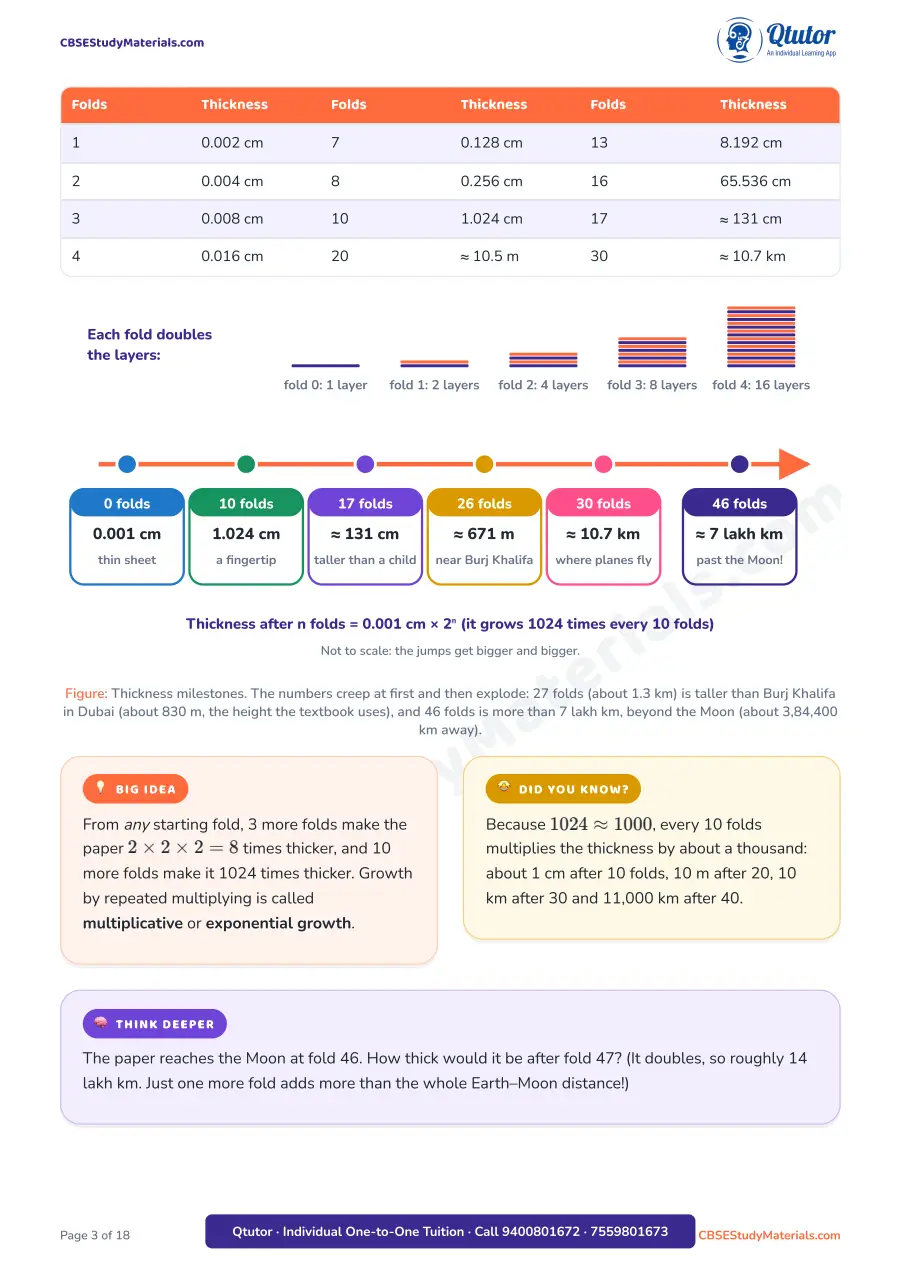
Fold a sheet of paper 0.001 cm thick just 46 times and, on paper at least, the stack would reach past the Moon. That one surprising fact opens these Power Play Class 8 Maths Chapter 2 notes, and every idea after it grows out of the same question: what happens when you keep multiplying instead of adding?
This is an 18-page Chapter Notes PDF for CBSE Class 8 Mathematics, Chapter 2: Power Play, written to follow the NCERT Ganita Prakash (Grade 8) textbook for CBSE 2026-27. It is a premium resource priced at ₹49. It explains exponents, the laws of exponents, zero and negative powers, scientific notation and large-number estimation in simple language, with original diagrams, 9 worked examples and a self-test with answers. It is an independent study resource and is not an official CBSE or NCERT publication.
Class 8 Maths Chapter 2 Power Play Notes: What Is Included
- A photo cover and a list of learning objectives
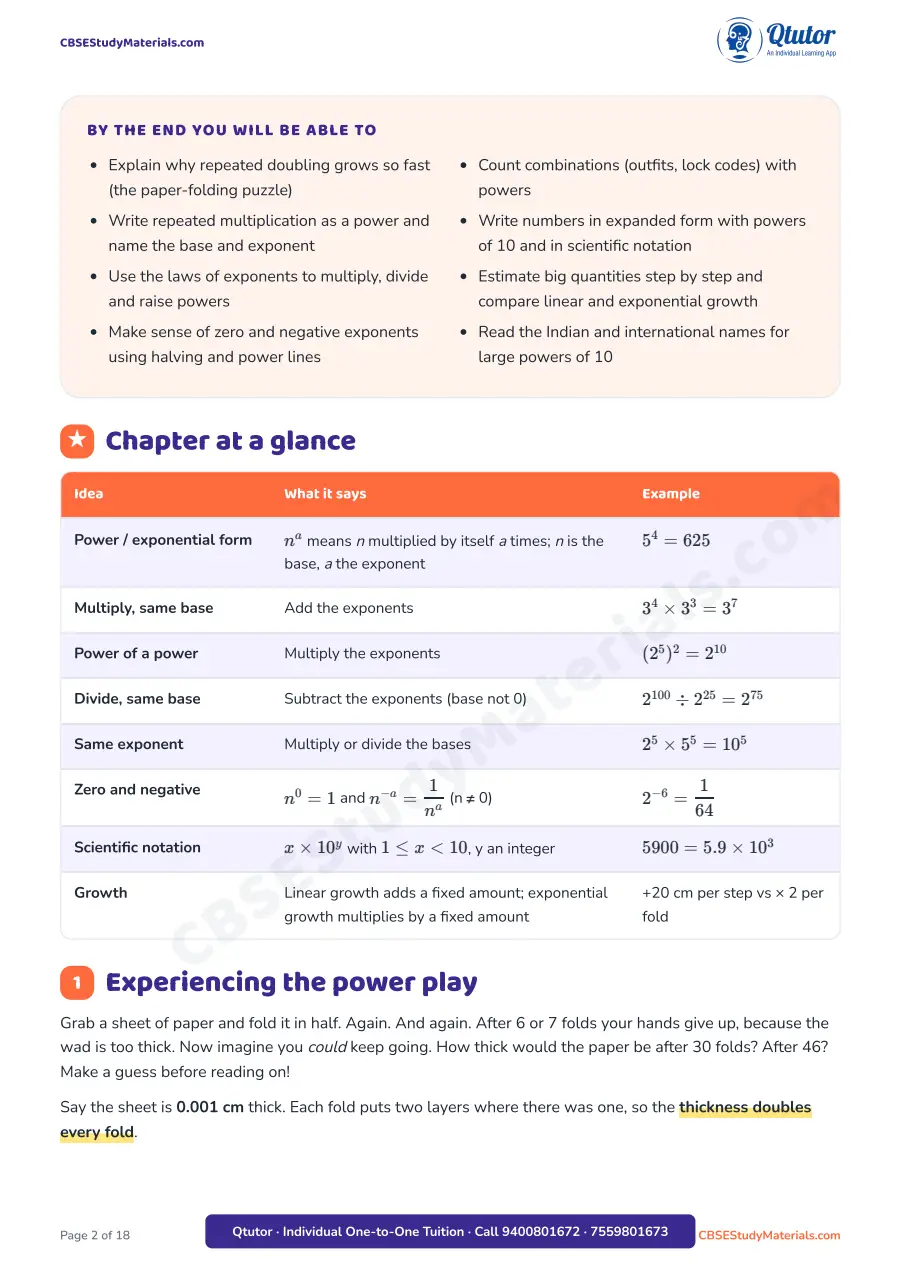
- A "chapter at a glance" table that sums up the whole chapter in eight rows
- 8 numbered sections that follow the order of the NCERT chapter, from the paper-folding puzzle to the history of number names, plus the Tremendous in Ten game
- 9 fully worked examples, each with clear steps and a check
- Definition, concept, "did you know", "common mistake", "think deeper" and real-life cards throughout
- 11 original figures: paper-folding milestones, a powers-of-3 tree for The Stones that Shine, an outfit tree diagram, lock-code slots, a halving line, a power line for 4, the parts of scientific notation, a Sun–Earth–Saturn number line, a linear vs exponential graph, a powers-of-10 population ladder and an Indian vs international naming scale
- Real photos (a tall stack of paper on the cover, plus a wooden-cube staircase and rice on a chessboard to compare linear and exponential growth)
- A key-terms grid and a mind map
- A one-page summary (revision notes on a single page) with every law and rule
- 12 "Check yourself" important questions (MCQ, assertion-reason, case-based, data, error-spotting and HOTS) with a worked answer key
Structure of the Power Play Notes PDF
| Part | What you will find |
|---|---|
| Cover, objectives, chapter at a glance | Goals and an eight-row summary table |
| Sections 1–2 | Paper folding, exponential notation, signs, prime factors in exponential form |
| Sections 3–4 | Laws of exponents (stones that shine, magical pond), counting combinations |
| Section 5 | Dividing powers, zero exponent, negative exponents, power lines |
| Section 6 | Expanded form with powers of 10, scientific notation (standard form) |
| Sections 7–8 | Estimation, linear vs exponential growth, sense of large numbers, time in powers of 10, a pinch of history, Tremendous in Ten game |
| Revision | Key terms, mind map, one-page summary |
| Practice | Check yourself (12 questions) and answer key |
Power Play Class 8 Important Topics
- Exponential notation na: base, exponent, and how to read powers
- Powers of negative numbers: why (−1)5 = −1 but (−1)56 = 1
- Writing numbers such as 7200 as products of prime powers: 25 × 32 × 52
- Laws of exponents: na × nb = na+b, (na)b = nab, na ÷ nb = na−b, ma × na = (mn)a
- Zero exponent n0 = 1 and negative exponents n−a = 1⁄na
- Counting outfits and lock codes with powers (105 five-digit codes, 266 letter codes)
- Expanded form using powers of 10, including decimals
- Scientific notation x × 10y with 1 ≤ x < 10, and why the exponent matters most
- Estimation steps (guess, relate, assume, compute) and linear vs exponential growth
- Lakh, crore, arab, kharab, neel, padma and million, billion, trillion as powers of 10
Power Play Class 8 Important Questions (Sample)
From the notes, Worked example 3: Find 45 × 255 quickly. Since the exponents match, 45 × 255 = (4 × 25)5 = 1005 = 1010.
From the notes, Worked example 6: Which distance is smallest: Sun–Saturn, Saturn–Uranus or Sun–Earth? In standard form they are 1.4335 × 10¹² m, 1.439 × 10¹² m and 1.496 × 10¹¹ m. The Sun–Earth distance has the smallest exponent, so it is the smallest, even though 1.496 looks like the biggest coefficient.
From Check yourself (HOTS): Which is greater, 240 or 1012? Answer: 240 = (210)4 = 10244 and 1012 = 10004, so 240 is greater.
| Linear growth | Exponential growth |
|---|---|
| Adds the same amount each step | Multiplies by the same amount each step |
| Ladder to the Moon: about 1.922 × 10⁹ steps of 20 cm | Paper to the Moon: just 46 folds |
How These Revision Notes Help
The notes are concept-first: each law of exponents is built from a story in the chapter (lotuses in a pond, keys and rooms, halving a line) before the formula appears, so students see why the rule works. Common mistakes, such as thinking 70 = 0 or that 2−3 is negative, are named and corrected. The one-page summary works as a quick chapter summary before tests, and the self-test checks real understanding rather than memory.
Who Should Use It
- Class 8 students studying Ganita Prakash Chapter 2 for the first time
- Students revising exponents and scientific notation before a unit test or half-yearly exam
- Parents and tutors who want NCERT based study material with clear worked examples
How to Download the Class 8 Power Play Notes PDF
Use the download button below. The PDF is a premium ₹49 resource and prints well on A4.
Power Play - Class 8 Maths Chapter Notes (PDF · 18 pages · ₹49)
Related Resources
- Class 8 Maths Chapter 2 Power Play chapter page
- Class 8 Maths Power Play case-based question bank with answers
- All Class 8 Maths study material
- Previous chapter: A Square and a Cube Class 8 notes, worksheet, flash cards and model question paper
- Next chapter: Class 8 Maths Chapter 3 A Story of Numbers
FAQs on Class 8 Maths Chapter 2 Power Play
Where can I download Class 8 Maths Chapter 2 Power Play notes PDF? On this page. Use the download button above to get the 18-page notes PDF.
What are the important topics in Power Play Class 8? Exponential notation, the laws of exponents, zero and negative exponents, powers of 10 and scientific notation, counting combinations, estimation, and linear vs exponential growth.
What is the price of the Power Play Class 8 notes PDF? These chapter notes are a premium resource priced at ₹49. The chapter page also lists other Power Play material.
Which book is Power Play Class 8 from? It is Chapter 2 of the NCERT Class 8 Mathematics textbook Ganita Prakash (Grade 8), used in CBSE schools for 2026-27.
Do the notes include important questions with answers? Yes. There are 12 "Check yourself" questions, including assertion-reason, case-based and HOTS questions, with a worked answer key, plus 9 worked examples.
What is scientific notation in Class 8 Power Play? It is writing a number as x × 10y, where x is at least 1 and less than 10 and y is an integer, for example 5900 = 5.9 × 10³.
Study tip: before using any law of exponents, say aloud whether the bases or the exponents are the same; that one check prevents most mistakes in this chapter.