Lines and Angles Class 6 Maths Ch 2 NCERT Solutions PDF (PDF · 28 pages · ₹49) Unlock the full PDF for ₹49
Free sample: pages 1 to 3 of 28. The full PDF costs ₹49.
How many lines can Sheetal draw through two points? Why can ∠APB not be called just ∠P? And what angle do the 24 spokes of the Ashoka Chakra make with each other? These Lines and Angles Class 6 Maths Chapter 2 NCERT Solutions answer every question of CBSE Class 6 NCERT Ganita Prakash Chapter 2, step by step and with clear diagrams.
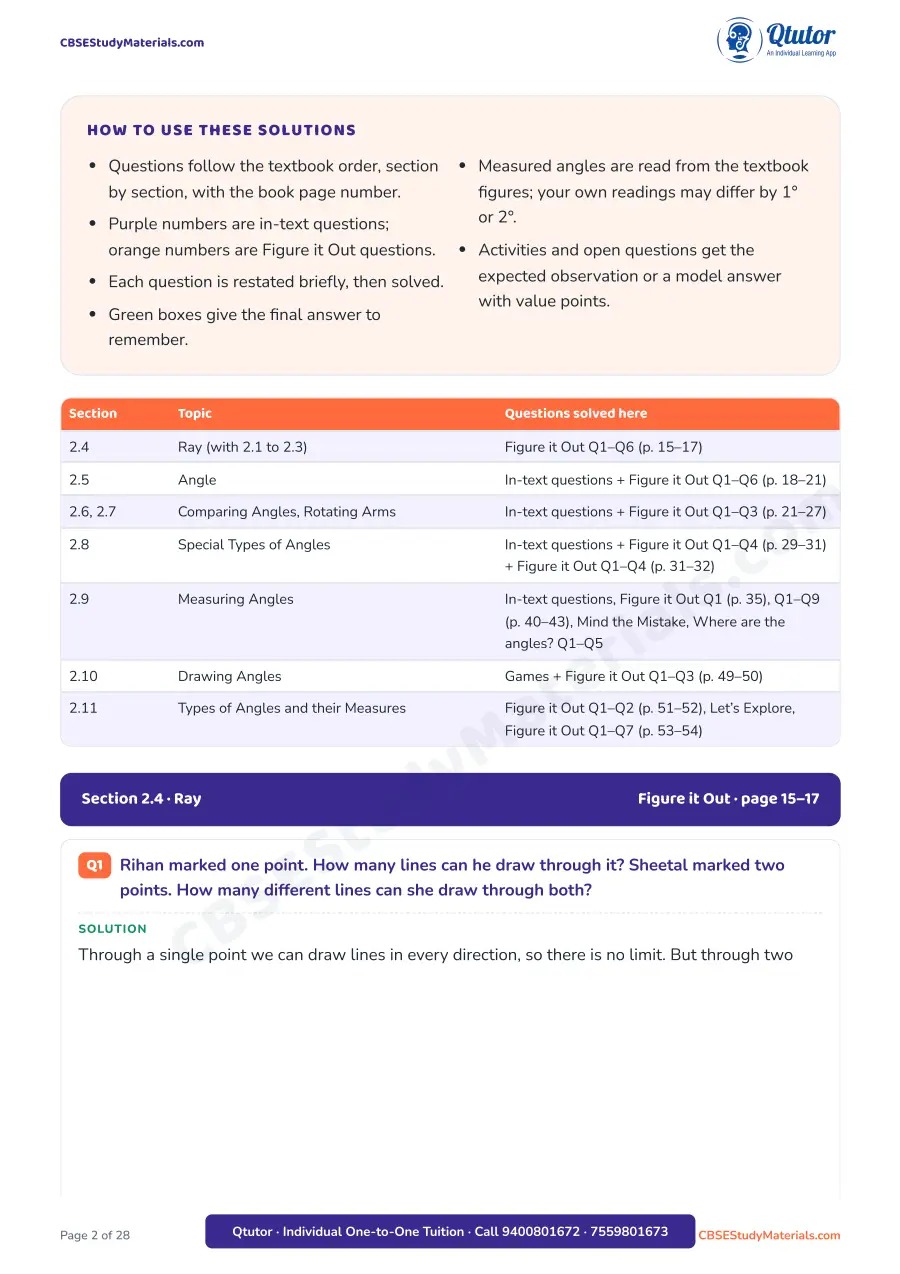
This is a premium 28-page PDF (₹49) built on the 2026-27 NCERT Ganita Prakash (Grade 6) textbook. It is our own study material and not an official CBSE or NCERT publication. The solutions follow the exact order and numbering of the textbook, section by section, with the book page number for each set, so you can use the PDF side by side with your book.
Class 6 Maths Chapter 2 Lines and Angles NCERT Solutions: What Is Included
- Solutions to all 50 Figure it Out questions of the chapter, from Section 2.4 to Section 2.11
- Answers to the in-text questions as well: Vidya’s book cover, comparing angles, the two cranes, folding a straight angle, the labelled protractor, Think!, Let’s Explore and Mind the Mistake
- Expected observations for the activities (rotating arms and the slit, making your own protractor, the paper craft)
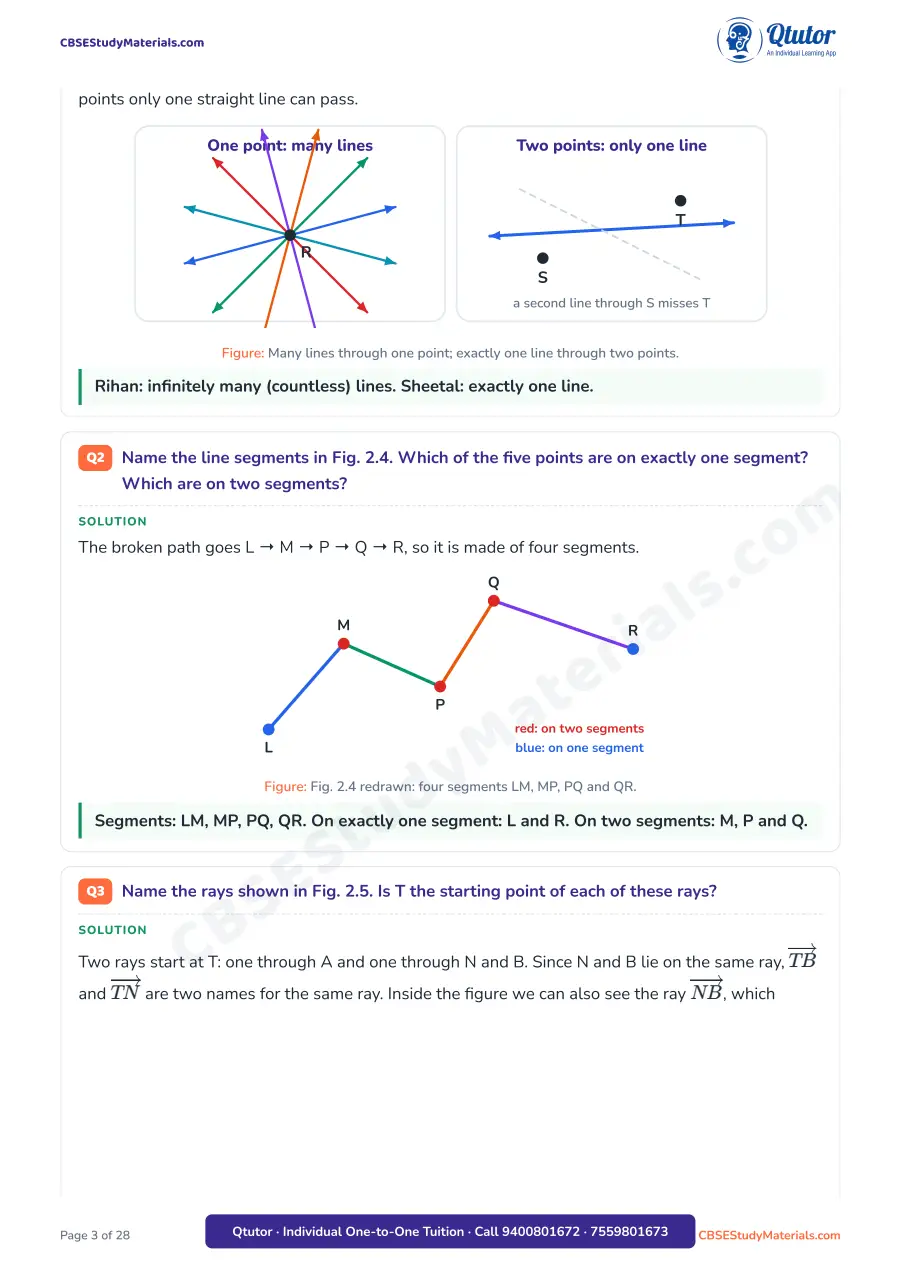
- 24 answer diagrams, including redrawn textbook figures, grid answers, the acute-angle triangle pattern, the letters M and Y and the Ashoka Chakra
- Measured values for every figure-based question, with a note that readings may differ by a degree or two
- Green “final answer” boxes and a Quick Answer Key for fast revision
Structure of the PDF
| Part | What you get |
|---|---|
| Section 2.4 | Lines through points, naming segments and rays, rough figures (Q1 to Q6) |
| Section 2.5 | Angles in daily objects, naming angles, lines and angles from 3 and 4 points |
| Sections 2.6 and 2.7 | Comparing angles, superimposition, the cranes, rotating arms |
| Section 2.8 | Straight and right angles on grids, perpendicular creases, acute and obtuse angles |
| Section 2.9 | Degrees, protractor readings, paper protractor, Mind the Mistake, clock and real-life angles |
| Sections 2.10 and 2.11 | Drawing angles, classifying acute, obtuse and reflex angles, puzzles |
| Answer key | One-line answers for revision |
Lines and Angles Class 6 Important Topics Covered
- Point, line segment, line and ray, and how to name each
- Angle, vertex and arms; naming an angle with three letters
- Comparing angles by superimposition and with a transparent circle
- Straight angle, right angle and perpendicular lines by paper folding
- Degree measure, the two scales of a protractor and the subtraction method
- Angle bisectors and the folded paper protractor (22.5° steps)
- Acute, right, obtuse, straight and reflex angles; clock angles
Lines and Angles Class 6 Important Questions (Sample)
Four points, no three on a line (Section 2.5 Q6). Each point joins the other three, so there are 4 × 3 ÷ 2 = 6 lines: AB, AC, AD, BC, BD, CD. Three lines meet at each point, giving 3 angles there and 4 × 3 = 12 angles in all.
Ashoka Chakra (Section 2.11 Q6). The 24 spokes share 360°, so neighbouring spokes make 360° ÷ 24 = 15°. The largest acute angle between two spokes is 5 × 15° = 75°.
Angle puzzle (Q7). Four times the angle is acute, so it is less than 22.5°; five times is obtuse, so it is more than 18°. In whole degrees: 19°, 20°, 21° or 22°.
| Clock time | 2 o’clock | 4 o’clock | 6 o’clock |
|---|---|---|---|
| Angle between hands | 60° | 120° | 180° |
How These NCERT Solutions Help
Many questions in this chapter depend on a figure: reading a protractor, comparing two angles, or counting angles on a dot grid. The solutions redraw the important figures and mark the answer on them, so you can see why it is right. For open questions, such as the swing, the door or the folded paper, you get a model answer that names the vertex and the arms clearly. The Mind the Mistake table lists what went wrong in each protractor picture and how to correct it, which is exactly the skill tested in class tests.
Who Should Use These Solutions
- Class 6 CBSE students checking their Ganita Prakash homework
- Students who missed a class and need each step explained
- Parents and tutors who want reliable answers to every textbook question
- Anyone revising Chapter 2 before a unit test or a half-yearly exam
Lines and Angles Class 6 Maths Ch 2 NCERT Solutions PDF (PDF · 28 pages · ₹49)
Related Resources for Class 6 Maths Chapter 2
- Class 6 Maths Chapter 2 Lines and Angles notes: concepts, diagrams, mind map and one-page summary
- Class 6 Maths Chapter 2 Lines and Angles question bank: 51 important questions with answers
- Lines and Angles chapter page
- All Class 6 Mathematics study material
- Previous chapter: Patterns in Mathematics
- Next chapter: Number Play
FAQs on Class 6 Maths Chapter 2 Lines and Angles NCERT Solutions
Where can I download Class 6 Maths Chapter 2 Lines and Angles NCERT solutions PDF? On this page. Use the download button to get the 28-page premium PDF for ₹49.
Do these solutions cover every question in the chapter? Yes. All 50 Figure it Out questions and the in-text questions, activities, Think!, Let’s Explore and Mind the Mistake are answered in textbook order.
Which book are these solutions for? NCERT Ganita Prakash, the Mathematics textbook for Grade 6 used in CBSE schools for 2026-27, Chapter 2 Lines and Angles.
What is the angle between the hands of a clock at 4 o’clock? The hands are 4 gaps apart and each gap is 30°, so the angle is 4 × 30° = 120°.
Why do my protractor readings differ slightly from the solutions? Printed figures and hand measurements vary a little. A difference of 1° or 2° is normal; the method shown is what matters.
Is there a question bank for extra practice? Yes. Our Lines and Angles question bank has 51 more questions with worked answers.
Study tip: when you read a protractor, put your finger on the 0 where the first arm lies and count up from there on that same scale.