Understanding the Weather - Class 7 Social Science Chapter 2 Notes (PDF · 19 pages · ₹49) Unlock the full PDF for ₹49
Free sample: pages 1 to 3 of 19. The full PDF costs ₹49.
If the news says your city got 30 mm of rain today, what does that really mean? And why do soldiers at Khardung La feel breathless even when resting? This premium Understanding the Weather Class 7 notes PDF covers CBSE Class 7 Social Science Chapter 2 from the NCERT book Exploring Society: India and Beyond (Grade 7, Part 1) as clear chapter notes, with diagrams, an India map, a mind map and important questions.
It is a 19-page premium PDF (₹49) of revision notes for CBSE 2026-27, NCERT based and written only from the current chapter. It is independent study material and is not an official CBSE or NCERT publication.
Class 7 Social Science Chapter 2 Understanding the Weather Notes: What Is Included
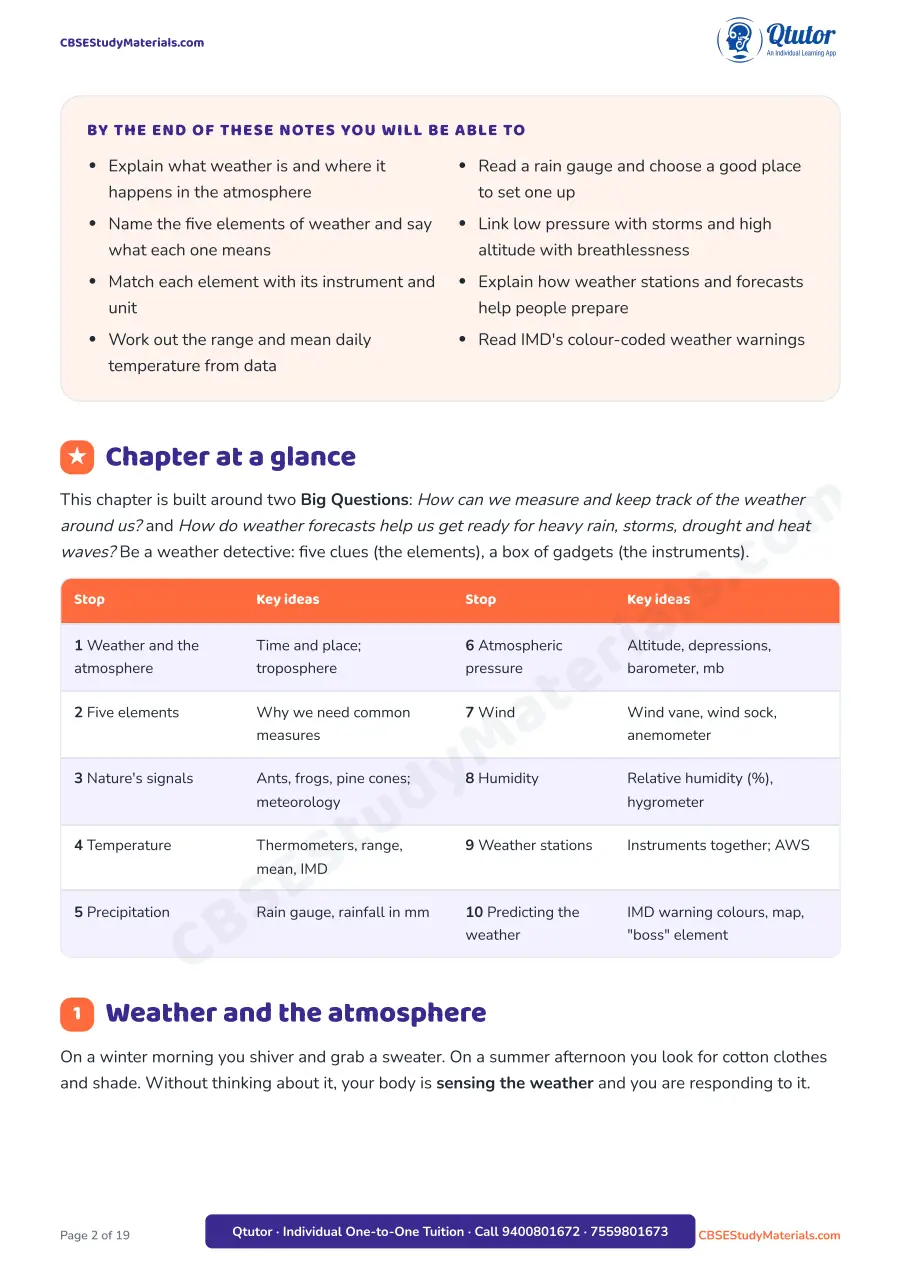
- A colourful cover, learning objectives and a "chapter at a glance" table covering all 10 sections
- Concept-first notes on weather, the atmosphere and the five elements of weather
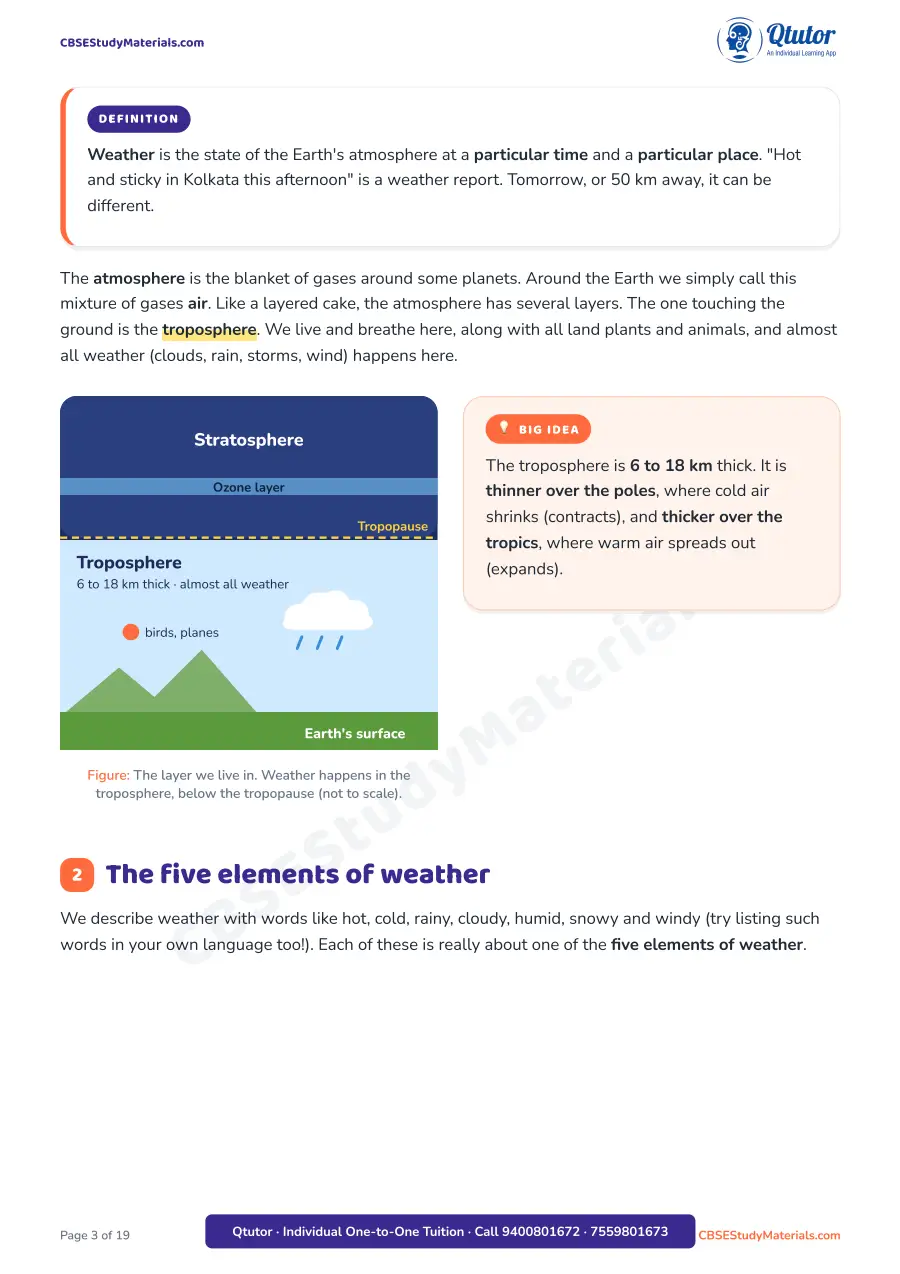
- Original labelled diagrams: the layers of the atmosphere, the five elements, a pine cone in humid and dry air, a temperature bar chart, a rain gauge, air pressure on a mountain, a wind vane and an anemometer, a relative humidity scale and IMD's four warning colours
- An outline map of India marking nine places from the chapter (Srinagar, Khardung La, Delhi, Jaipur, Mumbai, Mangaluru, Kochi, Chennai and Sikkim) with a legend that links each place to a weather fact
- 3 photos: dark monsoon clouds over green paddy fields, a small weather station with a rain gauge and wind vane, and an outdoor thermometer in bright sunshine
- Definition, "Big idea", "Did you know?", real-life, "Think deeper", "Make your own" and common-mistake cards
- A worked temperature table with the daily range and mean for a full week
- A key-terms grid with 15 terms, a mind map and a one-page summary for last-minute revision
- 12 "Check yourself" important questions with a value-point answer key
Structure of the PDF
| Part | What you get |
|---|---|
| Opening | Objectives, chapter at a glance |
| Sections 1 to 3 | Weather and the atmosphere, the five elements, reading Nature's signals |
| Sections 4 to 8 | Temperature, precipitation, atmospheric pressure, wind, humidity |
| Sections 9 and 10 | Weather stations and AWS, predicting the weather, IMD warnings, India map |
| Revision | Mind map, key terms |
| Practice | 12 questions (MCQ, assertion-reason, data, map, case-based, HOTS) with answers |
| Last page | One-page summary and a quick self-check list |
Understanding the Weather Class 7 Important Topics
- Weather as the state of the atmosphere at a particular time and place; the troposphere (6 to 18 km thick)
- The five elements: temperature, precipitation, atmospheric pressure, wind and humidity
- Why we need common units, through the story of Krishnan in Chennai and Amir in Kashmir
- Traditional weather signs (ants, frogs, birds, squirrels, pine cones) and meteorology
- Thermometers, °C and °F, range of temperature and mean daily temperature; the IMD (set up in 1875)
- The rain gauge, rainfall in millimetres and how to choose a good site
- Atmospheric pressure, altitude and breathlessness; the barometer, millibars, 1013 mb and depressions
- Wind from high to low pressure; the wind vane, wind sock and anemometer
- Humidity and relative humidity; the hygrometer
- Weather stations, Automated Weather Stations and the AWS at a glacial lake in Sikkim
- Forecasts, IMD's colour-coded warnings and the "dominant" element at different times of year
Sample from This PDF
Which element is the "boss" today?
| July | May and December | A cyclone is moving | The loo blows / forest fires spread |
|---|---|---|---|
| Rainfall | Temperature | Air pressure | Wind |
Worked example: on 03.03.2025 a city in Madhya Pradesh had a maximum of 32°C and a minimum of 18°C. Range = 32 − 18 = 14°C, and mean daily temperature = (32 + 18) ÷ 2 = 25°C.
Common mistake: "The plains always have high pressure." Pressure is usually higher at low places, but a sudden drop there is exactly what a depression is, and it may grow into a storm or cyclone.
Understanding the Weather Class 7 Important Questions (Sample)
The "Check yourself" section has 12 questions, mostly about applying ideas rather than memorising them:
- A barometer in a coastal town falls from 1012 mb to 994 mb. What should fishermen do?
- Assertion-reason: do wet clothes dry faster when the relative humidity is 85%?
- A map question: at which marked place would a barometer read lowest, and why?
- A case on an orange IMD alert for a fishing village on the Odisha coast
- A HOTS task: plan a school weather station and use its data to choose a sports day
Every answer comes with short value points and marks, so you can check your own work.
How It Helps
- Understand, not memorise: each instrument is explained with how it works and who uses it, from pilots and fishermen to farmers and museums.
- See it: diagrams and the India map make the ideas easy to picture.
- Practise numbers: range, mean temperature and weekly rainfall averages are worked out step by step.
- Revise fast: the key terms, mind map and one-page summary fit the chapter into a few minutes of reading.
Who Should Use It
- Class 7 students studying Exploring Society: India and Beyond in the 2026-27 session
- Students who want chapter notes and a chapter summary before a class test or school exam
- Parents and tutors looking for a ready, NCERT based revision sheet for this chapter
How to Download the Class 7 Understanding the Weather Notes PDF
Use the download button below to get the premium PDF for ₹49. It opens on phones, tablets and computers and prints well on A4 paper.
Understanding the Weather - Class 7 Social Science Chapter 2 Notes (PDF · 19 pages · ₹49)
Related Resources
- Understanding the Weather: chapter page
- Class 7 Social Science NCERT Solutions, Chapter 2 Understanding the Weather
- Class 7 Social Science Question Bank, Chapter 2 Understanding the Weather
- Previous chapter: Geographical Diversity of India
- Next chapter: Climates of India
- All Class 7 Social Science study material
FAQs on Class 7 Social Science Chapter 2 Understanding the Weather
Where can I download Class 7 Social Science Chapter 2 Understanding the Weather notes PDF? On this page. Use the download button above to get the 19-page premium notes PDF for ₹49.
What are the important topics in Understanding the Weather Class 7? The five elements of weather, the instruments that measure them (thermometer, rain gauge, barometer, wind vane, anemometer, hygrometer), range and mean temperature, weather stations and IMD weather warnings.
Which book is Understanding the Weather Class 7 from? It is Chapter 2 of the NCERT Social Science textbook Exploring Society: India and Beyond, Grade 7, Part 1, in the theme "India and the World: Land and the People".
What is the price of the Understanding the Weather Class 7 notes PDF? It is a premium PDF priced at ₹49, with diagrams, an India map, a mind map, a one-page summary and 12 questions with answers.
Does the PDF include important questions with answers? Yes. It has 12 "Check yourself" questions (MCQ, assertion-reason, data, map, case-based and HOTS) and an answer key with value points and marks.
Are these notes useful for CBSE 2026-27? Yes. They follow the current 2026-27 reprint of the NCERT chapter and cover only topics in that chapter.
Tip: keep a weather diary for one week, noting the temperature, rain and wind each day, and the chapter will make sense on its own.