Number Play - Class 6 Maths Chapter 3 NCERT Solutions (PDF · 31 pages · ₹49) Unlock the full PDF for ₹49
Free sample: pages 1 to 3 of 31. The full PDF costs ₹49.
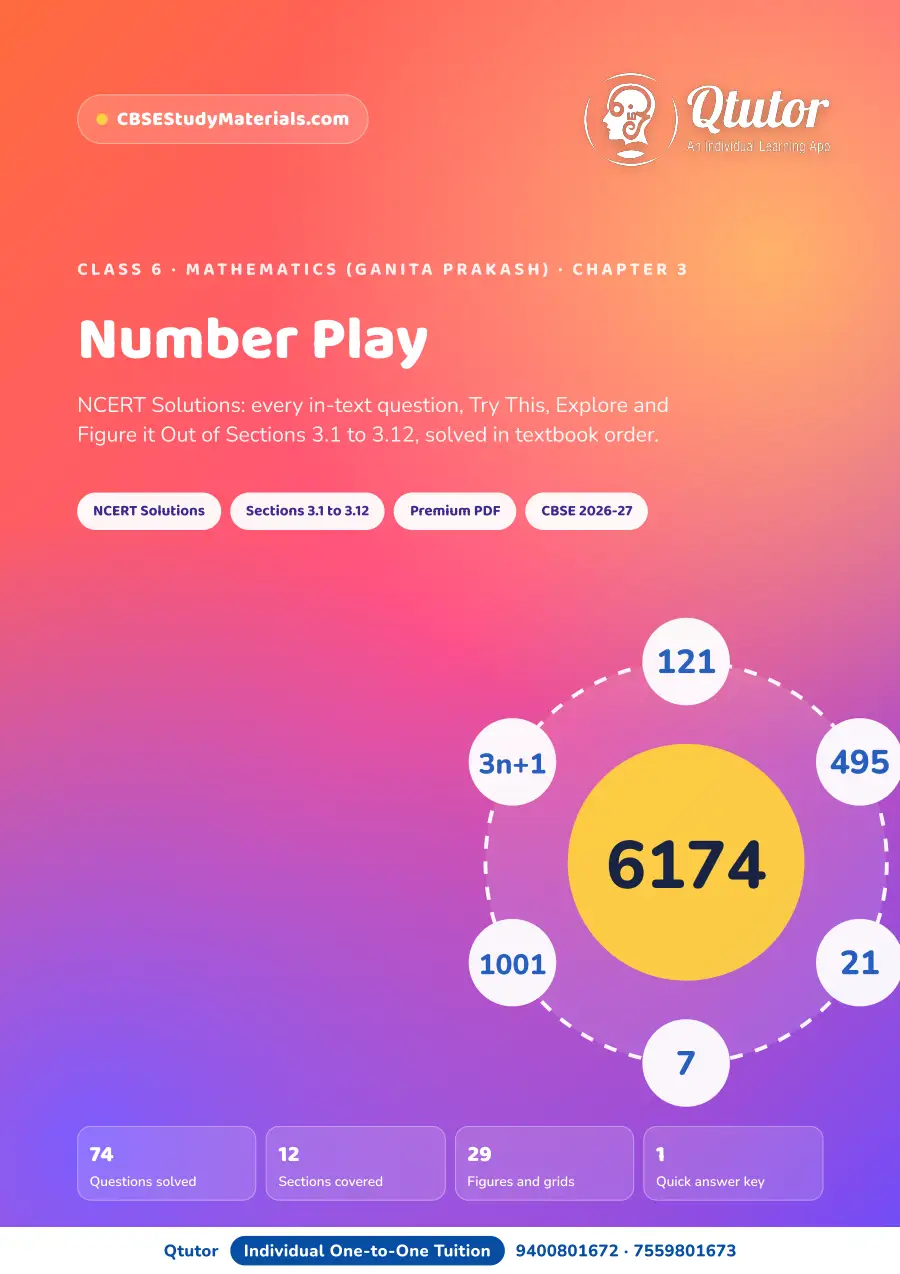
Can five children of different heights stand so that four of them say “1”? Which two digits do you swap to turn one supercell into four? How many rounds does 5683 need to reach 6174? These Number Play Class 6 Maths Chapter 3 NCERT solutions work out every such question from the textbook, step by step.
This is a premium 31-page PDF (₹49) of NCERT solutions for CBSE Class 6 Mathematics, Chapter 3, Number Play, from the Ganita Prakash textbook for the 2026-27 session. It answers every in-text question (Math Talk, Try This, Explore, Puzzle time) and every Figure it Out question, in the same order and numbering as the book. It is our own NCERT-based study material, not an official CBSE or NCERT publication, and every answer was recomputed before publishing.
Class 6 Maths Chapter 3 Number Play NCERT Solutions: What Is Included
- Solutions to all questions of Sections 3.1 to 3.12, plus the opening Math Talk question
- Each question restated briefly, then solved with clear steps and a green final-answer box
- Model answers with value points for open questions and estimation questions
- 29 figures and grids: children’s height pictures, supercell rows, the completed Table 2, number lines (a) to (d), digit-sum chart, reverse-and-add chains, Kaprekar rounds, clocks, the mental-maths web, Collatz graphs and game tracks
- A quick answer key at the end for fast revision
Structure of the Solutions PDF
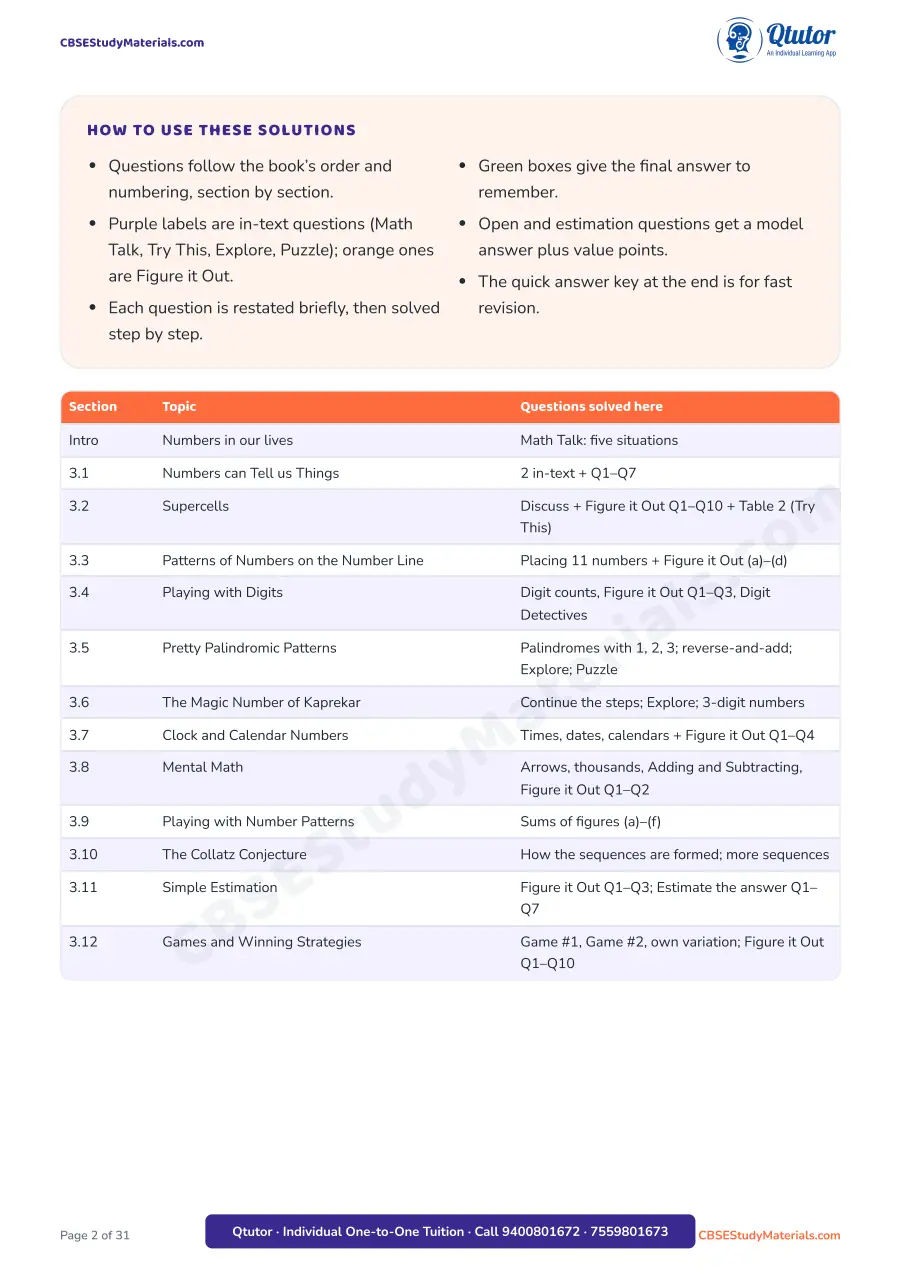
| Section | Questions solved |
|---|---|
| 3.1 Numbers can Tell us Things | In-text question and Q1–Q7 |
| 3.2 Supercells | Figure it Out Q1–Q10 and Table 2 |
| 3.3 Number Line | Placing 11 numbers and lines (a)–(d) |
| 3.4 Playing with Digits | Digit counts, Q1–Q3, Digit Detectives |
| 3.5 Palindromes | Palindromes with 1, 2, 3; reverse-and-add; Puzzle |
| 3.6 Kaprekar | 6174 and 495 |
| 3.7 Clock and Calendar | Times, dates, calendars, Q1–Q4 |
| 3.8 Mental Math | Thousands, Adding and Subtracting, Q1–Q2 |
| 3.9 to 3.12 | Pattern sums, Collatz, estimation, games and the final Figure it Out Q1–Q10 |
Number Play Class 6 Important Topics Covered
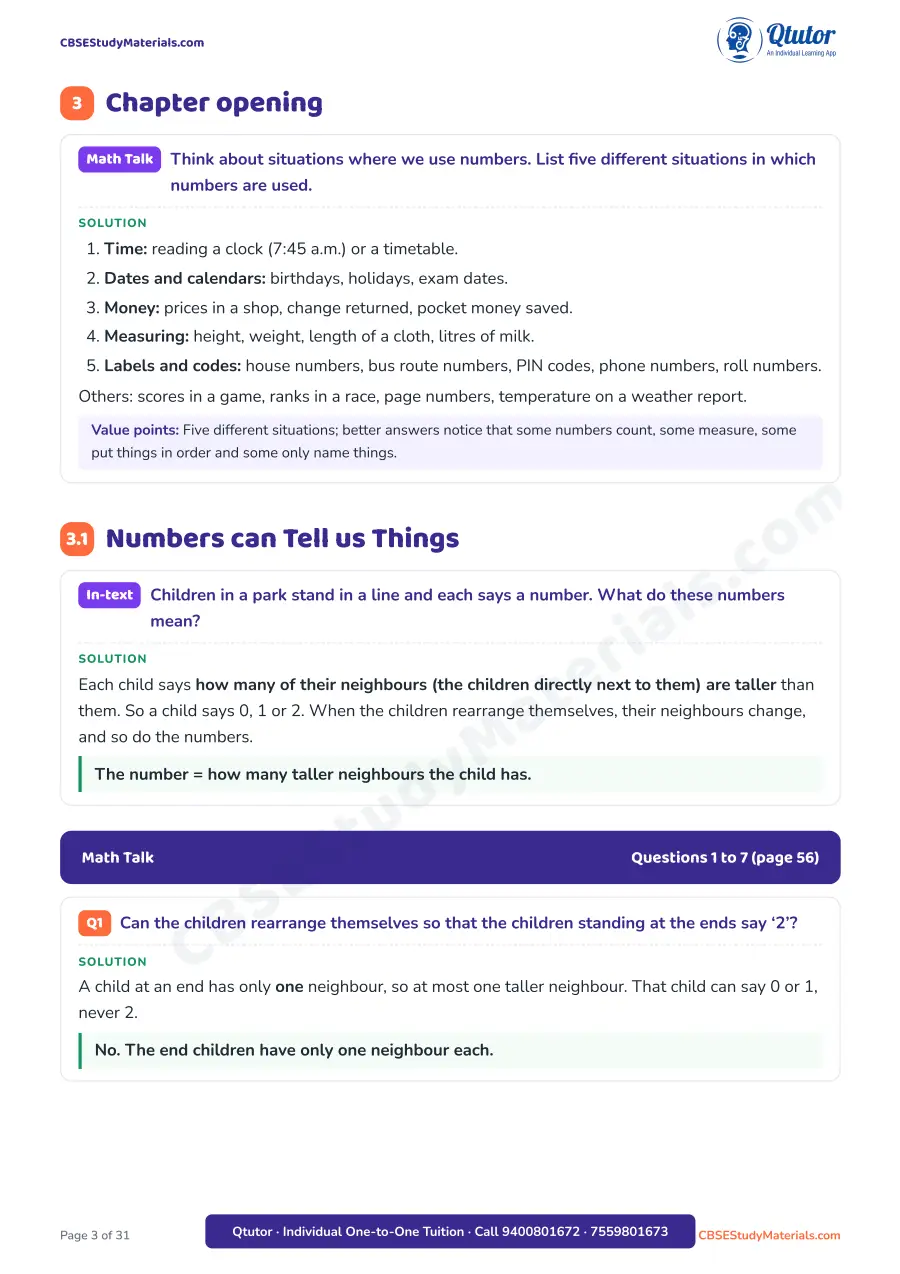
- Why the end children can never say 2 and why the tallest child always says 0
- Maximum supercells in a row and why the smallest number can never be a supercell
- Reading number lines with gaps of 1, 5 and 1000
- Digit sum 14: smallest number 59 and largest 5-digit number 95,000
- All 57 palindromic times and the palindromic dates since 2000
- Which sums and differences of 4- and 5-digit numbers are impossible, and why
- Winning strategies for the games of 21, 99 and 22
Number Play Class 6 Question Answers (Sample)
Always, Sometimes or Never? “4-digit number + 2-digit number gives a 6-digit number.” Never: the biggest possible sum is 9999 + 99 = 10098, which has only 5 digits.
Section 3.9 sums at a glance:
| Figure | Quick method | Sum |
|---|---|---|
| (a) | 12 × 40 + 10 × 50 | 980 |
| (c) | 32 × 32 + 16 × 64 | 2048 |
| (f) | 1000 + 4 × 500 + 8 × 250 + 18 × 125 | 7250 |
Figure it Out (3.12) Q1: swap the digits 6 and 1 in 62,871 to get 12,876; then 39,344, 23,609, 45,306 and 50,319 all become supercells.
How These NCERT Solutions Help
- Textbook order: easy to follow while doing homework from the book.
- Reasons, not just answers: each solution says why, which is what CBSE’s competency questions test.
- Open questions handled well: estimation and “make your own” questions get model answers and value points.
- Checked numbers: every calculation was recomputed, and where the book’s wording allows two methods (for example a leading 0 in Kaprekar’s routine) both are shown.
Tips for Solving Number Play Questions
- Test small cases first. For supercells or the height game, try 3, 4 or 5 cells before the full table.
- Look for the impossible. Many questions ask whether something can happen; find the smallest and largest possible answers and compare.
- Write every Kaprekar round. Show the largest number, the smallest number and the difference each time, and keep the zeros.
- Work backwards in games. Start from the target and subtract (largest step + 1) again and again to get the safe numbers.
- Show your method in estimation. Examiners look for a sensible starting count and a clear multiplication, not one exact number.
Who Should Use It
Class 6 students checking their Ganita Prakash homework, parents helping at home, and teachers preparing class discussions on Number Play. It is also good revision before a unit test.
How to Download the Class 6 Number Play NCERT Solutions PDF
These NCERT solutions are a premium PDF priced at ₹49. Use the download button below; the PDF prints well on A4.
Number Play - Class 6 Maths Chapter 3 NCERT Solutions (PDF · 31 pages · ₹49)
Related Resources
- Class 6 Maths Chapter 3 Number Play notes: revision notes, mind map and one-page chapter summary
- Class 6 Maths Chapter 3 Number Play question bank: important questions with answers
- Number Play chapter page
- All Class 6 Mathematics study material
- Previous chapter: Lines and Angles
- Next chapter: Data Handling and Presentation
FAQs on Class 6 Maths Chapter 3 Number Play NCERT Solutions
Where can I download Class 6 Maths Chapter 3 Number Play NCERT solutions PDF? On this page. Use the download button to get the 31-page premium solutions PDF for ₹49.
Do the solutions cover every question in the chapter? Yes. All in-text questions and all Figure it Out questions from Sections 3.1 to 3.12 are solved in textbook order.
Which book is Number Play Class 6 from? It is Chapter 3 of Ganita Prakash, the NCERT Mathematics textbook for Grade 6, CBSE 2026-27.
How are estimation questions answered? With a model method and sample numbers, plus value points, because the exact answer depends on your school and home.
How many rounds does 5683 take to reach the Kaprekar constant? 7 rounds when the smallest arrangement may start with 0, or 8 rounds if the smallest number must not start with 0. Both end at 6174.
Is there a quick answer key? Yes, the last page lists the key answers of every section for fast revision.
Study tip: try each question on your own first, then compare your reasoning with the solution, not just the final answer.