Prime Time - Class 6 Maths Chapter 5 Notes (PDF · 14 pages · ₹49) Unlock the full PDF for ₹49
Free sample: pages 1 to 3 of 14. The full PDF costs ₹49.
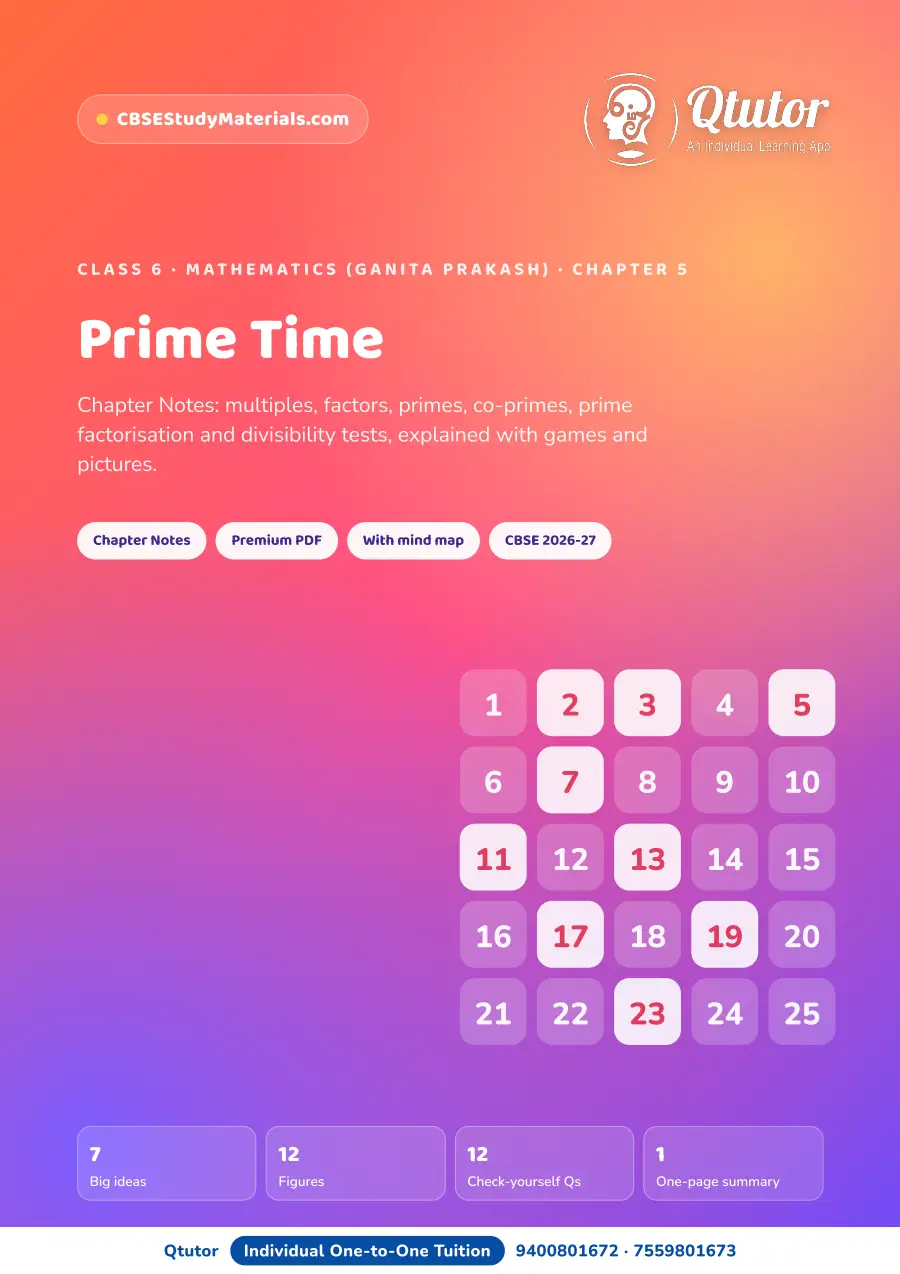
Why do children shout ‘idli-vada’ at 15, 30 and 45, and why can a jump of 7 never reach both 14 and 36? These Prime Time Class 6 Maths Chapter 5 Notes explain CBSE Class 6 NCERT Ganita Prakash Chapter 5 with the same games the textbook uses: the idli-vada game, Jump Jackpot, thread art and the prime puzzle. This is a premium 14-page PDF (₹49) of revision notes built on the 2026-27 NCERT Ganita Prakash (Grade 6) book. It is our own study material and not an official CBSE or NCERT publication.
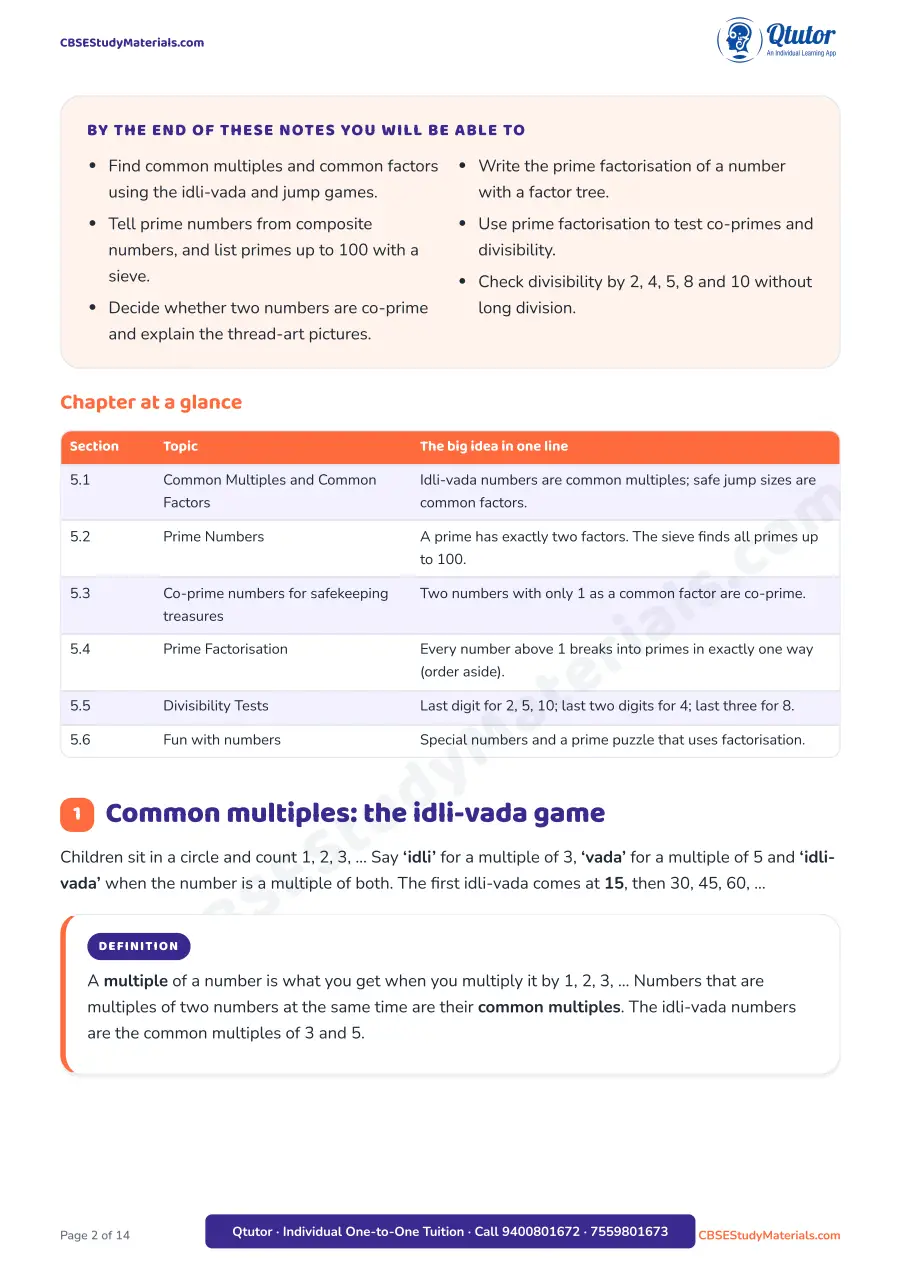
The notes move in the order of the chapter, from common multiples and common factors, through prime and composite numbers and co-prime pairs, to prime factorisation and divisibility tests. Every idea comes with a picture, a worked example and a common mistake to avoid, and the chapter ends with a one-page summary for quick revision before a test.
Class 6 Maths Chapter 5 Prime Time Notes: What Is Included
- Seven numbered topics covering Sections 5.1 to 5.6 of the NCERT chapter
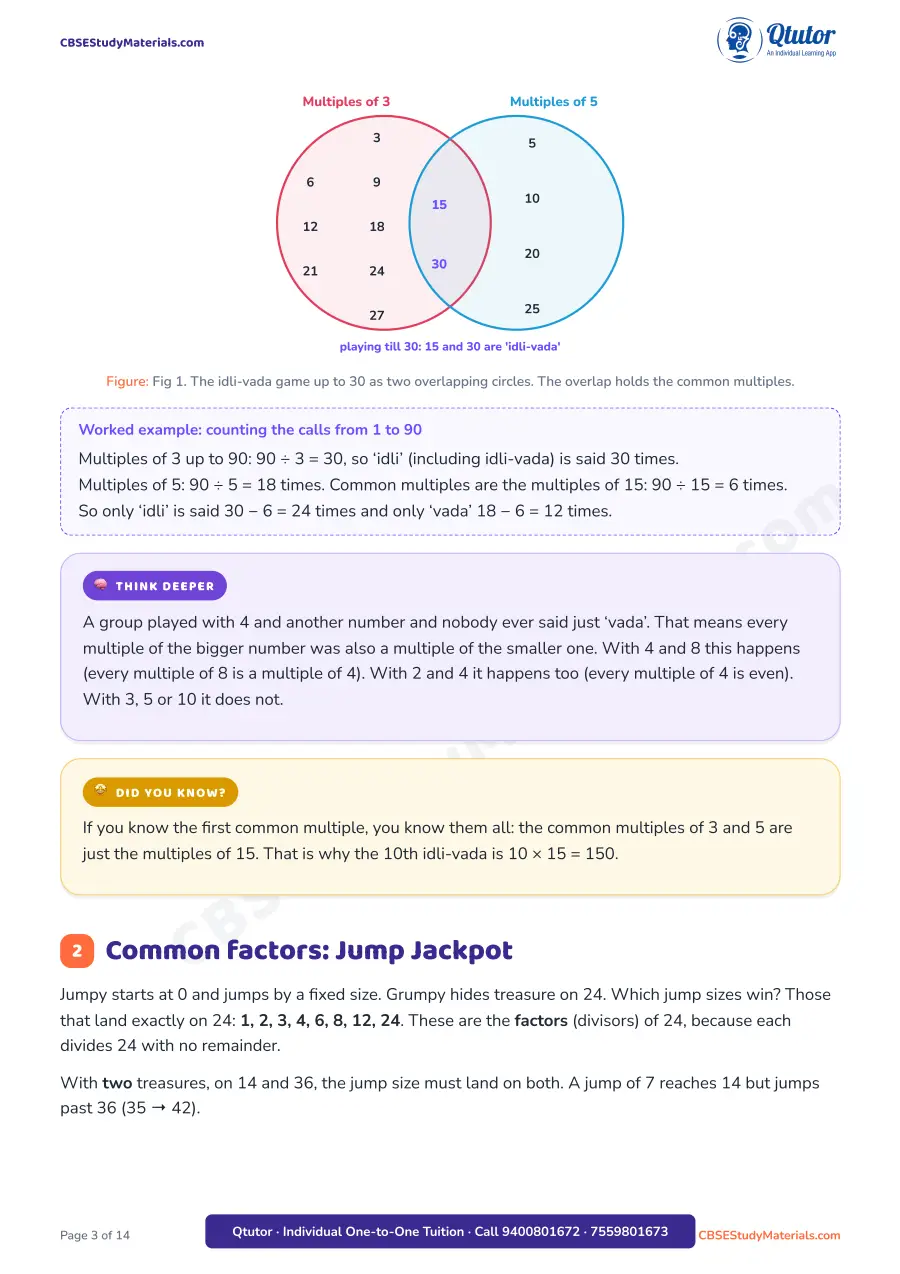
- 12 original figures: idli-vada Venn diagram, Jump Jackpot number line, fig arrangements for 12 and 7, a Sieve of Eratosthenes grid up to 100, factor trees for 56 and 36, thread-art circles, a 2 × 3 × 5 block of cubes, a prime puzzle with its solution and a mind map
- Definition, concept, “Did you know?”, “Think deeper” and “Common mistake” cards
- Worked examples such as counting idli-vada calls from 1 to 90 and finding the smallest multiple of 1 to 10 (2520)
- A facts table on primes up to 100: twin primes, gaps, primes in each ten
- A divisibility table for 10, 5, 2, 4 and 8 that says why each rule works
- A key-terms grid with 12 terms and meanings
- 12 “Check yourself” questions with a compact answer key
- A one-page chapter summary at the end
Structure of the PDF
| Part | What you get |
|---|---|
| Cover, objectives, chapter at a glance | What you will learn and a one-line idea for each section |
| Topics 1–2 | Common multiples (idli-vada) and common factors (Jump Jackpot), perfect numbers |
| Topic 3 | Prime and composite numbers, why 1 is neither, Sieve of Eratosthenes |
| Topic 4 | Co-prime numbers, safe treasure pairs, co-prime thread art |
| Topic 5 | Prime factorisation, factor trees, testing co-primes and divisibility |
| Topics 6–7 | Divisibility tests for 2, 4, 5, 8, 10, leap years, special numbers, prime puzzle |
| End pages | Key terms, mind map, Check yourself with answers, one-page summary |
Prime Time Class 6 Important Topics
- Multiples and common multiples, and why the 10th ‘idli-vada’ for 3 and 5 is 150
- Factors and common factors as the jump sizes that reach two treasures
- Prime numbers (exactly two factors), composite numbers, and why 1 is neither prime nor composite
- The Sieve of Eratosthenes and why it works; 25 primes up to 100; 2 as the only even prime
- Co-prime numbers, and why the first common multiple of a co-prime pair is their product
- Prime factorisation, its uniqueness, and using it to check co-primes and divisibility
- Divisibility tests: last digit for 2, 5 and 10, last two digits for 4, last three digits for 8
Prime Time Class 6 Important Questions (Sample)
Is 47,352 divisible by 8? Only the last three digits matter, because 1000 = 8 × 125. Here 352 = 8 × 44, so yes, 47,352 is divisible by 8.
Co-prime or not? Using prime factorisation:
| Pair | Prime factorisations | Co-prime? |
|---|---|---|
| 56 and 63 | 2 × 2 × 2 × 7 and 3 × 3 × 7 | No, both have 7 |
| 40 and 231 | 2 × 2 × 2 × 5 and 3 × 7 × 11 | Yes |
| 9 and 16 | 3 × 3 and 2 × 2 × 2 × 2 | Yes, even though neither is prime |
Divisible or not? A number with prime factorisation 2 × 3 × 3 × 5 × 7 is divisible by 45 = 3 × 3 × 5, but not by 28 = 2 × 2 × 7, because it has only one 2.
How These Prime Time Notes Help
The notes turn the chapter’s games into clear rules you can use in any question. The pictures show why a rule works, not just what it says: the Venn diagram shows common multiples, the number line shows common factors, and the thread-art circles show co-prime pairs. The common-mistake cards cover the errors students make most, such as mixing up factors and multiples or thinking all odd numbers are prime. The Check yourself questions are mostly application and reasoning questions in a real-life setting, like buses leaving a gate or sweets packed in boxes.
Who Should Use It
- Class 6 students studying Ganita Prakash Chapter 5 for school tests and the annual exam
- Students who want a chapter summary and revision notes before an exam
- Parents and tutors who want ready examples and pictures to explain primes and factors
How to Download the Class 6 Prime Time Notes PDF
This is a premium 14-page PDF priced at ₹49. Use the button below to buy and download it. It opens on phone, tablet or computer and prints cleanly on A4.
Prime Time - Class 6 Maths Chapter 5 Notes (PDF · 14 pages · ₹49)
Related Resources
- Class 6 Maths Chapter 5 Prime Time NCERT Solutions for every textbook question solved in order
- Class 6 Maths Chapter 5 Prime Time Question Bank for extra important questions with answers
- Prime Time chapter page
- All Class 6 Mathematics study material
- Previous chapter: Data Handling and Presentation
- Next chapter: Perimeter and Area
FAQs on Class 6 Maths Chapter 5 Prime Time
Where can I download Class 6 Maths Chapter 5 Prime Time notes PDF? You can download the 14-page notes PDF from this page using the download button after purchase.
What are the important topics in Prime Time Class 6? Common multiples and factors, prime and composite numbers, the Sieve of Eratosthenes, co-prime numbers, prime factorisation and divisibility tests for 2, 4, 5, 8 and 10.
What is the price of the Prime Time Class 6 notes PDF? It is a premium PDF priced at ₹49.
Which book is Prime Time Class 6 from? It is Chapter 5 of the NCERT Class 6 Mathematics textbook Ganita Prakash, used for CBSE 2026-27.
Do the notes include a mind map and summary? Yes. There is a mind map of the whole chapter and a one-page summary at the end.
Is this an official NCERT or CBSE document? No. It is our own NCERT based study material written for the current syllabus.
Study tip: before deciding anything about factors, write the prime factorisation first; most Prime Time questions become easy after that.