Introduction to Accounting - Class 11 Accountancy Chapter 1 Notes (PDF · 18 pages · Free download) Download the full PDF free
You are looking at pages 1 to 3 of 18. The full PDF is free to download.
These Introduction to Accounting notes for Class 11 Accountancy Chapter 1 (CBSE, NCERT Financial Accounting Part I, 2026-27) explain the whole chapter in clear, exam-ready language. If a shopkeeper says she "did well this month", a bank manager still asks how well, in rupees, and how he can trust the figure: the notes open with that question and show how accounting answers it. This free 18-page chapter notes PDF is NCERT based study material prepared by our team; it is not an official CBSE or NCERT publication.
The notes follow the order of the textbook: the meaning of accounting, accounting as a source of information, the qualitative characteristics of accounting information, the objectives of accounting, the users of accounting information, the role of accounting, and the twenty basic terms that every later chapter of Class 11 Accountancy uses. Every number in the worked examples and the answer key has been recomputed.
Class 11 Accountancy Chapter 1 Introduction to Accounting Notes: What Is Included
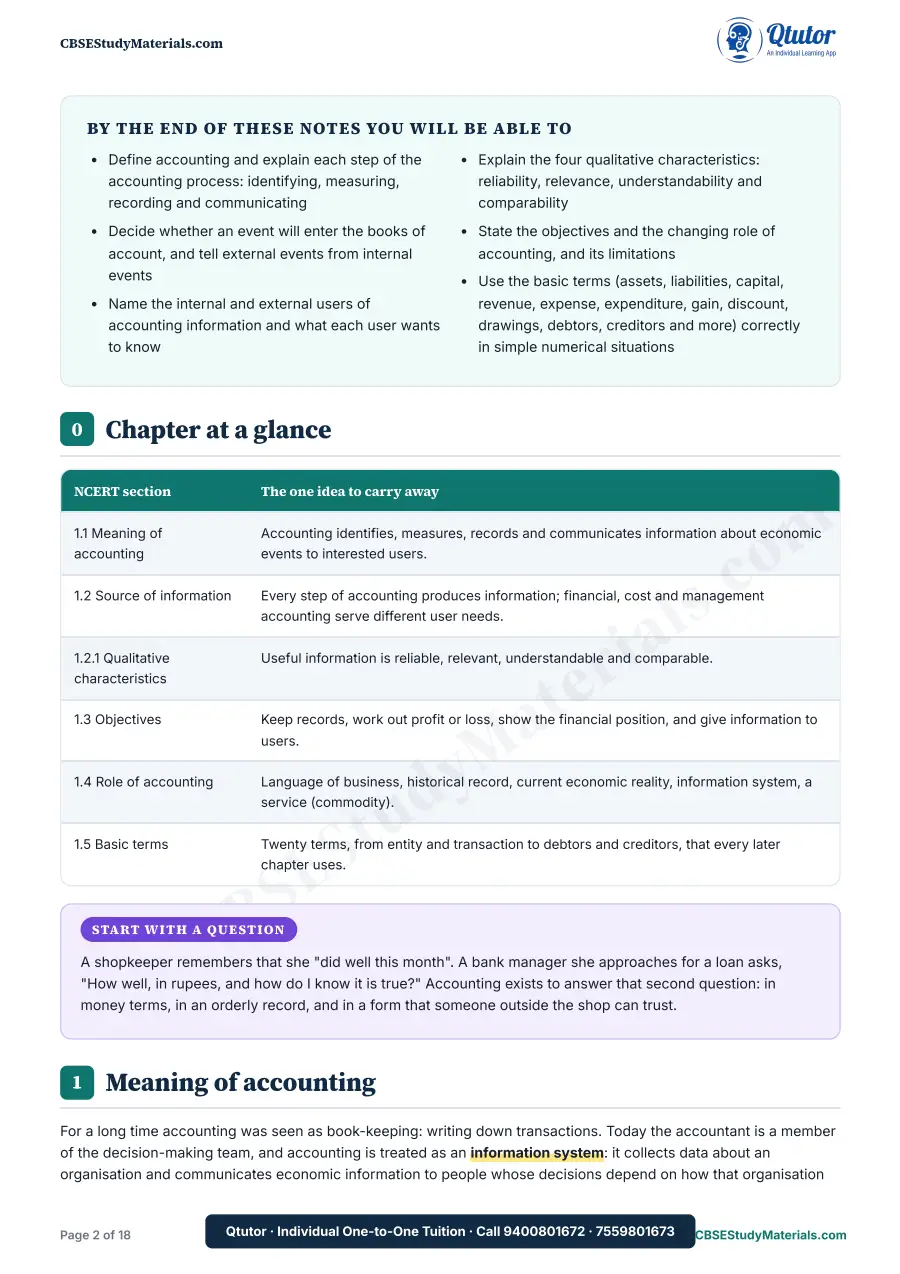
- A cover, learning objectives and a "chapter at a glance" table that maps each NCERT section (1.1 to 1.5) to the one idea you must remember
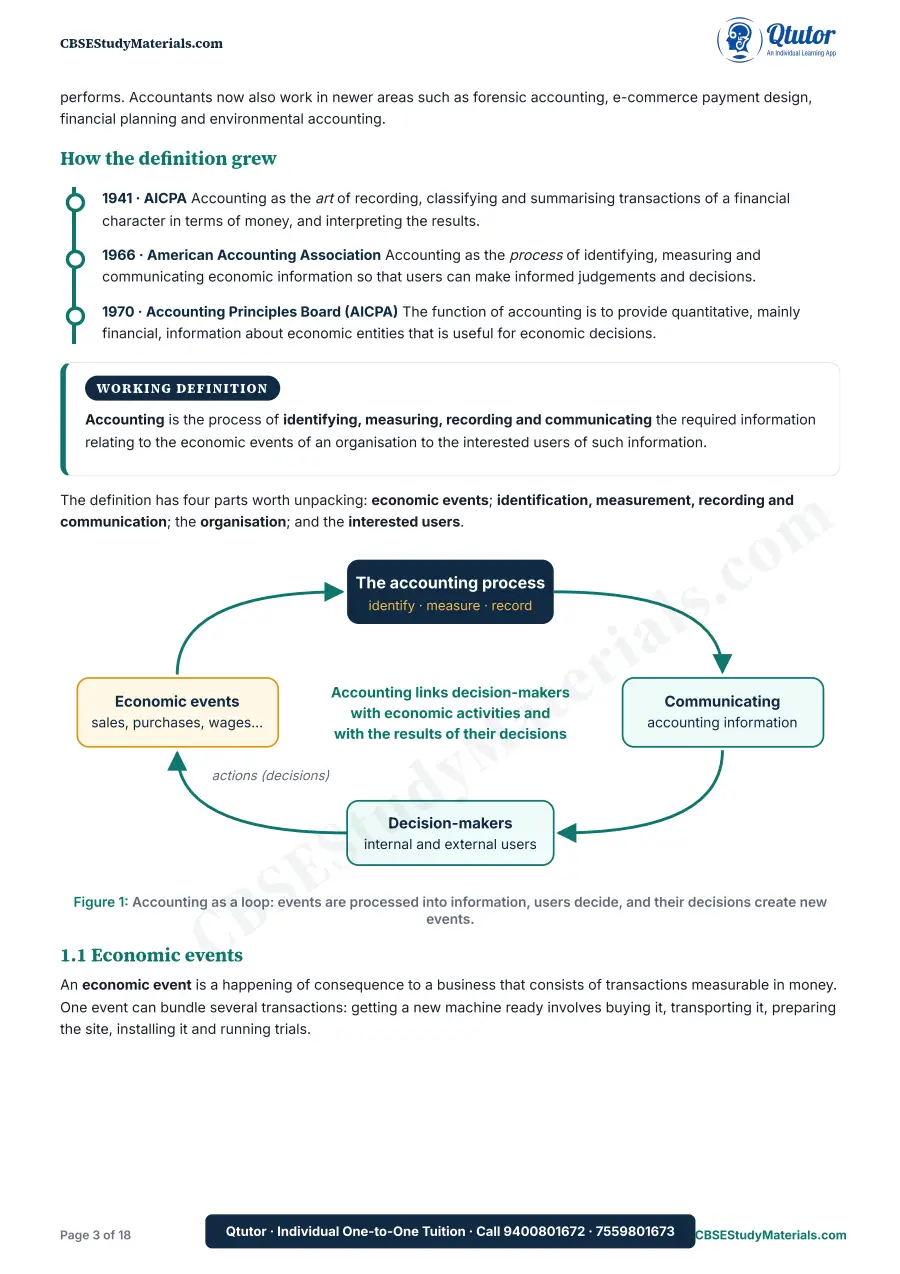
- How the definition of accounting grew (AICPA 1941, American Accounting Association 1966, Accounting Principles Board 1970) and the working definition: identifying, measuring, recording and communicating
- External and internal economic events, and a decision diagram that shows which events enter the books and which do not
- Financial, cost and management accounting compared in one figure
- Reliability, relevance, understandability and comparability, each with its features and a real-life example
- Internal and external users and the exact question each external user wants answered
- The five roles of accounting and its main limitation
- All basic terms: entity, transaction, voucher, goods, assets, liabilities, capital, sales, revenue, expenses, expenditure, profit, gain, loss, discount, drawings, purchases, stock, debtors and creditors
- 9 original labelled figures, including the classification of assets and of liabilities and a mind map of the chapter
- 5 worked examples with full steps, from profit or loss to trade and cash discount
- 3 photographs linking the chapter to real business: a ledger book, a neatly stocked shop and a calculator with receipts
- A 15-term key terms grid
- "Check yourself": 12 important questions (31 marks) in the CBSE board pattern, with an answer key and marking scheme
- A one-page summary (chapter summary for quick revision) with a "when you see... do this" table
Structure of the Introduction to Accounting Notes PDF
| Part | What you get |
|---|---|
| Opening | Cover, objectives, chapter at a glance, a starter question |
| Section 1 | Meaning of accounting, definitions, economic events, identification, measurement, recording, communication, organisation, users |
| Section 2 | Accounting as a source of information; financial, cost and management accounting |
| Section 3 | Qualitative characteristics with a tree diagram |
| Section 4 | Objectives of accounting, worked example on profit and loss |
| Section 5 | Internal and external users and their information needs |
| Section 6 | Role of accounting and its limitation |
| Section 7 | Basic terms with diagrams and 4 worked examples |
| Revision | Mind map, key terms grid, 12 board-pattern questions with answers, one-page summary |
Introduction to Accounting Class 11 Important Topics
- Meaning of accounting: accounting is the process of identifying, measuring, recording and communicating information about the economic events of an organisation to interested users. It is called the language of business and is a means to an end.
- What gets recorded: only events of a financial character that relate to the business and can be measured in money. Appointing a new managing director or the value of a skilled workforce is not recorded.
- Qualitative characteristics: reliability (free from error and bias, verifiable), relevance (timely, with predictive and feedback value), understandability and comparability (common period, unit and format).
- Objectives: maintaining records, calculating profit or loss, depicting the financial position, and providing information to users.
- Users: internal users such as managers, and external users such as investors, lenders, suppliers, customers, government, labour unions, social responsibility groups and competitors.
- Basic terms: the difference between profit and gain, expense and expenditure, goods and assets, trade discount and cash discount, and why drawings are not an expense.
Introduction to Accounting Class 11 Important Questions (Sample)
A worked example from the notes on discounts:
| Step | Working | Amount |
|---|---|---|
| List price | ₹40,000 | |
| Trade discount 10% | 10% of ₹40,000 | ₹4,000 |
| Invoice amount | ₹40,000 − ₹4,000 | ₹36,000 |
| Cash discount 2% (paid within 10 days) | 2% of ₹36,000 | ₹720 |
| Cash received | ₹36,000 − ₹720 | ₹35,280 |
An assertion-reason question from "Check yourself": Assertion: For a laptop dealer, laptops bought from the manufacturer are recorded as purchases of goods. Reason: Items bought for use in the business are not called goods. Both statements are true, but the reason does not explain the assertion, because laptops are goods for the dealer simply because he trades in them.
A case-based question gives a snack supplier whose revenue rose from ₹12,60,000 to ₹15,00,000 while profit fell from ₹1,26,000 to ₹1,20,000, and asks which qualitative characteristics an investor is checking when he asks for the same format, an independent check and a timely report.
How These Class 11 Accountancy Notes Help
Chapter 1 sets the vocabulary for the whole Class 11 Accountancy course. If you mix up gain and profit, or treat drawings as an expense, every later chapter becomes harder. The notes keep each idea short, name the common mistakes directly, and show every calculation step by step. The questions follow the CBSE board pattern used for Class 11 and 12 Accountancy: MCQs, assertion-reason, short answers, a case-based question with internal choice, and long answers, with value points and step marks in the answer key.
Who Should Use It
- Class 11 Commerce students starting Accountancy in the CBSE 2026-27 session
- Students who want revision notes and important questions before a unit test or the annual exam
- Teachers and parents looking for a clear, NCERT based summary of the first chapter
Introduction to Accounting - Class 11 Accountancy Chapter 1 Notes (PDF · 18 pages · Free download)
How to Download the Class 11 Introduction to Accounting Notes PDF
Use the download button above. The PDF is free, so you can save it, read it on your phone or print it.
Related Resources
- Class 11 Accountancy Chapter 1 Introduction to Accounting: chapter page
- All Class 11 Accountancy study material
- Next chapter: Chapter 2, Theory Base of Accounting (coming soon)
FAQs on Class 11 Accountancy Chapter 1 Introduction to Accounting
Where can I download Class 11 Accountancy Chapter 1 Introduction to Accounting notes PDF? On this page. Use the download button to get the 18-page notes PDF.
Is the Introduction to Accounting Class 11 notes PDF free? Yes. Chapter 1 notes are free to download.
What are the important topics in Introduction to Accounting Class 11? The meaning and process of accounting, qualitative characteristics, objectives, internal and external users, the role of accounting, and basic terms such as assets, liabilities, capital, gain, discount and drawings.
Which book is Introduction to Accounting Class 11 from? It is Chapter 1 of the NCERT textbook Financial Accounting Part I for Class 11 Accountancy (2026-27 reprint).
What are the qualitative characteristics of accounting information? Reliability, relevance, understandability and comparability. The notes explain each one with its features and an example.
Do the notes include important questions with answers? Yes. There are 12 board-pattern questions worth 31 marks, including assertion-reason and case-based questions, with a full answer key.
Study tip: learn the basic terms in pairs (profit and gain, expense and expenditure, debtors and creditors), because exam questions often test the difference between them.