Samvadheen (संवादहीन) Class 9 Hindi Chapter 3 Chapter Notes: Summary, Characters, Key Lines, Board Questions (PDF · 18 pages · ₹49) Unlock the full PDF for ₹49
Free sample: pages 1 to 3 of 18. The full PDF costs ₹49.
Why does Tai stand at Jagan Master's door calling and calling, while the parrot in the cage just looks around? And why did a schoolmaster who only wanted to set a caged bird at liberty end up rehearsing "Sitaram, Sitaram" for hours in front of a different parrot? These CBSE Class 9 Hindi Chapter 3 Samvadheen notes, based on the new NCERT book Ganga, explain the whole story and the quiet sadness at its centre.
This is a premium, 18-page Chapter Notes PDF (₹49) for Samvadheen (संवादहीन), Class 9 Hindi Chapter 3, a story by Shekhar Joshi in the NCERT Hindi textbook Ganga (CBSE 2026-27). The revision notes are NCERT based and written in Hindi (Devanagari), so they also work as Class 9 Hindi Chapter 3 notes in Hindi. The PDF is a study aid prepared independently and is not an official CBSE or NCERT publication. It covers the author, a six-part chapter summary, characters, themes, the meaning of the title, line-by-line explanations, word meanings, the grammar from the chapter's exercises, a mind map, a 40-mark board-pattern practice set with answers and a one-page summary.
Class 9 Hindi Chapter 3 Samvadheen Notes: What Is Included
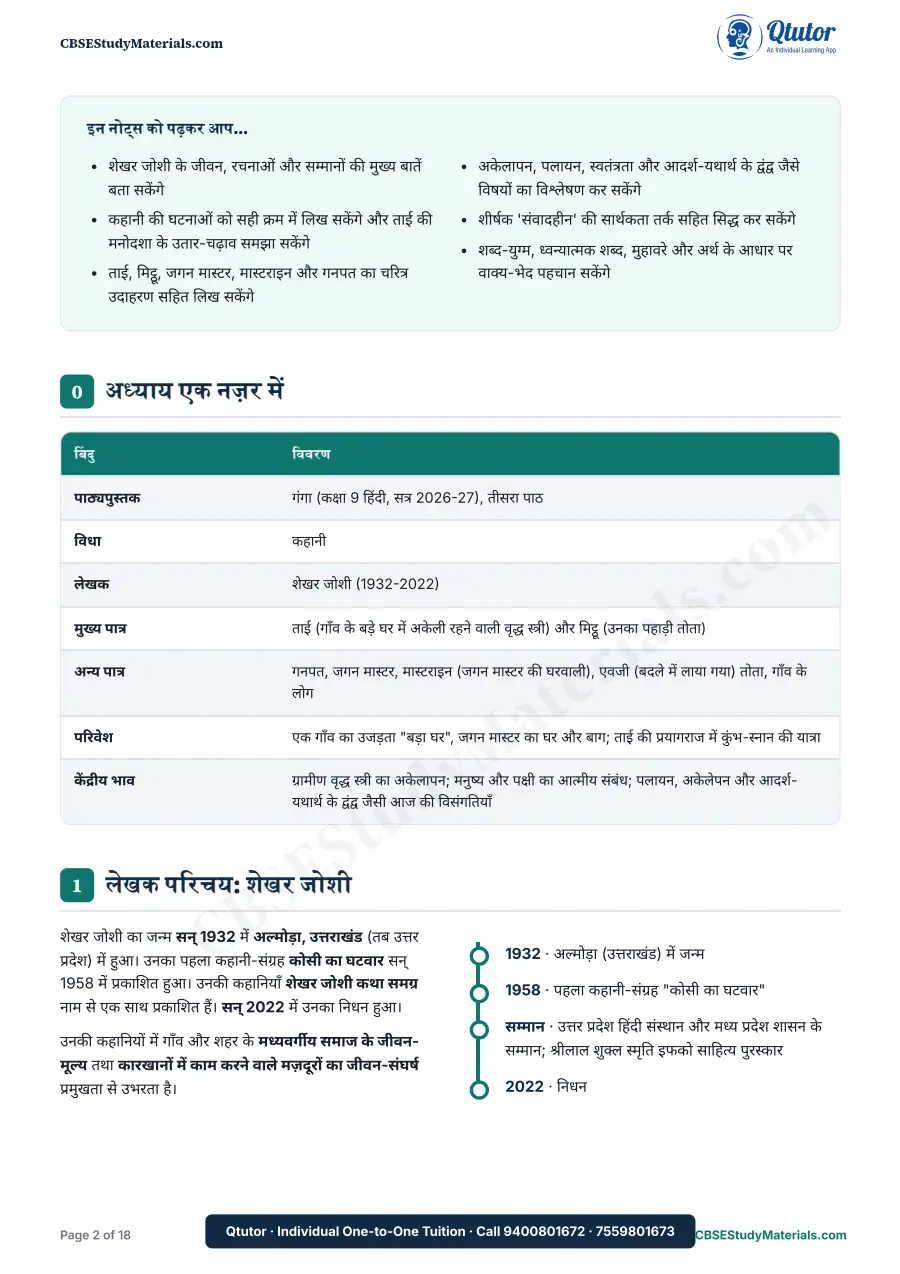
- अध्याय एक नज़र में (Chapter at a glance): book, genre, author, main and other characters, setting and central idea in one table
- लेखक परिचय (About the author): Shekhar Joshi as the textbook presents him: born 1932 in Almora, Uttarakhand (then Uttar Pradesh), first story collection Kosi ka Ghatwar (1958), his other works, awards, and his death in 2022
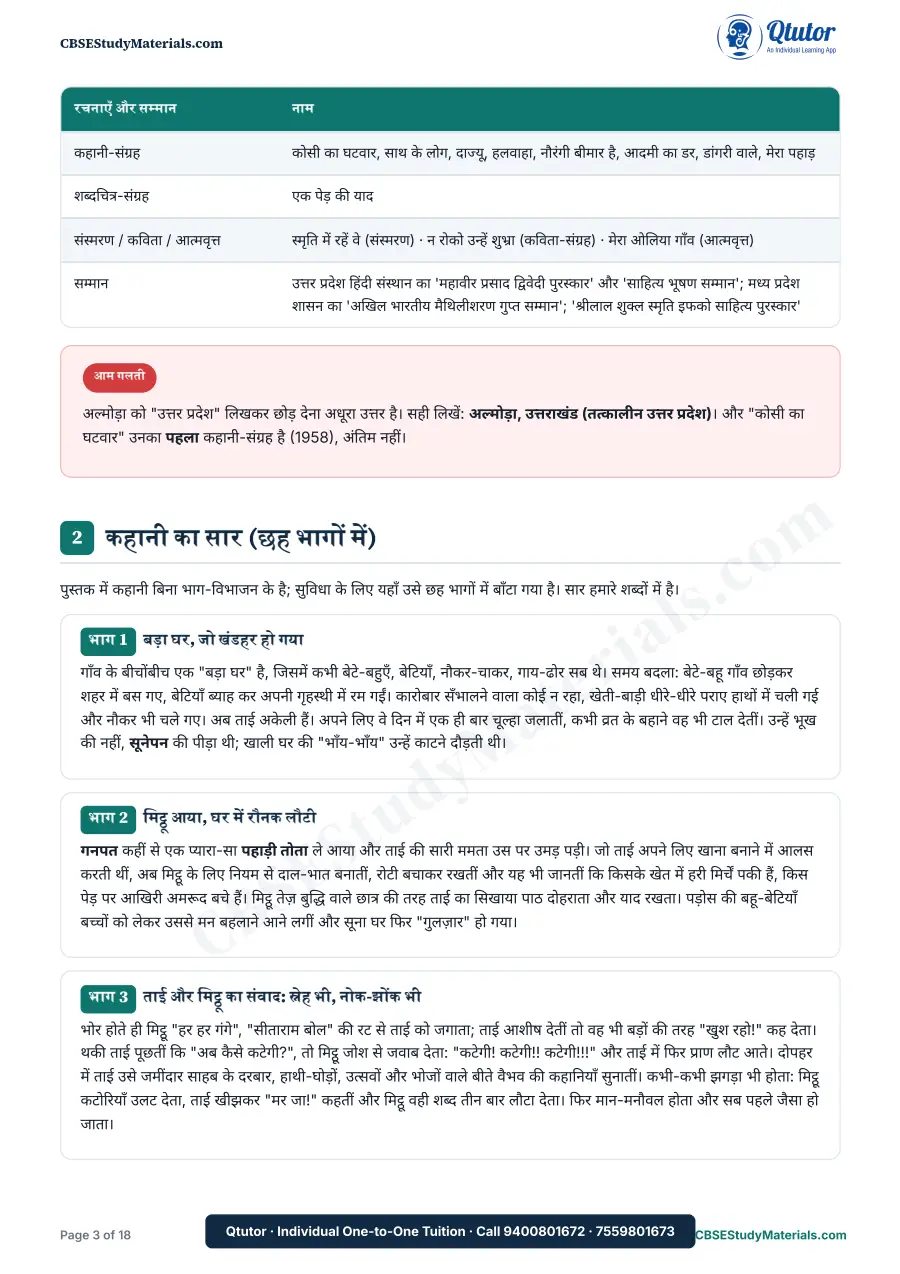
- कहानी का सार (Chapter summary): the story told in six parts in our own words, from the empty "bada ghar" to Tai's return from the Kumbh
- चरित्र-चित्रण (Character sketches): Tai, Mitthu, Jagan Master, the masterain and Ganpat, each trait backed by an incident
- प्रमुख विषय (Themes): loneliness in old age, migration to cities, the bond between a person and a bird, cage versus liberty, ideal versus reality, and hiding the truth
- शीर्षक की सार्थकता (Meaning of the title): a four-box diagram on who in the story is "samvadheen" and why the title fits Tai most
- मुख्य पंक्तियाँ और व्याख्या: seven key short lines explained, including "कटेगी! कटेगी!! कटेगी!!!" and "जगन मास्टर के हाथों के सभी तोते उड़ गए"
- कहानी का सौंदर्य: chitratmakta, samvadatmakta, punrukti, atishayokti, lokdharmi bhasha, prashnottar shaili and vyangya, each with a fresh example from the story, plus how to classify the ending
- व्याकरण (Grammar): shabd-yugm (four types with sentences), dhwanyatmak shabd, animal idioms, the "khojbeen shabdon ki" word hunt, and the eight kinds of sentences by meaning with new examples from the story
- शब्दार्थ (Word meanings): 30 words such as अचकचाना, निहाल, अतल, तुनकमिज़ाज, साँकल, पशोपेश, प्रायश्चित, कौतूहलवश, एवज़ी and आग्नेय
- Seven original diagrams including a plot-flow chart, the mood graph, a character web, a then-and-now chart of the big house, a symbol chart, a mind map, plus two photos
Structure of the Samvadheen Notes PDF
| Part | What you get |
|---|---|
| Cover and objectives | What you will be able to do after reading |
| 0. Chapter at a glance | Book, genre, author, characters, setting, central idea |
| 1. Lekhak parichay | Shekhar Joshi's life, works and awards, with a timeline |
| 2. Kahani ka saar | Six-part summary of the story |
| 3. Ghatnakram aur Tai ki manodasha | Eight-step plot chart, mood graph and a "think" question |
| 4. Patra | Character sketches and a character web |
| 5. Themes and title | Six themes, then-and-now chart, title analysis |
| 6. Key lines | Seven short lines with explanations |
| 7. Symbols and style | Symbol chart, style table, type of ending |
| 8. Vyakaran | Shabd-yugm, sound words, idioms, word hunt, sentence types |
| 9. Shabdarth | 30 word meanings |
| 10. Mind map | The chapter on one diagram |
| 11. Board-pattern practice | 27 questions, 40 marks, five sections, answer key |
| 12. One-page summary | Facts, plot, characters, themes, style, common mistakes |
Samvadheen Class 9 Important Topics
- Why Tai's real problem is silence, not hunger, and what "भगवान! कैसे नैया पार लगेगी?" tells us about her
- How Mitthu brings life back into the house and becomes "the centre of Tai's affection"
- Tai's dilemma (धर्म-संकट) over the Kumbh bath at Prayagraj and who agrees to keep Mitthu
- Jagan Master's daily experiment with the cage, the skylight (रोशनदान), and the gentle satire on his idealism
- Ganpat's two decisive acts: bringing Mitthu, and suggesting the look-alike parrot
- The title Samvadheen and the different kinds of "lack of conversation" in the story
Samvadheen Class 9 Important Questions (Sample)
The practice set follows the Class 10 Hindi board pattern, which CBSE uses for Class 9 as well: extract-based MCQs, assertion-reason (कथन-कारण), grammar from the chapter's sentences, 2-mark and 3-mark short answers, a 4-mark long answer with internal choice and a 6-mark paragraph, 40 marks in all.
Extract-based MCQ: What does the line "उनकी आजादी का सुख स्वयं भोगते" satirise? (a) Mitthu's cleverness (b) Jagan Master's own self-satisfaction (c) the masterain's carelessness (d) Tai's superstition. Answer: (b).
Assertion-reason: A: The masterain agreed to keep Mitthu after consulting her husband. R: Jagan Master grew restless seeing a caged bird. Answer: (d), A is false (she agreed without asking him) and R is true.
Short answer (3 marks): Was it right to keep Tai under an illusion with a look-alike parrot? The answer key gives one point for each side and one for a clear personal view.
| Section | Type | Marks |
|---|---|---|
| A | Two extracts, 10 MCQs | 10 × 1 |
| B | Assertion-reason and grammar | 6 × 1 |
| C | Short answer (any four) | 4 × 2 |
| D | Short answer (any two) | 2 × 3 |
| E | Long answer (one of two) and paragraph | 4 + 6 |
How These Class 9 Hindi Revision Notes Help
- The six-part summary and the plot chart fix the order of events, which most short answers depend on
- Every character trait comes with the incident that proves it
- The title diagram and the ideal-versus-reality section give ready value points for the long answers
- The one-page summary lists the facts students most often mix up, such as who opened the cage and who brought the second parrot
Who Should Use It
Class 9 CBSE students reading Ganga in 2026-27 who want Samvadheen notes in Hindi, a chapter summary and important questions before a test, and teachers who need a ready lesson outline.
Samvadheen (संवादहीन) Class 9 Hindi Chapter 3 Chapter Notes: Summary, Characters, Key Lines, Board Questions (PDF · 18 pages · ₹49)
How to Download the Class 9 Samvadheen Notes PDF
This is a premium study material priced at ₹49. Use the download button above; the PDF prints cleanly on A4.
Related Resources
- Class 9 Hindi Chapter 3 Samvadheen: all resources
- Samvadheen illustrated question answer notes
- Class 9 Hindi study material, all chapters
- Previous chapter: Kya Likhoon? (Class 9 Hindi Chapter 2)
- Do Bailon Ki Katha Class 9 Hindi Chapter 1 notes
FAQs on Class 9 Hindi Chapter 3 Samvadheen
Where can I download Class 9 Hindi Chapter 3 Samvadheen notes PDF? On this page. Use the download button to get the 18-page chapter notes PDF in Hindi.
Which book is Samvadheen Class 9 from? It is Chapter 3 of Ganga, the NCERT Class 9 Hindi textbook for 2026-27. The writer is Shekhar Joshi.
What are the important topics in Samvadheen Class 9? Tai's loneliness and the empty big house, the bond between Tai and Mitthu, the Kumbh trip, Jagan Master's experiment and Mitthu's escape, the look-alike parrot, and the meaning of the title.
What is the message of the story Samvadheen? Old age needs conversation and belonging more than food, a relationship grows from time spent together and not from looks, and acting on an ideal without thinking of others can hurt them.
How much does the Samvadheen notes PDF cost? It is a premium 18-page PDF priced at ₹49. The site also lists a separate illustrated question-answer PDF for this chapter.
Study tip: draw the eight-step plot chart from memory once; most Samvadheen questions are answered by knowing exactly what happened in which order.