Travel Class 7 English Chapter 11 NCERT Solutions PDF (PDF · 11 pages · ₹49) Unlock the full PDF for ₹49
Free sample: pages 1 to 3 of 11. The full PDF costs ₹49.
Does the speaker in "Travel" really hear a train that is miles away? These NCERT Solutions for Travel, Class 7 English Chapter 11 (CBSE, NCERT Poorvi textbook), answer that question and every other one in the chapter, in a neat 11-page PDF.
This is a premium NCERT Solutions PDF (₹49) for Class 7 English, Chapter 11 "Travel" by Edna St. Vincent Millay, the poem in Unit 4 "Travel and Adventure" of the new Poorvi book for CBSE 2026-27. It is independent study material and is not an official CBSE or NCERT publication. All 25 textbook questions and tasks are answered in the same order and numbering as the book, from "Let us do these activities before we read" to "Let us explore". Each question is restated briefly, then answered in simple, correct English.
Class 7 English Chapter 11 Travel NCERT Solutions: What Is Included
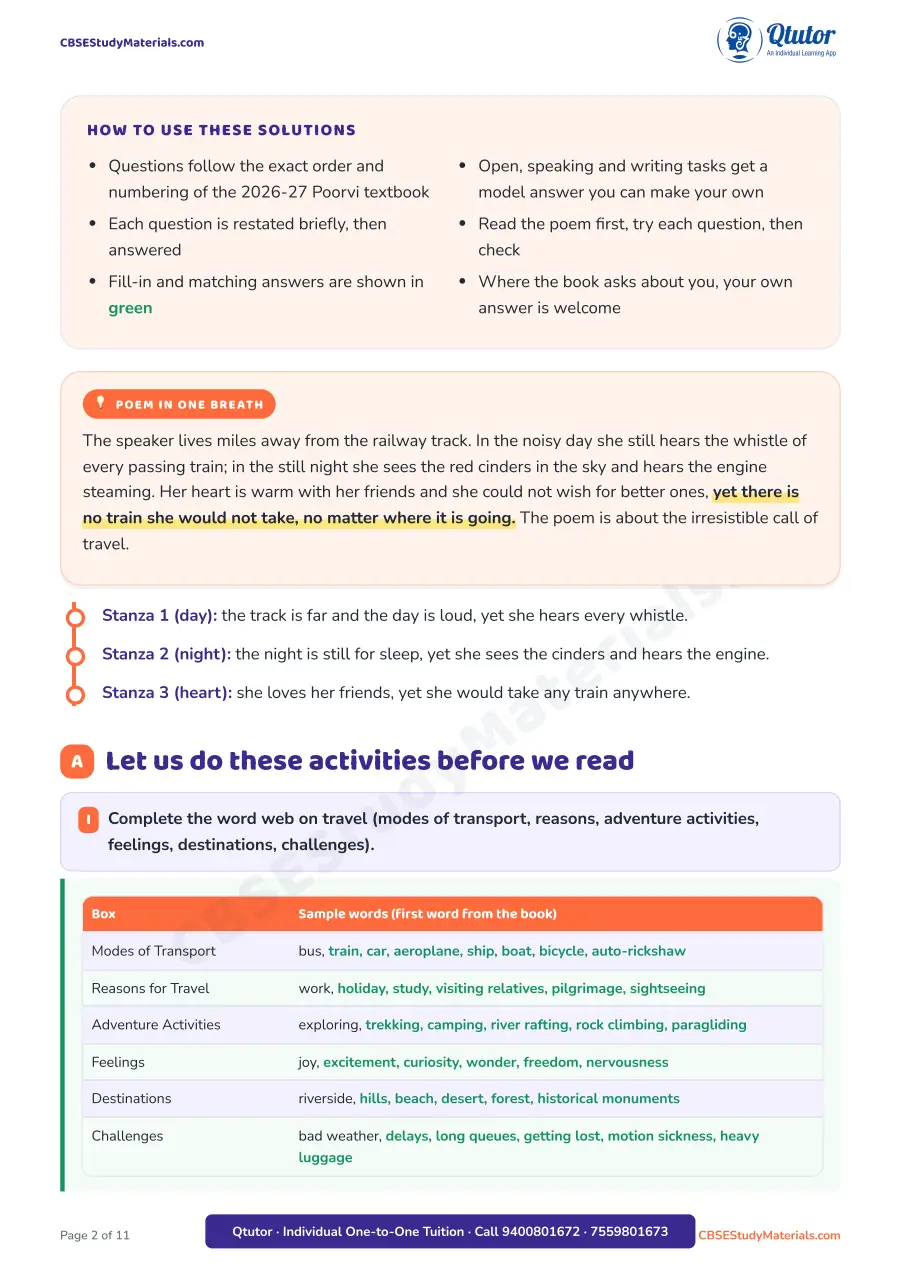
- A "poem in one breath" summary and a three-step timeline of the stanzas
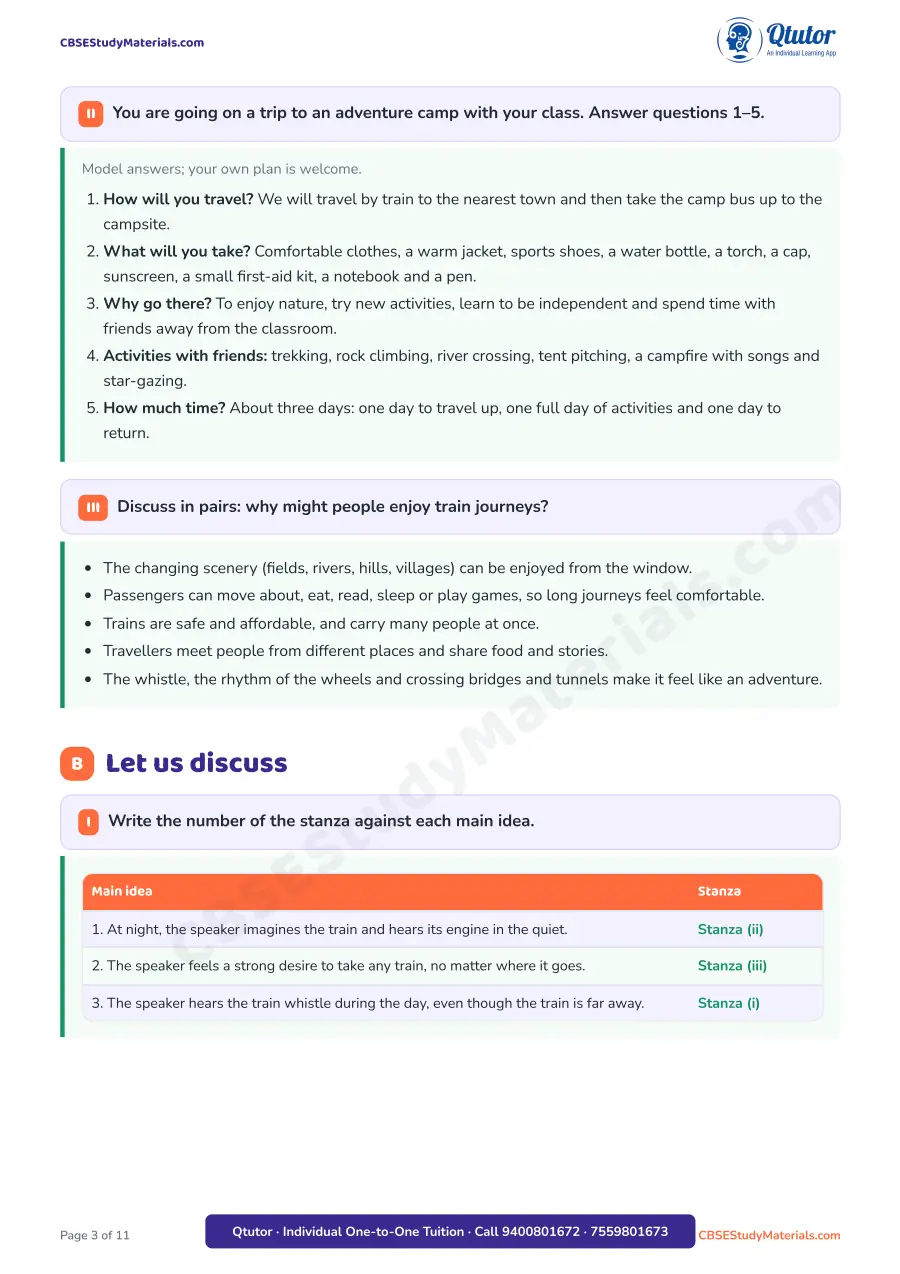
- Before we read: a completed word web on travel, model answers on the adventure-camp trip and reasons people enjoy train journeys
- Let us discuss: stanza-to-main-idea matching, rhyming words of every stanza, the ABAB rhyme scheme, the word that personifies the whistle, tone, what the train symbolises, why a line is repeated, the common factor of day and night, and all the imagery phrases
- Let us think and reflect: every part of the extract on "My heart is warm…" and full answers to the four questions on cinders, the whistle, "no matter where it's going" and whether the poet really sees and hears the train
- Let us learn: both matching tables with all fill-in-the-blank answers, including the sound-word paragraph
- Let us listen: the six incorrect sentences about the National Science Centre trip identified and corrected from the transcript
- Let us speak: a soft 'c' / hard 'c' table for all 11 words with the reason for each
- Let us write: a model diamante poem linking reading and adventure, and a model character sketch with value points
- Let us explore: model presentation points on the Mountain Railways of India, the Vande Bharat Express, underwater rail tunnels and which train would be most adventurous
- Exam tips for poem questions, a short word list and a quick recap box
Structure of the PDF
| Book section | Questions answered |
|---|---|
| A. Before we read | I, II, III |
| B. Let us discuss | I to IX |
| C. Let us think and reflect | I (four parts), II (1-4) |
| D. Let us learn | I (match and five blanks), II (match and paragraph) |
| E. Let us listen | I, II |
| F. Let us speak | Soft and hard 'c' words |
| G. Let us write | I diamante poem, II character description |
| H. Let us explore | I to IV |
Travel Class 7 Important Topics Covered
- The meaning of each stanza: the noisy day, the still night and the warm heart
- The ABAB rhyme scheme and personification in "whistle shrieking"
- Tone (thoughtful, excited, enthusiastic; content about friends) and the train as a symbol of adventure and opportunities
- Imagery of sound, sight and feeling
- Sound words such as hollering, yelling, bawling, whimpering and screeching
- Listening for exact details in an announcement, and the rules for soft and hard 'c'
Travel Class 7 Question Answers (Sample)
From "Let us discuss" VII: the poet repeats "...there isn't a train goes by" to highlight the speaker's fascination with the train. The solution adds that it does not mean many trains pass, because the track is miles away.
From "Let us listen", the corrected sentences include:
| Wrong in the book's list | Correct (from the announcement) |
|---|---|
| Trip on 15 September | Trip on 16 September |
| Return by 5.00 | Return by 5.30 |
| Slip signed by the class teacher | Slip signed by the parent |
| Mr. Mukherjee, Adventure Club in-charge | Mr. Mukherjee, excursion in-charge |
From "Let us speak": in bicycle the first 'c' is soft /s/ because it comes before y, and the second 'c' is hard /k/ because it comes before the consonant l.
How These NCERT Solutions Help
- Answers follow the textbook order, so you can check your homework question by question
- Fill-in and matching answers are shown in green for quick checking
- Open questions get a model answer plus value points, which shows how to write a full-mark answer
- Writing tasks come with a model you can adapt, not copy
- The exam tips and recap box make last-minute revision quick
Who Should Use These Solutions
- Class 7 students using the NCERT Poorvi English textbook (CBSE 2026-27)
- Students checking their textbook exercise answers after class
- Parents and tutors who want reliable model answers for the poem
How to Download the Class 7 Travel NCERT Solutions PDF
This is a premium PDF priced at ₹49. Use the download button below to get all 11 pages.
Travel Class 7 English Chapter 11 NCERT Solutions PDF (PDF · 11 pages · ₹49)
Related Resources
- Class 7 English Chapter 11 Travel Notes
- Class 7 English Chapter 11 Travel Question Bank
- Travel chapter page
- All Class 7 English study material
- Previous chapter: The Tunnel
- Next chapter: Conquering the Summit
FAQs on Class 7 English Chapter 11 Travel NCERT Solutions
Where can I get Class 7 English Chapter 11 Travel question answers? On this page. The 11-page premium PDF answers every textbook question in order for ₹49.
What is the rhyme scheme of Travel Class 7? ABAB (option 3 in the book). Line 1 rhymes with line 3 and line 2 with line 4 in every stanza.
Which word personifies the whistle in the poem Travel? "Shrieking". It gives the whistle a human cry, so the train seems to call out to the speaker.
What does "cinders red on the sky" mean? It shows that the train is a coal-burning steam engine whose glowing red sparks light up the night sky.
Does the poet actually see and hear the train? Most likely not every time. The track is miles away, so her strong longing and imagination make the train feel near.
Are the answers in the same order as the NCERT book? Yes. Every section and question number follows the 2026-27 Poorvi textbook.
Study tip: answer each question yourself first, then compare with the model answer and add any value point you missed.