Perimeter and Area Class 6 Maths Chapter 6 Notes PDF (PDF · 18 pages · ₹49) Unlock the full PDF for ₹49
Free sample: pages 1 to 3 of 18. The full PDF costs ₹49.
Why does a long thin garden need more fencing than a square one, even when both have exactly the same area? Perimeter and Area, Class 6 Maths Chapter 6, answers this with fences, running tracks, tiles and house plans, and these CBSE Class 6 Maths notes explain every idea with colourful pictures and short worked examples. This is a premium 18-page chapter notes PDF written from the NCERT Ganita Prakash (Grade 6) textbook, 2026-27 edition. It is an independent study resource and not an official CBSE or NCERT publication.
The notes follow the book in order: 6.1 Perimeter, 6.2 Area and 6.3 Area of a Triangle. Every number in the examples and in the answer key was checked by calculation, so this study material is safe to revise from before a test.
Class 6 Maths Chapter 6 Perimeter and Area Notes: What Is Included
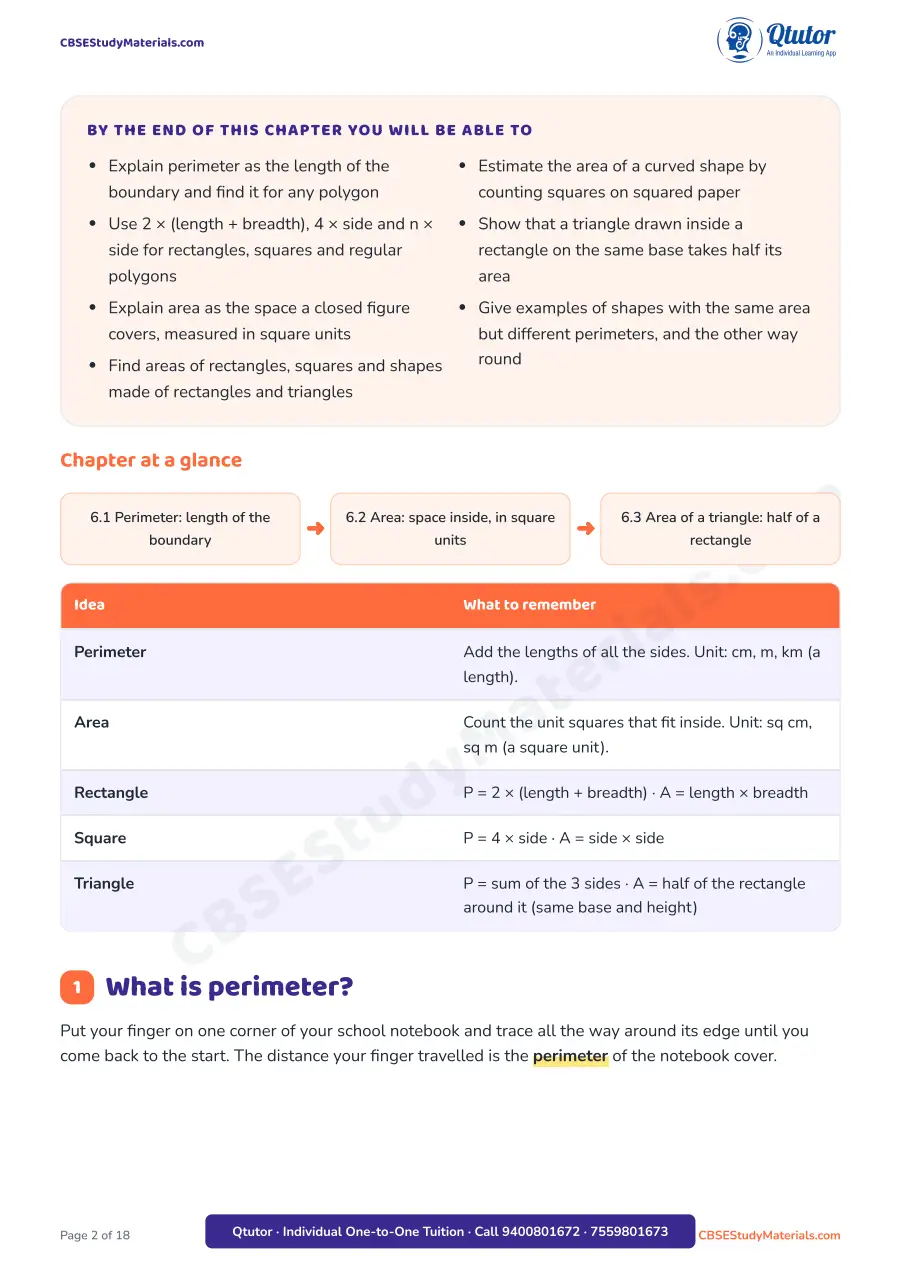
- A cover, seven learning goals and a "Chapter at a glance" table of every formula
- 15 numbered sections: what perimeter is, rectangles, squares and triangles, running tracks and rounds, straight and diagonal units, regular polygons, split and rejoin, what area is, splitting shapes into rectangles, tangram areas, counting squares, same area with different perimeters, area of a triangle, and floor plans with area mazes
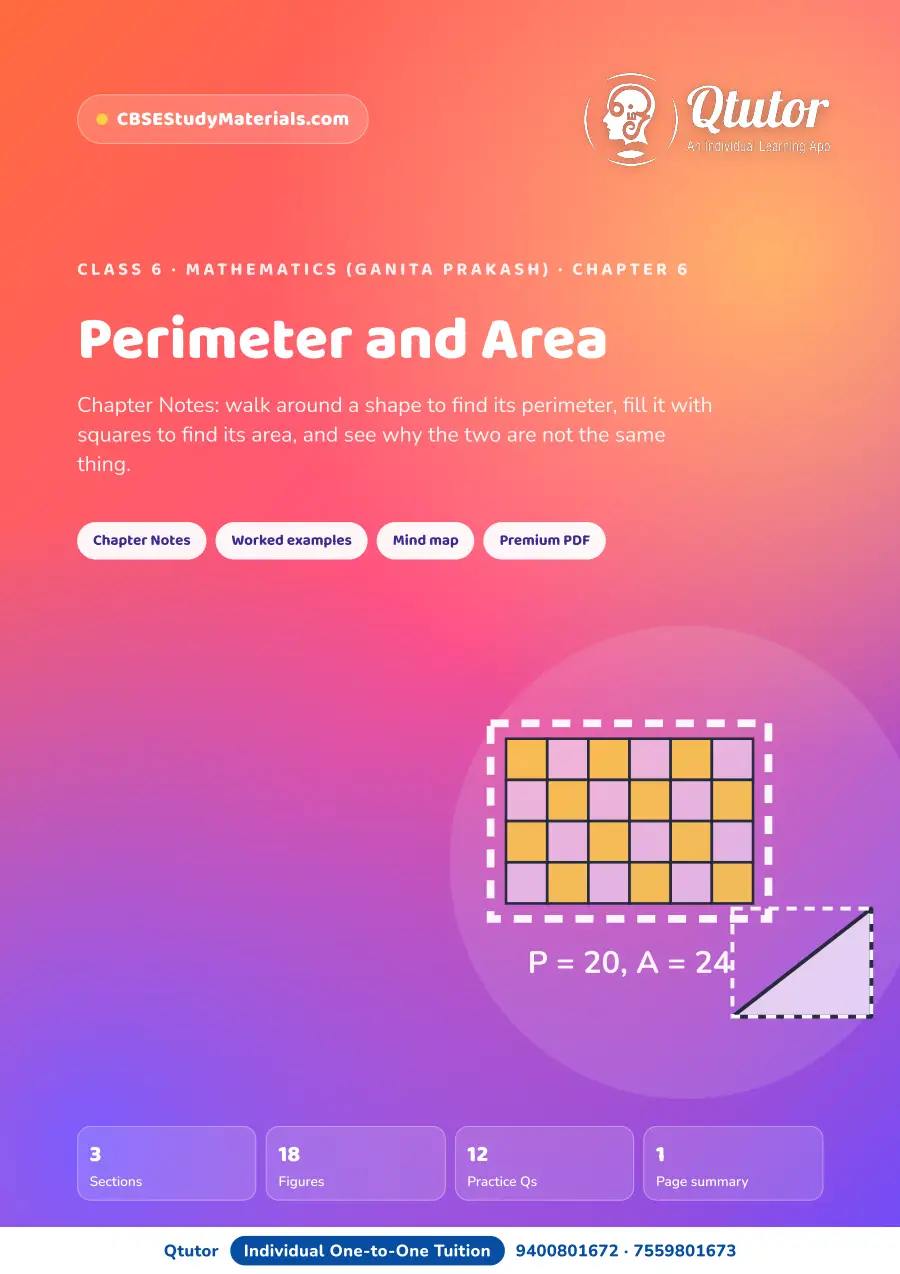
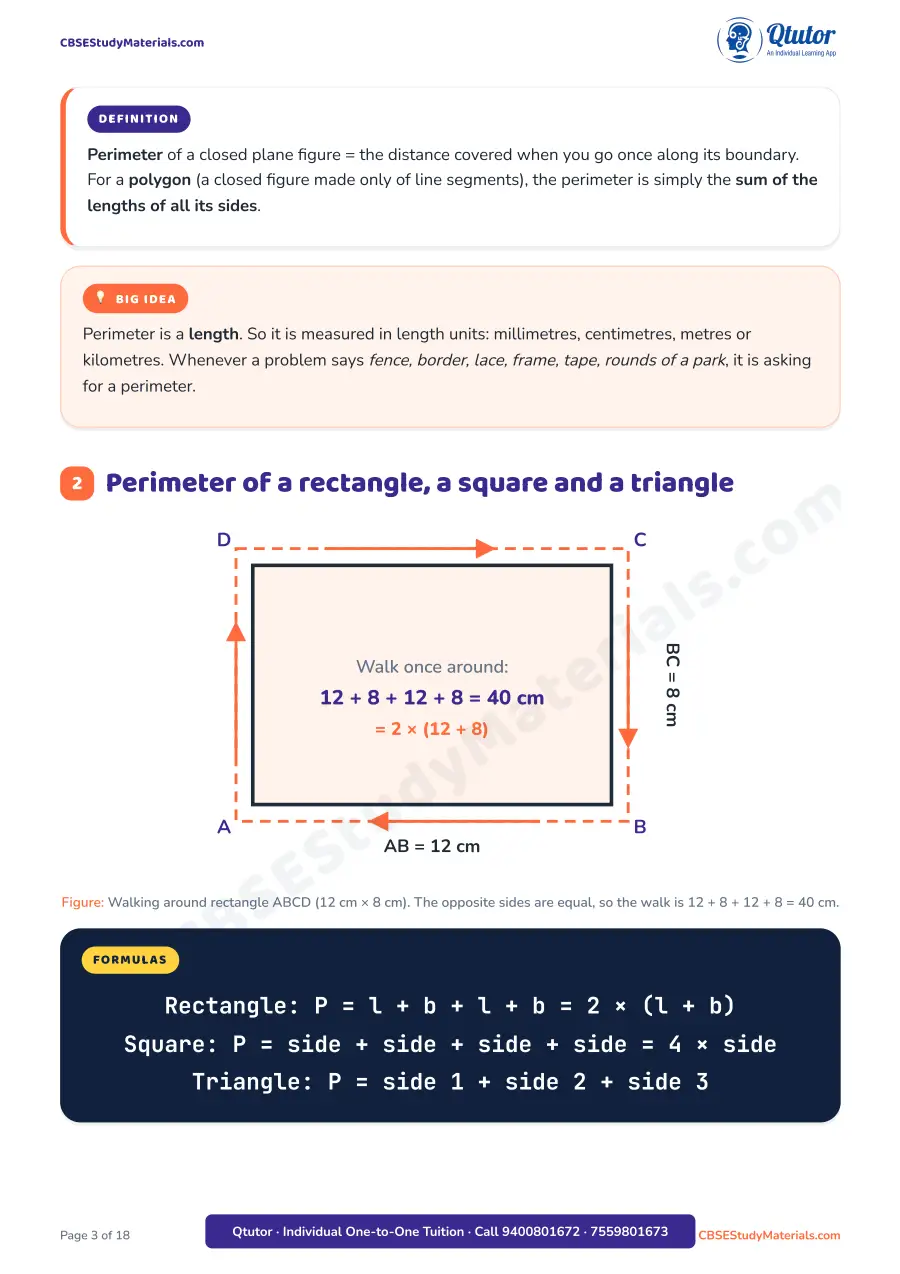
- 18 original figures, including a walk around a rectangle, the two running tracks, a staggered race start, dot-paper straight and diagonal units, regular polygons, the tangram with every piece's area, a counting-squares example, rectangles of area 24 and the triangle-in-a-rectangle grid
- 7 worked examples (gift-card ribbon, rope around a field, a missing side, a runner's position after 1 km, painting a wall, a hall's width, a triangle on a grid)
- "Big idea", "Common mistake", "Think deeper", "Real life", "Did you know?" and "Try this" boxes
- A key-terms table with 12 keywords and their meanings, and a mind map of the whole chapter
- 12 "Check yourself" important questions with a full answer key
- A one-page summary (chapter summary and revision notes) with formula and "useful moves" tables
Structure of the PDF
| Part | What you get |
|---|---|
| Cover and goals | Learning goals and a formula table for the whole chapter |
| Sections 1-5 (6.1) | Perimeter, formulas, tracks and rounds, s and d units, regular polygons, split and rejoin |
| Sections 6-9 (6.2) | Area and square units, cutting into rectangles, tangram, counting squares, same area with different perimeter |
| Sections 10-11 (6.3) | Area of a triangle as half a rectangle, floor plans and area mazes |
| Revision | Key terms, mind map, 12 questions with answers, one-page summary |
Perimeter and Area Class 6 Important Topics
- Perimeter of a polygon as the sum of its sides; perimeter of a rectangle = 2 × (l + b) and of a square = 4 × side
- Perimeter of an equilateral triangle and of any regular polygon: number of sides × side
- Total distance on a track = rounds × perimeter, and finding a runner's position
- Area as the space enclosed, measured in square units; area of a rectangle = l × b and of a square = side × side
- Estimating the area of curved shapes by counting squares (more than half = 1, exactly half = ½, less than half = 0)
- Why squares are the best unit of area
- Same area, different perimeters (rectangles of area 24) and the effect of adding a unit square
- Area of a triangle as half of the rectangle with the same base and height
Perimeter and Area Class 6 Important Questions (Sample)
From the worked examples:
> A field is 45 m long and 30 m wide. A farmer ties 4 rounds of rope around it. One round = 2 × (45 + 30) = 150 m, so four rounds = 600 m.
From the "Check yourself" set:
> From a 10 m × 8 m plot, a 4 m × 3 m corner is cut away. The area drops to 80 − 12 = 68 sq m, but the perimeter stays 36 m. Why? The two edges removed are replaced by two new edges of the same lengths.
From the rectangles-of-area-24 table:
| Rectangle | 1 × 24 | 2 × 12 | 3 × 8 | 4 × 6 |
|---|---|---|---|---|
| Perimeter (units) | 50 | 28 | 22 | 20 |
How These Perimeter and Area Notes Help
The chapter mixes two ideas that students often confuse. The notes keep them apart from the first page: perimeter is a length (fence, lace, border, rounds) and area is a surface (tiles, carpet, paint, grass). Each formula is shown with a picture first, so students see why 2 × (l + b) works instead of memorising it. Common mistakes, such as writing 2 × l + b or mixing metres with centimetres, are pointed out right where they happen. The "Think deeper" boxes prepare students for the reasoning questions of the new CBSE pattern, such as why the perimeter does not change when a corner is cut off.
Who Should Use These Notes
- Class 6 students using the NCERT Ganita Prakash book in CBSE schools, for daily revision and before unit tests
- Parents and tutors who want a clear, picture-based explanation of perimeter and area
- Students who want a quick chapter summary and PDF download for revision before exams in 2026-27
How to Download the Class 6 Perimeter and Area Notes PDF
The notes are a premium PDF for ₹49. Use the download button below; the file prints well on A4.
Perimeter and Area Class 6 Maths Chapter 6 Notes PDF (PDF · 18 pages · ₹49)
Related Resources
- Class 6 Maths Chapter 6 Perimeter and Area NCERT solutions: answers to every Figure it Out and in-text question
- Class 6 Maths Chapter 6 Perimeter and Area question bank: 71 important questions with answers
- Perimeter and Area chapter page
- All Class 6 Mathematics study material
- Previous chapter: Prime Time
- Next chapter: Fractions
FAQs on Class 6 Maths Chapter 6 Perimeter and Area
Where can I download Class 6 Maths Chapter 6 Perimeter and Area notes PDF? On this page. Use the download button to get the 18-page premium notes PDF for ₹49.
What are the important topics in Perimeter and Area Class 6? Perimeter of rectangles, squares, triangles and regular polygons; area of rectangles and squares; estimating area by counting squares; area of a triangle as half a rectangle; and shapes with the same area but different perimeters.
What is the difference between perimeter and area? Perimeter is the length of the boundary of a shape, measured in cm or m. Area is the surface it covers, measured in square units such as sq cm or sq m.
Which book is Perimeter and Area Class 6 from? It is Chapter 6 of Ganita Prakash, the NCERT Mathematics textbook for Grade 6 (2026-27 reprint).
Are these notes NCERT based? Yes. All topics and examples follow the current NCERT Ganita Prakash chapter. The notes are our own explanation and are not an official NCERT publication.
Do the notes include textbook answers? They explain every idea needed for the exercises. Full answers to every textbook question are in our separate Perimeter and Area NCERT Solutions PDF.
Study tip: for every word problem, first ask "is this about the boundary or the surface?" and you will pick the right formula every time.