The Cherry Tree - Class 8 English Chapter 10 NCERT Solutions (PDF · 11 pages · ₹49) Unlock the full PDF for ₹49
Free sample: pages 1 to 3 of 11. The full PDF costs ₹49.
What were the four true statements in the listening task, and what is the correct order of the ten events in Part I? These The Cherry Tree Class 8 English Chapter 10 NCERT Solutions answer those questions and every other question in the chapter, for CBSE students using the NCERT Poorvi textbook (Unit 4: Environment, 2026-27). This is a premium 11-page PDF priced at ₹49. It is NCERT based study material prepared by our team and is not an official CBSE or NCERT publication.
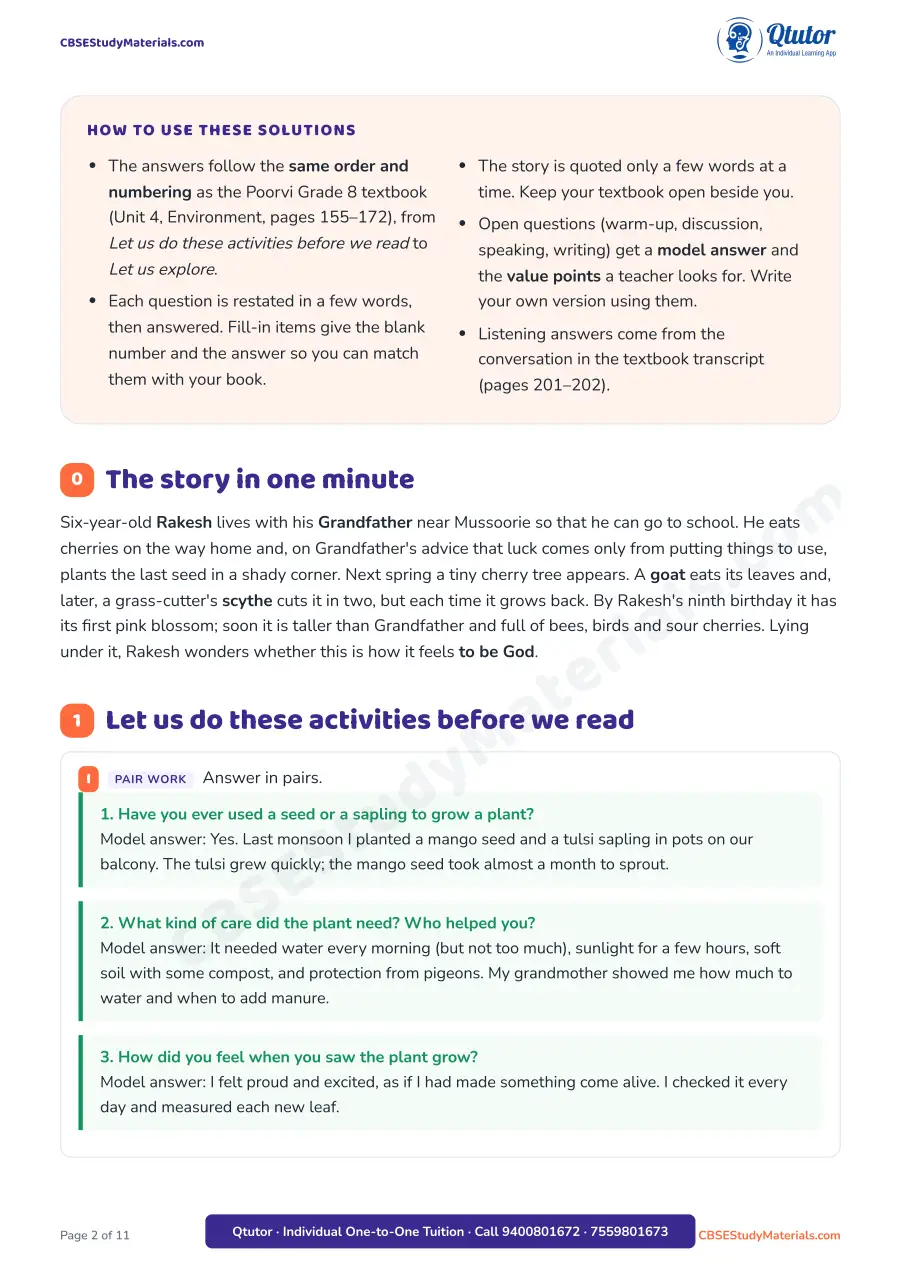
The solutions follow the textbook in the same order and numbering, from the warm-up questions on page 155 to "Let us explore" on page 172. Each question is restated in a few words and then answered in clear, simple English that a Class 8 student can learn from and write in their own words.
Class 8 English Chapter 10 The Cherry Tree NCERT Solutions: What Is Included
- Let us do these activities before we read: model answers for all five warm-up questions on growing plants, trees at home and fruit trees in your region.
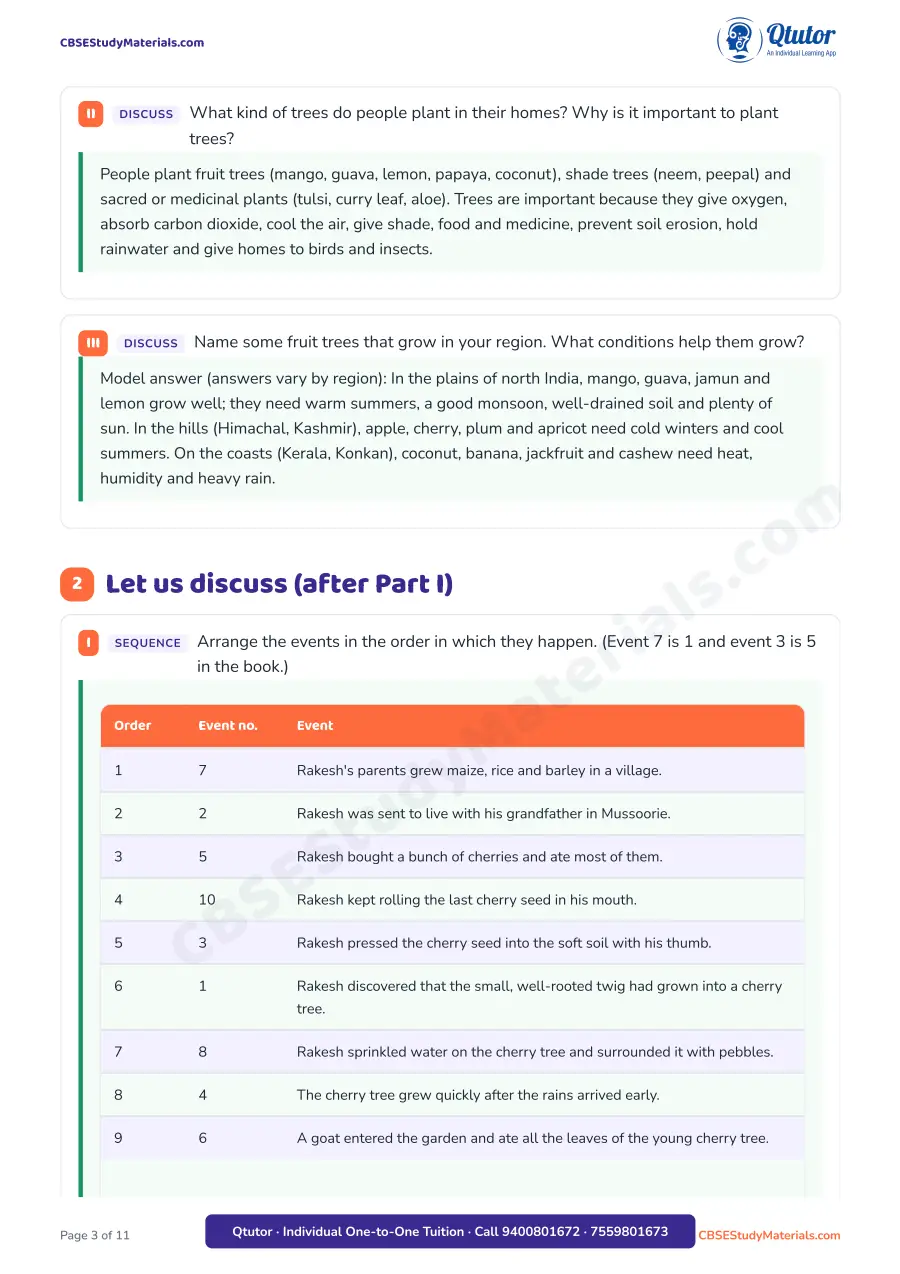
- Let us discuss (after Part I): the ten events arranged in order in a table, and a reasoned answer on whether the tree will survive.
- Let us discuss (after Part II): the complete cause-and-effect table.
- Let us think and reflect I: all eight extract-based sub-questions (two extracts), with the correct options and reasons.
- Let us think and reflect II: all seven questions, including the last line, the relationship between Rakesh and Grandfather, humans and nature, and a model reflection in Rakesh's voice.
- Let us learn: odd one out with reasons, taste words with five sample sentences, the eight antonyms, verbs and tenses in the three sentences, all ten past-tense blanks, and the fully punctuated Roshni paragraph.
- Let us listen: the four true statements with a reason for each true and false choice.
- Let us speak: syllables of all eleven words, and a model speech on Van Mahotsav with value points.
- Let us write: all ten blanks of the article "Trees–Our Lifeline", with notes on the article layout.
- Let us explore: notes on the famous banyan trees and a table of Indian environmentalists.
Structure of the PDF
| Part | What you get |
|---|---|
| Cover and how to use | Order of answers, how quotes and model answers work |
| Story in one minute | Short retelling to refresh your memory |
| Before you read | 5 model answers |
| Let us discuss (I and II) | Sequencing table, prediction, cause-and-effect table |
| Let us think and reflect | 8 extract answers and 7 long answers |
| Let us learn | Vocabulary, tenses and punctuation answers |
| Listen, speak, write, explore | True statements, syllables, speech, article blanks, explore tables |
The Cherry Tree Class 8 Question Answer: Important Topics
- Why Rakesh's parents sent him to Mussoorie
- Grandfather's view of luck and effort
- Why Rakesh let the praying mantis stay
- Life in the Himalayan foothills
- The meaning of "Is this what it feels to be God?"
- The relationship between Rakesh and Grandfather, and between humans and nature
- Simple Past, Past Progressive and Past Perfect tenses, and punctuation
The Cherry Tree NCERT Solutions: Sample Answers
Let us discuss I, order of events: 7, 2, 5, 10, 3, 1, 8, 4, 6, 9. The parents' village comes first, then the move to Mussoorie, the cherries, the seed, the planting, the sprout, the pebbles, the early rains, the goat and finally Grandfather's words that cherry trees are tough.
Let us learn III, antonyms:
| Word | Antonym |
|---|---|
| tender | hard |
| sturdy | shaky |
| grumpy | cheerful |
| sheltered | unprotected |
Let us think and reflect II.2: The mantis was the tree's first visitor and was not harming it; it was only perched there watching him. Rakesh was happy that his tree had become a home for living creatures, so he let it stay.
How These Solutions Help
You can check every textbook answer in one place, in the order of your book. Long questions come with value points, so you know what a teacher looks for, and open tasks such as the speech and the reflection have full models you can adapt. The grammar answers explain why each tense is used, which helps with the indirect and competency-based questions now common in school tests.
Who Should Use It
- Class 8 students checking their textbook exercises for The Cherry Tree
- Students who missed a class and want to catch up on the chapter's questions
- Parents and tutors who want reliable answers in textbook order
The Cherry Tree - Class 8 English Chapter 10 NCERT Solutions (PDF · 11 pages · ₹49)
How to Download the Class 8 The Cherry Tree NCERT Solutions PDF
Use the download button above. This is a premium PDF download priced at ₹49; once purchased, you can save and print it.
Related resources
- The Cherry Tree Class 8 Chapter Notes PDF
- The Cherry Tree Class 8 NCERT Solutions PDF
- The Cherry Tree Class 8 Question Bank PDF
- The Cherry Tree: Class 8 English chapter page
- All Class 8 English chapters
- Previous chapter: Spectacular Wonders
- Next chapter: Harvest Hymn
FAQs on Class 8 English Chapter 10 The Cherry Tree NCERT Solutions
Where can I get The Cherry Tree Class 8 question answers? On this page. The premium 11-page NCERT Solutions PDF answers every question in the chapter in textbook order for ₹49.
Why did Rakesh's parents send him to Mussoorie? There was no school in their village, and they were keen that he should study, so they sent him to live with his grandfather.
What does "Is this what it feels to be God?" mean? Rakesh is filled with wonder that a small seed he planted and cared for has become a living, blossoming tree; he feels like a creator, with pride, gratitude and a sense of responsibility.
What are the four true statements in The Cherry Tree listening task? Statements 2, 3, 5 and 7.
Are these solutions for the new Poorvi textbook? Yes. They follow the NCERT Poorvi Grade 8 book, Unit 4, Chapter 10, 2026-27 reprint.
How much does The Cherry Tree NCERT Solutions PDF cost? It is a premium PDF priced at ₹49, covering every question in the chapter.
Study tip: try each textbook question yourself first, then compare your answer with the solution and add any value point you missed.