Climates of India - Class 7 Social Science Chapter 3 Chapter Notes (PDF · 18 pages · ₹49) Unlock the full PDF for ₹49
Free sample: pages 1 to 3 of 18. The full PDF costs ₹49.
Why is Ooty pleasantly cool in May while Coimbatore, at almost the same latitude, swelters at up to 38 °C? These Climates of India Class 7 Social Science Chapter 3 notes answer that question and every other big idea of the chapter for CBSE students, using only the NCERT textbook Exploring Society: India and Beyond (Part I, 2026-27). This is a premium 18-page chapter notes PDF priced at ₹49. It is our own NCERT based study material, not an official CBSE or NCERT publication.
The notes are written for 12-year-olds in a friendly voice, with a cloud guide called Megha who travels across India from the snowy Himalayas to the hot Thar Desert. Every section is built from the current NCERT chapter only, so you revise exactly what your book teaches for CBSE 2026-27.
Class 7 Social Science Chapter 3 Climates of India Notes: What Is Included
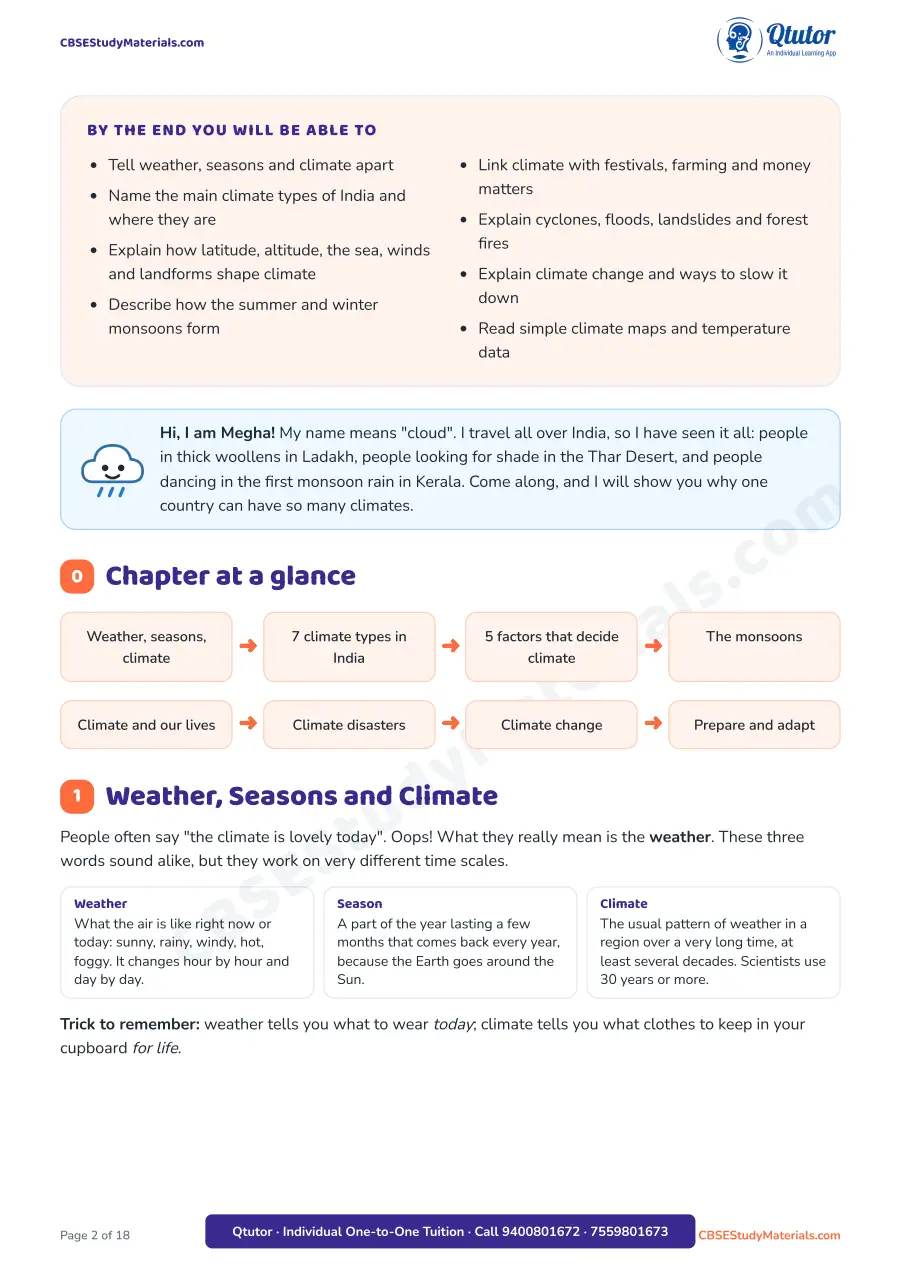
- A cover page, learning objectives and a "chapter at a glance" flow of all seven sections
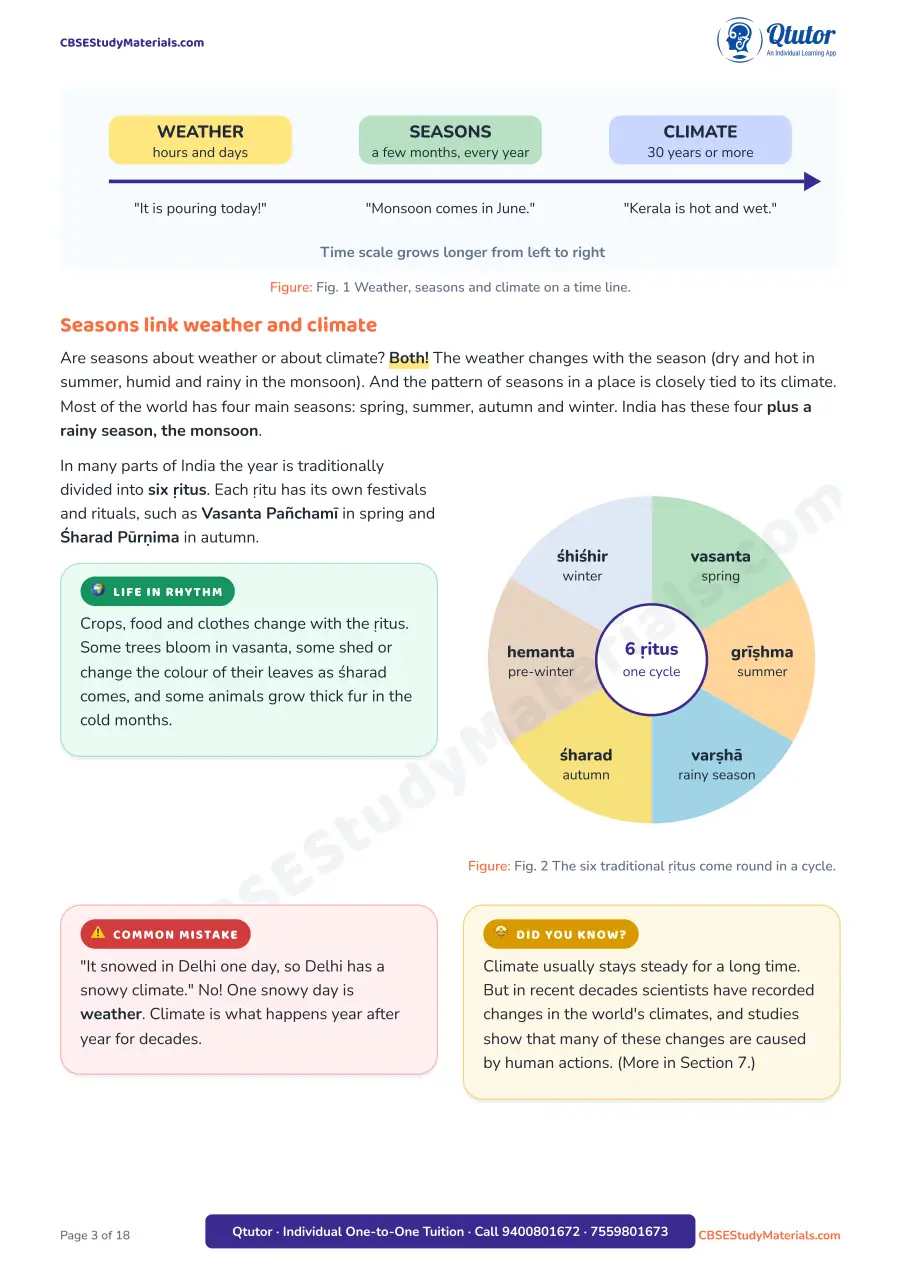
- Clear revision notes on weather, seasons and climate, including the six traditional ṛitus
- A table of the seven climate types of India (alpine, temperate, subtropical, arid, tropical wet, semi-arid, tropical) with a colour-coded simplified sketch map of India
- The five factors that decide climate: latitude, altitude, nearness to the sea, winds and topography, each with a diagram or worked example
- Microclimates and urban heat islands
- How the summer (southwest) and winter (northeast) monsoons form, with a pressure-and-wind diagram and two India wind maps
- Climate and our lives: festivals, farming and what happens when the monsoon fails
- Climate disasters: cyclones, floods, glacial bursts, landslides and forest fires
- Climate change, the greenhouse effect, mitigation and resilience
- A map of all the places named in the chapter, with a map task
- 15 key terms with simple meanings, and a full-chapter mind map
- "Check yourself": 12 important questions (MCQ, assertion-reason, data, case and HOTS) with an answer key
- A one-page summary for last-minute revision
All India maps show the complete official outline of India and are marked "Outline map not to scale; for practice only." The climate-types map is our own simplified sketch drawn from the chapter's descriptions, with approximate zone edges.
Structure of the Climates of India Notes PDF
| Part | What you get | Pages (approx.) |
|---|---|---|
| Cover, objectives, chapter at a glance | Big-picture start | 2 |
| Sections 1-2 | Weather, seasons, climate; 7 climate types with map | 3 |
| Section 3 | 5 factors of climate, microclimates | 3 |
| Section 4 | The monsoons, wind maps, traditional knowledge | 2 |
| Sections 5-7 | Climate and our lives, disasters, climate change | 4 |
| Revision tools | Places map, key terms, mind map | 2 |
| Practice and summary | 12 questions, answers, one-page summary | 2 |
Climates of India Class 7 Important Topics
- Difference between weather, season and climate (climate = pattern over 30 years or more)
- Six ṛitus: vasanta, grīṣhma, varṣhā, śharad, hemanta, śhiśhir
- Seven climate types of India and where each is found
- Latitude and the angle of the Sun's rays (Kanniyakumari versus Srinagar)
- Altitude and hill stations (Ooty versus Coimbatore)
- Sea as a temperature moderator (Mumbai versus Nagpur, range of temperature)
- Hot western winds, cold waves and moist sea winds
- Topography: the Himalayas and Karakoram as a shield, the flat Thar, the Western Ghats
- Monsoon mechanism: land heats and cools faster than the sea; air moves from high to low pressure
- Onset of the southwest monsoon (early June) and its spread (mid-July); the northeast monsoon
- Mawsynram's rainfall, monsoon ragas and traditional ways of predicting rain
- Monsoon failure and its effects on farms, prices and industry
- Cyclones and the eye, IMD and NDRF, floods, the 2013 Kedarnath disaster, landslides, forest fires
- Fossil fuels, greenhouse gases, global warming, mitigation, resilience, sustainable living
Climates of India Class 7 Important Questions (Sample)
Here are real excerpts from the "Check yourself" section and the notes.
Data question (Q3): Usual temperatures: Town X 34 °C (summer), 20 °C (winter); Town Y 45 °C (summer), 8 °C (winter). Which town is more likely on the coast? Show the ranges.
Answer: Range X = 34 − 20 = 14 °C; range Y = 45 − 8 = 37 °C. X has the smaller range, so it is more likely near the coast, because the sea moderates temperature.
Assertion-reason (Q5): Assertion: The northeast monsoon brings rain to the whole of north India in winter. Reason: Winter winds blow from the land towards the ocean.
Answer: Assertion false, Reason true. Winter winds are mostly dry; only the part that crosses the Bay of Bengal picks up moisture and brings rain to parts of east and south India.
From the notes, "Quick maths":
| City | Summer | Winter | Range |
|---|---|---|---|
| Mumbai (coast) | 32 °C | 18 °C | 14 °C |
| Nagpur (inland) | 44 °C | 10 °C | 34 °C |
How These Class 7 Climates of India Notes Help
- Understand, do not memorise. Each idea starts with a "why": why hills are cooler, why coasts are milder, why the monsoon winds reverse.
- See it on a map. Four original India maps (climate types, summer winds, winter winds and places in the chapter) make the geography easy to picture.
- Avoid common mistakes. Cards point out traps such as mixing up weather and climate, or thinking the southwest monsoon blows towards the southwest.
- Practise like the exam. The 12 questions are mostly application, data, case and HOTS, the competency-based style used in today's school tests.
- Revise fast. The mind map, key terms and one-page chapter summary are perfect the night before a test.
Who Should Use It
- Class 7 students studying Chapter 3 of Exploring Society: India and Beyond Part I
- Students who want short, clear revision notes before unit tests and half-yearly exams
- Parents and tutors looking for an NCERT based explanation with diagrams and practice questions
- Teachers who need a ready mind map and climate maps for class discussion
How to Download the Class 7 Climates of India Notes PDF
Click the download button below to buy and download the PDF (₹49). It opens on phones, tablets and computers, and prints well on A4 paper.
Climates of India - Class 7 Social Science Chapter 3 Chapter Notes (PDF · 18 pages · ₹49)
Related Resources
- Class 7 Social Science Chapter 3 Climates of India: chapter page
- Climates of India Class 7 NCERT Solutions
- Climates of India Class 7 Question Bank
- Previous chapter: Understanding the Weather
- Next chapter: New Beginnings: Cities and States
- All Class 7 Social Science study material
FAQs on Class 7 Social Science Chapter 3 Climates of India
Where can I download Class 7 Social Science Chapter 3 Climates of India notes PDF? Right on this page. Use the download button to get the 18-page premium notes PDF for ₹49.
What are the important topics in Climates of India Class 7? Weather versus climate, the seven climate types of India, the five factors of climate, the monsoons, climate and our lives, climate disasters and climate change.
What is the price of the Climates of India Class 7 notes PDF? It is a premium PDF priced at ₹49, with maps, diagrams, a mind map, 12 practice questions with answers and a one-page summary.
Which book is Climates of India Class 7 from? It is Chapter 3 of the NCERT Social Science textbook Exploring Society: India and Beyond, Grade 7 Part I (2026-27 edition).
Do the notes include important questions with answers? Yes. The "Check yourself" section has 12 questions (MCQ, assertion-reason, data, case-based and HOTS) followed by a compact answer key.
Are the India maps in the notes accurate? The maps are simplified outline maps for practice. They show the complete official boundary of India and are clearly marked "Outline map not to scale; for practice only."
Study tip: before you read Section 3, find Ooty, Coimbatore, Mumbai and Nagpur on the places map; the five factors of climate will make sense in minutes.