The Cherry Tree - Class 8 English Chapter 10 Notes (PDF · 13 pages · ₹49) Unlock the full PDF for ₹49
Free sample: pages 1 to 3 of 13. The full PDF costs ₹49.
Why does Grandfather say that nothing is lucky if you put it away, and how does one cherry seed survive a hungry goat and a grass-cutter's scythe? These The Cherry Tree Class 8 English Chapter 10 notes explain the whole story by Ruskin Bond for CBSE students using the new NCERT Poorvi textbook (Unit 4: Environment, 2026-27). This is a premium 13-page PDF of revision notes and study material, priced at ₹49. It is prepared independently by our team and is not an official CBSE or NCERT publication.
The notes follow the chapter in the same order as the book: the warm-up questions on growing plants, the story in two parts, the characters, the themes, the word meanings, the vocabulary and grammar exercises, listening, speaking, writing and the explore section. Everything is written in simple, friendly language for a Class 8 reader, with a labelled diagram on most topics.
Class 8 English Chapter 10 The Cherry Tree Notes: What Is Included
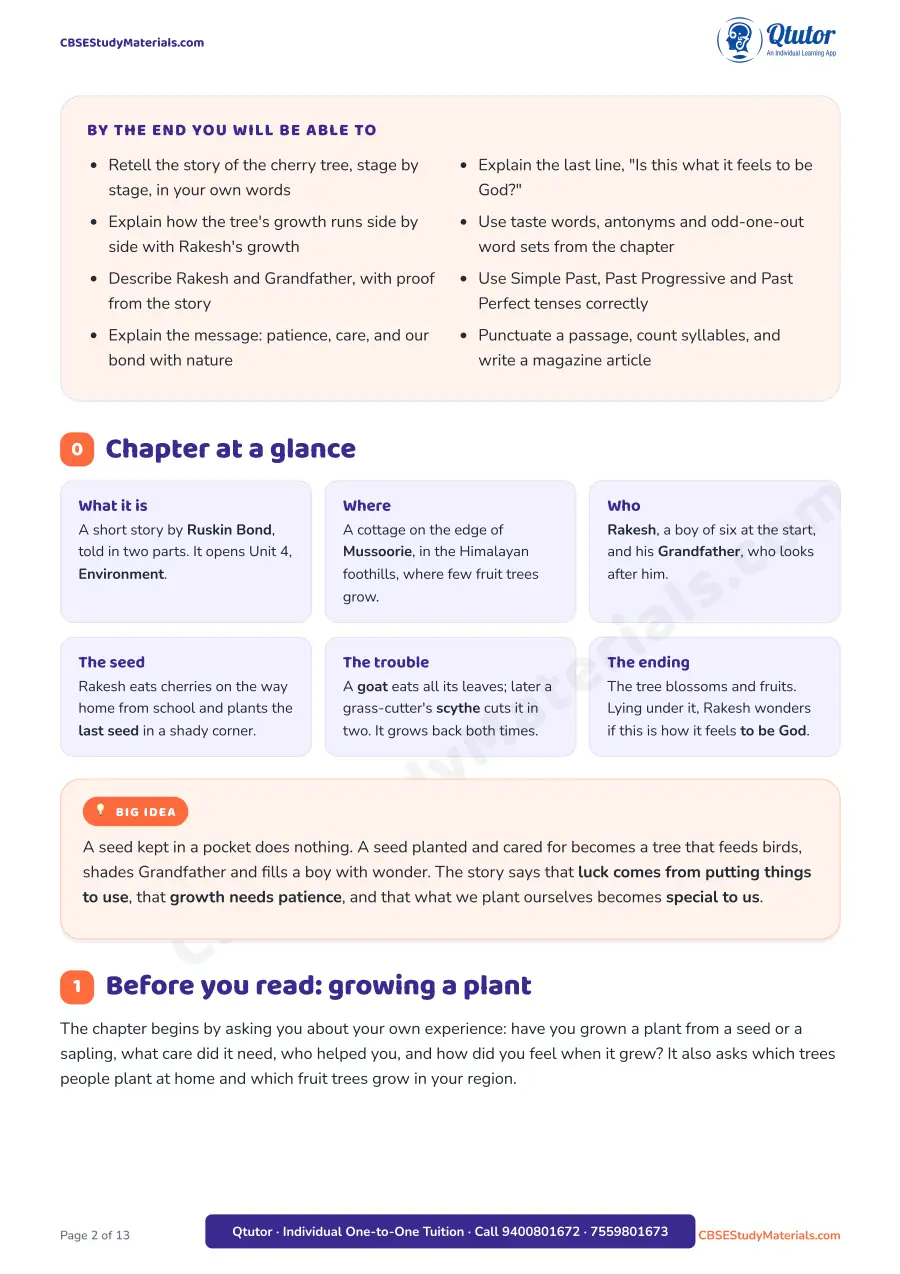
- Chapter at a glance: six quick boxes on the story type, the setting, the characters, the seed, the trouble and the ending, plus the big idea.
- Before you read: what every plant needs, and why cherries had to come all the way from the Kashmir Valley.
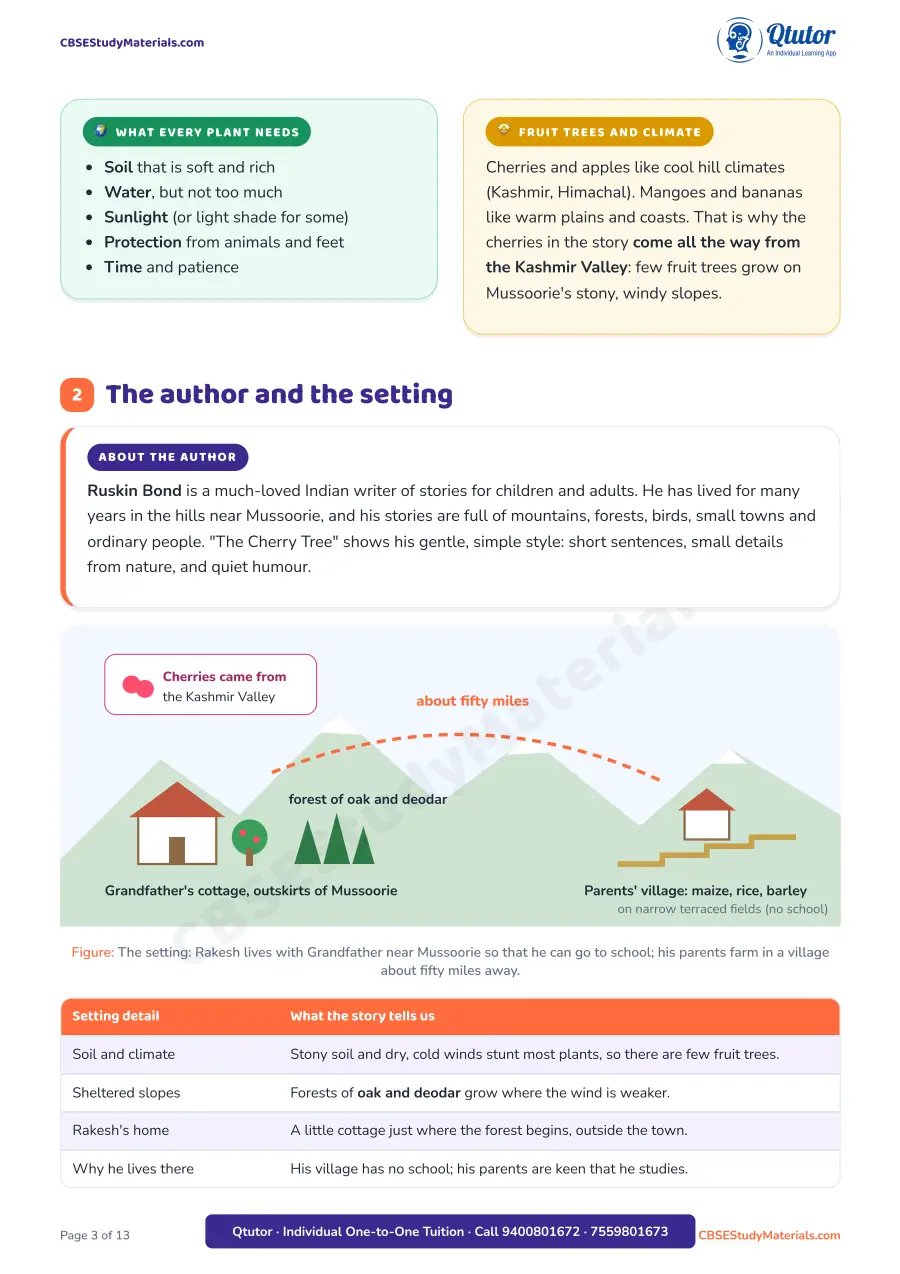
- The author and the setting: a note on Ruskin Bond, a labelled picture map of Grandfather's cottage near Mussoorie and the parents' village about fifty miles away, and a setting table.
- The story, part by part: a clear retelling of Part I and Part II in six short blocks, in our own words (a full chapter summary).
- Growing up together: a growth-line diagram showing the tree at each stage (4 inches, about 2 feet, chest-high, first blossom, sour cherries) beside Rakesh's age (6, 8, 9).
- Nature through the seasons: a four-season diagram (winter, spring, monsoon, summer) and what each season does to the tree, plus the V-shaped flight of wild ducks.
- The tree's visitors: an ecosystem diagram of the praying mantis, the hairy caterpillar, bees, birds, bulbuls and scarlet minivets.
- Characters: Rakesh, Grandfather and the tree itself, with qualities and evidence in a table.
- Themes and message: luck and effort, patience and care, resilience, and the bond between humans and nature, with an explanation of the last line, "Is this what it feels to be God?"
- Word meanings: 18 words such as stunted, tang, yielding, plodded, scythe, foliage, flitted and reclining.
- Vocabulary: odd-one-out sets, taste words (sweet, sour, tangy, bitter, spicy, salty, bland) and the eight antonyms from the exercise.
- Grammar: Simple Past, Past Progressive and Past Perfect on a timeline with examples from the story, and a full punctuation and capital-letters table.
- Listening, speaking, writing and exploring: the Chipko and Appiko movements, Saalumarada Thimakka and Jadav Payeng, syllable counting, the article format, Van Mahotsav, famous banyan trees and Kailash Sankhala.
- A mind map, a 12-question practice set with an answer key, and a one-page summary to revise before a test.
Structure of the PDF
| Part | What you get |
|---|---|
| Cover and objectives | Eight learning goals for the chapter |
| Chapter at a glance | Six-box overview and the big idea |
| Before you read, author, setting | Plant-care card, setting map, setting table |
| The story | Part I and Part II retold in six blocks |
| Growth and seasons | Growth-line diagram, four-season diagram |
| Visitors and characters | Ecosystem diagram, character table, their bond |
| Themes and word meanings | Four theme cards, the last line explained, 18-word grid |
| Vocabulary and grammar | Taste words, antonyms, tense timeline, punctuation table |
| Listen, speak, write, explore | Tree heroes timeline, syllable table, article plan |
| Revision | Mind map, 12 practice questions with answers, one-page summary |
The Cherry Tree Class 8 Important Topics
- Why Rakesh lives with Grandfather in Mussoorie, and why few fruit trees grow there
- Grandfather's advice on luck, and planting the seed in a shady corner
- The sprout in spring, the pebbles "for privacy" and "Don't drown it!"
- The two setbacks: the goat and the scythe, and how the tree recovers
- The tree's growth running parallel to Rakesh's growth
- The visitors: the praying mantis and the hairy caterpillar, and Rakesh's different reactions
- The first pink blossom, the sour cherries and the birds that feast on them
- The meaning of the last line and the message of the story
- Taste words, antonyms, past tenses and punctuation from the language exercises
The Cherry Tree Class 8 Notes: Sample from This PDF
From the growth-line diagram:
| Stage | Tree | Rakesh |
|---|---|---|
| Seed planted | in a shady corner | 6 years old |
| Goat eats leaves | about 2 feet | |
| After the scythe and the monsoon | chest-high | 8 years old |
| First blossom | almost as tall as Rakesh | 9 (tree is 4) |
Common mistake box: Rakesh does not kill the hairy caterpillar. He drops it on a heap of dry leaves and tells it to come back when it is a butterfly. He protects the tree and respects the creature.
Practice question (from Check yourself): Why does Rakesh water the tree even when it rains? Answer: he wants the tree to know that he is there; watering is a sign of love and attention, not only a need.
How These Revision Notes Help
The notes turn a gentle story into clear exam answers. You learn to describe Rakesh and Grandfather with evidence, to explain the message about luck, patience and nature, and to answer the tricky question on the last line. The diagrams make the order of events and the seasons easy to remember, which helps with sequencing and cause-and-effect questions. The vocabulary and grammar parts match the textbook exercises, so the notes also help with the language section of your test, and the one-page summary is built for a quick look the night before.
Who Should Use It
- Class 8 students reading The Cherry Tree in the NCERT Poorvi book for the first time
- Students revising Unit 4 (Environment) before a periodic test or the annual exam
- Parents and tutors who want an organised, NCERT based chapter summary to teach from
The Cherry Tree - Class 8 English Chapter 10 Notes (PDF · 13 pages · ₹49)
How to Download the Class 8 The Cherry Tree Notes PDF
Use the download button above. This is a premium PDF download priced at ₹49; once purchased, you can save it and study offline or print it.
Related resources
- The Cherry Tree Class 8 Chapter Notes PDF
- The Cherry Tree Class 8 NCERT Solutions PDF
- The Cherry Tree Class 8 Question Bank PDF
- The Cherry Tree: Class 8 English chapter page
- All Class 8 English chapters
- Previous chapter: Spectacular Wonders
- Next chapter: Harvest Hymn
FAQs on Class 8 English Chapter 10 The Cherry Tree
Where can I download Class 8 English Chapter 10 The Cherry Tree notes PDF? On this page. Use the download button to get the 13-page premium notes PDF for ₹49.
What are the important topics in The Cherry Tree Class 8? Grandfather's advice on luck, planting the seed, the goat and the scythe, the tree's recovery, the visitors, the first blossom, the parallel growth of Rakesh and the tree, and the meaning of the last line.
Who wrote The Cherry Tree? Ruskin Bond. The story is set near Mussoorie in the Himalayan foothills.
What is the message of The Cherry Tree? Luck comes from putting things to use, growth needs patience and care, nature is tough, and what we plant ourselves becomes special to us.
Which book is The Cherry Tree Class 8 from? It is Chapter 10 of the NCERT Class 8 English textbook Poorvi, the first chapter of Unit 4, Environment.
How much does The Cherry Tree notes PDF cost? It is a premium PDF priced at ₹49, with diagrams, a mind map, practice questions and a one-page summary.
Study tip: when you write about a character, give one quality, then one action from the story that proves it.