Orienting Yourself: The Use of Coordinates - Class 9 Maths Chapter 1 Model Question Paper (PDF · 13 pages · Free download) Download the full PDF free
You are looking at pages 1 to 3 of 13. The full PDF is free to download.
Can a merchant in an old grid town tell which shop is nearer just by looking at the map? In Question 23 of this paper the Granary is nearer to the Well as the crow flies, but the Dock is nearer for anyone walking along the streets. This free Orienting Yourself: The Use of Coordinates Class 9 Maths Chapter 1 model question paper is a CBSE board-pattern PDF of 13 pages, written on the NCERT Ganita Manjari (Grade 9, Part I) textbook for CBSE 2026-27. It is an independent practice paper, not an official CBSE or NCERT publication, and it comes with a full answer key and marking scheme.
The paper has 24 questions for 50 marks, set out in the same five sections (A to E) that the Class 10 Maths board paper uses, which the 2026-27 curriculum also recommends for Class 9. Eight questions carry an internal OR choice. Use it as a timed chapter test, as a set of important questions for revision, or as study material for a class test.
Class 9 Maths Chapter 1 Model Question Paper: What Is Included
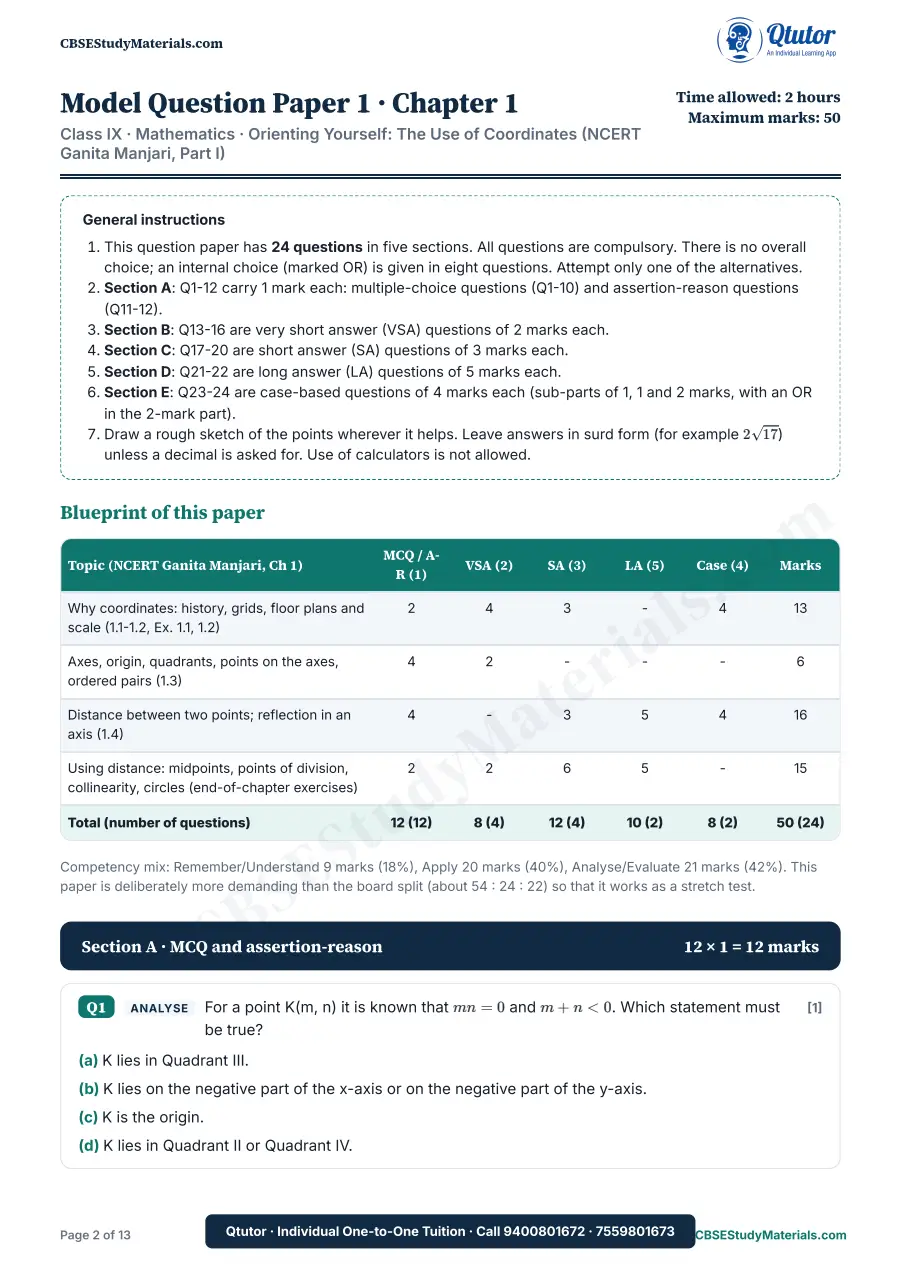
- A board-style paper head (time 2 hours, maximum marks 50) and seven general instructions
- A blueprint table that maps every mark to a part of the chapter (sections 1.1 to 1.4 and the end-of-chapter exercises) and to a question type, plus the competency split
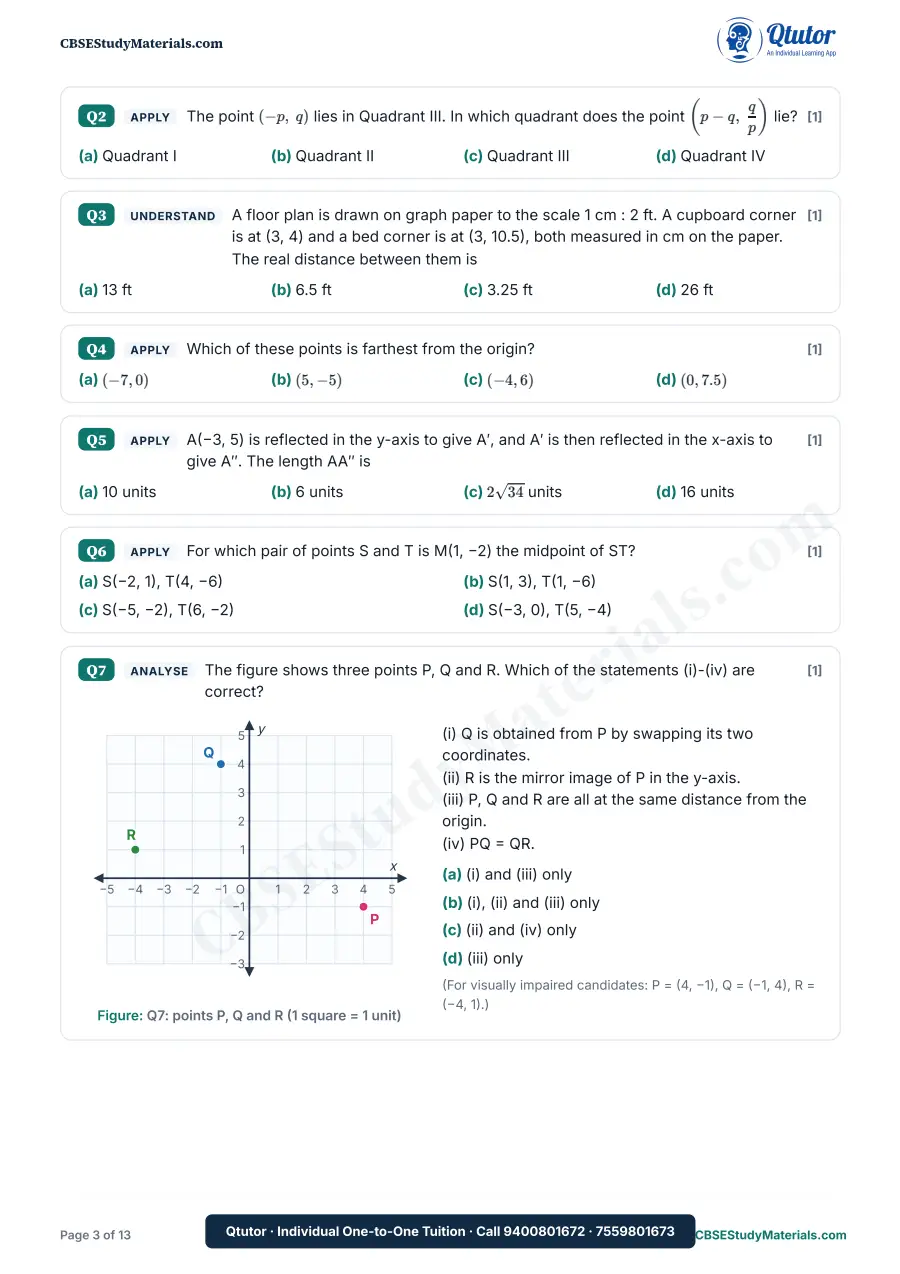
- Section A: 10 MCQs and 2 assertion-reason questions (1 mark each), including a "which of (i)-(iv) are correct" item with a coordinate-grid figure
- Section B: 4 very short answer questions (2 marks), two with an OR choice
- Section C: 4 short answer questions (3 marks), two with an OR choice
- Section D: 2 long answer questions (5 marks), both with an OR choice
- Section E: 2 case-based questions (4 marks, sub-parts of 1, 1 and 2) with an OR in the 2-mark part
- A complete answer key and marking scheme with ½-mark step values, a one-line reason for every MCQ answer and a "where marks are lost" box
- Six original figures: five coordinate grids drawn to scale (three of them inside the answer key) and an auditorium seating plan, plus two photos
Structure of the Paper
| Section | Questions | Type | Marks |
|---|---|---|---|
| A | Q1-12 | MCQ and assertion-reason | 12 × 1 = 12 |
| B | Q13-16 | Very short answer | 4 × 2 = 8 |
| C | Q17-20 | Short answer | 4 × 3 = 12 |
| D | Q21-22 | Long answer | 2 × 5 = 10 |
| E | Q23-24 | Case-based | 2 × 4 = 8 |
| 24 | 50 |
About 18% of the marks test recall and understanding, 40% application and 42% analysis and evaluation. It is tougher than the usual board split on purpose.
Orienting Yourself Class 9 Important Topics Covered
- Why we need a system of coordinates, and the history the chapter tells, from the grid streets of the Sindhu-Sarasvatī cities to Brahmagupta's negative numbers and Descartes
- Floor plans and scale, in the spirit of Reiaan's room in the textbook
- The x-axis, the y-axis, the origin and points that lie on the axes
- The four quadrants and the sign of each coordinate; why (x, y) and (y, x) are different points
- Distance between two points on a line parallel to an axis
- The distance formula from the Baudhāyana–Pythagoras theorem
- Reflection of points and shapes in the x-axis and the y-axis
- Ideas from the end-of-chapter exercises: midpoints, points of trisection, collinearity without plotting, points inside, on or outside a circle, and vertices from the midpoints of a triangle's sides
Orienting Yourself Class 9 Important Questions (Sample)
Section A, MCQ (Q2). The point (−p, q) lies in Quadrant III. In which quadrant does left(p − q, q⁄pright) lie? The marking scheme reasons from the signs: p > 0 and q < 0, so the point has signs (+, −) and lies in Quadrant IV.
Section A, assertion-reason (Q12). Assertion: The distance between (−3, 2) and (5, 2) is 8 units. Reason: The distance between (x1, y) and (x2, y) is |x1| + |x2|. The assertion is true, but the reason is false: the correct rule is |x2 − x1|, and it only matches here because the two points lie on opposite sides of the y-axis.
Section D, long answer (Q22). A mobile tower at T(1, 2) covers places within 5 km. Villages are at P(4, 6), Q(−2, 5), R(−2, −3) and S(6, 3). Comparing squared distances with 25:
| Village | Squared distance from T | Signal? |
|---|---|---|
| P(4, 6) | 32 + 42 = 25 | Yes (on the edge) |
| Q(−2, 5) | 32 + 32 = 18 | Yes |
| R(−2, −3) | 32 + 52 = 34 | No |
| S(6, 3) | 52 + 12 = 26 | No |
A second tower on the x-axis, equally far from R and S, comes out at (2, 0), exactly 5 km from both.
Section E, case-based (Q24). Seats in an auditorium are named (seat number, row number), with seats 0.5 m apart and rows 1 m apart. For seats (4, 3) and (16, 11) the shifts are 6 m across and 8 m back, so the distance is √(62 + 82) = 10 m, and the scheme explains why √(122 + 82) would be wrong.
How This Model Question Paper Helps
- Every question is original and most are indirect: you have to decide which idea to use before you calculate.
- The blueprint shows exactly how the 50 marks are spread over the chapter, so you can find your weak topic quickly.
- The marking scheme shows where the ½ marks go (the formula, the substitution, the sign check, the final answer), which is how board examiners mark.
- Real contexts such as a mobile tower, a water pipeline, a classroom plan, a chessboard and an auditorium make the coordinate ideas stick.
Who Should Use It
Class 9 students preparing for a unit test, periodic test or half-yearly exam on Chapter 1; students who have finished the NCERT exercises and want board-style important questions; and teachers who need a ready chapter test with a marking scheme. Attempt it in 2 hours without a calculator, then check your answers with the scheme.
How to Download the Class 9 Orienting Yourself Model Question Paper PDF
The PDF is free. Use the button below to download it and print it.
Orienting Yourself: The Use of Coordinates - Class 9 Maths Chapter 1 Model Question Paper (PDF · 13 pages · Free download)
Related Resources
- Class 9 Maths Chapter 1 Orienting Yourself: The Use of Coordinates, all materials
- Orienting Yourself: The Use of Coordinates Class 9 chapter notes PDF
- Orienting Yourself: The Use of Coordinates Class 9 worksheet PDF
- Class 9 Maths Coordinate Geometry model question paper (question bank, more practice)
- Next chapter: Class 9 Maths Chapter 2 Introduction to Linear Polynomials
- All Class 9 Mathematics study material
FAQs on Class 9 Maths Chapter 1 Orienting Yourself: The Use of Coordinates
Where can I download the Class 9 Maths Chapter 1 model question paper PDF? On this page. Click the download button above to get the 13-page PDF with its answer key and marking scheme.
Is the Orienting Yourself Class 9 model question paper free? Yes. This Chapter 1 paper is free to download, and the answer key and marking scheme are inside the same PDF.
Which book is Orienting Yourself: The Use of Coordinates Class 9 from? It is Chapter 1 of the NCERT Class 9 Mathematics textbook Ganita Manjari (Grade 9, Part I), used for CBSE 2026-27.
What is the pattern of this Class 9 Maths Chapter 1 question paper? It follows the CBSE board Maths section pattern: Section A MCQs and assertion-reason, Section B very short answers, Section C short answers, Section D long answers and Section E case-based questions, 50 marks in all.
What are the important questions in Orienting Yourself Class 9? Questions on quadrants and signs of coordinates, distance between two points, collinearity, midpoints and points of trisection, points inside or outside a circle, and reflections in the axes. This paper has board-style examples of each.
Does the paper have answers? Yes. A full answer key and marking scheme with step marks follows the question paper, with a reason for every MCQ.
Study tip: before using any formula, say out loud which coordinate changes and which stays the same; half the mistakes in this chapter disappear.