Try Again - Class 7 English Chapter 2 NCERT Solutions (PDF · 13 pages · ₹49) Unlock the full PDF for ₹49
Free sample: pages 1 to 3 of 13. The full PDF costs ₹49.
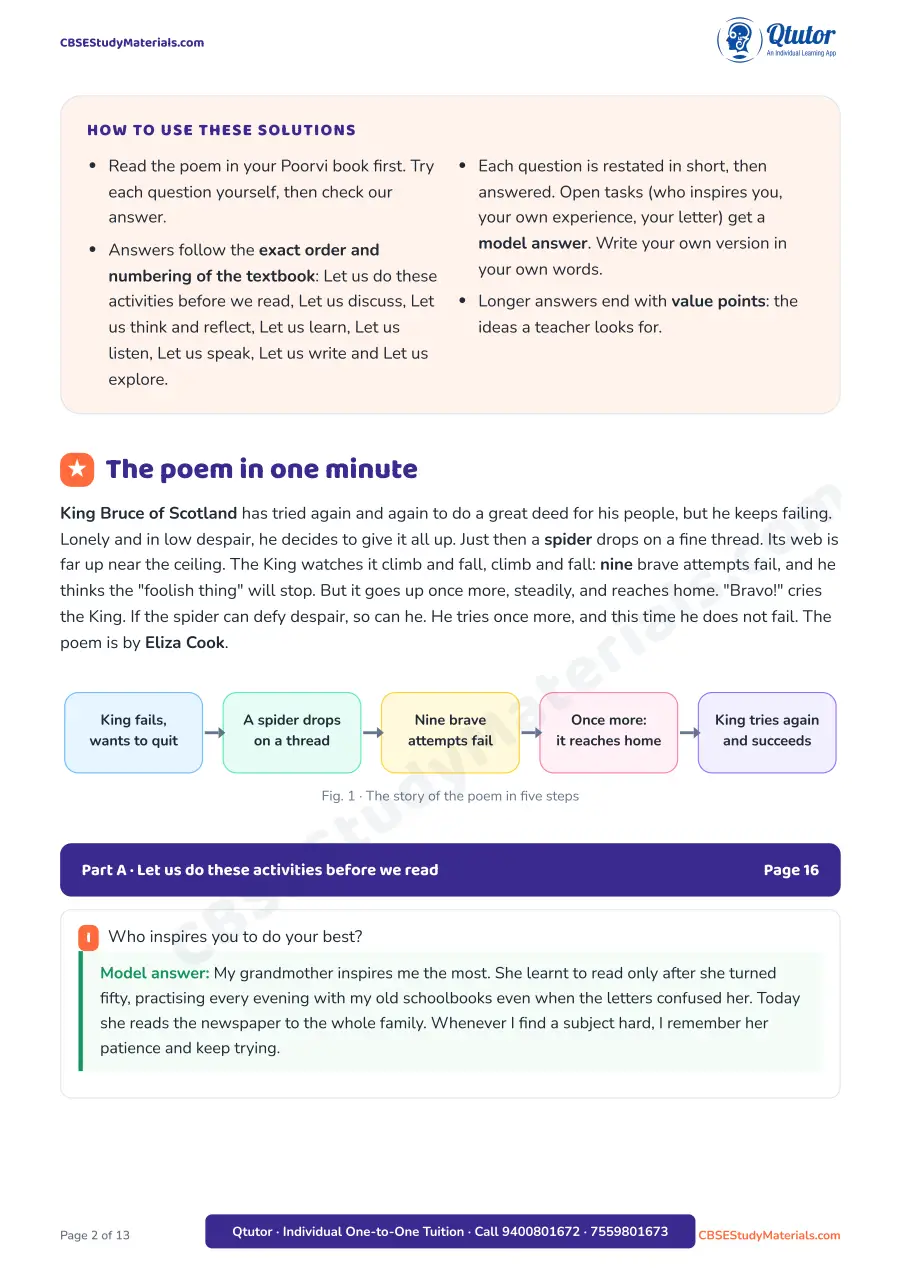
What does "toil : hard" have to do with "roll : tumble", and why does the poet repeat "steadily, steadily"? Class 7 English Chapter 2 Try Again in the CBSE NCERT Poorvi textbook comes with many such questions, and these NCERT Solutions answer every one of them in a clear 13-page PDF. This is a premium PDF (₹49) of NCERT based solutions for the new Poorvi book (CBSE 2026-27). It is our own study material, not an official CBSE or NCERT publication.
The solutions follow the textbook page by page, in the same order and with the same numbering, so you can keep your Poorvi book open beside the PDF. Each question is restated in short and then answered. Open tasks such as "Who inspires you?", the personal narration and the letter to your cousin get a model answer that you can adapt into your own words.
Class 7 English Chapter 2 Try Again NCERT Solutions: What Is Included
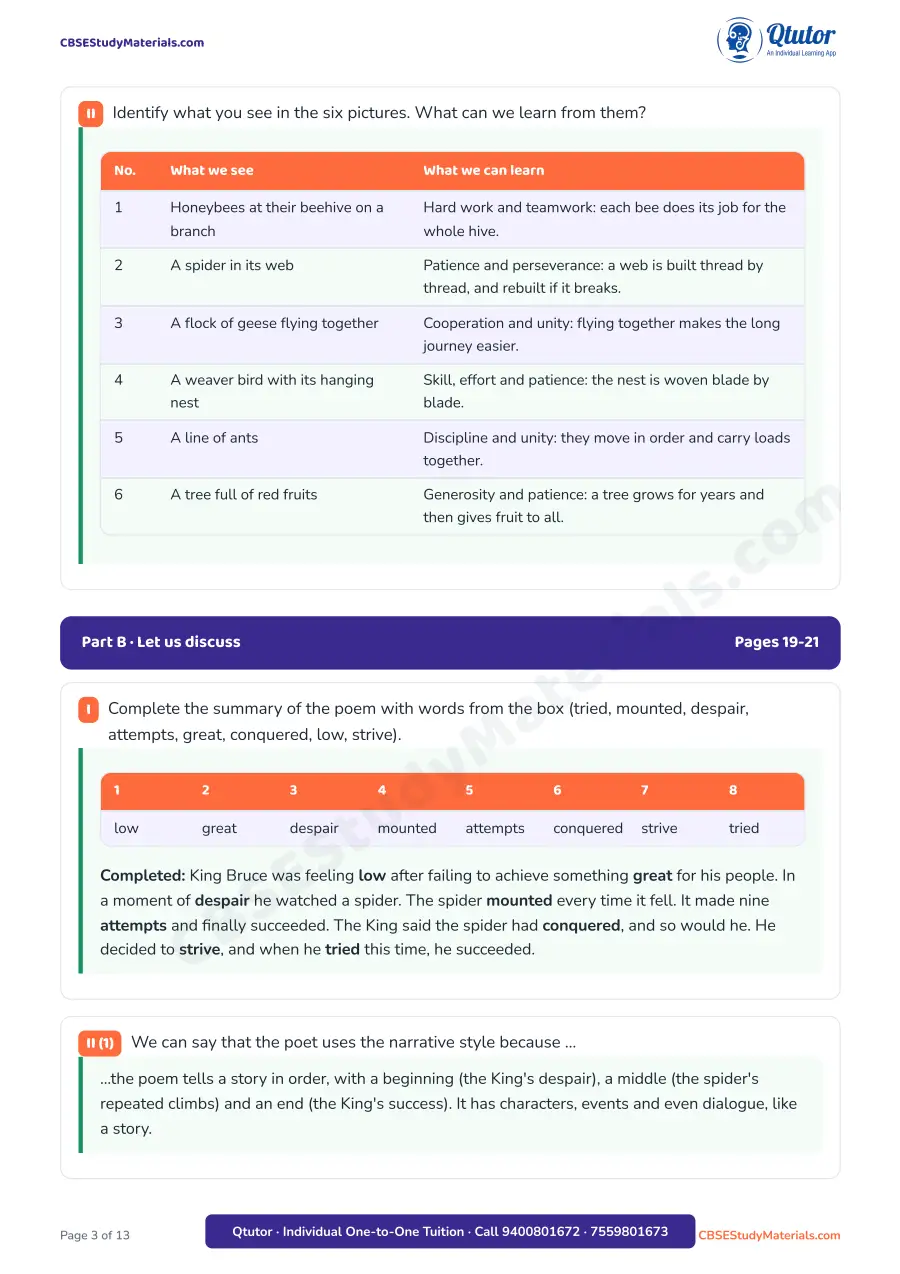
- Let us do these activities before we read: a model answer for "Who inspires you?" and a table of all six pictures with what we see and what we can learn.
- Let us discuss: the completed poem summary (all 8 blanks), both sentence completions, three lines on the spider's efforts, alliteration examples, why the poet repeats words, the rhyme scheme, "Bravo" and 'twas/'tis.
- Metaphor and simile: all nine M/S items and the five transformations (iii to vii).
- Let us think and reflect: both extract sets (eight parts, including the MCQs and the analogy) and all six long questions, with value points.
- Let us learn: opposites, the four underlined words with meanings and our own sentences, the far/near classification and tongue twisters.
- Let us listen: answers to all five questions on the ant's story, based on the transcript printed in the book.
- Let us speak: a complete model narration following the book's seven prompts.
- Let us write: a full model letter to a cousin using To begin with, Next, After that, Then and Finally.
- Let us explore: how to collect folk songs, a spider vs ant comparison table, and the web-weaving steps with a diagram.
- 3 original diagrams and a four-box quick recap.
Structure of the PDF
| Part | Textbook section | Pages |
|---|---|---|
| Cover, how to use, poem in one minute | Plot flow diagram | 1-2 |
| Part A | Let us do these activities before we read | 2-3 |
| Part B | Let us discuss (I to VI) | 3-5 |
| Part C | Let us think and reflect (I and II) | 5-8 |
| Part D | Let us learn (I to IV) | 8-9 |
| Parts E, F, G | Let us listen, Let us speak, Let us write | 10-11 |
| Part H and recap | Let us explore, quick revision | 12-13 |
Try Again Class 7 Question Answers: Important Topics
- Completing the summary of the poem with words like despair, mounted and conquered
- Narrative style and the central idea of the poem
- Alliteration, repetition, rhyme scheme ABAB and the interjection "Bravo"
- Similes and metaphors, and changing one into the other
- Extract-based questions on "low despair", "pondered", "silken filmy clue" and "Ah me!"
- How King Bruce's attitude changes, and how the spider inspires us
- Opposites, effort words and near/far distance words
Try Again Class 7 NCERT Solutions (Sample)
Let us discuss, V: 1. The rhyme scheme is ABAB. 2. "Bravo" is an interjection. 3. The poet uses 'twas and 'tis for the sake of rhythm.
Let us learn, III (Far or Near):
| Far | Near |
|---|---|
| middle of nowhere, remoteness, yonder, afar, light year, farther | proximity, vicinity, adjacent, a stone's throw, hairline |
Think and reflect, II.5 (extract of the model answer): Each fall teaches the spider something; once it even gets "half-yard higher". Its nine failed attempts lead to the successful next try, so failures are not wasted but bring us a step closer to success.
How These NCERT Solutions Help
The exercises on this poem mix comprehension, poetic devices, vocabulary, grammar, listening, speaking and writing. Having every answer in one place, in book order, saves time when you do homework or revise before a test. Long answers end with value points, so you learn what a teacher looks for, and the model narration and letter show the right format and tone. For tricky items such as the analogy question, the PDF explains the reasoning step by step and why the other options are wrong.
Who Should Use These Solutions
- Class 7 CBSE students using the NCERT Poorvi English textbook in 2026-27
- Students who want to check their own answers after attempting the exercises
- Parents who help with English homework
- Tutors who want a quick, reliable answer guide for this chapter
How to Download the Try Again Class 7 NCERT Solutions PDF
Use the download button below to buy and download the premium 13-page PDF for ₹49.
Try Again - Class 7 English Chapter 2 NCERT Solutions (PDF · 13 pages · ₹49)
Related Resources
- Chapter page: Try Again, Class 7 English Chapter 2
- Subject page: Class 7 English study material
- Try Again Class 7 notes: stanza-by-stanza notes, word meanings, poetic devices, mind map and a one-page summary (15 pages)
- Try Again Class 7 question bank: 63 extra important questions with answers, grammar and writing practice (13 pages)
- Previous chapter: The Day the River Spoke, Class 7 English Chapter 1
- Next chapter: Three Days to See, Class 7 English Chapter 3
FAQs on Class 7 English Chapter 2 Try Again NCERT Solutions
Where can I download Class 7 English Chapter 2 Try Again NCERT Solutions PDF? On this page. The premium 13-page PDF costs ₹49 and answers every question of the chapter.
Are the answers in the same order as the NCERT book? Yes. They follow the Poorvi book from "Let us do these activities before we read" to "Let us explore", with the same numbering.
What is the rhyme scheme of the poem Try Again? ABAB: the first and third lines rhyme, and the second and fourth lines rhyme in every stanza.
What is the central idea of Try Again Class 7? Never give up. Perseverance and the courage to try again after failing lead to success, and inspiration can come even from a tiny spider.
Which book is Try Again Class 7 from? It is from Poorvi, the NCERT English textbook for Class 7, Unit 1 "Learning Together". The poem is by Eliza Cook.
Do the solutions include the letter and the speaking task? Yes. There is a full model narration for "Let us speak" and a model letter for "Let us write", each with value points.
Study tip: attempt each exercise on your own first, then use the solutions to check and improve your answers.