Symmetry - Class 6 Maths Chapter 9 Notes (PDF · 16 pages · ₹49) Unlock the full PDF for ₹49
Free sample: pages 1 to 3 of 16. The full PDF costs ₹49.
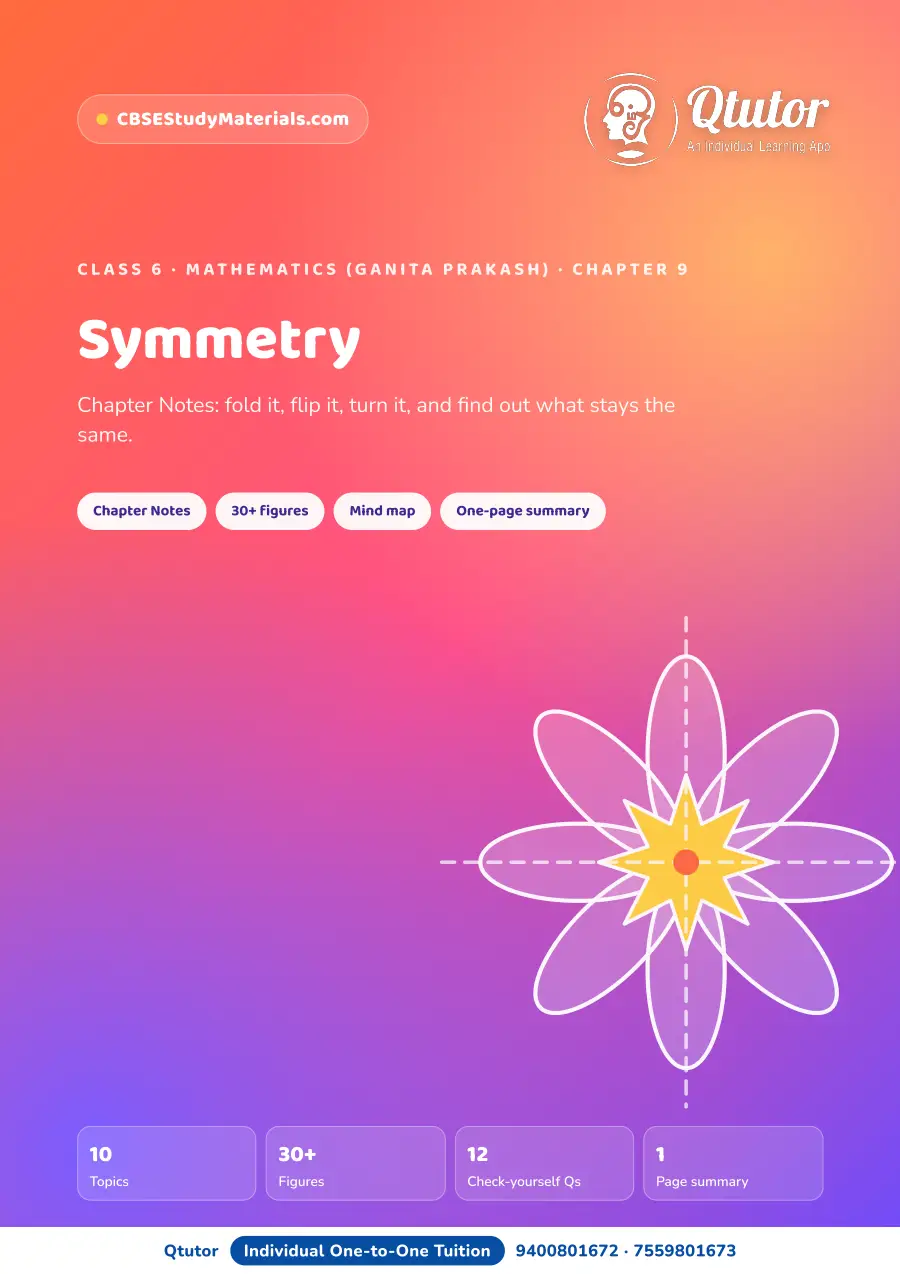
Why does a paper windmill look perfect even though no fold can split it into matching halves? And why can a figure turn into itself after 45° but never after 17°? These Symmetry Class 6 Maths Chapter 9 notes answer such questions for CBSE Class 6 NCERT Ganita Prakash Chapter 9, with more than 30 original diagrams. This is a premium 16-page PDF (₹49) of chapter notes and revision notes built on the 2026-27 NCERT textbook. It is our own study material and not an official CBSE or NCERT publication.
The notes explain every idea of the chapter in simple words, with pictures you can copy into your notebook: folding a square four ways, reflecting the corners of a square, punching holes in folded paper, completing figures on squared paper, turning a windmill and a square, and spreading radial arms evenly. Each topic ends with a short real-life link or a common-mistake warning, so you understand why the rule works and not only what it is.
Class 6 Maths Chapter 9 Symmetry Notes: What Is Included
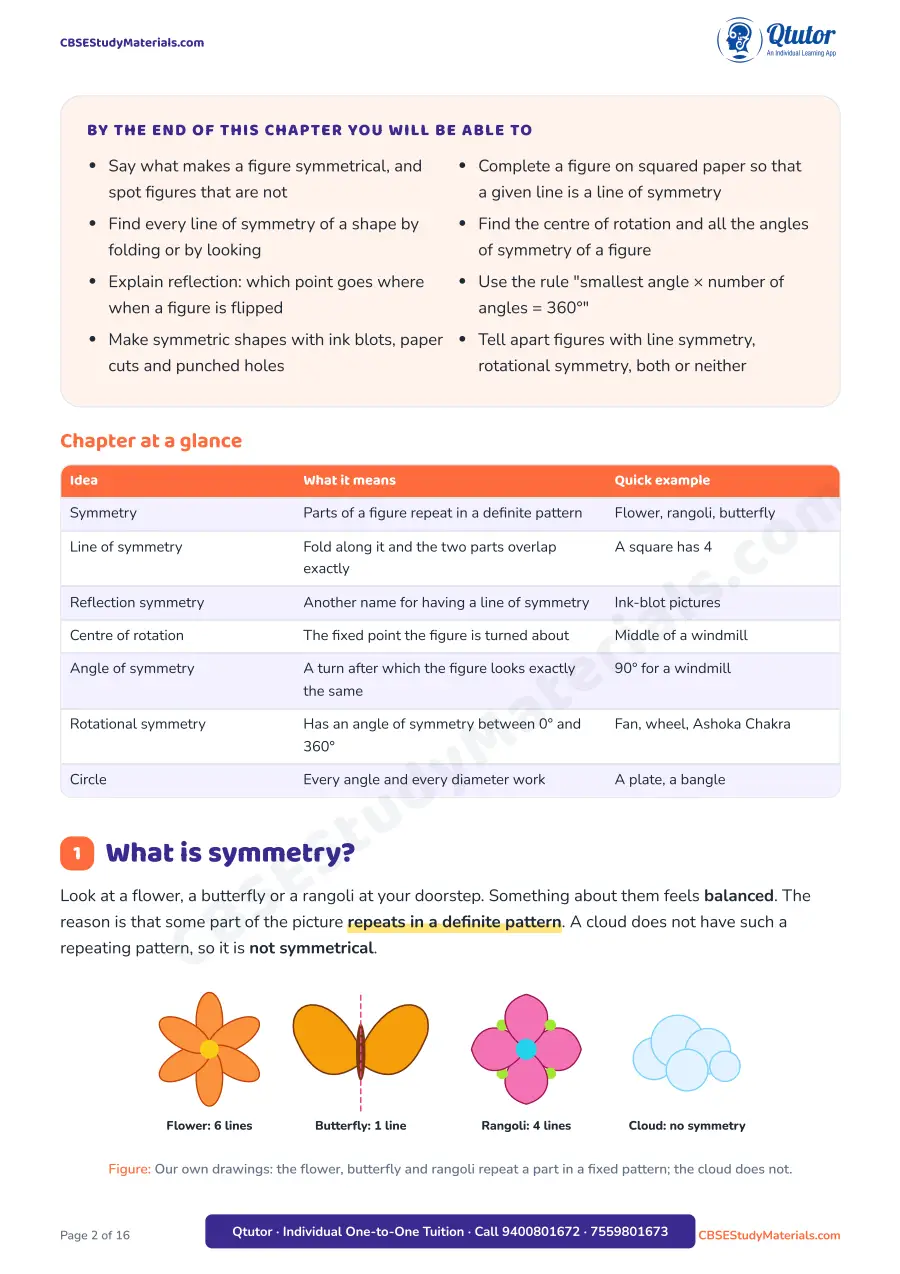
- Learning objectives and a "chapter at a glance" table of the seven key ideas
- 10 numbered topics, from "What is symmetry?" to "Line symmetry, rotational symmetry, or both?"
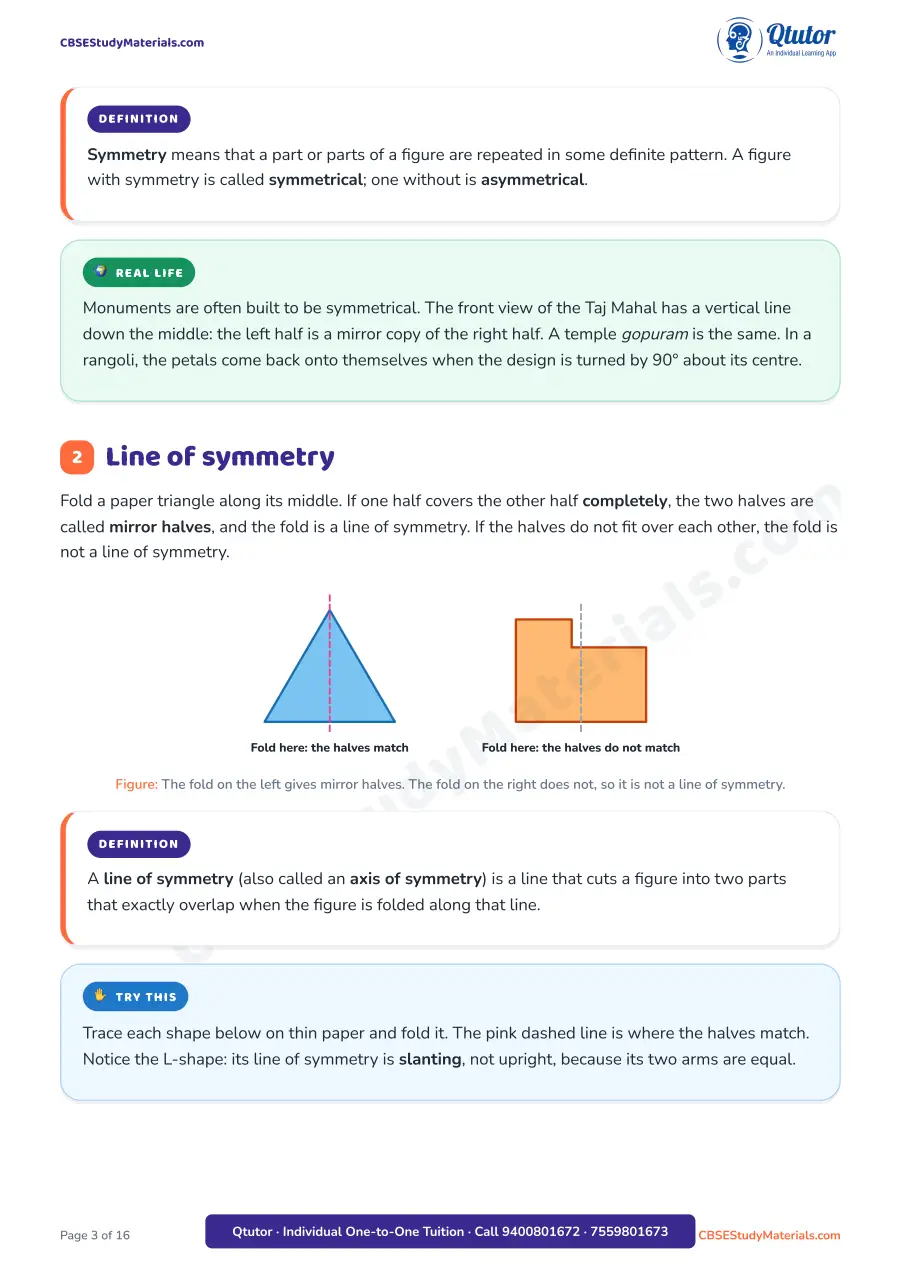
- More than 30 original SVG figures: mirror halves, square folds, regular polygons, reflection of square ABCD, ink blots, paper cuts, punched holes, squared-paper completions, windmill, radial arms, circle sectors and the Ashoka Chakra
- Definition, concept, real-life, did-you-know, think-deeper and common-mistake cards
- Two rules about angles of symmetry, with a table showing which smallest angles are possible
- A comparison table of lines and angles of symmetry for 8 common shapes
- A puzzle corner: the 6 × 6 domino game and how symmetry wins it
- Key terms grid and a colourful mind map
- "Check yourself": 12 application and reasoning questions with an answer key
- A one-page summary for last-minute revision
Structure of the PDF
| Part | What you get |
|---|---|
| Cover, objectives, at a glance | What you will learn and a one-table overview |
| Topics 1–5 | Symmetry, line of symmetry, reflection, making symmetric shapes, completing figures on squared paper |
| Topics 6–8 | Rotational symmetry, radial arms, the two rules about angles of symmetry |
| Topics 9–10 | The circle, symmetry around us, figures with one kind, both kinds or neither |
| Key terms and mind map | All the new words of the chapter on one page |
| Check yourself | 12 questions with a compact answer key |
| One-page summary | The whole chapter in 15 bullet points |
Symmetry Class 6 Important Topics
- Symmetry as parts of a figure repeating in a definite pattern
- Line (axis) of symmetry and mirror halves; figures with many lines of symmetry
- Why a rectangle's diagonal is not a line of symmetry
- Regular polygons: n sides, n lines; triangles with 3, 1 or 0 lines, and why 2 is impossible
- Reflection and reflection symmetry
- Making symmetric shapes with ink blots, paper folding and cutting, and the punching game
- Rotational symmetry, centre of rotation and angle of symmetry
- Radial arms: smallest angle = 360° ÷ number of arms
- All angles of symmetry are multiples of the smallest one, which must divide 360
- Symmetries of a circle; objects with rotational symmetry around us
Symmetry Class 6 Important Questions (Sample)
Which smallest angles are possible? The notes include this table:
| Smallest angle | Possible? | Number of angles |
|---|---|---|
| 45° | Yes: 360 ÷ 45 = 8 | 8 |
| 60° | Yes: 360 ÷ 60 = 6 | 6 |
| 17° | No: 360 ÷ 17 is not whole | – |
Radial arms. Three equal arms make the figure fit on itself only if A = B = C, so each gap is 360° ÷ 3 = 120° and the angles of symmetry are 120°, 240° and 360°. With 7 arms the smallest angle is 51tfrac37°, not a whole number.
Check yourself, Q6. A square sheet is folded in half upright and then sideways, and one hole is punched. On opening there are 4 holes, and both fold lines are lines of symmetry of the pattern.
How It Helps
The notes turn a very visual chapter into clear steps you can follow with a pencil and paper. The figures show exactly where each line of symmetry lies and where each point goes after a reflection or a turn. The two rules about angles of symmetry help you solve the trickier "smallest angle" questions in seconds. The check-yourself questions are mostly application and reasoning questions, so you practise thinking, not memorising.
Who Should Use It
- Class 6 students studying Ganita Prakash who want picture-based notes for Chapter 9
- Students revising before a unit test who need the mind map and one-page summary
- Parents and tutors looking for NCERT based study material and important questions for CBSE 2026-27
How to Download the Class 6 Symmetry Notes PDF
This is a premium PDF priced at ₹49. Use the button below to buy and download it; it prints well on A4 and reads easily on a phone.
Symmetry - Class 6 Maths Chapter 9 Notes (PDF · 16 pages · ₹49)
Related Resources
- Class 6 Maths Chapter 9 Symmetry chapter page
- All Class 6 Mathematics study material
- Symmetry Class 6 NCERT Solutions PDF
- Symmetry Class 6 Question Bank PDF
- Previous chapter: Playing with Constructions (Class 6 Maths Chapter 8)
- Next chapter: The Other Side of Zero (Class 6 Maths Chapter 10)
FAQs on Class 6 Maths Chapter 9 Symmetry
Where can I download Class 6 Maths Chapter 9 Symmetry notes PDF? You can buy and download it from this page. It is a premium 16-page PDF with diagrams, a mind map, practice questions and a one-page summary.
What are the important topics in Symmetry Class 6? Line of symmetry, reflection, making symmetric shapes by folding, cutting and punching, rotational symmetry with the centre of rotation and angles of symmetry, radial arms, and the symmetries of a circle.
What is the price of the Symmetry Class 6 notes PDF? It is a premium PDF priced at ₹49.
Which book is Symmetry Class 6 from? It is Chapter 9 of Ganita Prakash, the NCERT Class 6 Mathematics textbook used in CBSE schools for 2026-27.
How many lines of symmetry does a rectangle have? A rectangle that is not a square has 2 lines of symmetry: the lines joining the midpoints of opposite sides. Its diagonals are not lines of symmetry.
What is an angle of symmetry in Class 6 Maths? It is an angle through which a figure can be turned so that it looks exactly the same. 360° is always one; a figure has rotational symmetry when it also has one between 0° and 360°.
Study tip: when you meet a new shape, first fold it in your mind, then turn it in your mind, and count what works each time.