Wisdom Paves the Way - Class 8 English Chapter 3 Question Bank (PDF · 15 pages · ₹49) Unlock the full PDF for ₹49
Free sample: pages 1 to 3 of 15. The full PDF costs ₹49.
Can you deduce a camel's health from its footprints? This Wisdom Paves the Way Class 8 English Chapter 3 question bank puts that skill to work with extract-based, MCQ, assertion-reason, short and long answer questions, all fully answered, for CBSE students using the NCERT Poorvi textbook (2026-27). It is a 15-page premium PDF priced at ₹49, with important questions, grammar and writing practice. It is NCERT based study material prepared by our team and is not an official CBSE or NCERT publication.
All questions are original and written in the competency-based style that schools now use: most ask you to infer, explain, compare or apply, not just recall. Every answer is in the key at the end, with value points for longer answers.
Class 8 English Chapter 3 Wisdom Paves the Way Question Bank: What Is Included
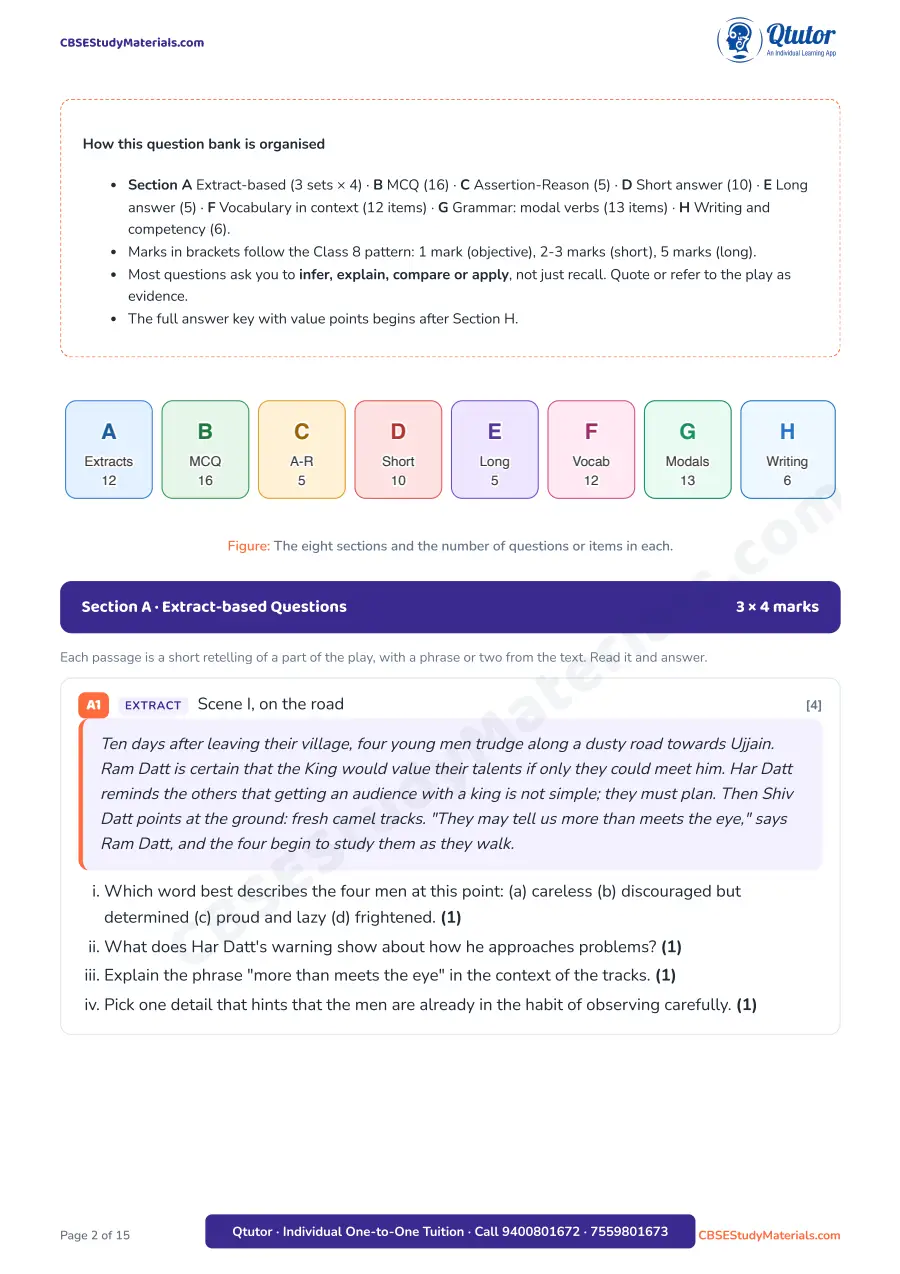
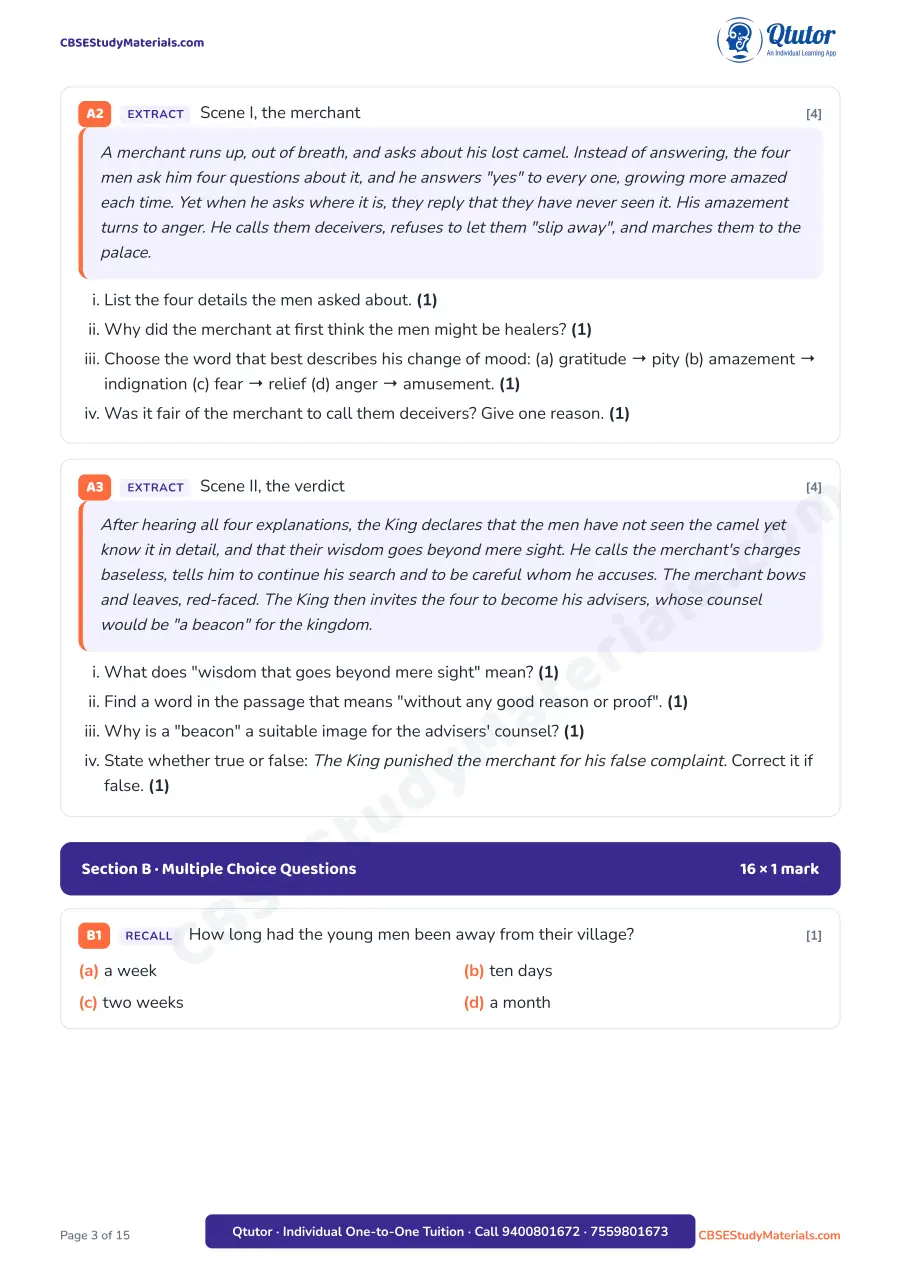
- Section A, extract-based: 3 passages (retellings of the road, the merchant and the King's verdict) with 4 questions each.
- Section B, MCQ: 16 multiple choice questions on events, clues, characters, vocabulary, form and modals.
- Section C, assertion-reason: 5 items with all four standard options.
- Section D, short answer: 10 questions, such as comparing the merchant's reasoning with the young men's, and the irony of how they reached the King.
- Section E, long answer: 5 questions including a character sketch of the merchant, the qualities of a good adviser, a diary entry as Dev Datt and a "what if" ending.
- Section F, vocabulary in context: word-box blanks, noun forms, and meanings of face and bear.
- Section G, grammar: modal verbs, naming functions, filling blanks and rewriting sentences.
- Section H, writing and competency: a letter of complaint, a notice for auditions, a deduction table, word stress, a real-life case and a dialogue-writing task.
- A complete answer key with reasons for every MCQ and A-R item and value points for all written answers.
In all there are 79 questions and items.
Structure of the PDF
| Section | Type | Count |
|---|---|---|
| A | Extract-based | 3 sets × 4 |
| B | MCQ | 16 |
| C | Assertion-Reason | 5 |
| D | Short answer | 10 |
| E | Long answer | 5 |
| F | Vocabulary in context | 12 items |
| G | Grammar: modal verbs | 13 items |
| H | Writing and competency | 6 tasks |
| Key | Answers and value points | all |
Wisdom Paves the Way Class 8 Important Topics Covered
- The four clues and the reasoning behind each one
- The merchant's hasty judgement and his change from anger to shame
- The King's fairness and why he made the men his advisers
- The meaning of the title and the message of the play
- Knowledge versus wisdom
- Modal verbs, noun forms and multiple-meaning words
- Formal letter, notice and dialogue writing
Wisdom Paves the Way Class 8 Important Questions (Sample)
MCQ: Which clue is based on something the camel did not do? (a) the faint footprint (b) the untouched leaves on the right (c) the drops of blood (d) the deep front prints. Answer: (b).
Assertion-Reason: A: The merchant thought the young men were thieves. R: He had seen them leading his camel away. Answer: (c), A is true but R is false; he suspected them only because they knew so much about the camel.
Short answer: If the camel had been blind in its left eye, what would Shiv Datt have noticed? The leaves on the left side of the road would have been untouched and those on the right nibbled.
How This Question Bank Helps
- Practise every type of question your school test may have, chapter by chapter.
- Learn to back answers with evidence from the play.
- The answer key explains why each option is right, so you learn from mistakes.
- Grammar and writing tasks link the chapter to the skills you need for tests.
- Section A uses short retellings of the play, so you practise reading closely and answering in your own words.
- Long answers come with a marks split (for example, intro 1 + clues 3 + conclusion 1), which shows how a full answer is built.
You can use the sections in any order. A good plan is to read the play once, attempt Sections A to C in one sitting as a quick check of understanding, then take Sections D and E on another day as a written test. Keep Sections F to H for grammar and writing practice before the exam. Mark your own work with the answer key and rewrite any answer that misses a value point.
Who Should Use It
Class 8 students of the CBSE 2026-27 session using NCERT Poorvi, parents who want reliable practice material, and teachers looking for ready worksheets and class tests on this chapter.
How to Download the Class 8 Wisdom Paves the Way Question Bank PDF
This is a premium PDF priced at ₹49. Use the button below to get the full 15-page PDF download.
Wisdom Paves the Way - Class 8 English Chapter 3 Question Bank (PDF · 15 pages · ₹49)
Related Resources
- Wisdom Paves the Way Class 8 notes PDF
- Wisdom Paves the Way Class 8 NCERT Solutions PDF
- Wisdom Paves the Way chapter page
- Class 8 English study material
- Previous chapter: A Concrete Example
- Next chapter: A Tale of Valour: Major Somnath Sharma and the Battle of Badgam
FAQs on Class 8 English Chapter 3 Wisdom Paves the Way
Where can I get Class 8 English Chapter 3 Wisdom Paves the Way important questions? On this page. The 15-page premium question bank PDF costs ₹49 and includes answers to all 79 questions and items.
Does the question bank have assertion-reason questions? Yes. Section C has 5 assertion-reason items, and the key explains each answer.
Are the answers included? Yes. Every question has an answer: MCQ and A-R items with reasons, and written answers with value points.
Which book is Wisdom Paves the Way Class 8 from? It is a play in Unit 1, Wit and Wisdom, of the NCERT Poorvi English textbook for Grade 8.
Is there grammar practice in this PDF? Yes. Section G covers modal verbs and Section F covers noun forms and multiple-meaning words, all tied to the chapter.
Study tip: attempt one section at a time without the key, then mark your own work using the value points.