A Funny Man Class 7 English Chapter 5 Notes PDF (PDF · 15 pages · ₹49) Unlock the full PDF for ₹49
Free sample: pages 1 to 3 of 15. The full PDF costs ₹49.
Who wears a shoe on his head, hats on his feet, and offers you a bun as a rose? In Class 7 English Chapter 5 A Funny Man, he is the hero, and these CBSE chapter notes, based on the NCERT Poorvi textbook, explain the whole nonsense poem stanza by stanza in a colourful 15-page PDF.
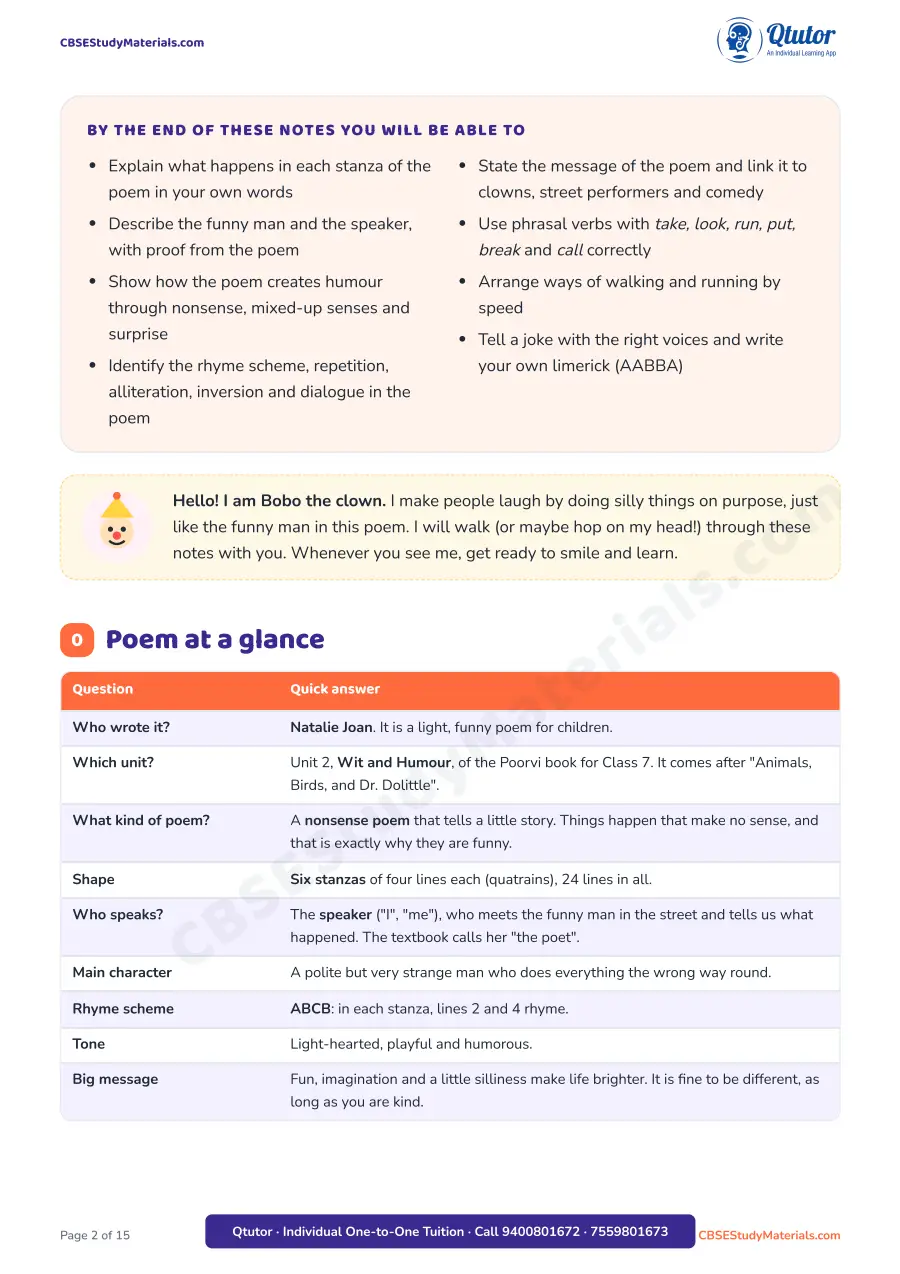
This is a premium Chapter Notes PDF (₹49) for Class 7 English, Chapter 5 "A Funny Man" by Natalie Joan, a poem in Unit 2 "Wit and Humour" of the new NCERT Poorvi book (Grade 7, CBSE 2026-27). It is independent study material and is not an official CBSE or NCERT publication. A friendly guide, Bobo the clown, walks students through the poem in short, simple sentences, so the PDF works as revision notes, a chapter summary, a word list and a set of important questions with answers in one download.
Class 7 English Chapter 5 A Funny Man Notes: What Is Included
- Learning objectives and a "Poem at a glance" table: poet, unit, type of poem, shape, speaker, rhyme scheme, tone and the big message
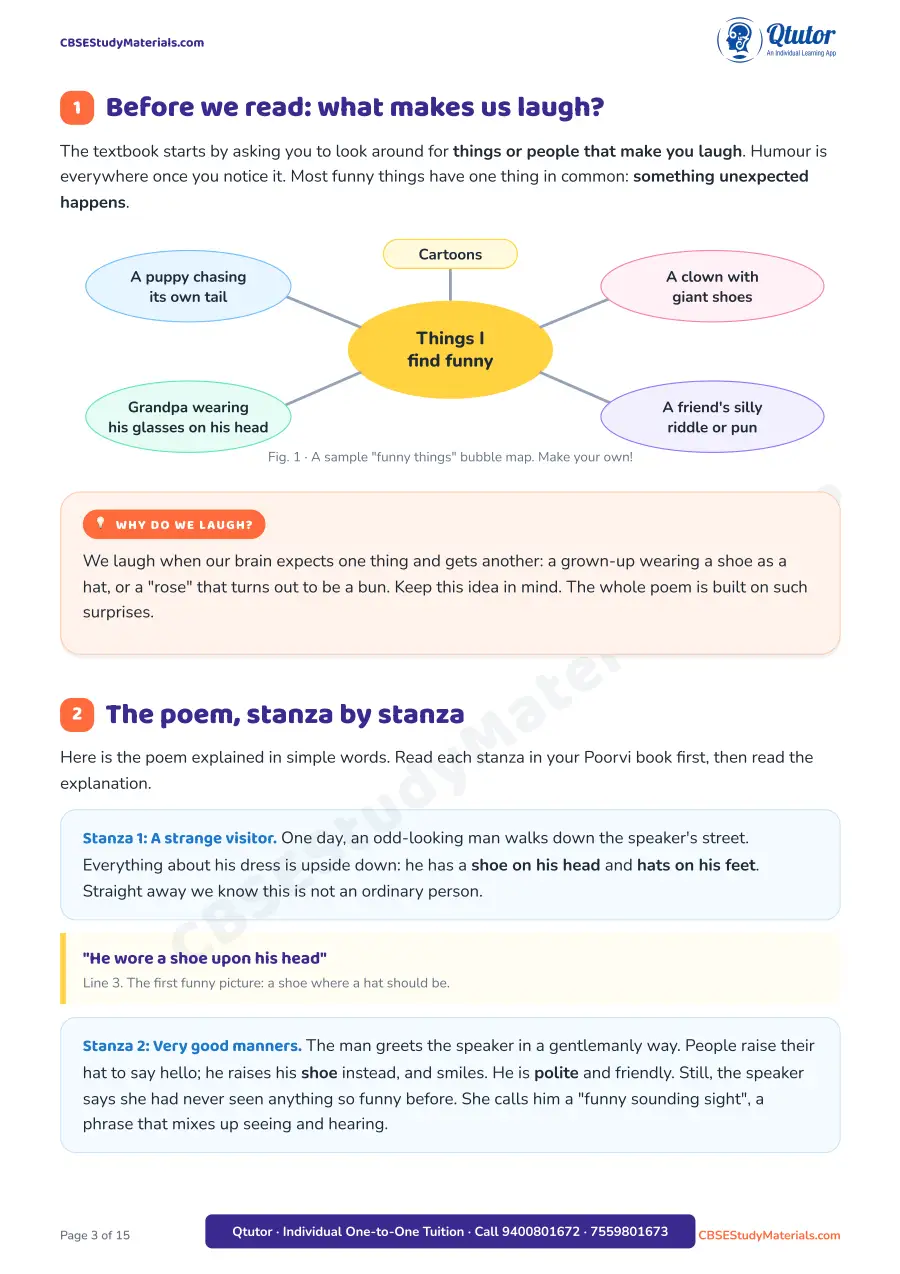
- A "what makes us laugh" bubble map for the pre-reading activity
- The poem explained stanza by stanza in our own words, with key single lines and what they mean
- The poem as a story: all seven events in order, plus a common-mistake box (the "rose" was really a currant bun)
- Character notes on the funny man and the speaker, with a traits-and-proof table
- Why the poem is funny: reversal, surprise, exaggeration and the mixed-up senses in "funny sounding sight", "funny looking smell" and "funny feeling sound"
- Poetic devices with examples and effects: rhyme scheme ABCB, repetition, alliteration, inversion, imagery and dialogue
- Theme and message cards, with real-life links to clowns, street performers and comedy shows
- 15 word meanings, including currant, staggered, polite and Your Highness
- Grammar corner: phrasal verbs with take, look, run, put, break and call, and a slow-to-fast ladder of ways of moving (stagger to sprint)
- Speaking and writing: how to tell a joke with the right voices, and how to write a limerick (AABBA) with our own sample
- An "Explore" page on Tenali Rama, Birbal, Mullah Nasruddin, Vikram and Betal, and Sukumar Ray's Abol Tabol
- Seven original diagrams, including the upside-down man, the mixed senses, the rhyme scheme and a full mind map
- 12 "Check yourself" questions with a complete answer key
- A one-page summary in 15 points for the night before the test
Structure of the PDF
| Part | What you get |
|---|---|
| Cover, objectives, poem at a glance | The poem in nine quick answers |
| Sections 1-3 | What makes us laugh, stanza-by-stanza explanation, events in order |
| Sections 4-7 | Characters, nonsense and mixed senses, poetic devices, theme and message |
| Sections 8-11 | Word meanings, phrasal verbs and ways of moving, jokes and limericks, funny characters in Indian stories |
| Mind map and Check yourself | Whole chapter on one page, 12 questions and answers |
| One-page summary | 15 points to revise in five minutes |
A Funny Man Class 7 Important Topics
- What the funny man wears and how he greets the speaker
- The "rose" for "Your Highness" that turns out to be a currant bun
- Why the speaker staggers back, and her witty reply
- The surprise ending: hopping home on his head
- Mixed-up senses and why the poet uses them
- Rhyme scheme ABCB, repetition of "funny", alliteration and inversion
- The message: humour, imagination and accepting people who are different
- Phrasal verbs (take up, take after, take in, take over, take off) and limericks
A Funny Man Class 7 Notes (Sample)
From "Poetic devices":
| Device | Example from the poem | Effect |
|---|---|---|
| Alliteration | sounding sight; hopped home on his head | Adds rhythm and fun |
| Inversion | "But never had I seen before" | Keeps the rhythm and rhyme |
| Repetition | "funny" again and again | Stresses how strange and amusing he is |
From the grammar corner: a phrasal verb is a verb plus a small word that work as one unit. Take after means to look or behave like an older family member: "Raju takes after his grandfather."
From "Check yourself": The speaker staggers back, yet later calls the man "My friend". What does this change tell us about her? Answer: she gets over her shock quickly; she is good-humoured, open-minded and friendly, and enjoys the fun instead of being annoyed.
How These Notes Help
Poems in the new Poorvi book are tested through extracts, devices, tone and personal response, not just the story. These notes cover all of that in one place. Every stanza is explained, every device has an example and an effect, and the grammar and writing pages follow the same topics as the textbook exercises. The mind map and the one-page summary make last-minute revision quick. If you also want every textbook question answered in order, use the NCERT Solutions PDF for this chapter.
Who Should Use These Notes
- Class 7 students studying the NCERT Poorvi English book in CBSE schools
- Students who find poetry questions on tone, rhyme scheme and devices tricky
- Parents and tutors who want ready revision material with answers
- Teachers who want diagrams and a mind map to explain the poem in class
How to Download the Class 7 A Funny Man Notes PDF
This is a premium 15-page PDF priced at ₹49. Use the button below to buy and download it.
A Funny Man Class 7 English Chapter 5 Notes PDF (PDF · 15 pages · ₹49)
Related Resources
- Chapter page: A Funny Man, Class 7 English
- Subject page: Class 7 English study material
- A Funny Man Class 7 NCERT Solutions: every textbook question answered in order
- A Funny Man Class 7 question bank: 51 extra important questions with answers
- Previous chapter: Animals, Birds, and Dr. Dolittle, Class 7 English
- Next chapter: Say the Right Thing, Class 7 English
FAQs on Class 7 English Chapter 5 A Funny Man
Where can I download Class 7 English Chapter 5 A Funny Man notes PDF? On this page. The premium 15-page notes PDF costs ₹49 and downloads right after purchase.
Who wrote the poem A Funny Man in Class 7 English? Natalie Joan. The poem is in Poorvi, the NCERT English textbook for Class 7, Unit 2, Wit and Humour.
What is the rhyme scheme of A Funny Man? ABCB. In every four-line stanza, lines 2 and 4 rhyme, for example street and feet, rose and nose.
What are the important topics in A Funny Man Class 7? The funny man's upside-down dress and polite manners, the currant bun "rose", the mixed-up senses, the surprise ending, the poetic devices, the message of the poem, phrasal verbs and limericks.
What is the message of the poem A Funny Man? Humour and imagination make life brighter, and we can enjoy people who are different while staying kind and polite.
Is this an official NCERT or CBSE PDF? No. These are our own NCERT based revision notes for CBSE 2026-27, written in simple language for Class 7 students.
Study tip: picture the six stanzas in order (shoe-hat, smile, bun, stagger, song, hop) and you will never mix up the events.