Paper Boats Class 7 English Chapter 8 Notes PDF (PDF · 15 pages · ₹49) Unlock the full PDF for ₹49
Free sample: pages 1 to 3 of 15. The full PDF costs ₹49.
Why does a village child write his name in big black letters on a paper boat and send it down a stream? These Paper Boats notes for Class 7 English Chapter 8 (CBSE, NCERT Poorvi textbook) answer that question and explain the whole poem in simple, friendly language, in a 15-page PDF.
This is a premium Chapter Notes PDF (₹49) for Class 7 English, Chapter 8 "Paper Boats" by Rabindranath Tagore, from Unit 3 "Dreams and Discoveries" of the new Poorvi book for CBSE 2026-27. It is independent, NCERT based study material and is not an official CBSE or NCERT publication. The revision notes retell the poem part by part, explain its symbols and poetic devices, and finish with a mind map, a one-page chapter summary and important questions with answers.
Class 7 English Chapter 8 Paper Boats Notes: What Is Included
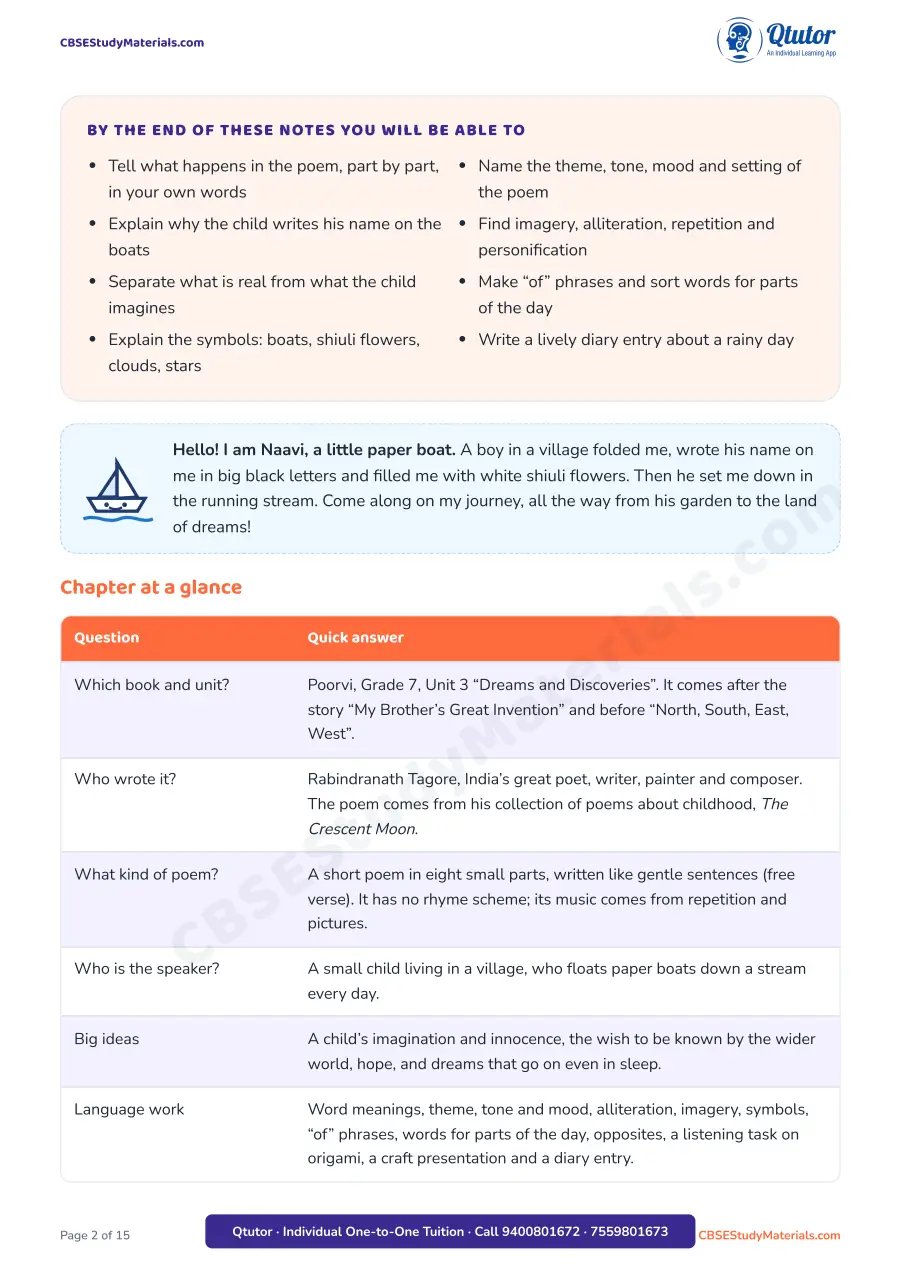
- A "chapter at a glance" table: book, unit, poet, type of poem, speaker, big ideas and the language work in the chapter
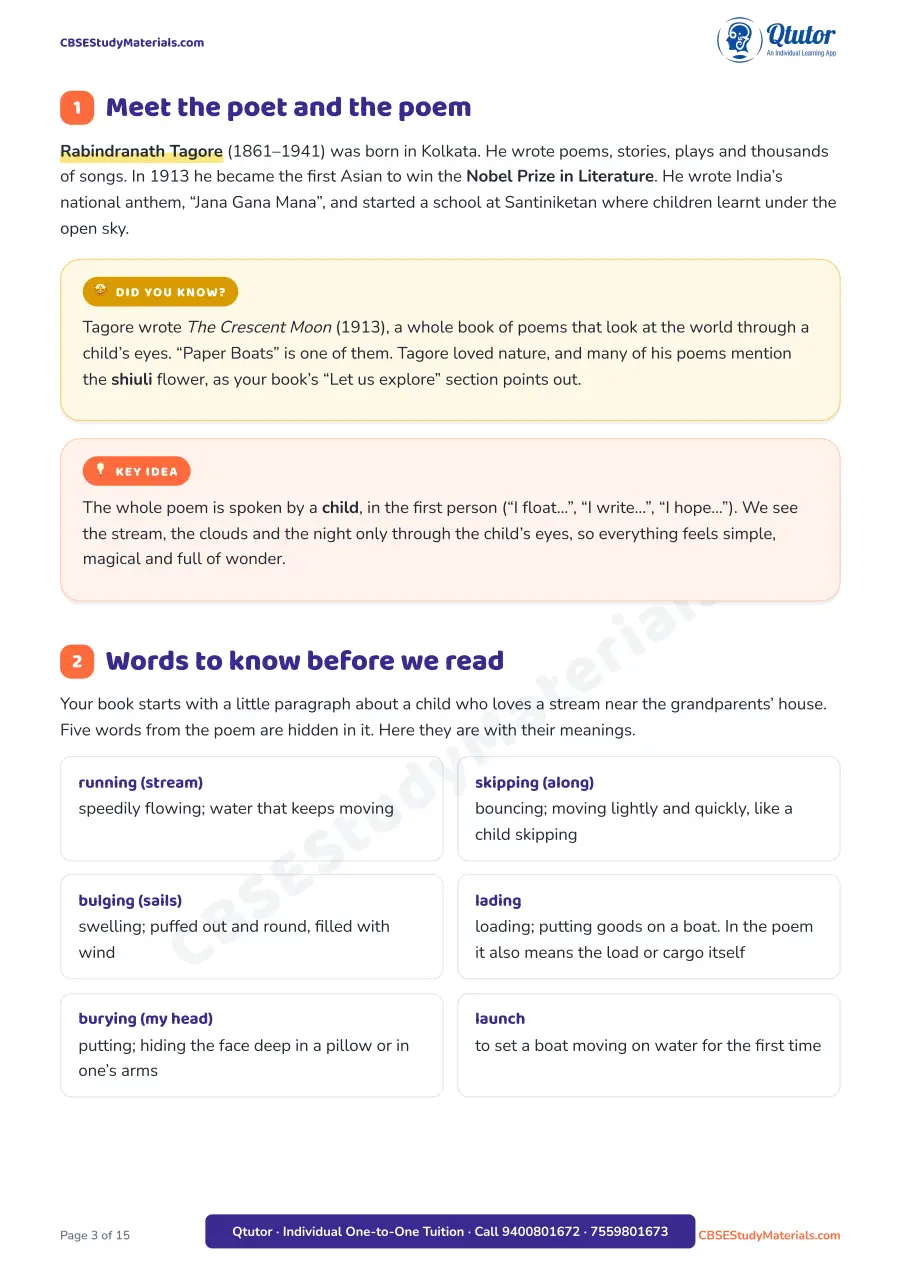
- A short introduction to Rabindranath Tagore and his book of childhood poems, The Crescent Moon
- Eight "words to know" with meanings, including running, skipping, bulging, lading and burying
- The poem retold in eight small parts, with one-line quotes and what each line shows
- Seven original diagrams: the boat's journey, a dawn-to-midnight timeline, a real-versus-imagined chart, a symbol map, the parts of the day, a labelled shiuli flower and a mind map
- Theme, message, tone, mood and setting in one table, with common mistakes to avoid
- Poetic devices: alliteration, repetition, imagery, metaphor, personification and the poem's unrhymed form, each with examples from the poem
- Character notes on the child speaker, the playmate in the sky and the fairies of sleep
- Language corner: "of" phrases, words for parts of the day, opposites and the simple present tense
- Notes on origami (from the listening task), diary-entry tips and a fold-your-own-paper-boat activity
- Key terms, a one-page summary and "Check yourself" with 12 questions and an answer key
Structure of the PDF
| Part | What you get |
|---|---|
| Pages 1-2 | Cover, learning goals, chapter at a glance |
| Sections 1-4 | Poet and poem, words to know, the poem part by part, dawn to midnight |
| Sections 5-8 | Real versus imagined, symbols, theme and tone, poetic devices |
| Sections 9-10 | Character notes and language corner |
| End pages | Mind map, key terms, one-page summary, Check yourself with answers |
Paper Boats Class 7 Important Topics
- Why the child writes his name and his village on the boats
- The shiuli flowers as "blooms of the dawn" and what they stand for
- How the little white clouds become "white bulging sails" and a playmate's race
- The night dream: midnight stars and the fairies of sleep with baskets full of dreams
- Theme (innocence, imagination, playfulness), gentle and wishful tone, thoughtful mood
- Alliteration such as "big black letters" and "Day by day"
Paper Boats Class 7 Important Questions (Sample)
Your friend says the child writes his name on the boats so that no one steals them. Is your friend right? No. He writes his name and village because he hopes someone in a strange land will find the boats and know who he is. It is a message to make a connection, not a mark against theft.
A classmate says the theme of the poem is travel. Do you agree? No. The boats travel, but the child never leaves home. The poem is about innocence, imagination and playfulness: his hope to be known and his dreams.
| Symbol | What it stands for |
|---|---|
| paper boats | the child's innocence, hopes and messages to the world |
| shiuli flowers | purity, beauty and the start of a new day |
| midnight stars | the vast universe and dreams that go on all night |
How These Revision Notes Help
- Every idea is explained in short sentences that a Class 7 student can read alone
- The diagrams make the order of the poem and its symbols easy to remember
- The common-mistake cards stop typical errors, such as calling "paper boats" alliteration
- The one-page summary works as a quick chapter summary before a test
- The Check yourself questions are mostly thinking questions, not just recall
Who Should Use This Study Material
- Class 7 students using the NCERT Poorvi English book under the CBSE 2026-27 syllabus
- Students who want word meanings, poetic devices and important questions for Paper Boats in one place
- Parents and tutors who want a clear, picture-rich explanation of the poem
How to Download the Class 7 Paper Boats Notes PDF
This is a premium PDF priced at ₹49. Use the download button below to get all 15 pages. It prints well in colour and is easy to read on a phone.
Paper Boats Class 7 English Chapter 8 Notes PDF (PDF · 15 pages · ₹49)
Related Resources
- Class 7 English Chapter 8 Paper Boats NCERT Solutions
- Class 7 English Chapter 8 Paper Boats Question Bank
- Paper Boats chapter page
- All Class 7 English study material
- Previous chapter: My Brother’s Great Invention
- Next chapter: North, South, East, West
FAQs on Class 7 English Chapter 8 Paper Boats
Where can I download Class 7 English Chapter 8 Paper Boats notes PDF? On this page. Use the download button to get the 15-page premium notes PDF for ₹49.
Who wrote the poem Paper Boats in Class 7 English? Rabindranath Tagore. The poem comes from his collection of childhood poems, The Crescent Moon.
What is the theme of Paper Boats Class 7? Innocence, imagination and playfulness. A child's simple game turns into a big adventure in his mind, and his hope to be known goes on even in his dreams.
What do the paper boats symbolise in the poem? They stand for the child's innocence, dreams and hopes, and for the messages he sends out into the world.
Which book and unit is Paper Boats from? It is Chapter 8 of Poorvi, the NCERT English textbook for Class 7, in Unit 3 "Dreams and Discoveries".
Do these notes include the textbook exercise answers? The notes explain every topic the exercises test. Full answers to every textbook question are in our separate Paper Boats NCERT Solutions PDF.
Study tip: read the poem aloud once, then say what is real and what is imagined in each part; if you can do that, you understand the poem.