Sexual Reproduction in Flowering Plants - Class 12 Biology Chapter 1 Model Question Paper (PDF · 18 pages · Free download) Download the full PDF free
You are looking at pages 1 to 3 of 18. The full PDF is free to download.
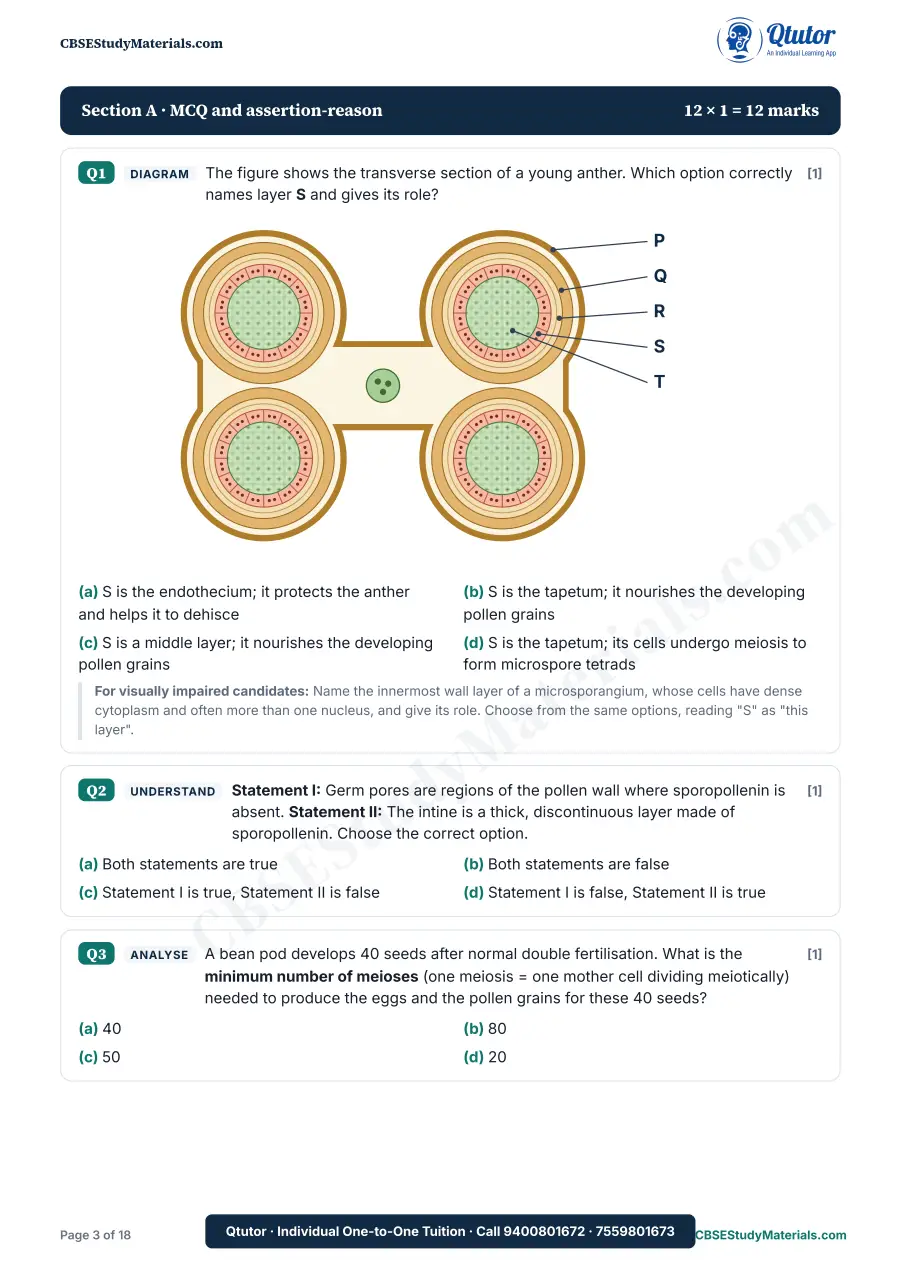
A bean pod holds 40 seeds. What is the smallest number of meioses the plant needed to make the eggs and the pollen for them? That is Q3 of this free Sexual Reproduction in Flowering Plants Class 12 model question paper, an 18-page CBSE Class 12 Biology Chapter 1 model question paper PDF built on the rationalised NCERT Biology textbook for CBSE 2026-27. It is an independent practice paper with a complete marking scheme, not an official CBSE or NCERT publication.
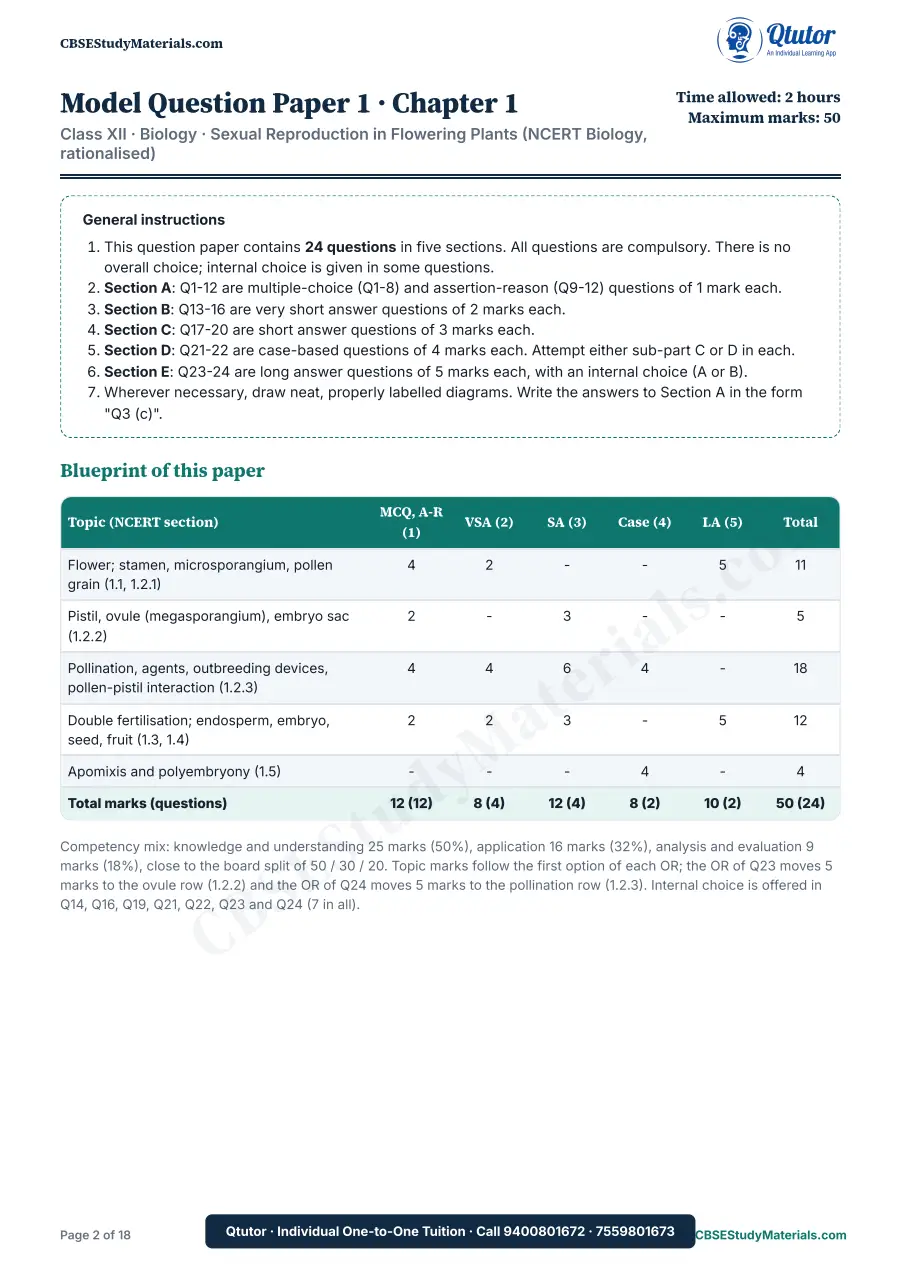
The paper follows the board section pattern of the Class 12 Biology sample paper (Sections A to E), scaled down to one chapter: 24 questions for 50 marks, to be finished in 2 hours. Most questions are application, data, diagram and case based, so it works as a timed chapter test once your revision notes are done, and the marking scheme shows where each mark is earned.
Class 12 Biology Chapter 1 Sexual Reproduction in Flowering Plants Model Question Paper: What Is Included
- A cover, the paper heading (time allowed 2 hours, maximum marks 50) and board-style general instructions
- A blueprint table that maps every mark to an NCERT section and question type, with the competency mix (about 50% knowledge and understanding, 32% application, 18% analysis)
- Section A: 8 MCQs (a labelled anther diagram item, a Statement I / Statement II item, a match-the-columns item and a meiosis-counting item) and 4 assertion-reason questions
- Section B: 4 very short answer questions of 2 marks, including a pollen-to-ovule data table
- Section C: 4 short answer questions of 3 marks, including a labelled embryo sac diagram question
- Section D: 2 case-based questions with sub-parts of 1 + 2 + 1 marks and a choice between C and D
- Section E: 2 long answer questions of 5 marks, each with an A or B choice
- 7 internal choices (OR), text versions of the diagram questions for visually impaired candidates, and answer-writing lines after every question
- Original labelled diagrams: T.S. of a young anther, a mature 7-celled, 8-nucleate embryo sac and the L.S. of an anatropous ovule
- A full answer key and marking scheme with value points and ½-mark splits, plus a "where marks are lost" box
Structure of the Sexual Reproduction in Flowering Plants Question Paper
| Section | Question type | Questions | Marks |
|---|---|---|---|
| A | MCQ and assertion-reason | Q1-12 | 12 × 1 = 12 |
| B | Very short answer | Q13-16 | 4 × 2 = 8 |
| C | Short answer | Q17-20 | 4 × 3 = 12 |
| D | Case-based | Q21-22 | 2 × 4 = 8 |
| E | Long answer | Q23-24 | 2 × 5 = 10 |
| Total | 24 questions | 50 marks |
The answer key and marking scheme start on a new page, so you can attempt the paper first and check later.
Sexual Reproduction in Flowering Plants Class 12 Important Topics Covered
- The stamen and anther: four microsporangia, the wall layers (epidermis, endothecium, middle layers, tapetum) and the sporogenous tissue
- Microsporogenesis and the pollen grain: exine of sporopollenin, germ pores, intine, the vegetative and generative cells, 2-celled and 3-celled pollen
- The pistil and the anatropous ovule, megasporogenesis, monosporic development and the 7-celled, 8-nucleate embryo sac
- Pollination: autogamy, geitonogamy, xenogamy, cleistogamy, wind, water and animal pollination, pollen robbers and floral rewards
- Outbreeding devices (timing, position, self-incompatibility, monoecy and dioecy) and pollen-pistil interaction
- Double fertilisation: syngamy and triple fusion; endosperm, embryo, seed and fruit, albuminous and non-albuminous seeds, false fruits and parthenocarpy
- Apomixis and polyembryony, and why nucellar embryos are clones of the mother plant
Sexual Reproduction in Flowering Plants Class 12 Important Questions (Sample)
Section A, Q6 (analyse). In a species with bisexual flowers, each flower sheds its pollen two days before its own stigma becomes receptive, and one plant keeps opening new flowers for weeks. Does this rule out autogamy, geitonogamy or both? The key explains why only autogamy is prevented: a younger, receptive flower on the same plant can still receive the pollen.
Section B, Q13 (data). A table gives pollen grains and ovules per flower for three species:
| Species | Pollen grains per flower | Ovules per flower | Do the flowers open? |
|---|---|---|---|
| W | 5,00,000 | 1 | Yes |
| X | 12,000 | 20 | Yes |
| Y | 400 | 8 | Never |
Students pick the wind-pollinated species and the cleistogamous one and explain the pollen numbers.
Section D, Q21 (case). A Citrus nursery finds three to six embryos in one seed. Most seedlings look exactly like the mother tree, but now and then one looks different. Students name polyembryony, explain why nucellar embryos are clones, and say which embryo the odd seedling most likely came from.
Section E, Q24 (A). For a plant with 2n = 20, students describe syngamy and triple fusion and give the chromosome numbers of the products: the zygote has 20 and the primary endosperm nucleus 30.
How This Model Question Paper Helps
- Every section type, internal choice and case format of the CBSE 2026-27 Biology paper appears in it.
- Most questions are indirect, so you practise applying the chapter rather than recalling lines from the textbook.
- The diagram questions cover the chapter's three key figures: the anther T.S., the embryo sac and the anatropous ovule.
- The marking scheme splits marks into value points, so you can mark yourself honestly and see which points you missed.
Who Should Use It
Class 12 CBSE students who have finished Chapter 1 and want a timed test, students revising before unit tests, pre-boards or the board exam, and teachers who need a ready chapter test with a marking scheme.
How to Download the Class 12 Biology Chapter 1 Model Question Paper PDF
The PDF is free. Use the button below to download it and print it if you like to write on paper.
Sexual Reproduction in Flowering Plants - Class 12 Biology Chapter 1 Model Question Paper (PDF · 18 pages · Free download)
Related Resources
- Sexual Reproduction in Flowering Plants Class 12 notes: revise the full chapter with diagrams before you attempt this paper
- Sexual Reproduction in Flowering Plants Class 12 worksheet
- Sexual Reproduction in Flowering Plants flash cards
- Sexual Reproduction in Flowering Plants question bank
- Sexual Reproduction in Flowering Plants question paper with answer key
- Sexual Reproduction in Flowering Plants short exam-oriented notes
- All study material for Class 12 Biology Chapter 1
- Class 12 Biology: all chapters
- Next chapter: Class 12 Biology Chapter 2 Human Reproduction
FAQs on Class 12 Biology Chapter 1 Sexual Reproduction in Flowering Plants
Where can I download the Class 12 Biology Chapter 1 model question paper PDF? You can download it free from this page using the download button. It is an 18-page PDF with 24 questions and a full marking scheme.
Is the Sexual Reproduction in Flowering Plants model question paper free? Yes. This model question paper is free to download and print.
Does this paper follow the CBSE 2026-27 Class 12 Biology pattern? Yes. It uses Sections A to E with MCQs, assertion-reason, 2-mark, 3-mark, case-based and 5-mark questions and internal choices, the same design as the Class 12 Biology sample paper, scaled to one chapter of 50 marks.
What are the important questions in Sexual Reproduction in Flowering Plants Class 12? Expect questions on the anther wall layers, the 7-celled, 8-nucleate embryo sac, outbreeding devices, double fertilisation, endosperm and seed types, and apomixis and polyembryony. This paper tests each of them.
Which diagrams are important in Class 12 Biology Chapter 1? The T.S. of a young anther, the mature embryo sac and the L.S. of an anatropous ovule. The paper asks about all three and the key shows labelled versions.
Which book is Sexual Reproduction in Flowering Plants from? It is Chapter 1 of the NCERT Class 12 Biology textbook (rationalised edition), which CBSE schools follow.
Is a marking scheme given with the model paper? Yes. Every answer has value points with mark splits, as in a board marking scheme.
Study tip: sit the paper in one 2-hour block, then mark it with the scheme and redraw every diagram on which you lost a label.