Travel Class 7 English Chapter 11 Notes PDF (PDF · 14 pages · ₹49) Unlock the full PDF for ₹49
Free sample: pages 1 to 3 of 14. The full PDF costs ₹49.
The railway track is miles away, so how can a girl hear every train that passes? Class 7 English Chapter 11 Travel answers that in just twelve lines, and these premium CBSE chapter notes, based on the NCERT Poorvi textbook, explain the whole poem in a colourful 14-page PDF that a Class 7 student can read alone.
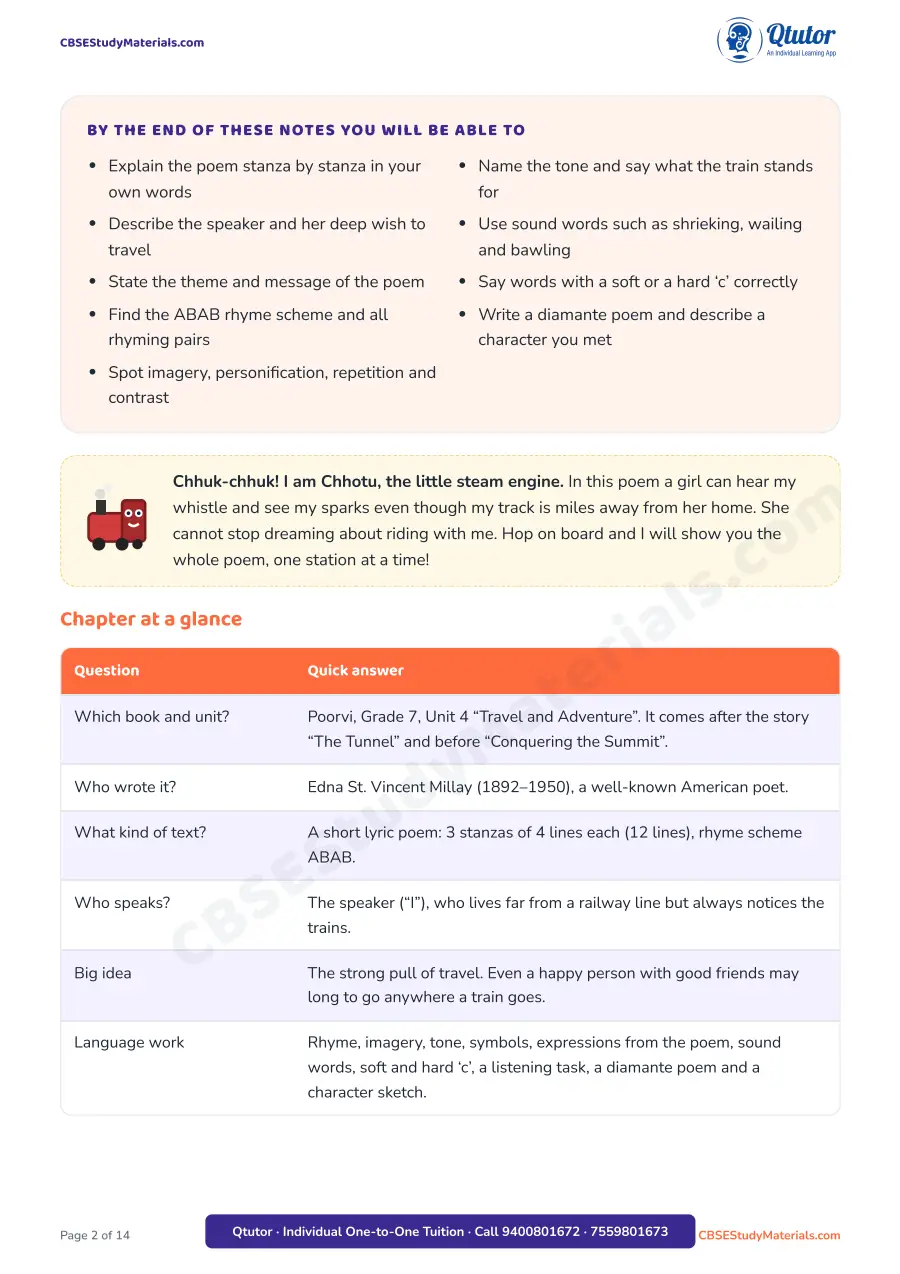
This is a premium Chapter Notes PDF (₹49) for Class 7 English, Chapter 11 "Travel" by Edna St. Vincent Millay, from Unit 4 "Travel and Adventure" of the new NCERT Poorvi book (Grade 7, CBSE 2026-27). It is independent study material and is not an official CBSE or NCERT publication. A friendly guide, Chhotu the little steam engine, takes you through the poem, so the PDF works as revision notes, a chapter summary, a word list and a set of important questions with answers in one PDF download.
Class 7 English Chapter 11 Travel Notes: What Is Included
- Learning objectives and a "Chapter at a glance" table: book, unit, poet, type of text, speaker, big idea and language work
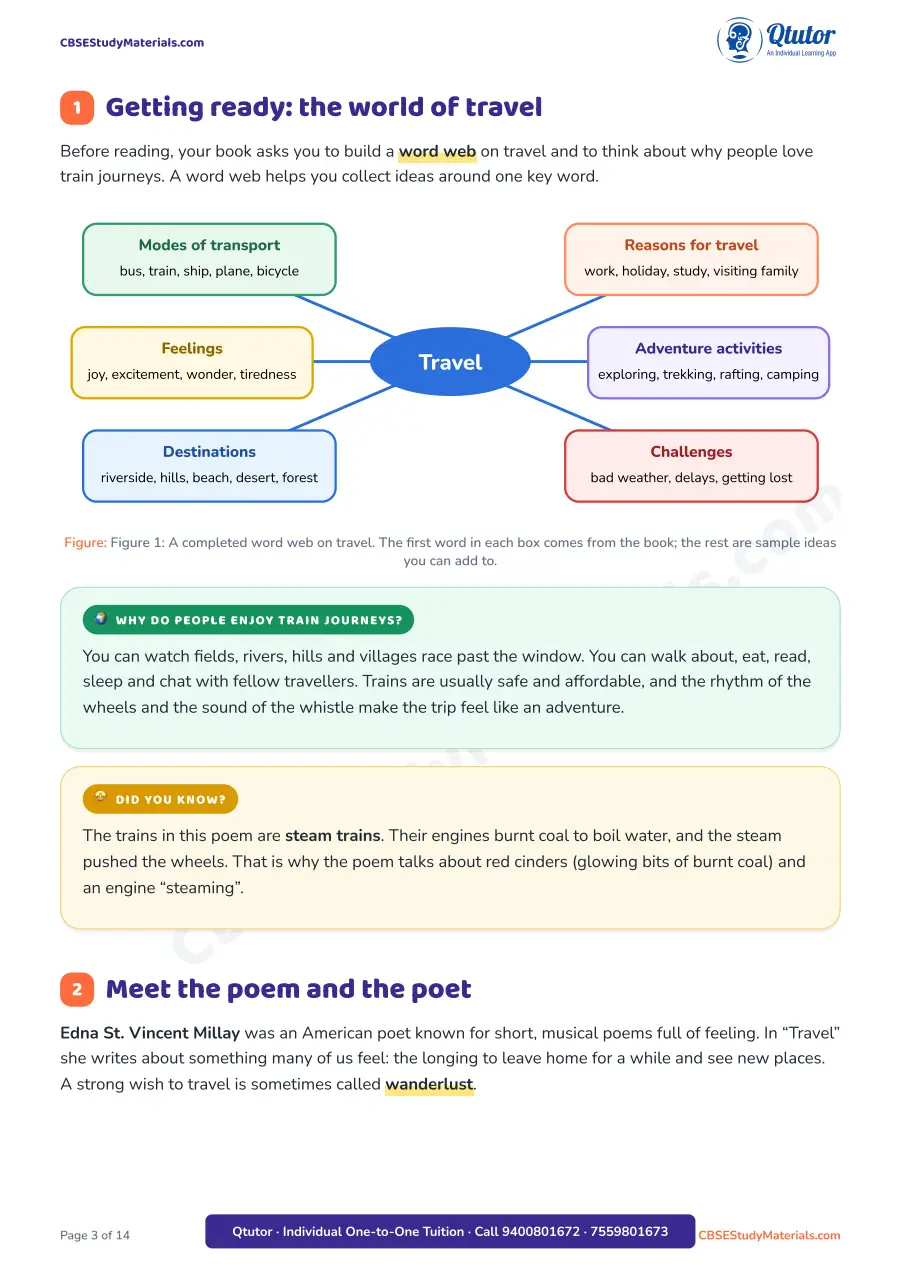
- A completed word web on travel (modes of transport, reasons, adventure activities, feelings, destinations, challenges) and why people enjoy train journeys
- Why the trains in the poem are steam trains, and what that tells us about "cinders" and "steaming"
- The poem explained stanza by stanza in our own simple words, with one key line from each stanza explained
- A three-panel picture of the stanzas (day, night, heart) and the "even so" pattern built on yet, though and but
- A day-versus-night contrast picture showing which senses the speaker uses
- Character notes on the speaker, and the train as a symbol of adventure and opportunities
- Theme, message and tone, with a balance picture of home and friends versus travel and adventure
- Poetic devices: the ABAB rhyme scheme with all six rhyming pairs, imagery table with senses, personification, repetition and contrast
- Word meanings (railroad, shrieking, still, cinders, steaming and more) and the seven sound words from the book
- Language corner: soft and hard 'c' with a sorting chart, the listening task, a model diamante poem and steps for a character sketch
- "Let us explore" facts on the Mountain Railways of India, the Vande Bharat Express and India's first underwater metro
- A full mind map, a one-page summary and a "Can you do these?" checklist
- 12 "Check yourself" questions with a complete answer key
Structure of the PDF
| Part | What you get |
|---|---|
| Cover, objectives, chapter at a glance | The chapter in six quick answers |
| Sections 1-3 | Word web, the poem and the poet, the poem stanza by stanza |
| Sections 4-6 | Day and night contrast, the speaker, theme, message and tone |
| Sections 7-9 | Poetic devices, word meanings and sound words, language corner |
| Revision pages | Mind map, one-page summary and checklist |
| Check yourself | 12 questions and the answer key |
Travel Class 7 Important Topics
- The story of the poem: the track is miles away, yet the speaker hears every whistle by day and sees the red cinders and hears the engine by night
- The twist in Stanza 3: her heart is warm with friends, yet she would take any train, no matter where it is going
- What "there isn't a train goes by ... but I hear" really means (every train, not no train)
- The theme of wanderlust: love of home and love of adventure can live side by side
- The rhyme scheme ABAB and the rhyming pairs away–day, speaking–shrieking, by–sky, dreaming–steaming, make–take, knowing–going
- Imagery, personification of the whistle, repetition and tone (thoughtful, excited, enthusiastic; content about friends)
- Sound words (yelling, screaming, wailing, screeching, hollering, whimpering, bawling) and the soft and hard 'c'
Travel Class 7 Important Questions (Sample)
The notes set out the imagery of the poem in a simple table:
| Phrase from the poem | Sense | Picture it creates |
|---|---|---|
| whistle shrieking | sound | a sharp, high whistle in the distance |
| cinders red on the sky | sight | glowing sparks against a dark sky |
| heart is warm | touch (feeling) | love and happiness inside |
A sample from "Check yourself": Why does the speaker see "cinders red" only at night and not during the day? The answer key explains that glowing sparks show up clearly against a dark sky but cannot be seen in bright daylight.
Another sample asks which image the poet would have to change if the poem were about a modern electric train. The answer: "cinders red on the sky" and "engine steaming", because an electric train burns no coal and gives off no cinders or steam.
How These Class 7 English Chapter 11 Notes Help
- The stanza-by-stanza retelling keeps the meaning clear, and each key line is explained in plain words
- Common-mistake cards catch traps such as reading "there isn't a train goes by" as "no trains pass" or writing the rhyme scheme as AABB
- Real-life links connect the poem to your own feelings, such as wondering where an aeroplane overhead is going
- The mind map, checklist and one-page summary make quick revision easy before a class test
- Most of the 12 questions ask you to infer, give reasons or apply ideas, which builds real reading skill
Who Should Use This Study Material
- Class 7 students reading the NCERT Poorvi English book under the CBSE 2026-27 syllabus
- Students who want a short chapter summary, rhyming words, word meanings and important questions in one place
- Parents and tutors who want a clear, picture-rich explanation of the poem and its language points
How to Download the Class 7 Travel Notes PDF
This is a premium PDF priced at ₹49. Use the download button below to get all 14 pages. It prints well in colour and is easy to read on a phone.
Travel Class 7 English Chapter 11 Notes PDF (PDF · 14 pages · ₹49)
Related Resources
- Class 7 English Chapter 11 Travel NCERT Solutions
- Class 7 English Chapter 11 Travel Question Bank
- Travel chapter page
- All Class 7 English study material
- Previous chapter: The Tunnel
- Next chapter: Conquering the Summit
FAQs on Class 7 English Chapter 11 Travel
Where can I download Class 7 English Chapter 11 Travel notes PDF? On this page. Use the download button to get the 14-page premium notes PDF for ₹49.
Who wrote the poem Travel in Class 7 English? Edna St. Vincent Millay, an American poet (1892–1950). The poem is in Unit 4 "Travel and Adventure" of the Poorvi book.
What is the central idea of the poem Travel Class 7? The poem is about the strong pull of travel. The speaker is happy with her friends, yet she notices every train and would take any train, wherever it goes.
What is the rhyme scheme of the poem Travel? ABAB. The rhyming pairs are away–day, speaking–shrieking, by–sky, dreaming–steaming, make–take and knowing–going.
What does the train symbolise in the poem Travel? Adventure and opportunities: new places, new people and new experiences.
Do these notes include the textbook exercise answers? The notes explain every topic of the exercises. Full answers to every textbook question are in our separate Travel NCERT Solutions PDF.
Study tip: read the poem aloud once, then say each stanza in one sentence using "yet"; if you can do all three, you know the poem.