Animals, Birds, and Dr. Dolittle Class 7 NCERT Solutions PDF (PDF · 14 pages · ₹49) Unlock the full PDF for ₹49
Free sample: pages 1 to 3 of 14. The full PDF costs ₹49.
What does "Ka-ka oi-ee, fee-fee?" mean, and why did the plough horse want green glasses? These Class 7 English Chapter 4 Animals, Birds, and Dr. Dolittle NCERT Solutions answer every CBSE textbook question of the chapter from the NCERT Poorvi book, in the same order and numbering, in a 14-page PDF.
This is a premium NCERT Solutions PDF (₹49) for Class 7 English, Chapter 4 "Animals, Birds, and Dr. Dolittle" by Hugh Lofting, in Unit 2 "Wit and Humour" of Poorvi (CBSE 2026-27). It is our own study material and is not an official CBSE or NCERT publication. Each question is restated in short and then answered, so you can check your work quickly.
Class 7 English Chapter 4 NCERT Solutions: What Is Included
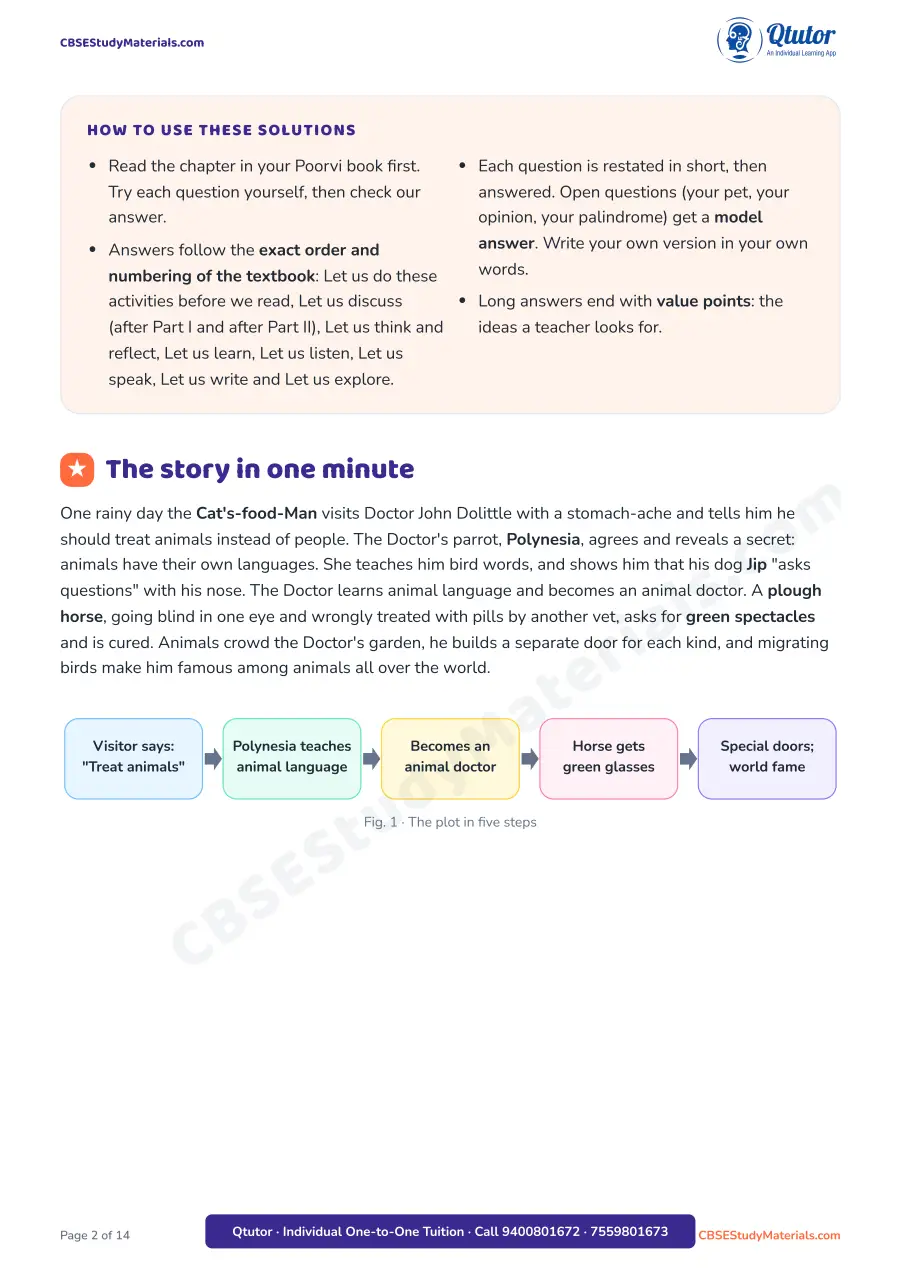
- The story in one minute with a five-step plot diagram
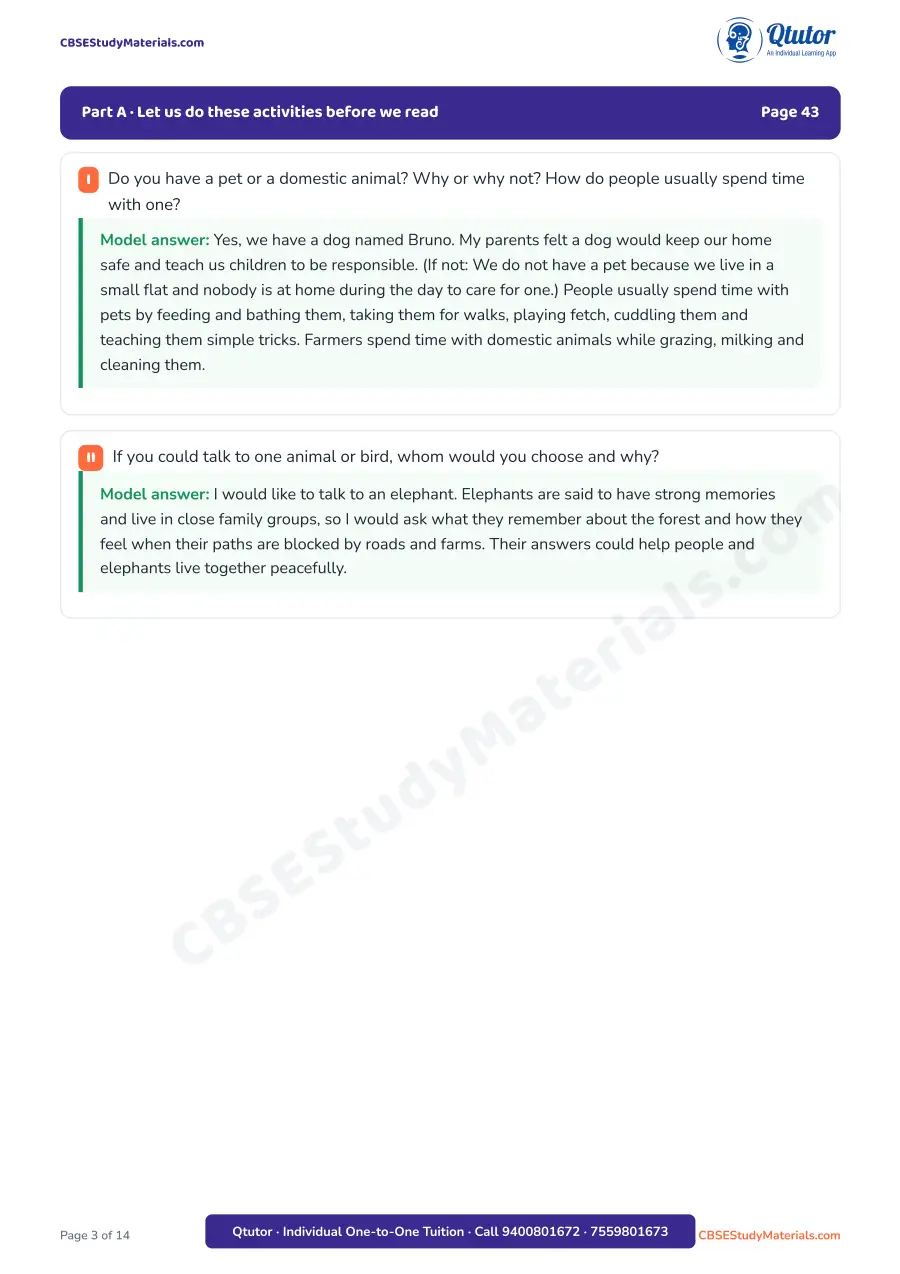
- Let us do these activities before we read: model answers about pets, talking to an animal, and a table reading the emotions of the duck, cat, dog and cockatoo from their body language
- Let us discuss (after Part I): the Cat's-food-Man's reason, the fill-in-the-blanks (curiosity, write) and whether Dolittle would be famous as an animal doctor
- Let us discuss (after Part II): the common sight in Puddleby, challenges of a crowded clinic with solutions, and the full event order with a table
- Let us think and reflect: both extracts with all sub-parts (gosh, surprised, ploughing, understanding or respectful, and more) and all five long questions with value points
- Let us learn: compound word table, matching and paragraph, hidden animals, palindromes with your own examples, tenses of verbs, and present perfect blanks
- Let us listen: true or false and the six blanks from the clinic announcement
- Let us speak: two complete doctor-patient model dialogues using the cue cards, with notes for the other two problems
- Let us write: the completed Annual Health Check-up notice
- Let us explore: a model goshala visit report, names of animal welfare organisations, and the best way to care for stray animals
- A quick recap box of the key answers
Structure of the PDF
| Part | Textbook section | Pages in the book |
|---|---|---|
| A | Let us do these activities before we read | 43 |
| B | Let us discuss (after Part I) | 46 |
| C | Let us discuss (after Part II), event order | 49-50 |
| D | Let us think and reflect | 50-52 |
| E | Let us learn | 52-55 |
| F | Let us listen | 55 |
| G | Let us speak | 55-56 |
| H | Let us write | 57 |
| I | Let us explore | 58 |
Animals, Birds, and Dr. Dolittle Class 7 Important Questions (Sample)
Let us discuss (after Part II), Q III. Arrange the events in order. Answer: 3, 6, 4, 1, 10, 5, 8, 2, 7, 9. The visitor's suggestion and Polynesia's encouragement come first; the Doctor's world fame comes last.
Let us think and reflect, Extract 2 (i). digging : flower bed :: ______ : field Answer: ploughing. We dig a flower bed; we plough a field.
Let us learn, Q III. Find the hidden animals.
| Sentence part | Animal |
|---|---|
| eatin*g oat*meal | goat |
| beg*an t*o | ant |
| aut*hor se*es | horse |
| fro*m ice* age | mice |
| *came l*ate | camel |
Let us learn, Q VI. Present perfect: has learnt, has treated, has taught, has written, have brought, has become.
How These NCERT Solutions Help
The new Poorvi exercises mix reading, grammar, listening, speaking and writing. Students often get stuck on the open questions ("What challenges might the Doctor face?") and on the word puzzles (hidden animals, palindromes). These solutions give a clear answer for every closed question and a model answer plus value points for every open one, so you know what a full answer looks like. The listening answers are checked against the announcement in the book's transcript, and the notice is completed exactly in the textbook's format.
Who Should Use These Solutions
- Class 7 CBSE students using the NCERT Poorvi English textbook
- Students checking homework or preparing for unit tests
- Parents and tutors who want correct, complete answers in textbook order
How to Download the Class 7 Animals, Birds, and Dr. Dolittle NCERT Solutions PDF
This is a premium 14-page PDF priced at ₹49. Use the button below to buy and download it.
Animals, Birds, and Dr. Dolittle Class 7 NCERT Solutions PDF (PDF · 14 pages · ₹49)
Related Resources
- Chapter page: Animals, Birds, and Dr. Dolittle, Class 7 English
- Subject page: Class 7 English study material
- Animals, Birds, and Dr. Dolittle Class 7 notes: revision notes with story summary, characters, word meanings, mind map and a one-page summary
- Animals, Birds, and Dr. Dolittle Class 7 question bank: 51 extra important questions with answers
- Previous chapter: Three Days to See, Class 7 English
- Next chapter: A Funny Man, Class 7 English
FAQs on Class 7 English Chapter 4 Animals, Birds, and Dr. Dolittle NCERT Solutions
Where can I download Class 7 English Chapter 4 Animals, Birds, and Dr. Dolittle NCERT Solutions PDF? On this page. The premium 14-page PDF costs ₹49 and has every question of the chapter answered in textbook order.
Do these solutions cover the listening, speaking and writing tasks? Yes. They include the listening answers, two model doctor-patient dialogues, the completed health check-up notice and the "Let us explore" tasks.
What is the correct order of events in Animals, Birds, and Dr. Dolittle? 3, 6, 4, 1, 10, 5, 8, 2, 7, 9, as explained with a table in the PDF.
Which book is Animals, Birds, and Dr. Dolittle Class 7 from? Poorvi, the NCERT English textbook for Class 7, Unit 2, Wit and Humour. The chapter is an extract from Hugh Lofting's The Story of Doctor Dolittle.
Why did the plough horse want green spectacles? He was going blind in one eye, and green glasses would also keep the Sun out of his eyes while he ploughed the field.
Are these official NCERT Solutions? No. They are our own NCERT based answers for CBSE 2026-27, written in simple English.
Study tip: try each question yourself first, then compare with the model answer and add any value point you missed.