Electric Charges and Fields - Class 12 Physics Chapter 1 Model Question Paper (PDF · 14 pages · Free download) Download the full PDF free
You are looking at pages 1 to 3 of 14. The full PDF is free to download.
Electric Charges and Fields Class 12 model question paper: this is a free 14-page CBSE Class 12 Physics Chapter 1 model question paper PDF, written on the current rationalised NCERT Physics Part I textbook for CBSE 2026-27. It is an independent practice paper, not an official CBSE or NCERT publication, and it comes with a complete marking scheme.
How far does an ink droplet bend between the plates of an inkjet printer? How much charge can a school Van de Graaff dome hold before the air around it sparks? Why does spray paint reach the back of a pipe that the gun cannot see? Questions like these turn Chapter 1 into a real exam paper: 24 questions for 50 marks, set out in the same five sections (A to E) as the Class 12 Physics board paper, with seven internal choices.
Class 12 Physics Chapter 1 Model Question Paper: What Is Included
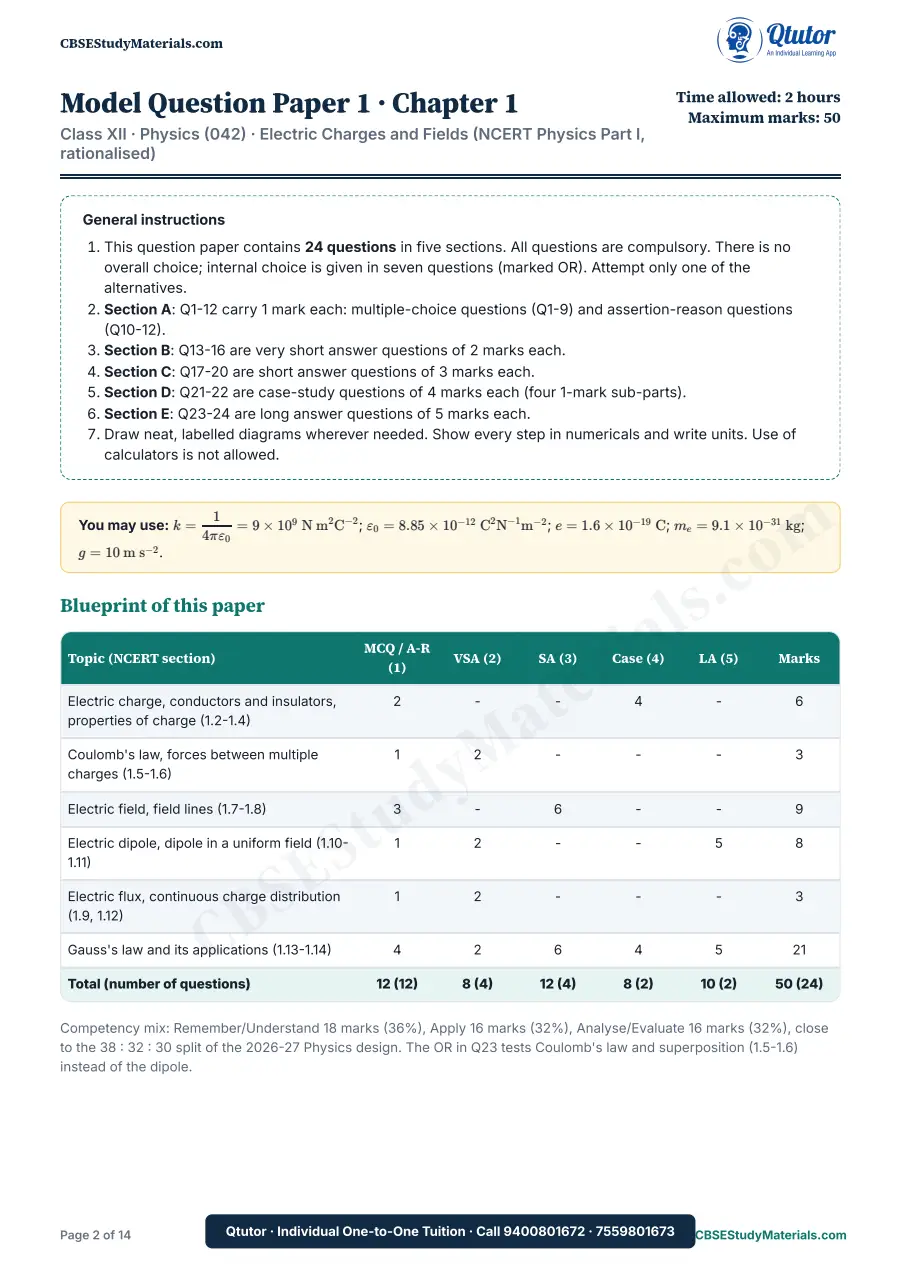
- A board-style paper head (time 2 hours, maximum marks 50), general instructions and a box of physical constants
- A blueprint table that maps every mark to an NCERT section (1.2 to 1.14) and to the question type
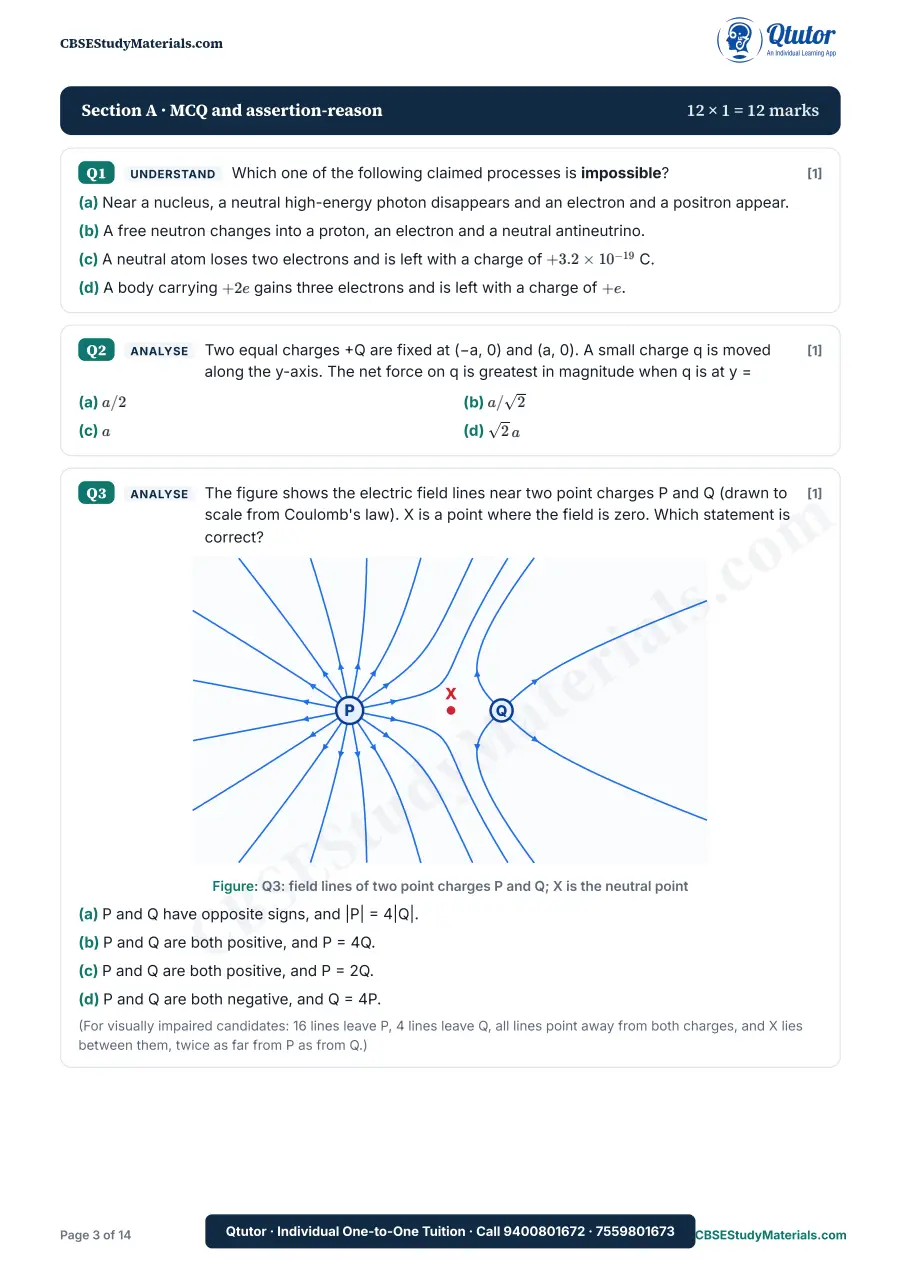
- Section A: 9 MCQs and 3 assertion-reason questions (1 mark each), including a statement-combination item and a field-line diagram question
- Section B: 4 very short answer questions (2 marks), three of them with an OR choice
- Section C: 4 short answer questions (3 marks): numericals, a Gauss's law derivation and a two-sheet field problem
- Section D: 2 case studies (4 × 1 marks) on a Van de Graaff generator and electrostatic spray painting
- Section E: 2 long answer questions (5 marks) with OR choices: the dipole equatorial field, superposition of forces, Gauss's law for a cube, a charged sheet and a coaxial cable
- A full answer key and marking scheme with ½-mark steps, a reason for every MCQ answer and a "where marks are lost" box
- Field-line figures drawn from Coulomb's law, not freehand sketches
Structure of the Paper
| Section | Questions | Type | Marks |
|---|---|---|---|
| A | Q1-12 | MCQ and assertion-reason | 12 × 1 = 12 |
| B | Q13-16 | Very short answer | 4 × 2 = 8 |
| C | Q17-20 | Short answer | 4 × 3 = 12 |
| D | Q21-22 | Case study (4 sub-parts) | 2 × 4 = 8 |
| E | Q23-24 | Long answer | 2 × 5 = 10 |
| 24 | 50 |
About a third of the marks test recall and understanding, a third test application, and a third test analysis, close to the competency split of the CBSE 2026-27 Physics design.
Electric Charges and Fields Class 12 Important Topics Covered
- Electric charge, conductors and insulators, and the three properties of charge: additivity, conservation and quantisation
- Coulomb's law and the superposition principle for forces between several charges
- Electric field of point charges and of a system of charges; motion of a charge in a uniform field
- Electric field lines and the neutral point between two charges
- Electric flux and continuous charge distributions
- Electric dipole: field on the equatorial line, torque in a uniform field, behaviour in a non-uniform field
- Gauss's law and its applications to a long wire, a plane sheet, a thin spherical shell and a coaxial cylinder
Electric Charges and Fields Class 12 Important Questions (Sample)
Section A, assertion-reason (Q10). Assertion: An electron released in a uniform field of 9.1 × 10³ N/C pointing upwards accelerates upwards at 1.6 × 10¹⁵ m/s². Reason: The force on a charge q in a field E is qE. The marking scheme explains why the answer is (d): the magnitude is right, but a negative charge accelerates opposite to the field.
Section C (Q18). An ink droplet of mass 1.0 × 10⁻¹⁰ kg carrying −1.6 × 10⁻¹³ C enters plates with charge densities ± 8.85 × 10⁻⁶ C/m² at 20 m/s. The key works it out in steps:
| Step | Working | Mark |
|---|---|---|
| Field between plates | E = σ/varepsilon0 = 1.0 × 10⁶ N/C | 1 |
| Deflection | y = 1⁄2at2 = 0.51 mm, towards the positive plate | 1 |
| Ignore gravity? | a/g = 160 | 1 |
Section D case (Q21). A Van de Graaff dome of radius 15 cm sparks when the surface field reaches 3 × 10⁶ N/C. Students find the largest charge it can hold (7.5 μC), the field at 30 cm, and explain why doubling the radius allows four times the charge.
How This Model Paper Helps
- Board-pattern practice: the sections, marks, internal choices and assertion-reason options follow the CBSE 2026-27 Class 12 Physics paper, scaled to one chapter.
- Mostly indirect questions: most items ask you to apply or analyse, often in a real context such as a printer, a spray booth or a molecule, rather than repeat a textbook line.
- Honest self-marking: the step-marked scheme shows where half marks are won and lost, so you can grade yourself the way an examiner would.
- Fresh questions: this paper does not repeat the questions in our Chapter 1 worksheet or flash cards, so you can use all three.
Who Should Use This Paper
Class 12 CBSE students revising Chapter 1 before a unit test, pre-board or the board exam; students who have finished the NCERT exercises and want a timed, full-length chapter test; and teachers and tutors who need a ready chapter-wise test paper with a blueprint and marking scheme.
How to Download the Class 12 Electric Charges and Fields Model Question Paper PDF
This model question paper is free. Use the download button below to get the PDF, print it, and attempt it in 2 hours without a calculator before you open the answer key.
Electric Charges and Fields - Class 12 Physics Chapter 1 Model Question Paper (PDF · 14 pages · Free download)
Related Resources
- Electric Charges and Fields: chapter page, with every PDF for this chapter
- Electric Charges and Fields Class 12 Chapter 1 notes
- Electric Charges and Fields complete notes with derivations and solved numericals
- Electric Charges and Fields Class 12 Chapter 1 worksheet
- Electric Charges and Fields Class 12 Chapter 1 flash cards
- Electric Charges and Fields competency-based question bank
- All Class 12 Physics study material
- Next chapter: Electrostatic Potential and Capacitance
FAQs on Class 12 Physics Chapter 1 Electric Charges and Fields Model Question Paper
Where can I download the Class 12 Physics Chapter 1 Electric Charges and Fields model question paper PDF? On this page. Click the download button to get the free 14-page PDF with questions, blueprint and marking scheme.
Is the Electric Charges and Fields model question paper free? Yes. This first model paper for Class 12 Physics is free to download.
Does the paper follow the CBSE 2026-27 Class 12 Physics pattern? Yes. It uses the board's five sections (MCQ and assertion-reason, 2-mark, 3-mark, case-based and 5-mark questions) with internal choices, scaled to 50 marks for one chapter.
What are the important topics in Electric Charges and Fields Class 12? Coulomb's law and superposition, the electric field and field lines, electric flux, the electric dipole and torque on it, and Gauss's law with its applications to a wire, a sheet and a thin shell.
Which book is Electric Charges and Fields Class 12 from? It is Chapter 1 of the NCERT Physics Part I textbook for Class 12. The paper is based on the current rationalised edition.
Are answers and a marking scheme included? Yes. Every question has a worked answer with ½-mark steps, and every MCQ answer has a one-line reason.
How long should I take to solve this paper? Two hours, the same pace as the board paper (about 2.4 minutes per mark). Attempt it in one sitting before checking the key.
Study tip: draw every force and field as an arrow before you add them; most lost marks in this chapter come from adding magnitudes that point in different directions.