Harvest Hymn - Class 8 English Chapter 11 Chapter Notes (PDF · 13 pages · ₹49) Unlock the full PDF for ₹49
Free sample: pages 1 to 3 of 13. The full PDF costs ₹49.
Why do the village men in Sarojini Naidu's poem call the Sun the "lord of the lotus", and why does the last stanza end with a prayer instead of a drum? These Harvest Hymn notes for Class 8 English Chapter 11 (CBSE, NCERT Poorvi textbook, 2026-27) answer that and much more. This premium 13-page chapter notes PDF costs ₹49; it is our own NCERT based study material and not an official CBSE or NCERT publication.
The notes explain the poem stanza by stanza in simple language, with seven original diagrams, a mind map, a word bank and a one-page summary for last-minute revision.
Class 8 English Chapter 11 Harvest Hymn Notes: What Is Included
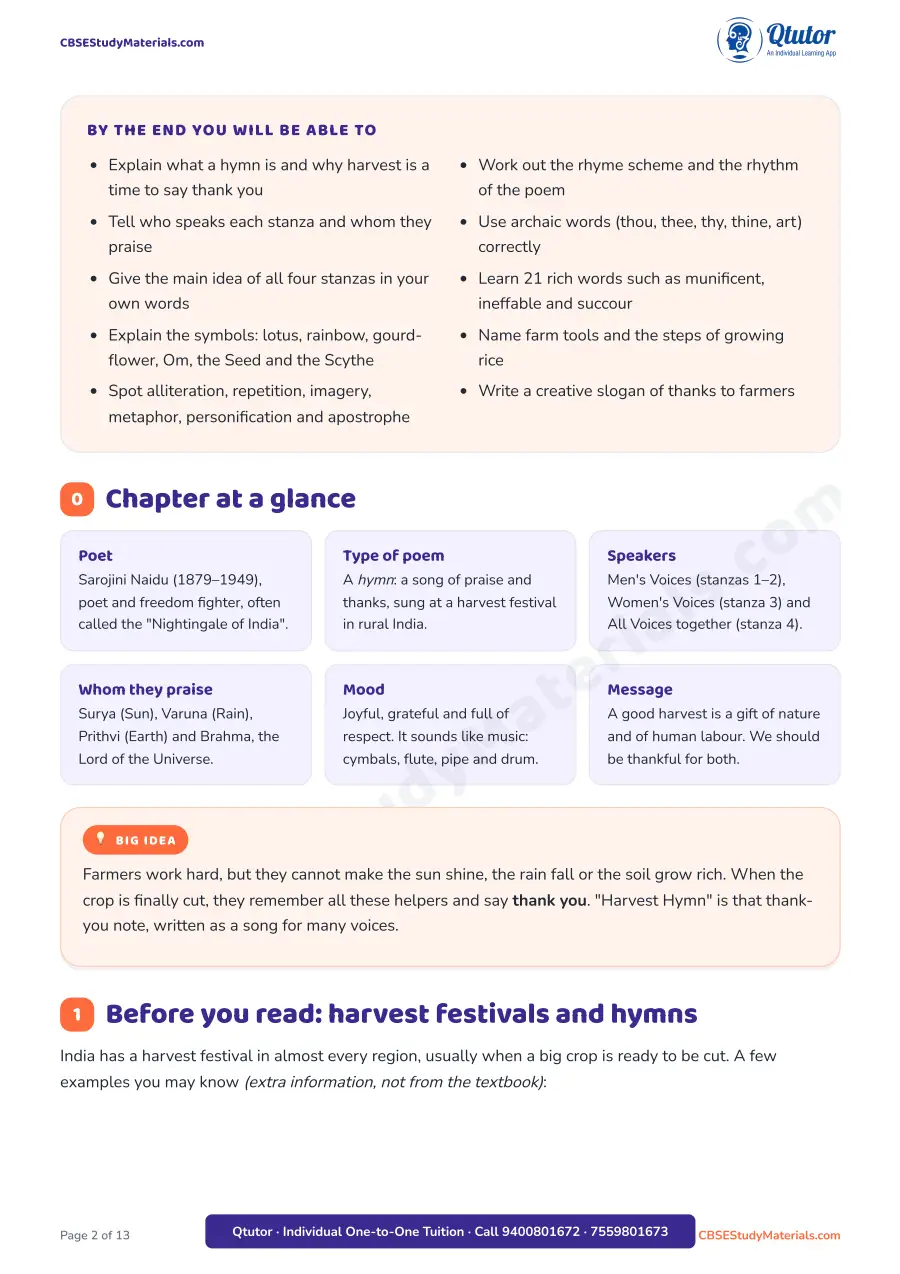
- Chapter at a glance: poet, type of poem, speakers, the four powers praised, mood and message in six quick boxes.
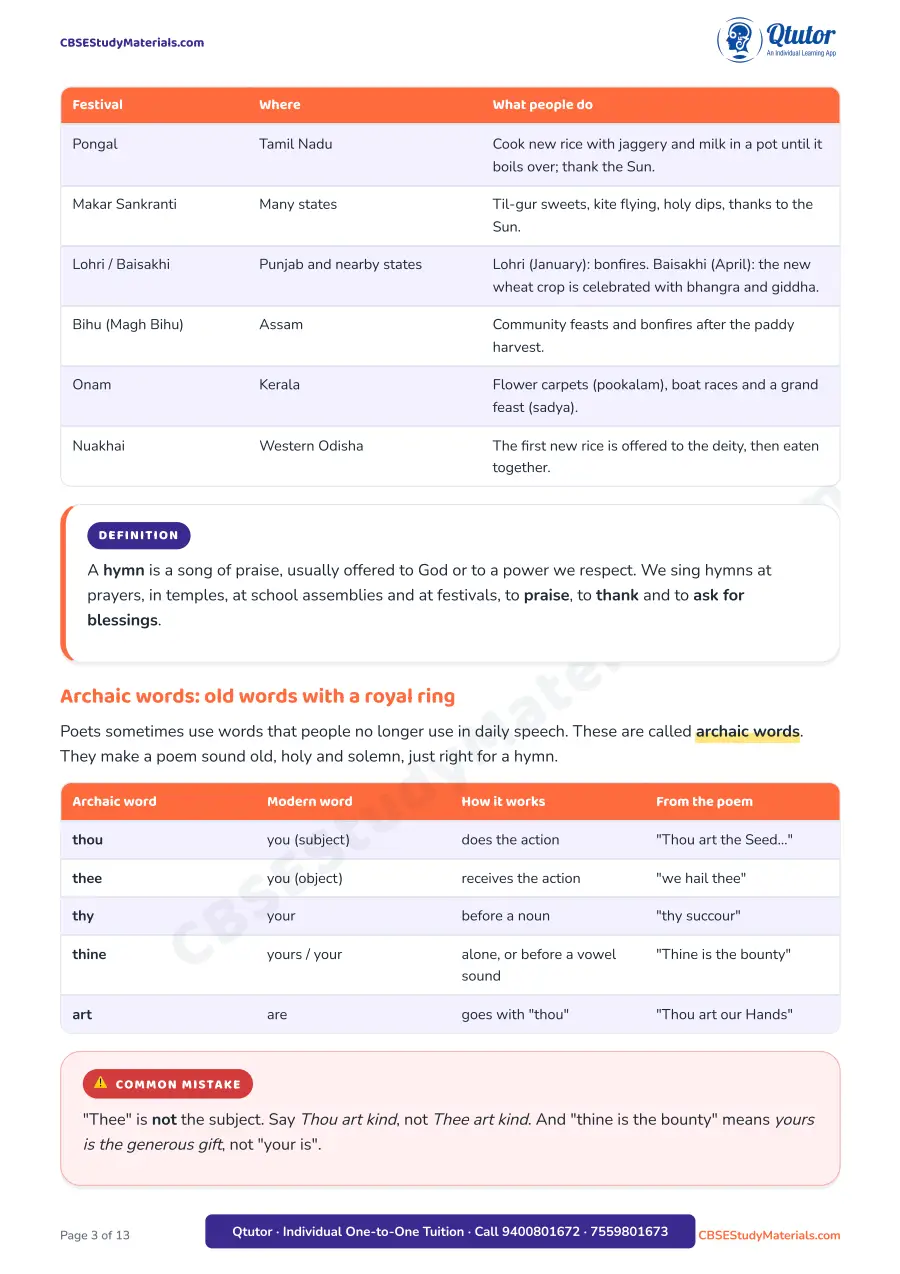
- Before you read: a table of six Indian harvest festivals (Pongal, Makar Sankranti, Lohri and Baisakhi, Bihu, Onam, Nuakhai), what a hymn is, and the archaic words thou, thee, thy, thine and art.
- Meet the poet: a short note on Sarojini Naidu, the "Nightingale of India".
- How the poem is built: four stanzas of eight lines, Men's Voices, Women's Voices and All Voices, and the four-step pattern inside every stanza.
- Stanza-by-stanza explanation of the hymns to Surya, Varuna, Prithvi and Brahma, with one line quoted from each stanza and every hard word explained.
- Symbols: lotus, rainbow, gourd-flower, Om, "the gold of our fields" and the Seed and the Scythe.
- Poetic devices table: alliteration, repetition, apostrophe, personification, metaphor, imagery, symbolism and archaic diction, each with an example from the poem.
- Rhyme scheme and rhythm (abcb defe) with a diagram of the rhyming pairs.
- Theme, tone and message, a 21-word glossary, synonyms in context, more archaic words (morrow, hither, quoth, betwixt, yonder) and silent letters.
- Beyond the poem: six farm tools and the steps of growing rice, plus the pearl millet fact file.
- Check yourself: 12 indirect questions with answers, and a one-page summary.
Structure of the Harvest Hymn Notes PDF
| Part | What you get | Pages |
|---|---|---|
| Cover, objectives, chapter at a glance | 10 learning goals and six summary boxes | 1–2 |
| Sections 1–3 | Festivals, hymns, archaic words, the poet, poem structure | 2–4 |
| Sections 4–7 | Stanza-wise explanation, symbols, devices, rhyme, themes | 5–8 |
| Sections 8–9 | Word bank, farm tools, rice steps, millets, mind map | 9–11 |
| Check yourself | 12 questions with answers | 11–12 |
| One-page summary | Everything on a single sheet | 13 |
Harvest Hymn Class 8 Important Topics
- Who speaks each stanza and whom they thank: Surya (Sun), Varuna (rain), Prithvi (Earth) and Brahma (Lord of the Universe).
- What each group offers: songs and garlands, thanks, love, and finally their own lives and labours.
- The meaning of munificent, beneficent, bounty, mellowing radiance, furrows, garnered, omnipotent, opulent, manifold, ineffable, succour and counsel.
- Why "Hands", "Heart" and "Home" have capital letters.
- How repetition and the even-line rhyme make the poem easy to sing as a group.
- The Seed and the Scythe as a metaphor for the beginning and end of the harvest.
Sample from This PDF
From the stanza explanation: "Varuna is 'lord of the rainbow' (rainbows appear with rain) and 'lord of the main', an old word for the sea. His mercy, the rain, cherished the furrows and fostered the grain."
From the devices table:
| Device | Example from the poem |
|---|---|
| Alliteration | "our lives and our labours" |
| Apostrophe | "O Surya", "O Earth!" |
| Metaphor | "Thou art the Seed and the Scythe" |
From Check yourself: "Which stanza would a farmer who has just had a dry summer sing most gratefully after good monsoon rains? Why?" (Answer: stanza 2, to Varuna, who sends the rain and dewfall.)
How These Revision Notes Help
The poem uses old words and many images, so students often lose marks by giving vague answers. These revision notes turn each stanza into plain English, show the pattern the poet repeats, and give you exact examples of every poetic device, which is what extract-based and reference-to-context questions ask for. The diagrams make the four speakers, the symbols and the rhyme scheme easy to remember, and the chapter summary page is ideal for the night before a test.
Who Should Use It
- Class 8 students using the NCERT Poorvi English textbook in the CBSE 2026-27 session.
- Students who find poems hard to explain in their own words.
- Parents and tutors who want a clear, ready explanation of Harvest Hymn.
Harvest Hymn - Class 8 English Chapter 11 Chapter Notes (PDF · 13 pages · ₹49)
How to Download the Class 8 Harvest Hymn Notes PDF
Click the download button above, complete the ₹49 payment, and the 13-page PDF is yours to read on a phone or print at home.
Related Resources
- Harvest Hymn Class 8 NCERT Solutions PDF
- Harvest Hymn Class 8 Question Bank PDF
- Class 8 English Chapter 11 Harvest Hymn: chapter page
- All Class 8 English (Poorvi) chapters
- Previous chapter: The Cherry Tree (Chapter 10)
- Next chapter: Waiting for the Rain (Chapter 12)
FAQs on Class 8 English Chapter 11 Harvest Hymn
Where can I download Class 8 English Chapter 11 Harvest Hymn notes PDF? On this page. It is a premium 13-page PDF priced at ₹49, available right after payment.
What are the important topics in Harvest Hymn Class 8? The four speakers and the gods they praise, the symbols (lotus, rainbow, gourd-flower, Om, the Seed and the Scythe), the poetic devices, the rhyme scheme abcb defe, archaic words and the theme of gratitude.
Who wrote the poem Harvest Hymn? Sarojini Naidu, the poet and leader of India's independence movement, known as the Nightingale of India.
Which book is Harvest Hymn Class 8 from? It is Chapter 11 of the NCERT Class 8 English textbook Poorvi, in Unit 4 (Environment).
Do these notes include important questions? Yes. There are 12 "Check yourself" questions with answers. For full textbook answers, see the NCERT Solutions PDF, and for more practice, the Question Bank.
Is this an official NCERT or CBSE PDF? No. It is independent study material written by our team from the current NCERT textbook.
Study tip: read the poem aloud once, clapping on the strong beats, before you revise the devices; you will remember the lines far better.