Electricity: Circuits - Class 7 Science Chapter 3 Question Bank (PDF · 22 pages · ₹49) Unlock the full PDF for ₹49
Free sample: pages 1 to 3 of 22. The full PDF costs ₹49.
Two cells, an LED and a switch: the LED stays dark until you turn it round. Why? This Electricity: Circuits and their Components Class 7 Science Chapter 3 question bank is built around puzzles like that. It is a premium 22-page PDF of important questions with answers for CBSE 2026-27 students using the NCERT Curiosity textbook (Grade 7). It is NCERT based study material prepared by our team. It is not an official CBSE or NCERT publication.
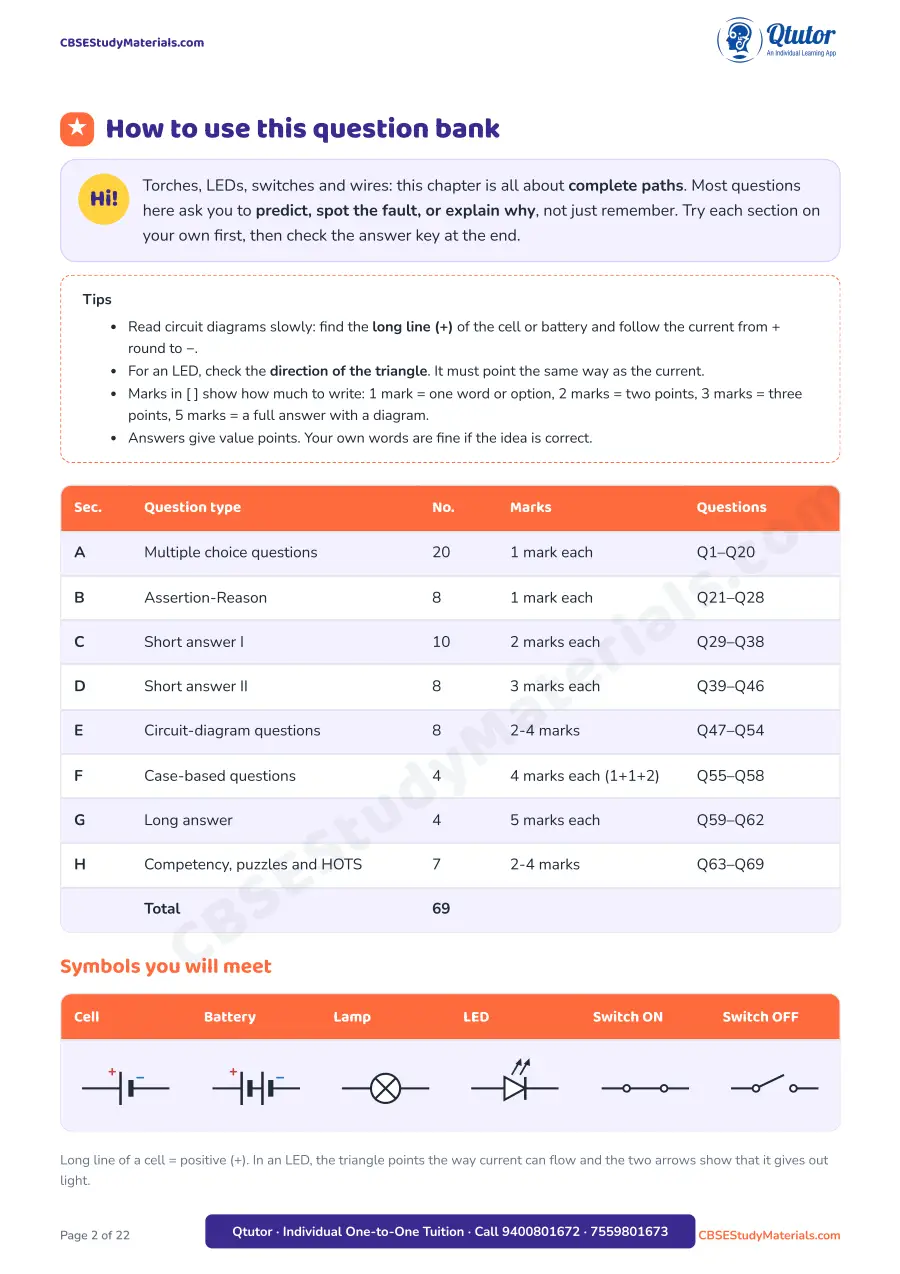
The PDF costs ₹49. It has 69 original questions in eight sections. Most ask you to predict, spot a fault or explain why, not just recall a line. Every question has a worked answer with value points.
Class 7 Science Chapter 3 Question Bank: What Is Included
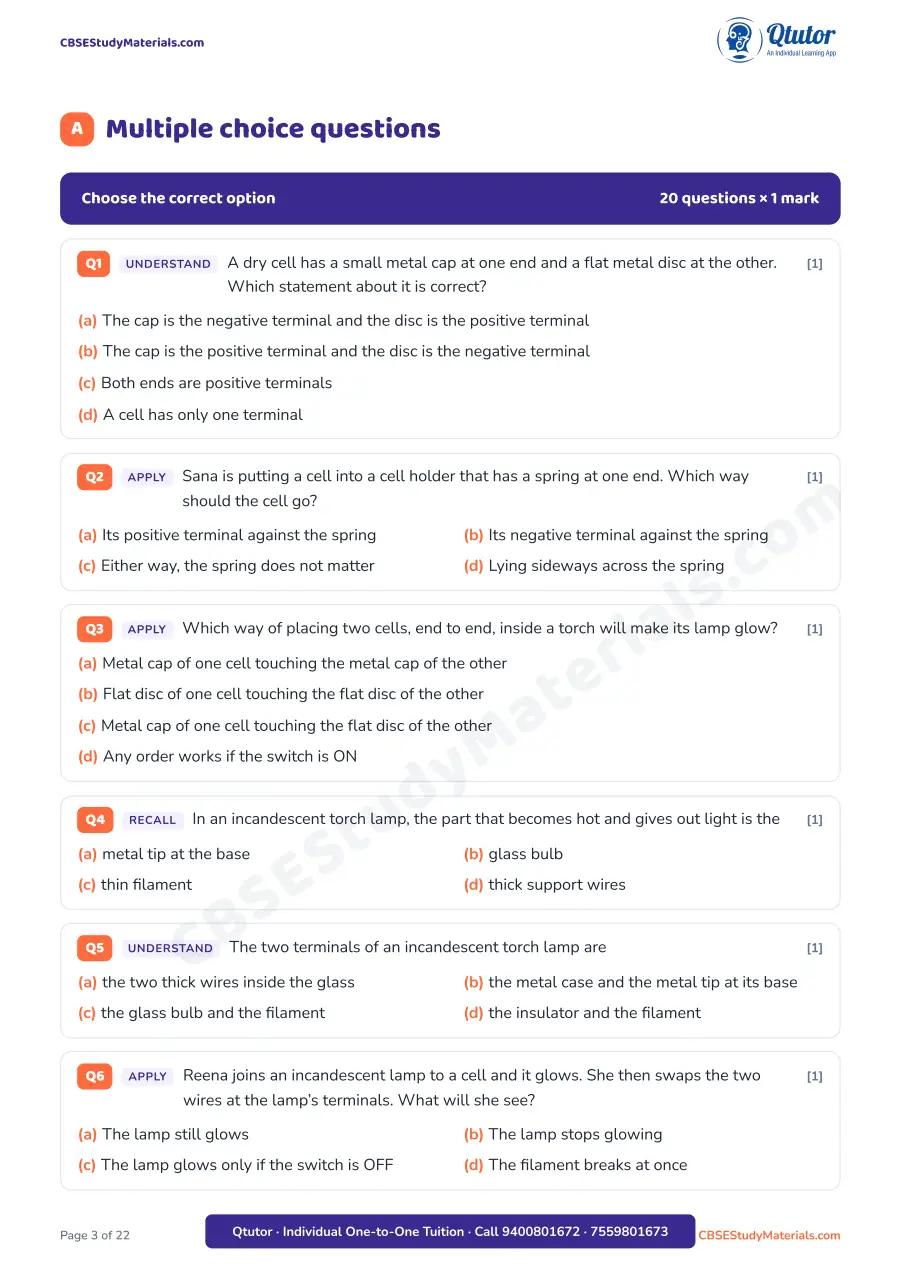
- 20 MCQs on cells, batteries, incandescent lamps, LEDs, switches, conductors and insulators, including symbol-reading and a Statement I / Statement II item
- 8 Assertion-Reason questions in the standard four-option format
- 10 short answer questions (2 marks) and 8 short answer questions (3 marks)
- 8 circuit-diagram questions: name the components, complete a switch table, find the faulty circuit, trace the direction of current, and draw a torch circuit or a conduction tester
- 4 case-based questions (1 + 1 + 2 marks, with an OR option): an LED project for a science fair, a conduction-test data table, batteries used at home, and electrical safety in the monsoon
- 4 long answer questions (5 marks) that need explanations and diagrams
- 7 competency and HOTS items: a steady-hand game to design, a hidden-wire box puzzle, a three-column match, odd one out, material choice, a power-cut task and error spotting
- A complete answer key with marks shown and 6 labelled answer diagrams
- A one-page guide with a table of the six circuit symbols used in the chapter
Structure of the PDF
| Section | Question type | Questions | Marks |
|---|---|---|---|
| A | Multiple choice | Q1-Q20 | 1 each |
| B | Assertion-Reason | Q21-Q28 | 1 each |
| C | Short answer I | Q29-Q38 | 2 each |
| D | Short answer II | Q39-Q46 | 3 each |
| E | Circuit diagrams | Q47-Q54 | 2-4 |
| F | Case-based | Q55-Q58 | 4 each |
| G | Long answer | Q59-Q62 | 5 each |
| H | Competency and HOTS | Q63-Q69 | 2-4 |
| Key | Answers with value points | All 69 | - |
Electricity: Circuits and their Components Class 7 Important Topics
The questions cover every part of the chapter:
- Uses of electricity and the ways it is generated, including the hydroelectric power house at Bhakra Nangal
- The electric cell: its positive terminal (metal cap) and negative terminal (flat disc), and placing cells in a holder
- Making a battery by joining the positive terminal of one cell to the negative terminal of the next, and what happens when one cell is reversed
- The incandescent lamp: filament, support wires, its two terminals and the fused lamp
- The LED: longer leg positive, shorter leg negative, and current in one direction only
- The complete path, the direction of current from + to −, open and closed circuits
- The electric switch (ON and OFF) and why its position in the loop does not matter
- Circuit symbols and circuit diagrams for a cell, battery, lamp, LED, switch and wire
- Conductors and insulators, why copper is used for wires, and how plastic, rubber and ceramics protect us
- Electrical safety, and the difference between DC from cells and AC from the wall socket
Electricity Class 7 Important Questions (Sample)
MCQ (Q11): Two identical new cells are joined with the second one turned round, with a lamp and a switch that is ON. What happens to the lamp? Answer: (b) It does not glow. The two negative terminals face each other, so the cells do not act as a battery.
Assertion-Reason (Q24): A: An incandescent lamp glows whichever way its terminals are joined to the cell. R: The two terminals of the lamp are at its base. Answer: (b) Both are true, but R does not explain A. The lamp glows either way because current can pass through the filament in either direction.
Circuit diagram (Q48): A battery feeds two lamps. Switch S1 is in the main wire and switch S2 controls only lamp L2. The answer table gives the result for each case:
| S1 | S2 | Lamps that glow |
|---|---|---|
| OFF | ON | none |
| ON | OFF | L1 only |
| ON | ON | L1 and L2 |
How This Question Bank Helps
- Builds circuit sense. You keep tracing current from the long line (+) round to the negative terminal, so reading any circuit diagram becomes routine.
- Trains you to find faults. Reversed cells, a backward LED, an open switch, a broken filament and stray insulation each appear in more than one form.
- Matches the competency style. Case-based, data-based and assertion-reason items follow the pattern schools now use, scaled for Class 7.
- Makes self-checking easy. The answer key gives marks for each value point, so you can grade your own answers.
Who Should Use It
Class 7 students revising Chapter 3 before a unit test, periodic test or half-yearly exam. Parents and tutors who want ready, checked practice questions with answers. Teachers who need a quick worksheet or a class quiz on circuits.
How to Download the Class 7 Electricity Question Bank PDF
Click the button below. This premium PDF costs ₹49 and downloads instantly as a print-ready A4 file.
Electricity: Circuits - Class 7 Science Chapter 3 Question Bank (PDF · 22 pages · ₹49)
Related resources
- Class 7 Science Chapter 3 Electricity: Circuits and their Components Notes: revision notes, chapter summary and mind map
- Class 7 Science Chapter 3 NCERT Solutions: answers to every textbook question in order
- Electricity: Circuits and their Components chapter page
- All Class 7 Science chapters
- Previous chapter: Exploring Substances: Acidic, Basic, and Neutral
- Next chapter: The World of Metals and Non-metals
FAQs on Class 7 Science Chapter 3 Electricity: Circuits and their Components
Where can I download Class 7 Science Chapter 3 important questions with answers PDF? On this page. Click the download button above to get the 22-page question bank. It costs ₹49.
How many questions are in the Class 7 Electricity question bank? There are 69 questions: 20 MCQs, 8 assertion-reason, 18 short answer, 8 circuit-diagram, 4 case-based, 4 long answer and 7 competency or HOTS questions. All of them have answers.
Does it include circuit diagram questions for Class 7 Chapter 3? Yes. Section E has 8 diagram questions, and other sections use diagrams too. The answer key includes labelled answer diagrams drawn with the standard symbols.
Are these the NCERT textbook exercise questions? No. They are original practice questions based on the chapter. For the textbook exercises, use the Class 7 Science Chapter 3 NCERT Solutions PDF linked above.
Which book is Electricity: Circuits and their Components Class 7 from? It is Chapter 3 of Curiosity, the NCERT Science textbook for Grade 7 used in CBSE schools in 2026-27.
What is the price of the Class 7 Electricity question bank PDF? It is a premium PDF priced at ₹49, with a full answer key included.
Study tip: in every circuit question, first find the long line of the cell, then trace the path back to the short line. If there is a gap or a wrongly turned LED anywhere along it, nothing glows.