Understanding the Weather - Class 7 Social Science Chapter 2 NCERT Solutions (PDF · 13 pages · ₹49) Unlock the full PDF for ₹49
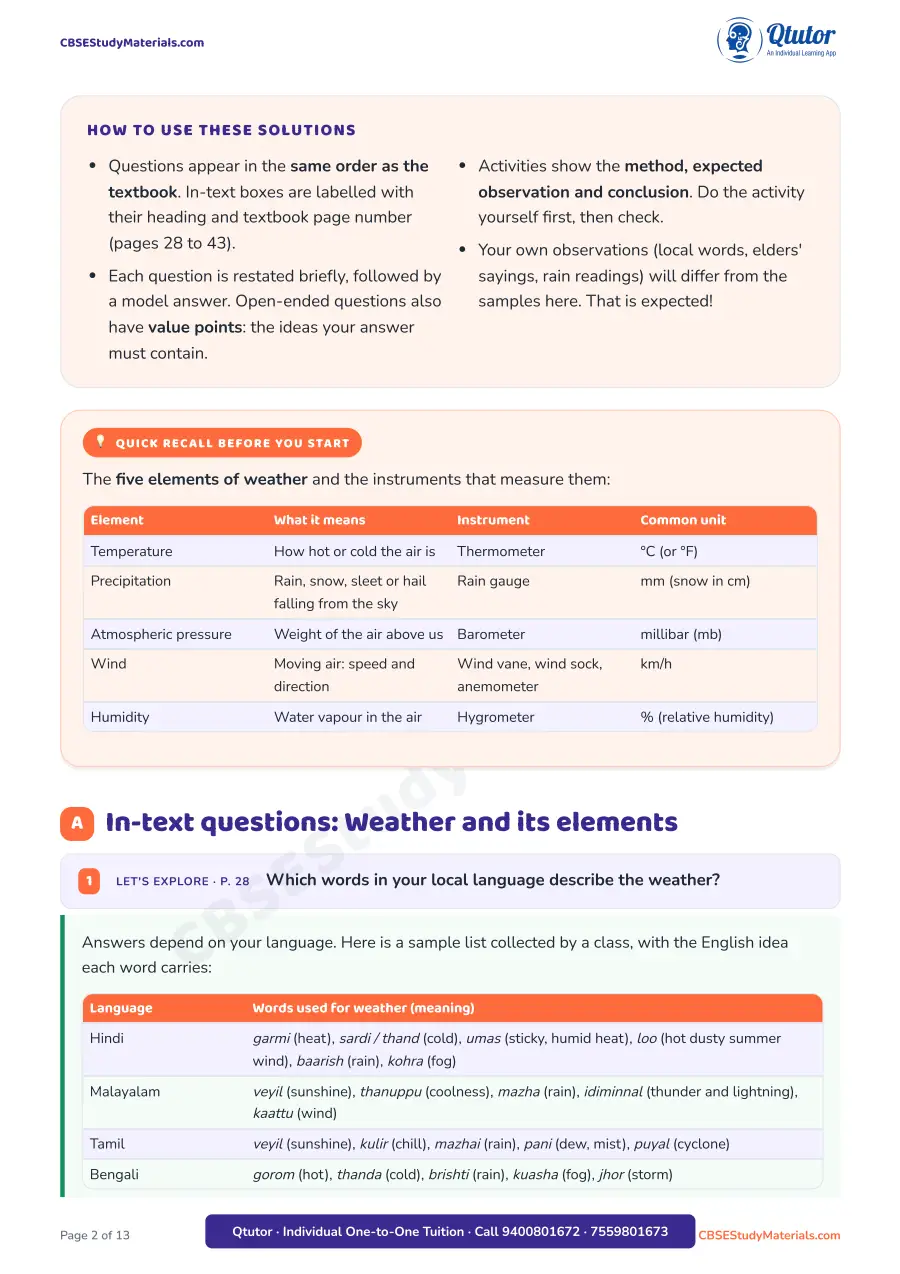
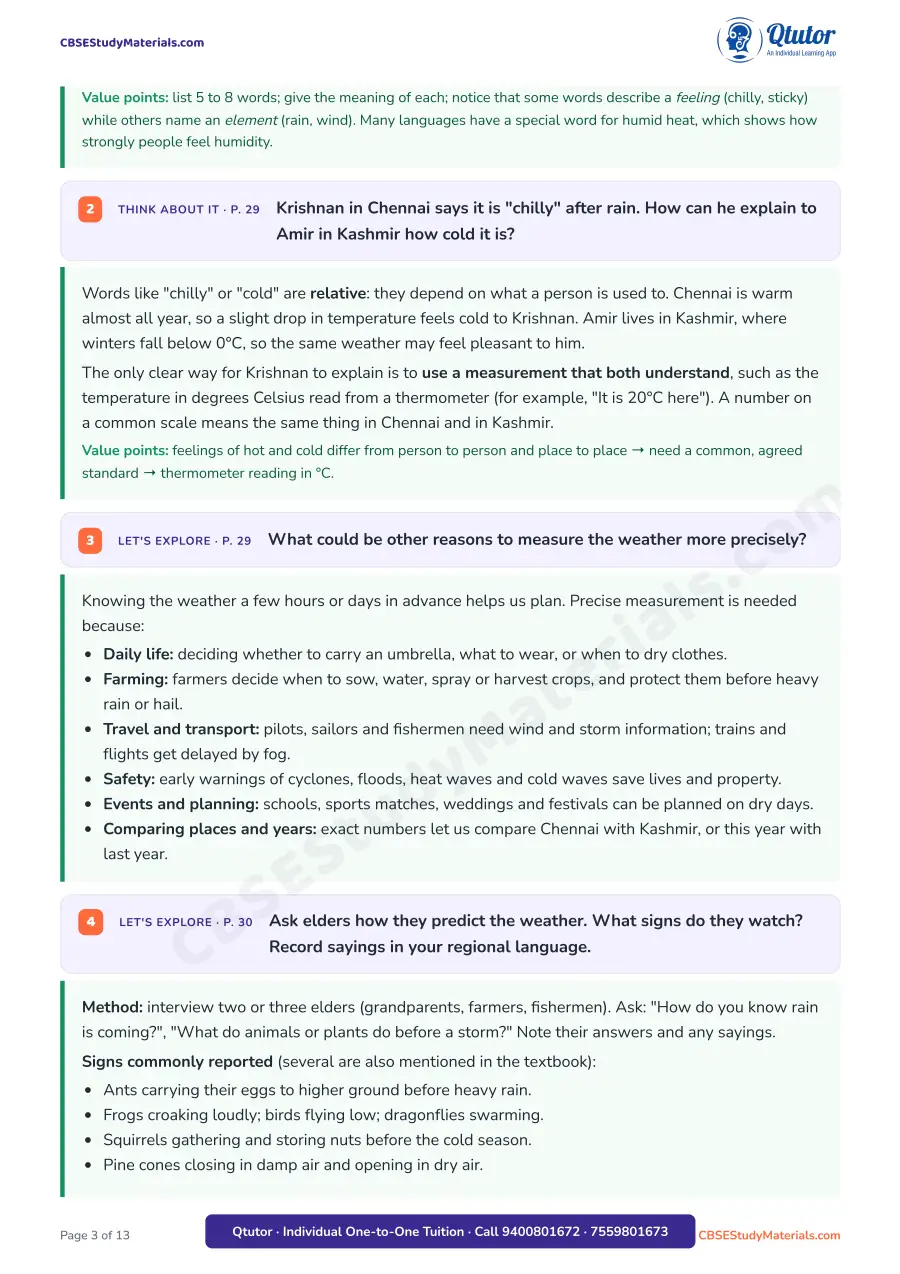
Free sample: pages 1 to 3 of 13. The full PDF costs ₹49.
Krishnan in Chennai says it feels "chilly" after a night of rain, but his friend Amir in Kashmir would call the same weather pleasant. So how do we describe the weather in a way everyone understands? These Understanding the Weather Class 7 NCERT Solutions answer every question in CBSE Class 7 Social Science Chapter 2 from the NCERT book Exploring Society: India and Beyond (Part I, 2026-27), with step-by-step answers, worked calculations and value points.
This is a 13-page premium PDF priced at ₹49. It is NCERT based study material prepared independently by our subject team for CBSE 2026-27; it is not an official CBSE or NCERT publication.
Class 7 Social Science Chapter 2 Understanding the Weather NCERT Solutions: What Is Included
- All 15 in-text questions answered in textbook order: every Let's Explore, Think About It and Don't Miss Out box, labelled with its textbook page number (pages 28 to 41).
- All 4 end-of-chapter questions from "Questions and activities", including the matching question, the Mumbai trip question, the rain gauge site question and the Jammu and Kashmir weather-report script.
- Both Big Questions from the chapter opener answered in short paragraphs.
- Worked calculations: the temperature range and mean daily temperature for the Madhya Pradesh chart, and a full table of ranges and departures from normal for seven Jammu and Kashmir stations.
- Activity solutions with method, expected observation and conclusion, such as the home-made rain gauge with a sample month of readings and weekly averages.
- Value points under open-ended answers, showing which ideas a complete answer must contain.
- 3 original diagrams: the "from the sun arises rain" water-cycle sketch, a line graph of the week's maximum and minimum temperatures, and a labelled home-made rain gauge.
- A quick-recall table of the five weather elements, their instruments and units, and a six-line chapter summary at the end.
Structure of the PDF
| Section | What you get |
|---|---|
| Cover and how to use | How the solutions are laid out; quick-recall table of elements and instruments |
| A. Weather and its elements | In-text questions 1 to 8 (local weather words, Krishnan and Amir, traditional forecasting, IMD motto, temperature chart, rain gauge activity) |
| B. Pressure, wind and humidity | In-text questions 9 to 13 (why measure pressure, Khardung La, seeds and wind, Kochi vs Jaipur, Delhi vs Kochi humidity) |
| C. Predicting the weather | In-text questions 14 and 15 (uses of forecasts, reading the IMD warning map of 19 May 2024) and the two Big Questions |
| D. Questions and activities | All 4 exercise questions with full answers |
| Recap | Six-line chapter summary |
Understanding the Weather Class 7 Important Topics
The solutions cover every idea the chapter asks about: weather as the state of the atmosphere in the troposphere; the five elements of weather (temperature, precipitation, atmospheric pressure, wind and humidity); traditional ways of reading Nature's signs; thermometers, temperature range and mean daily temperature; the rain gauge; the barometer, millibars and depressions; wind vanes, wind socks and anemometers; relative humidity and the hygrometer; weather stations and Automated Weather Stations; and how the India Meteorological Department uses colour-coded warnings to help people prepare.
Understanding the Weather Class 7 Questions and Answers (Sample)
In-text question 6 (Let's Explore, p. 32): find the maximum, minimum and range from the temperature chart. Maximum of the week = 32°C (3 March 2025). Minimum of the week = 14°C (5 March 2025). Range = 32°C − 14°C = 18°C. Mean daily temperature on 3 March = (32 + 18) ÷ 2 = 25°C.
In-text question 13 (Think About It, p. 38): humidity is 52% in Delhi and 84% in Kochi. Where do clothes dry faster?
| Delhi (52%) | Kochi (84%) | |
|---|---|---|
| Wet clothes | Dry faster: water evaporates quickly | Dry slowly: air is nearly saturated |
| Sweating | Sweat evaporates and cools you | You sweat more and feel sticky |
Exercise question 3: best site for the school rain gauge. Option 3, open ground with an elevated platform. It is open to the sky with nothing blocking the rain, the platform keeps the gauge level and stable, and it stops rain splashing up from the ground. The verandah gives a reading that is too low because the roof shelters it.
How These NCERT Solutions Help
- You can check your own answers to every textbook box without hunting through the chapter.
- The value points show how to turn a one-line idea into a complete answer for class tests and school exams.
- The data questions (temperature chart, IMD map, Jammu and Kashmir table) are solved step by step, which builds the skill of reading weather data, not just remembering it.
- Activity answers show what you should observe and conclude, so practical work makes sense.
- The chapter summary at the end doubles as quick revision notes before a test.
Who Should Use It
- Class 7 students studying CBSE Social Science (Geography) from Exploring Society: India and Beyond, Part I.
- Parents helping with homework who want clear, correct answers in simple language.
- Teachers looking for model answers and value points for the in-text questions.
How to Download the Class 7 Understanding the Weather NCERT Solutions PDF
Use the download button below to get the 13-page PDF for ₹49. It opens on phones, tablets and computers and can be printed.
Understanding the Weather - Class 7 Social Science Chapter 2 NCERT Solutions (PDF · 13 pages · ₹49)
Related Resources
- Understanding the Weather Class 7 chapter page: chapter summary, key points and practice questions.
- Understanding the Weather Class 7 Notes: chapter notes with diagrams, a mind map and a one-page summary.
- Understanding the Weather Class 7 Question Bank: MCQs, short and long answers and case-based questions with answers.
- Class 7 Social Science: all chapters
- Previous chapter: Geographical Diversity of India
- Next chapter: Climates of India
FAQs on Class 7 Social Science Chapter 2 Understanding the Weather
Where can I download Class 7 Social Science Chapter 2 Understanding the Weather NCERT Solutions PDF? On this page. Use the download button to get the 13-page premium PDF for ₹49.
Does this PDF answer the in-text questions too, or only the exercise? Both. It answers all 15 in-text boxes (Let's Explore, Think About It and Don't Miss Out) and all 4 end-of-chapter questions, in the same order as the textbook.
Which book is Understanding the Weather Class 7 from? It is Chapter 2 of the NCERT Class 7 Social Science textbook Exploring Society: India and Beyond, Part I (2026-27 edition), in the theme "India and the World: Land and the People".
What is the answer to the matching question in Class 7 Understanding the Weather? Hygrometer measures humidity, anemometer measures wind direction and speed, barometer measures atmospheric pressure, thermometer measures temperature and rain gauge measures precipitation (1-d, 2-c, 3-b, 4-e, 5-a).
How do you calculate the temperature range in Class 7 Chapter 2? Subtract the minimum temperature from the maximum temperature for the period. For the chapter's Madhya Pradesh chart, 32°C − 14°C = 18°C.
What is the price of the Understanding the Weather Class 7 NCERT Solutions PDF? It is a premium PDF priced at ₹49 for all 13 pages.
Study tip: when a question gives weather numbers, always say what the number means for people (clothes, crops, travel or safety); that is what turns a correct answer into a complete one.