Introduction - Class 11 Economics Chapter 1 Notes (Statistics) (PDF · 16 pages · Free download) Download the full PDF free

You are looking at pages 1 to 3 of 16. The full PDF is free to download.
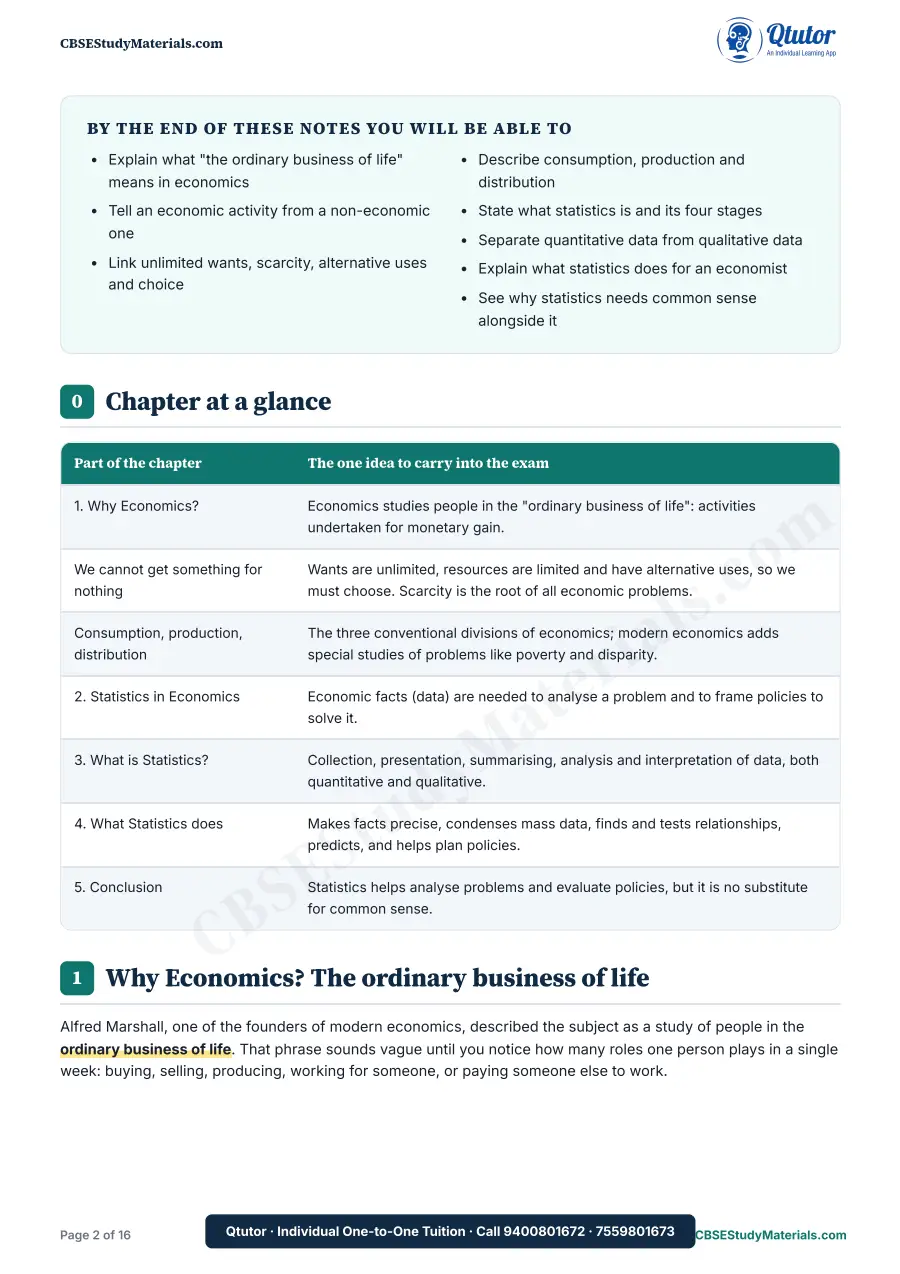
These Introduction notes for Class 11 Economics Chapter 1 (CBSE, NCERT Statistics for Economics, 2026-27) explain the opening chapter of the statistics book in clear, exam-ready language. A family once tried to cross a river because their average height was more than the river's average depth, and the children drowned: the notes use that story from the chapter to show why statistics is powerful and why it still needs common sense. This free 16-page chapter notes PDF is NCERT based study material prepared by our team; it is not an official CBSE or NCERT publication.
The notes follow the order of the textbook: why we study economics, scarcity and choice, consumption, production and distribution, the place of statistics in economics, what statistics is, what statistics does for an economist, and the chapter's conclusion on policy and decision making. Every number in the worked examples and the answer key has been recomputed.
Class 11 Economics Chapter 1 Introduction Notes: What Is Included
- A cover, eight learning objectives and a "chapter at a glance" table that gives the one idea to remember from each part of the chapter
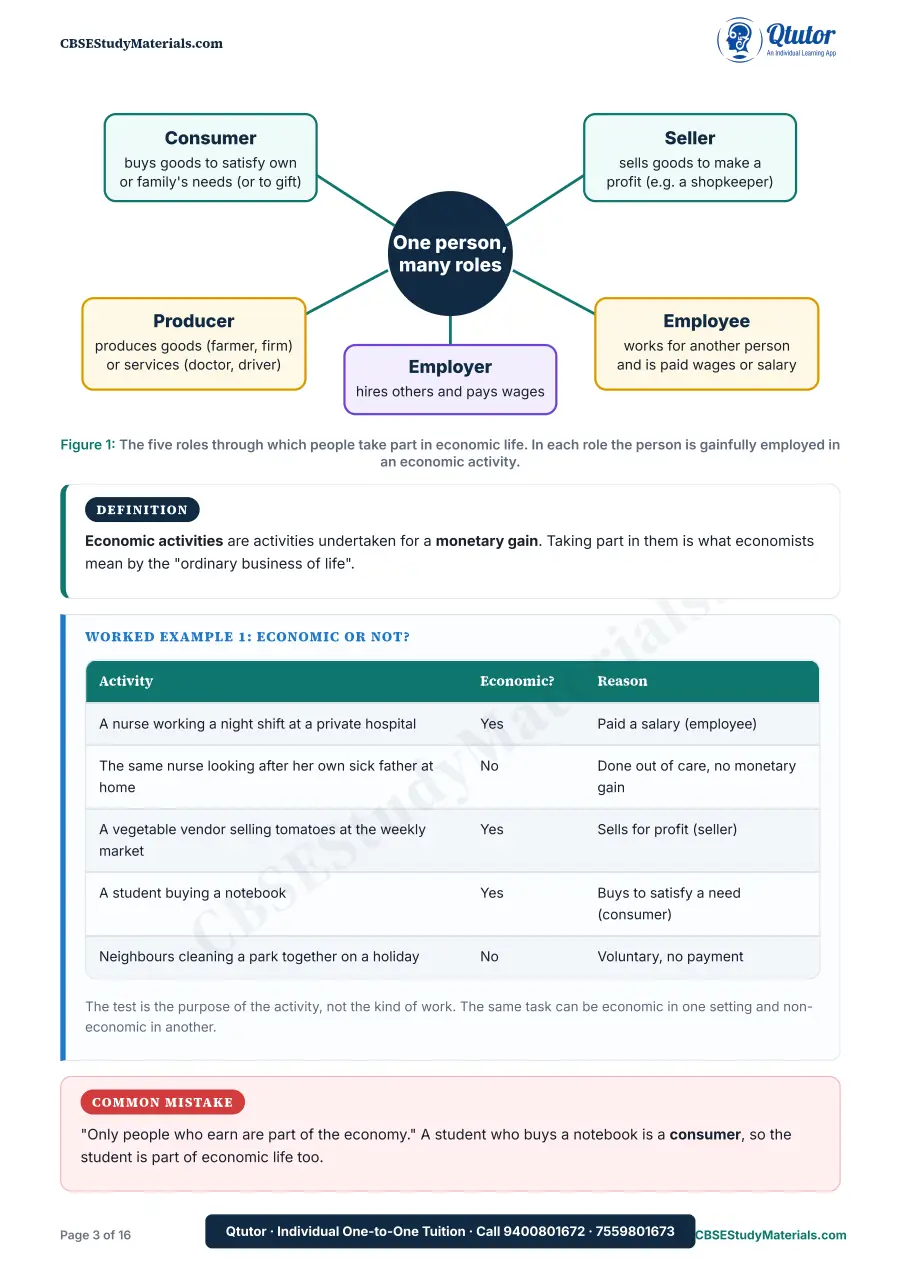
- The "ordinary business of life" and the five economic roles (consumer, seller, producer, employee, employer), with a diagram
- A worked table that sorts everyday activities into economic and non-economic ones, with the reason for each
- Scarcity and choice: unlimited wants, limited means, and why resources with alternative uses force a choice (two diagrams)
- Consumption, production and distribution explained side by side, with a vegetable-market example for each and the meaning of distribution of GDP
- The working definition of economics broken into parts, each linked to an idea in the chapter
- Statistics in economics: how data lead to analysis, analysis leads to policy, and statistics later evaluates the policy
- Quantitative and qualitative data, a bar diagram of the chapter's rice production figures, and the four stages of a statistical study
- A table of what statistics does, from precise facts to prediction and planning, with the chapter's own examples
- 9 original diagrams in all, including a full-page-width mind map
- Common-mistake, did-you-know, real-life and think-deeper boxes throughout
- An 18-term key terms grid, a one-page summary (revision notes for the night before the test) and 12 board-pattern important questions with marking points
Structure of the Introduction Class 11 Notes PDF
| Part | What you get |
|---|---|
| Opening pages | Cover, objectives, chapter at a glance |
| Sections 1-2 | Why economics, scarcity and choice, consumption, production and distribution |
| Sections 3-6 | Statistics in economics, what statistics is, what it does, conclusion |
| Sections 7-8 | Key terms grid and mind map |
| Summary page | One-page chapter summary with comparison tables and exam pointers |
| Check yourself | 12 questions (35 marks) in the CBSE Class 11 Economics exam pattern |
| Answers | Value-point answers with marks shown for each point |
Introduction Class 11 Economics Important Topics
- Alfred Marshall's idea of economics as the study of people in the ordinary business of life
- Economic activities as activities undertaken for monetary gain
- Scarcity as the root of all economic problems, and how it shows up in daily life (queues, crowded trains, shortages)
- Alternative uses of land, labour, water and fertiliser, and the problem of choice
- The three divisions of economics: consumption, production and distribution of national income (GDP) as wages (and salaries), profits and interest (the chapter's Recap also lists rent)
- Special studies of poverty, disparity, education and jobs, and disasters
- Economic data, analysis and policies
- Definition of statistics and its four stages: collection, presentation, summarising, analysis and interpretation
- Quantitative versus qualitative data
- Functions of statistics: precise facts, condensing data, finding and testing relationships, prediction, planning and evaluating policies
- Why statistical methods are no substitute for common sense
Introduction Class 11 Important Questions (Sample)
Here are three short excerpts from the PDF.
From the worked example on the rice data. The chapter states that rice production in India rose from 39.58 million tonnes in 1974–75 to 106.5 million tonnes in 2013–14. The notes turn this into numbers you can use:
| Measure | Working | Result |
|---|---|---|
| Increase | 106.5 − 39.58 | 66.92 million tonnes |
| Ratio | 106.5 ÷ 39.58 | about 2.69 times |
| Percentage rise | 66.92⁄39.58 × 100 | about 169.1% |
An assertion-reason question. Assertion (A): Long queues at a railway booking counter in the festival season are a sign of scarcity. Reason (R): Scarcity arises because the things that satisfy our wants are limited in availability. Answer: both are true and R correctly explains A.
A data-based question (imaginary figures). Two villages each have an average household income of ₹20 thousand a month. In one village the incomes are 8, 9, 10, 11 and 62 (₹ thousand); in the other they are 18 to 22. Students must judge whether the villages are "equally well off", which brings in disparity and the limits of an average.
How the Class 11 Economics Chapter 1 Notes Help
The chapter is short, but board-style questions on it are rarely direct. They ask you to classify an activity, spot scarcity in a situation, or explain how statistics helps a policy maker. The notes train exactly that: each idea comes with a real-life case, and the practice questions are mostly application and analysis items with marking points, so you learn how many points a 3, 4 or 6 mark answer needs. The diagrams make the chain from problem to data to analysis to policy easy to recall in an exam, and the one-page summary works as a quick chapter summary before a test.
Who Should Use These Notes
- Class 11 CBSE students starting Statistics for Economics in the 2026-27 session
- Students who want revision notes and important questions in one PDF
- Teachers and tutors looking for a ready summary page and a short practice set for the first chapter
- Anyone who finds the "what statistics does" part hard to write as points
How to Download the Class 11 Economics Introduction Notes PDF
The PDF is free. Use the download button below to save it to your phone or computer and revise offline.
Introduction - Class 11 Economics Chapter 1 Notes (Statistics) (PDF · 16 pages · Free download)
Related Resources
- All Class 11 Economics Chapter 1 Introduction resources: Introduction chapter page
- Every Class 11 Economics chapter: Class 11 Economics
- Next chapter in Statistics for Economics: Collection of Data (coming soon)
FAQs on Class 11 Economics Chapter 1 Introduction
Where can I download Class 11 Economics Chapter 1 Introduction notes PDF? On this page. The 16-page PDF download is free and covers the whole chapter with diagrams, a summary and practice questions.
What are the important topics in Introduction Class 11 Economics? Scarcity and choice, consumption, production and distribution, the meaning of statistics, quantitative and qualitative data, and the functions of statistics in economics, including why it needs common sense.
Which book is the Introduction chapter from? It is Chapter 1 of the NCERT textbook Statistics for Economics for Class 11 (2026-27 reprint).
Are these Class 11 Economics Chapter 1 notes free? Yes. These notes are free to download.
Do the notes include important questions with answers? Yes. There are 12 questions in the CBSE Class 11 Economics exam pattern, including MCQs, an assertion-reason item, a data-based question and two 6-mark HOTS questions, each with value-point answers.
Is this an official NCERT or CBSE document? No. It is NCERT based study material written by our team to help you revise the chapter for CBSE 2026-27.
Study tip: when a question asks how statistics helps, name the function first (precision, condensing, relationships, prediction, policy) and then give one example for each.