Patterns in Mathematics - Class 6 Maths Chapter 1 Question Bank (PDF · 21 pages · Free download) Download the full PDF free
You are looking at pages 1 to 3 of 21. The full PDF is free to download.
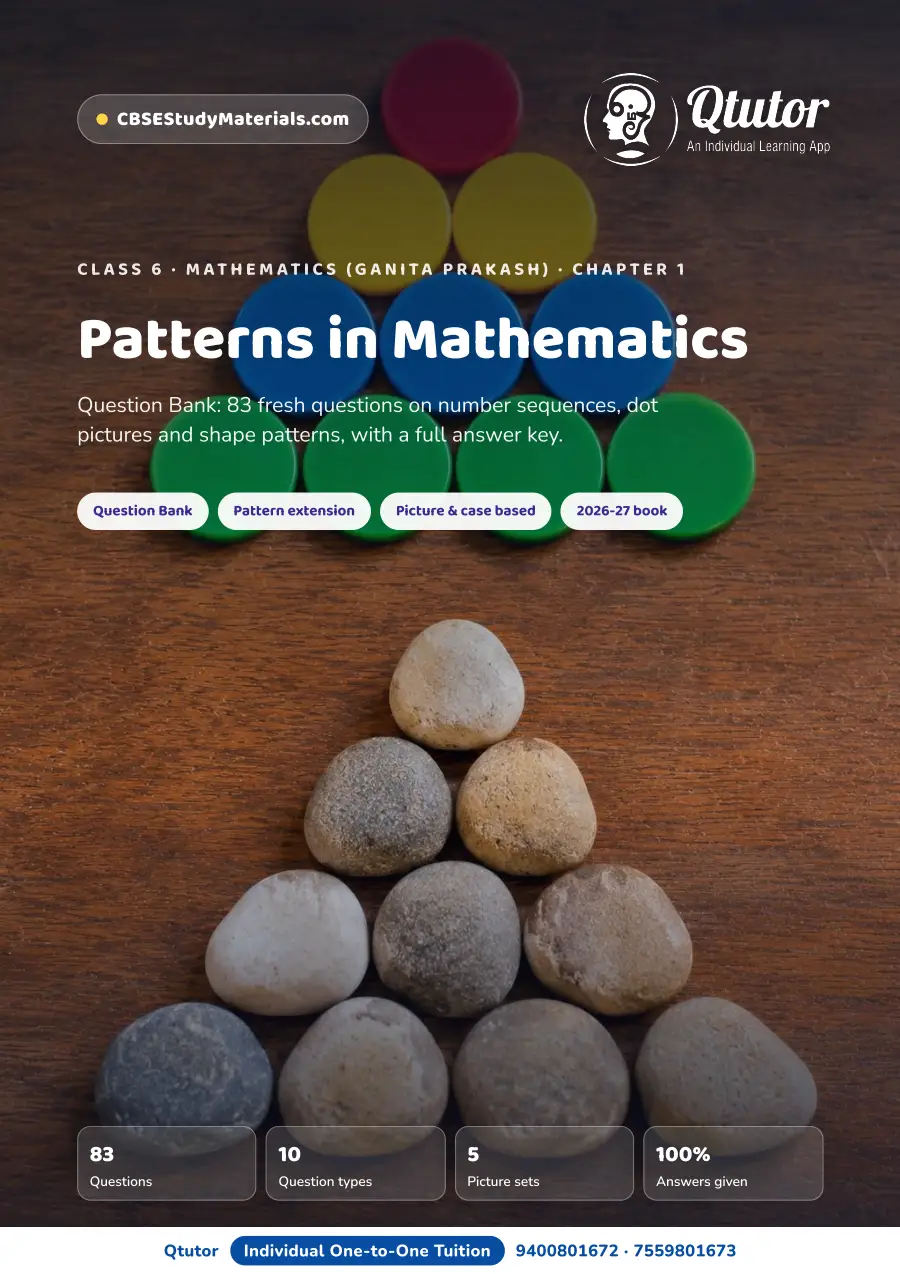
Can 50 marbles be arranged as a perfect triangle? Is the sum of the first 50 odd numbers bigger than 1 + 2 + … + 50 + … + 2 + 1? This Patterns in Mathematics question bank for Class 6 Maths Chapter 1 (CBSE, NCERT Ganita Prakash, 2026-27) is full of questions like these, with every answer worked out. It is a free 21-page PDF of 83 original important questions, made by CBSEStudyMaterials.com. It is our own study material and not an official CBSE or NCERT publication.
The questions do not repeat the "Figure it Out" exercises of the textbook. They test the same ideas with new numbers, new pictures and everyday situations, so a student who has finished the NCERT exercises still has plenty to practise.
Class 6 Maths Chapter 1 Patterns in Mathematics Question Bank: What Is Included
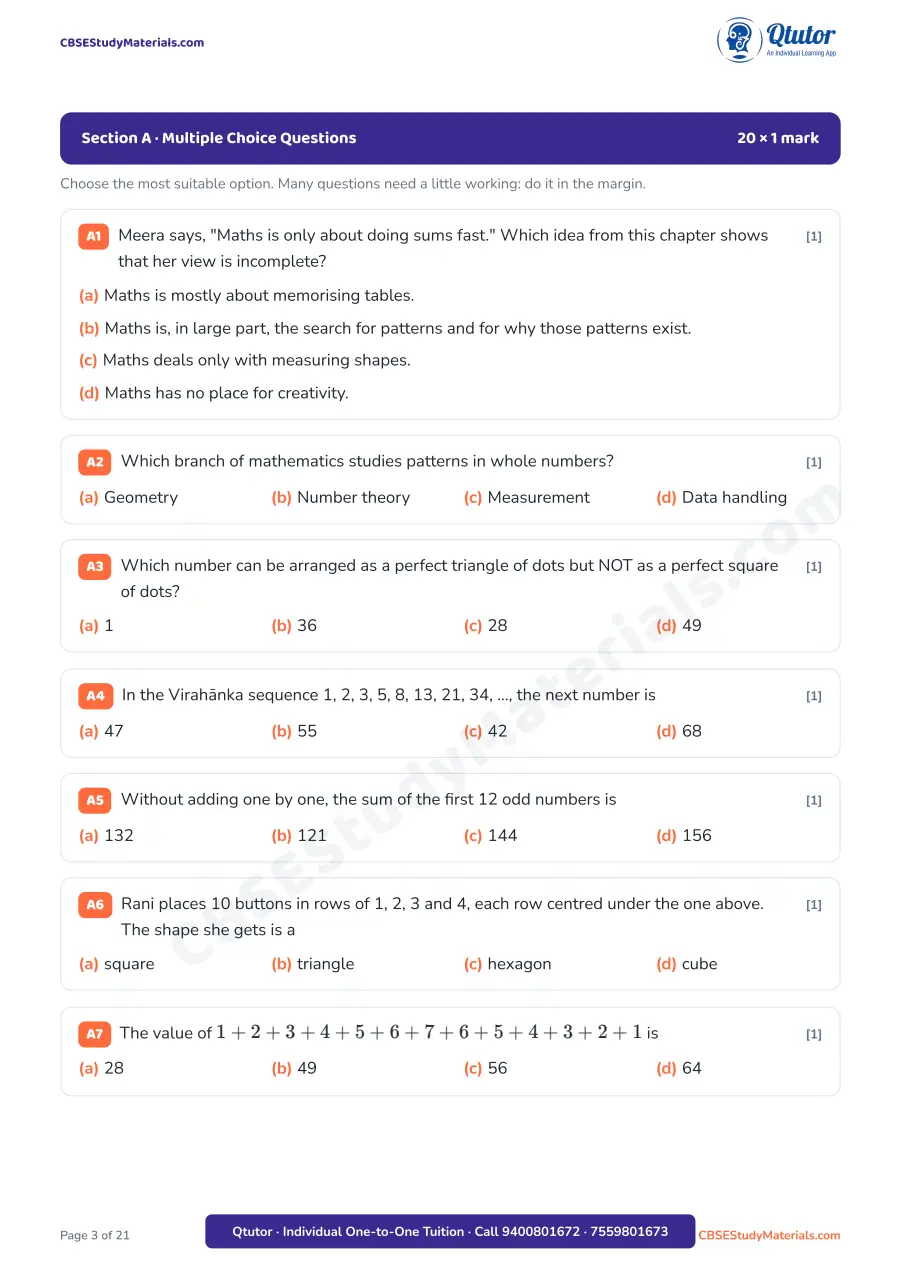
- 20 MCQs with a one-line reason for every answer
- 10 fill in the blanks and 6 true or false statements (false ones corrected in the key)
- 8 very short answer (2 marks) and 8 short answer (3 marks) questions with answer lines
- 10 pattern extension questions: write the next two numbers and the rule
- 5 picture-based sets with original diagrams: L-shapes of dots, matchstick squares, complete graphs, a stacked triangle and paper folding
- 4 case-based sets: a Diwali diya rangoli, a Sports Day formation, an odd-number piggy bank and courtyard tiles
- 5 long answer questions and 7 competency and HOTS questions
- A full answer key with marks shown for each step, and a score tracker
Structure of the PDF
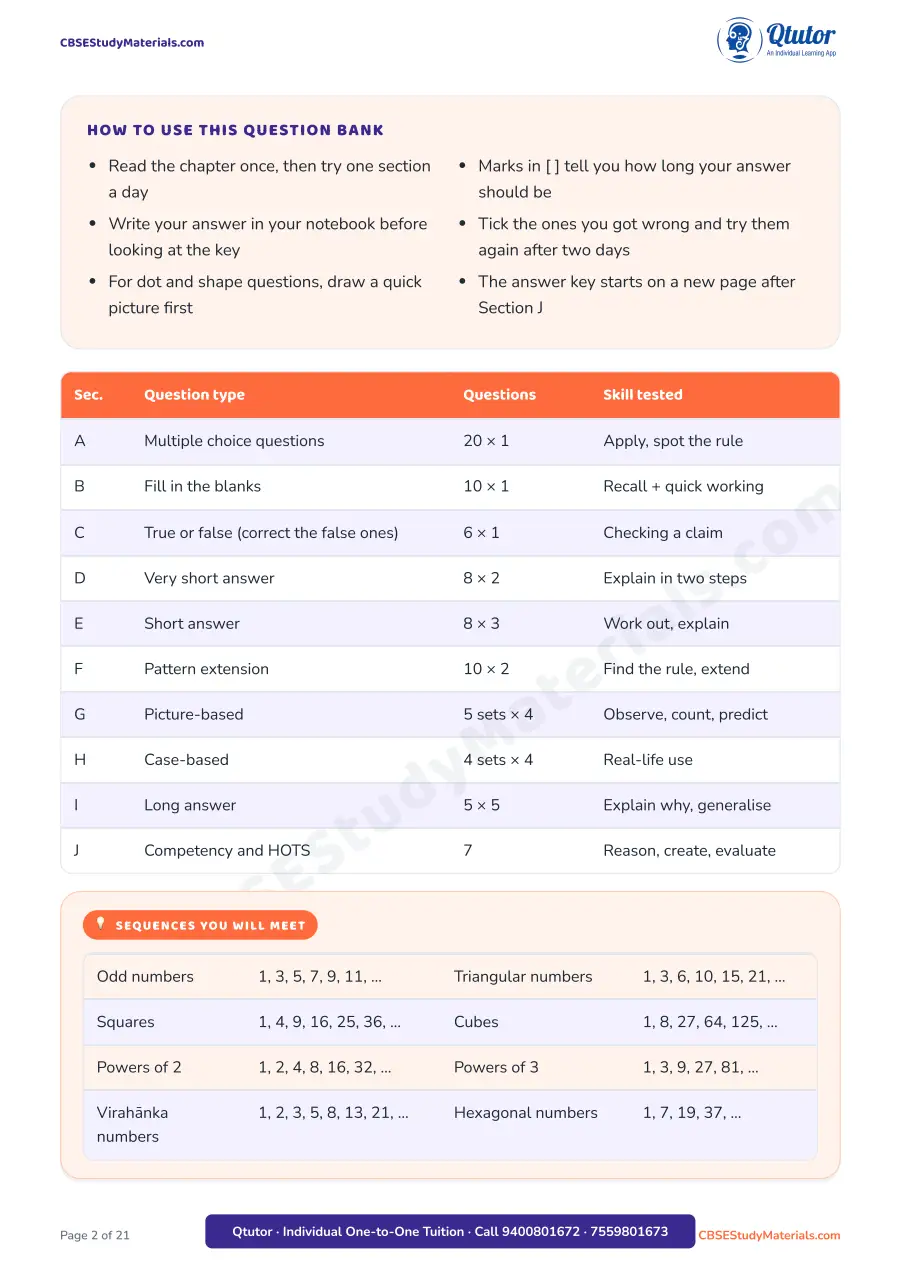
| Section | Question type | Questions |
|---|---|---|
| A | Multiple choice | 20 × 1 |
| B | Fill in the blanks | 10 × 1 |
| C | True or false | 6 × 1 |
| D | Very short answer | 8 × 2 |
| E | Short answer | 8 × 3 |
| F | Pattern extension | 10 × 2 |
| G | Picture-based | 5 sets × 4 |
| H | Case-based | 4 sets × 4 |
| I | Long answer | 5 × 5 |
| J | Competency and HOTS | 7 |
| Key | Answers with value points | all 83 |
Patterns in Mathematics Class 6 Important Topics
Every question comes from the topics of the current Ganita Prakash chapter:
- What mathematics is: the search for patterns and for why they happen; number theory and geometry
- The key number sequences: all 1's, counting numbers, odd and even numbers, triangular numbers, squares, cubes, Virahānka numbers, powers of 2 and powers of 3
- Seeing sequences as dot pictures, including hexagonal numbers
- Relations between sequences: adding odd numbers gives squares, adding up and down gives squares, two neighbouring triangular numbers make a square, powers of 2 added up
- Shape sequences: regular polygons, complete graphs, stacked squares, stacked triangles and the Koch snowflake
- Linking shape sequences to number sequences (sides and corners, lines in a complete graph, little squares and triangles, Koch segments as 3 times powers of 4)
Patterns in Mathematics Class 6 Important Questions (Sample)
MCQ (A8): Seven dots are placed on a circle and every dot is joined to every other dot. How many lines are drawn? (a) 14 (b) 21 (c) 28 (d) 42. Answer: (b), because 1+2+3+4+5+6 = 21.
Case-based (H1), Diwali diya rangoli: Priya makes hexagon designs of 1, 7, 19 and 37 diyas, adding a ring each time. With 100 diyas, what is the biggest complete design she can make? Answer: the rings grow by 6 each time (6, 12, 18, 24, 30), so the designs are 37, 61, 91; the next needs 127. She makes the 91-diya design and has 9 diyas left.
HOTS (J7): Mark the triangular numbers as odd or even:
| 1 | 3 | 6 | 10 | 15 | 21 | 28 | 36 |
|---|---|---|---|---|---|---|---|
| O | O | E | E | O | O | E | E |
The block O, O, E, E repeats every 4 numbers. Since 50 = 4 × 12 + 2, the 50th triangular number is odd, and indeed 1 + 2 + … + 50 = 1275.
How It Helps
- Builds the habit of asking "why". Many answers explain a pattern with a picture, the way the chapter does, not just give a number.
- Real-life practice. Calendars, handshakes, savings, tiles and messages show students that patterns are everywhere.
- Exam-style marking. The key shows which step earns which mark, which helps with self-checking.
- Every number checked. All answers were recomputed before publishing.
Who Should Use It
Class 6 students studying Ganita Prakash in the CBSE 2026-27 session, parents who want ready practice with answers, and teachers looking for class tests, homework or quiz questions on Chapter 1. It works well right after reading the chapter or as revision before a unit test.
How to Download the Class 6 Patterns in Mathematics Question Bank PDF
The PDF is free. Use the download button below. It prints well on A4, and the questions have answer lines so students can write directly on the printout.
Patterns in Mathematics - Class 6 Maths Chapter 1 Question Bank (PDF · 21 pages · Free download)
Related Resources
- Class 6 Maths Chapter 1 Patterns in Mathematics notes: revision notes and chapter summary
- Class 6 Maths Chapter 1 Patterns in Mathematics NCERT solutions: answers to every textbook question
- Patterns in Mathematics chapter page
- All Class 6 Mathematics study material
FAQs on Class 6 Maths Chapter 1 Patterns in Mathematics
Where can I download Class 6 Maths Chapter 1 Patterns in Mathematics important questions PDF? On this page. Click the download button to get the free 21-page question bank with all answers.
Is the Patterns in Mathematics question bank free? Yes. Chapter 1 resources on CBSEStudyMaterials.com are free to download.
Which book is Patterns in Mathematics Class 6 from? It is Chapter 1 of Ganita Prakash, the NCERT Mathematics textbook for Grade 6 used in the CBSE 2026-27 session.
What are the important topics in Patterns in Mathematics Class 6? Number sequences (odd, triangular, square, cube, Virahānka, powers of 2 and 3), dot pictures, relations between sequences, and shape sequences such as regular polygons, complete graphs, stacked squares and triangles and the Koch snowflake.
Are these the same as the NCERT textbook questions? No. These are original practice questions on the same topics. For the textbook questions, use our NCERT solutions for the chapter.
Does the PDF have answers? Yes. All 83 questions have answers, with marks for each step in the longer ones.
Study tip: when you find a pattern, draw a small dot picture and ask yourself why it works before you check the answer.