North, South, East, West - Class 7 English Ch 9 NCERT Solutions (PDF · 12 pages · ₹49) Unlock the full PDF for ₹49
Free sample: pages 1 to 3 of 12. The full PDF costs ₹49.
Why does Amma feel sad in the Sundarbans, and what do less snow and more floods tell us? Those are some of the questions in Class 7 English Chapter 9 North, South, East, West, and these CBSE NCERT Solutions, based on the NCERT Poorvi textbook, answer every question of the chapter in a 12-page PDF.
This is a premium NCERT Solutions PDF (₹49) for Class 7 English, Chapter 9 "North, South, East, West" (excerpts from the book by C.G. Salamander), from Unit 3 "Dreams and Discoveries" of the new NCERT Poorvi book (CBSE 2026-27). It is independent study material and is not an official CBSE or NCERT publication. All 24 textbook tasks, with their 70+ sub-parts and blanks, are answered in the same order and numbering as the book, so the PDF works as a question answer guide and a homework checker.
Class 7 English Chapter 9 North, South, East, West NCERT Solutions: What Is Included
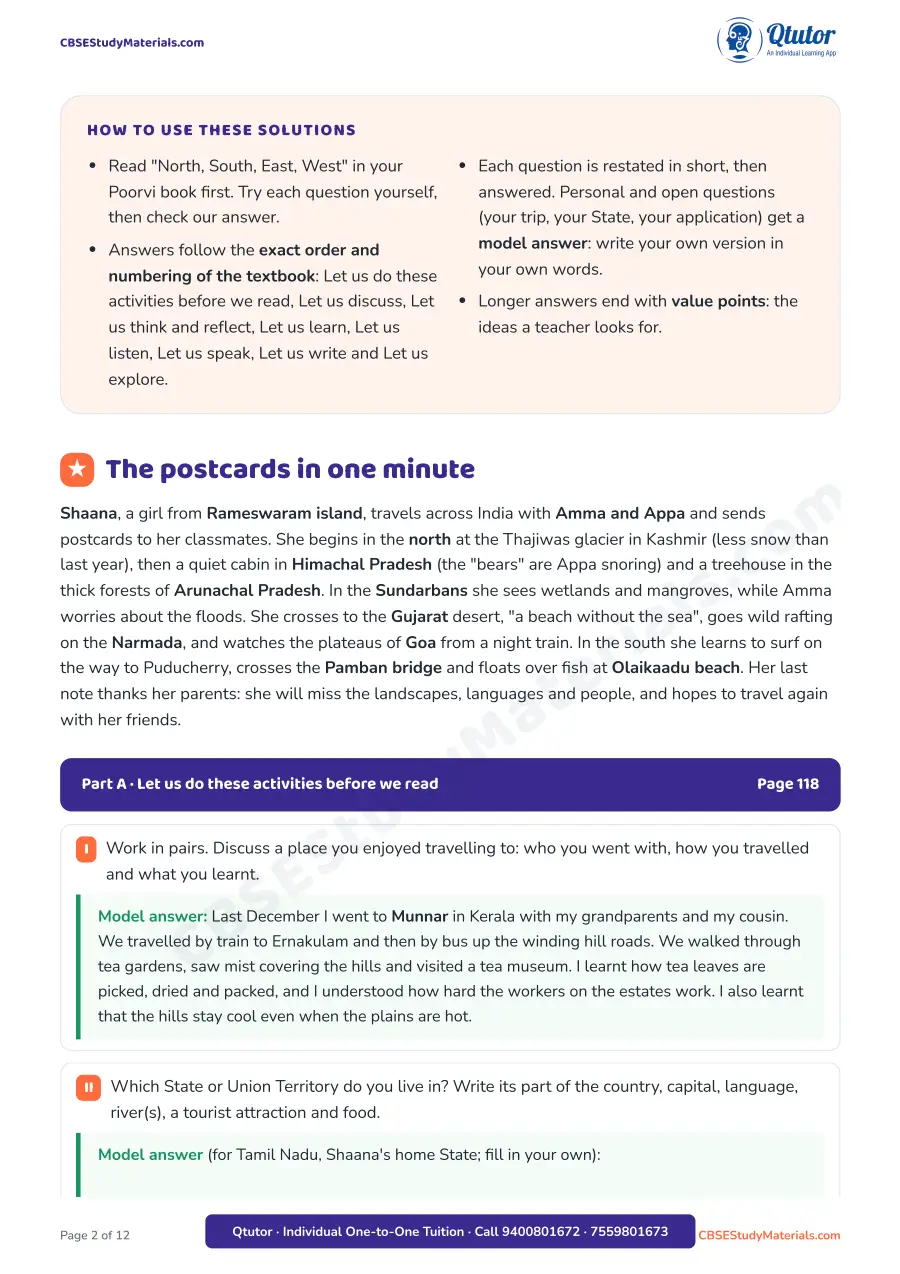
- "The postcards in one minute": a short summary to read before you start
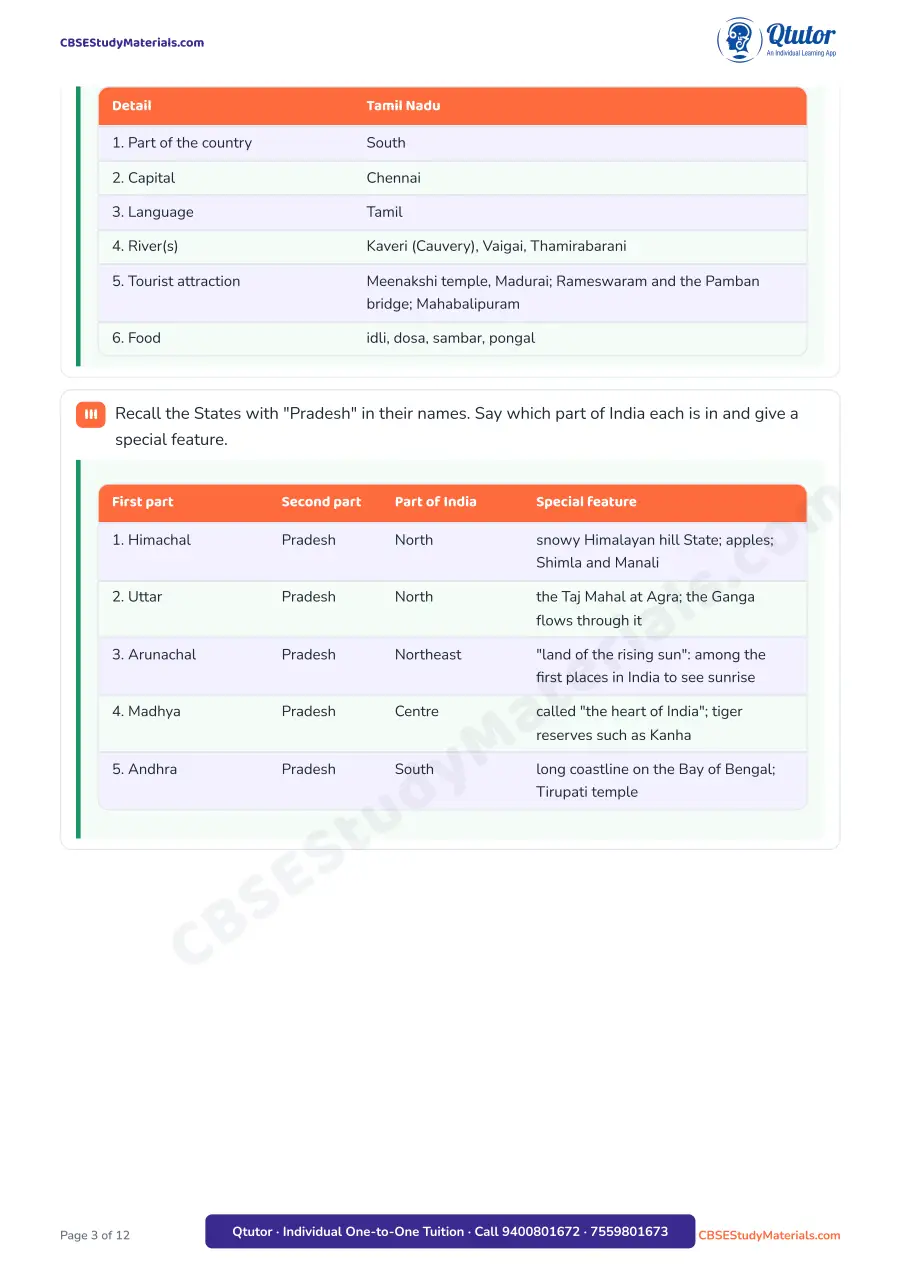
- Let us do these activities before we read: a model travel talk, a model State details table and the "Pradesh" States table with directions and special features
- Let us discuss: the completed table of places Shaana visited with descriptions and activities
- Let us think and reflect: both extracts (eight sub-questions, including the assertion-reason item) and all seven long questions with value points
- Let us learn: picture matching, words in context, the six travel words in the word grid, subjects and verbs underlined, and all ten subject-verb agreement blanks with the rule for each
- Let us listen: all five answers on Agartala and agarwood
- Let us speak: a model talk using the preference phrases
- Let us write: a model leave application with value points
- Let us explore: all sixteen crossword answers (States and Union Territories), a model note on a unique place, and facts on the Hornbill festival
Structure of the PDF
| Part | Textbook section | What you get |
|---|---|---|
| A | Before we read | Model answers for I, II and III |
| B | Let us discuss | Places visited table |
| C | Let us think and reflect | Two extracts and seven long answers |
| D | Let us learn | Matching, vocabulary, word grid, subject-verb agreement |
| E-G | Listen, speak, write | Agarwood answers, model talk, leave application |
| H | Let us explore | Crossword, unique places, Hornbill festival |
North, South, East, West Class 7 Important Questions and Answers (Sample)
From the extract on the night train to Goa: Shaana's attitude to tunnels changes "from fear to comfort", and her wish to tour the plateaus with her class shows her sense of connection and the value she places on shared experiences.
From the subject-verb agreement exercise:
| Sentence | Answer | Rule |
|---|---|---|
| A pair of sunglasses ___ essential. | is | "pair" is the subject |
| Either the tour guide or the tourists ___ to arrive first. | have | verb agrees with the nearer subject |
| Keeping accounts ___ important. | is | one activity, singular |
From the word grid: the six travel words are boat, drove, train, walked, reached and tour.
North, South, East, West Class 7 Important Topics Covered
- Shaana's postcards from Kashmir to Rameswaram
- The diversity of India's land: glaciers, forests, wetlands, deserts, rivers, plateaus and seas
- Less snow, more floods and less river water as signs of a changing environment
- Why the author tells the story through postcards
- Subject-verb agreement
- Agartala and agarwood, preferences, and the leave application format
How These NCERT Solutions Help
- Each question is restated in short, so you can study without the book open
- Long answers end with value points, the ideas a teacher looks for
- Grammar answers name the rule, so you learn why and not just what
- Model answers for personal questions show the length and style expected, while you write your own version
Who Should Use It
Class 7 students using the Poorvi English textbook, parents who help with homework, and tutors who want a clean answer key for Unit 3, Dreams and Discoveries. Read the chapter in your book first, try each question on your own, and then compare.
How to Download the Class 7 North, South, East, West NCERT Solutions PDF
This is a premium PDF priced at ₹49. Use the download button below to save all 12 pages on your phone or computer and print the pages you need.
North, South, East, West - Class 7 English Ch 9 NCERT Solutions (PDF · 12 pages · ₹49)
Related Resources
- North, South, East, West Class 7 notes: revision notes with a compass diagram of Shaana's stops, every postcard retold, characters, themes, subject-verb agreement, a mind map and a one-page summary
- North, South, East, West Class 7 question bank: 46 extra important questions with a full answer key
- Chapter page: North, South, East, West, Class 7 English
- Subject page: Class 7 English study material
- Previous chapter: Paper Boats, Class 7 English
- Next chapter: The Tunnel, Class 7 English
FAQs on Class 7 English Chapter 9 North, South, East, West
Where can I download Class 7 English Chapter 9 North, South, East, West NCERT Solutions PDF? On this page. Use the download button to get the 12-page premium PDF for ₹49 with every question of the chapter answered.
Does the PDF answer every question in the chapter? Yes. It covers all 24 tasks from "Let us do these activities before we read" to "Let us explore", in the textbook's order and numbering.
What do less snow and more floods indicate in North, South, East, West? They point to climate change: a warmer earth is melting glaciers, and rising seas and storms bring more floods to low wetlands such as the Sundarbans.
What are the crossword answers in North, South, East, West Class 7? Across: Ladakh, Rajasthan, Puducherry, Karnataka, Telangana, Sikkim, Gujarat, Bihar. Down: Mizoram, Andaman, Meghalaya, Goa, Uttarakhand, Odisha, Jharkhand, Haryana.
Which book is North, South, East, West Class 7 from? It is from Poorvi, the NCERT English textbook for Class 7, Unit 3, Dreams and Discoveries.
Is this an official NCERT solutions PDF? No. It is our own study material based on the NCERT Poorvi chapter and is not an official CBSE or NCERT publication.
Study tip: answer each question aloud in one sentence before you read our answer; if you can say it, you can write it.