Number Play - Class 6 Maths Chapter 3 Question Bank (PDF · 14 pages · ₹49) Unlock the full PDF for ₹49
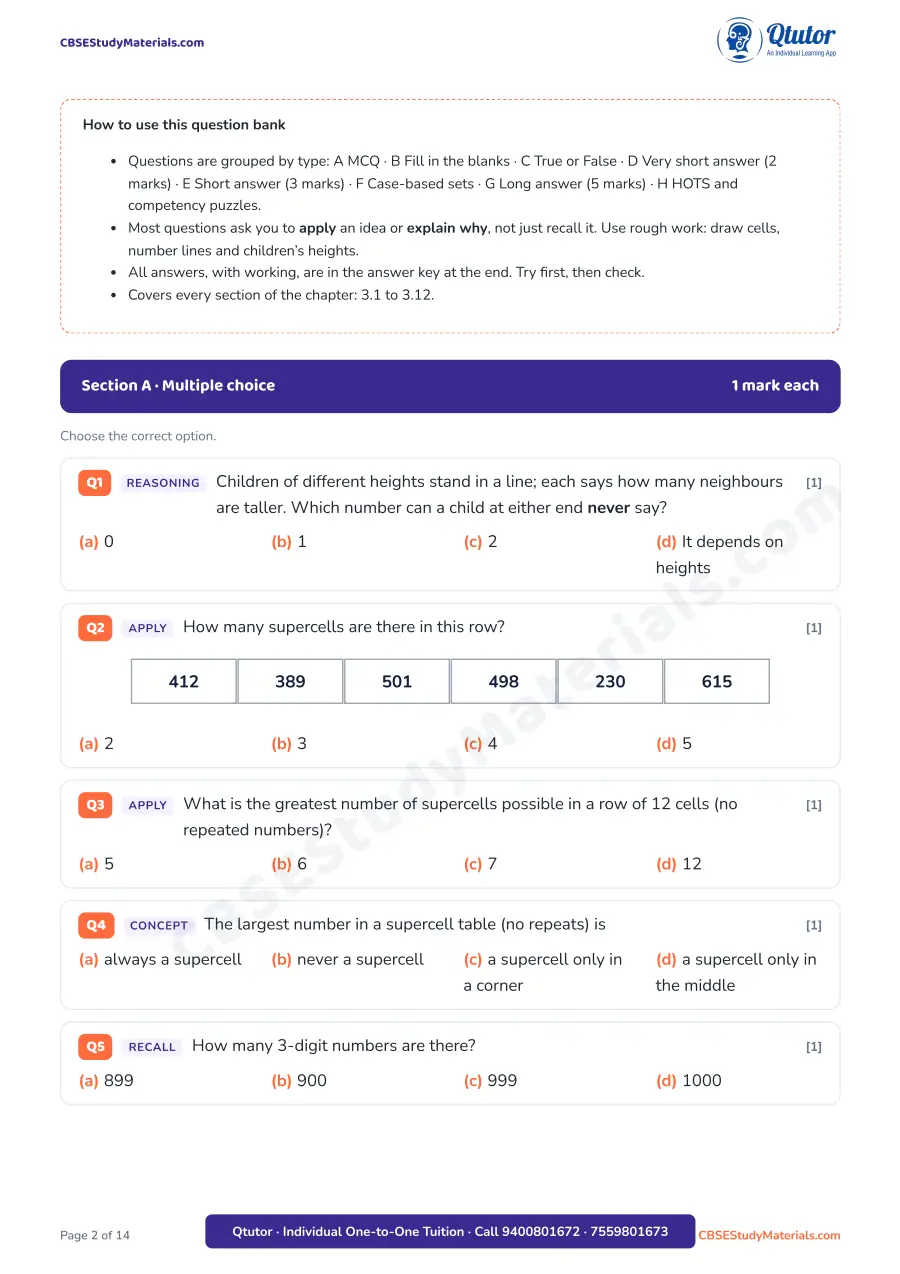
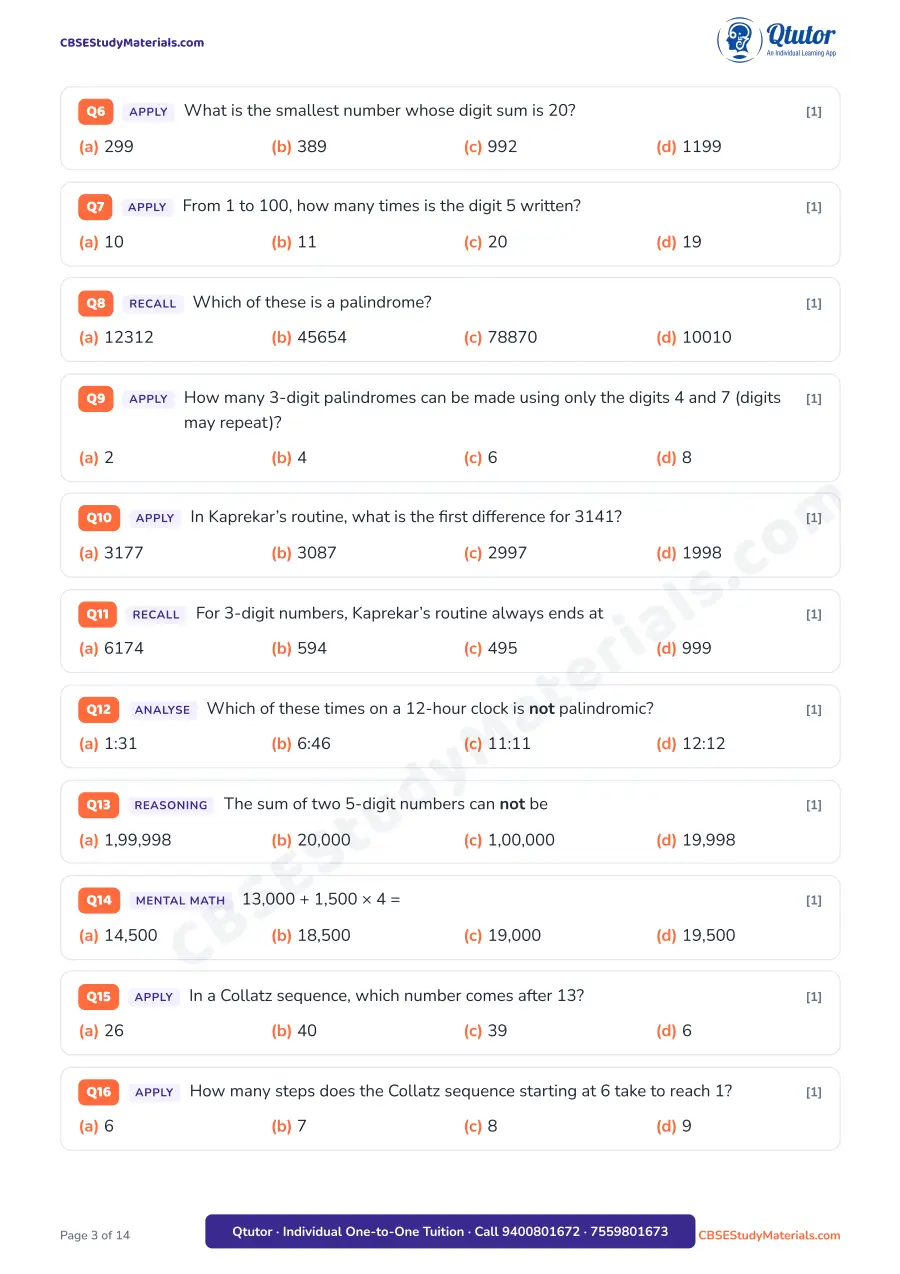
Free sample: pages 1 to 3 of 14. The full PDF costs ₹49.
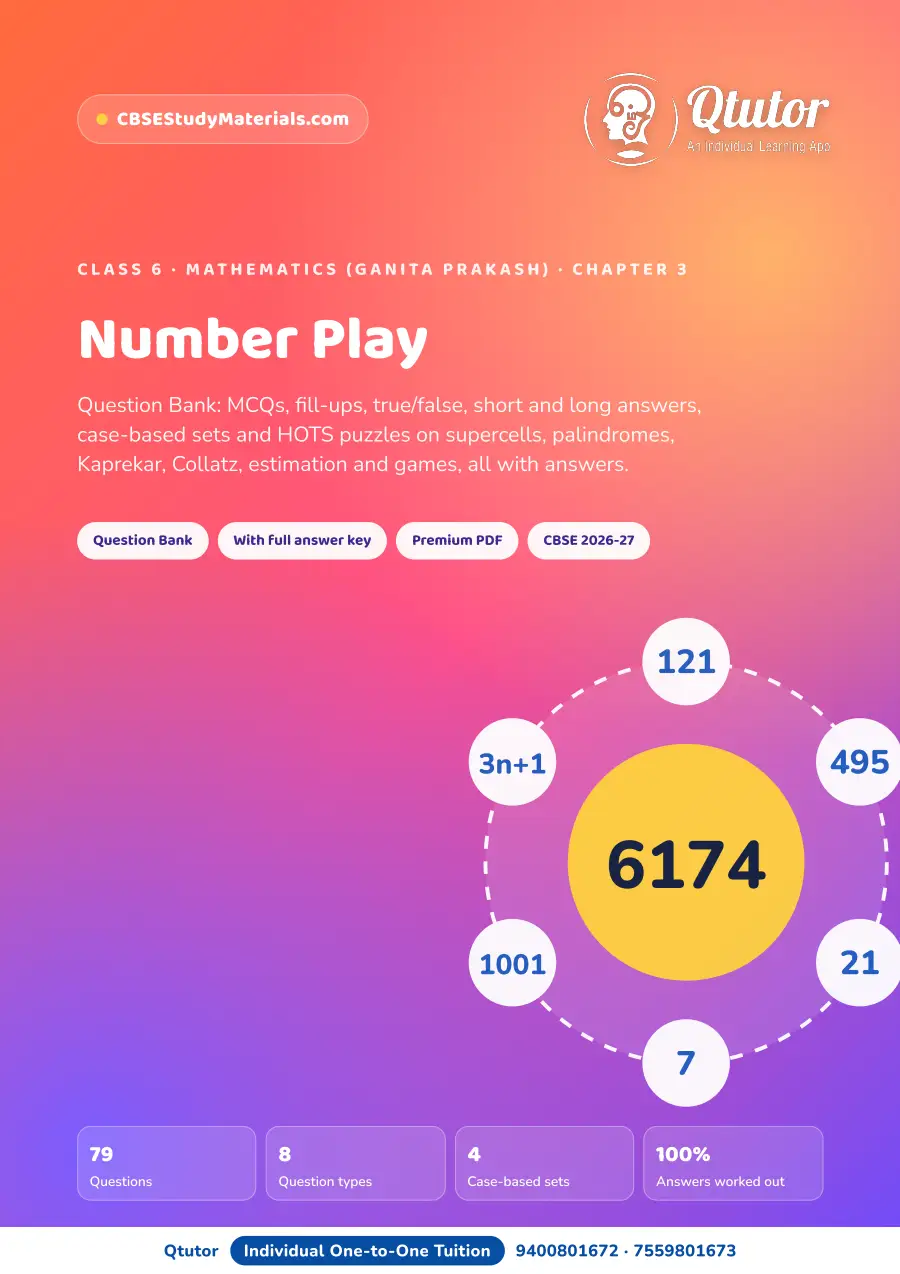
Can you place the numbers 1 to 6 in a 2 × 3 grid to get the most supercells? Is one lakh seconds more or less than a day? Should you go first or second in a game where the winner says 40? This Number Play Class 6 Maths Chapter 3 question bank is full of questions like these, with every answer worked out.
This is a premium 14-page PDF (₹49) of important questions for CBSE Class 6 Mathematics, Chapter 3, Number Play, from the NCERT Ganita Prakash textbook (2026-27). It has 79 original questions of eight types, all with answers. It is our own NCERT-based study material, not an official CBSE or NCERT publication, and every answer was recomputed before publishing.
Class 6 Maths Chapter 3 Number Play Question Bank: What Is Included
- Section A: 20 multiple choice questions
- Section B: 10 fill in the blanks
- Section C: 8 true or false with reasons
- Section D: 10 very short answer questions (2 marks)
- Section E: 8 short answer questions (3 marks)
- Section F: 4 case-based sets (1 + 1 + 2 marks): a treasure grid, a palindromic school bell, a diya rangoli and a school trip
- Section G: 5 long answer questions (5 marks)
- Section H: 6 HOTS and competency puzzles
- A complete answer key with working on separate pages
Structure of the Question Bank PDF
| Section | Type | Questions |
|---|---|---|
| A | MCQ (1 mark) | 20 |
| B | Fill in the blanks (1 mark) | 10 |
| C | True or False (1 mark) | 8 |
| D | Very short answer (2 marks) | 10 |
| E | Short answer (3 marks) | 8 |
| F | Case-based (4 marks each set) | 4 sets, 12 parts |
| G | Long answer (5 marks) | 5 |
| H | HOTS and competency (3 marks) | 6 |
Number Play Class 6 Important Topics Covered
Every section of the chapter is tested: taller neighbours (3.1), supercells in rows and grids (3.2), number lines (3.3), digit counts and digit sums (3.4), palindromes and reverse-and-add (3.5), Kaprekar’s 6174 and 495 (3.6), clock and calendar numbers (3.7), mental maths and what sums are possible (3.8), number-pattern sums (3.9), Collatz sequences (3.10), estimation (3.11) and winning strategies (3.12). Most questions ask students to apply an idea or explain why, in the competency-based style of CBSE 2026-27.
Number Play Class 6 Important Questions (Sample)
MCQ: The sum of two 5-digit numbers can not be (a) 1,99,998 (b) 20,000 (c) 1,00,000 (d) 19,998. Answer: (d), because the smallest possible sum is 10000 + 10000 = 20000.
Case-based (school trip): Class 6 has sections of 38, 41 and 36 students, and 9 teachers will go. Each bus has 45 seats. How many buses are needed?
| Step | Working |
|---|---|
| Estimate students | about 40 + 40 + 40 = 120 |
| Exact students | 38 + 41 + 36 = 115 |
| Everyone | 115 + 9 = 124, so 3 buses (135 seats) |
HOTS: Priya says adding 11 to a 5-digit palindrome always gives a palindrome. Sometimes: 19991 + 11 = 20002 is a palindrome, but 10001 + 11 = 10012 is not.
How This Question Bank Helps
- Exam-style variety: objective, short, long and case-based questions as in CBSE tests.
- Thinking, not cramming: about four in five questions need reasoning, estimation or strategy.
- Self-check made easy: the answer key shows the working, so students can find where they went wrong.
- Whole chapter covered: every one of the 12 sections has questions.
Tips to Score Well in Number Play
- Draw it. A quick sketch of cells, a number line or children’s heights makes most questions easy to reason about.
- Find the limits. For “is it possible?” questions, work out the smallest and largest answers first.
- Keep the zeros in Kaprekar’s routine and write every round neatly so step marks are not lost.
- Use grouping for sums. Count how many times each number appears, multiply, then add.
- Explain in one line. For true or false and “always, sometimes, never” items, a single counter-example is the strongest reason.
Who Should Use It
Class 6 students revising Number Play before a unit test or half-yearly exam, parents who want practice questions with answers, and teachers looking for class tests, homework and quiz questions on Chapter 3.
How to Download the Class 6 Number Play Question Bank PDF
This question bank is a premium PDF priced at ₹49. Use the download button below; it prints well on A4.
Number Play - Class 6 Maths Chapter 3 Question Bank (PDF · 14 pages · ₹49)
Related Resources
- Class 6 Maths Chapter 3 Number Play notes: revision notes, mind map and one-page chapter summary
- Class 6 Maths Chapter 3 Number Play NCERT solutions: answers to every textbook question in order
- Number Play chapter page
- All Class 6 Mathematics study material
- Previous chapter: Lines and Angles
- Next chapter: Data Handling and Presentation
FAQs on Class 6 Maths Chapter 3 Number Play Important Questions
Where can I download Class 6 Maths Chapter 3 Number Play important questions PDF? On this page. Use the download button to get the 14-page premium question bank for ₹49.
How many questions are in the Number Play question bank? 79 questions of eight types, including 20 MCQs and 4 case-based sets, all with answers.
Are there assertion-reason questions? No. Class 6 tests usually do not use assertion-reason items, so the bank uses MCQs, true or false, case-based sets and HOTS puzzles instead.
Which book is Number Play Class 6 from? It is Chapter 3 of Ganita Prakash, the NCERT Mathematics textbook for Grade 6, CBSE 2026-27.
Are these the same as the NCERT textbook questions? No. These are original practice questions on the same topics. For the textbook questions, use our NCERT solutions for this chapter.
Does the question bank have answers? Yes. Every question has an answer, with working for the longer ones.
Study tip: for any number game, work backwards from the target; it is the fastest way to find the winning moves.