Nature and Significance of Management - Class 12 BST Chapter 1 Notes (PDF · 18 pages · Free download) Download the full PDF free
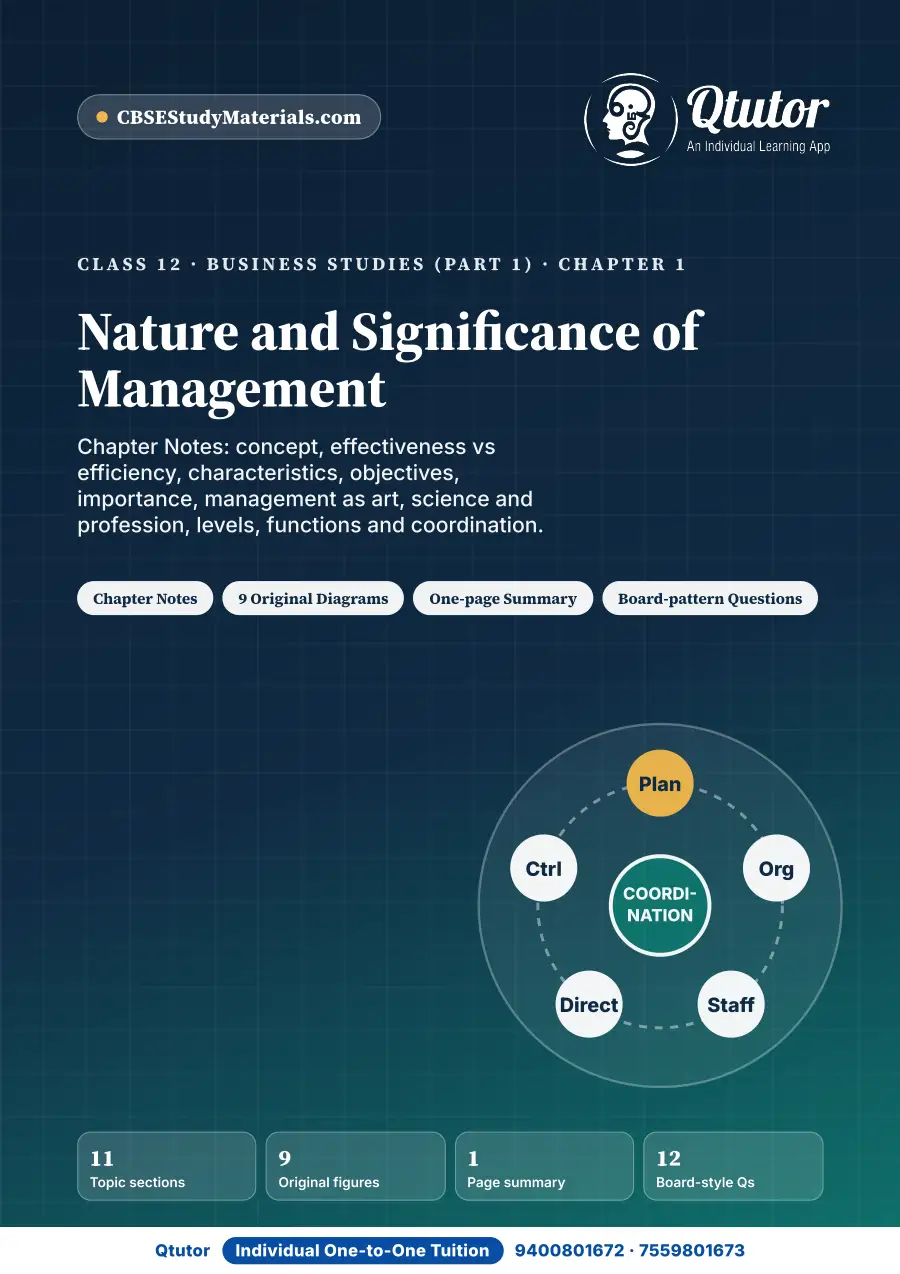
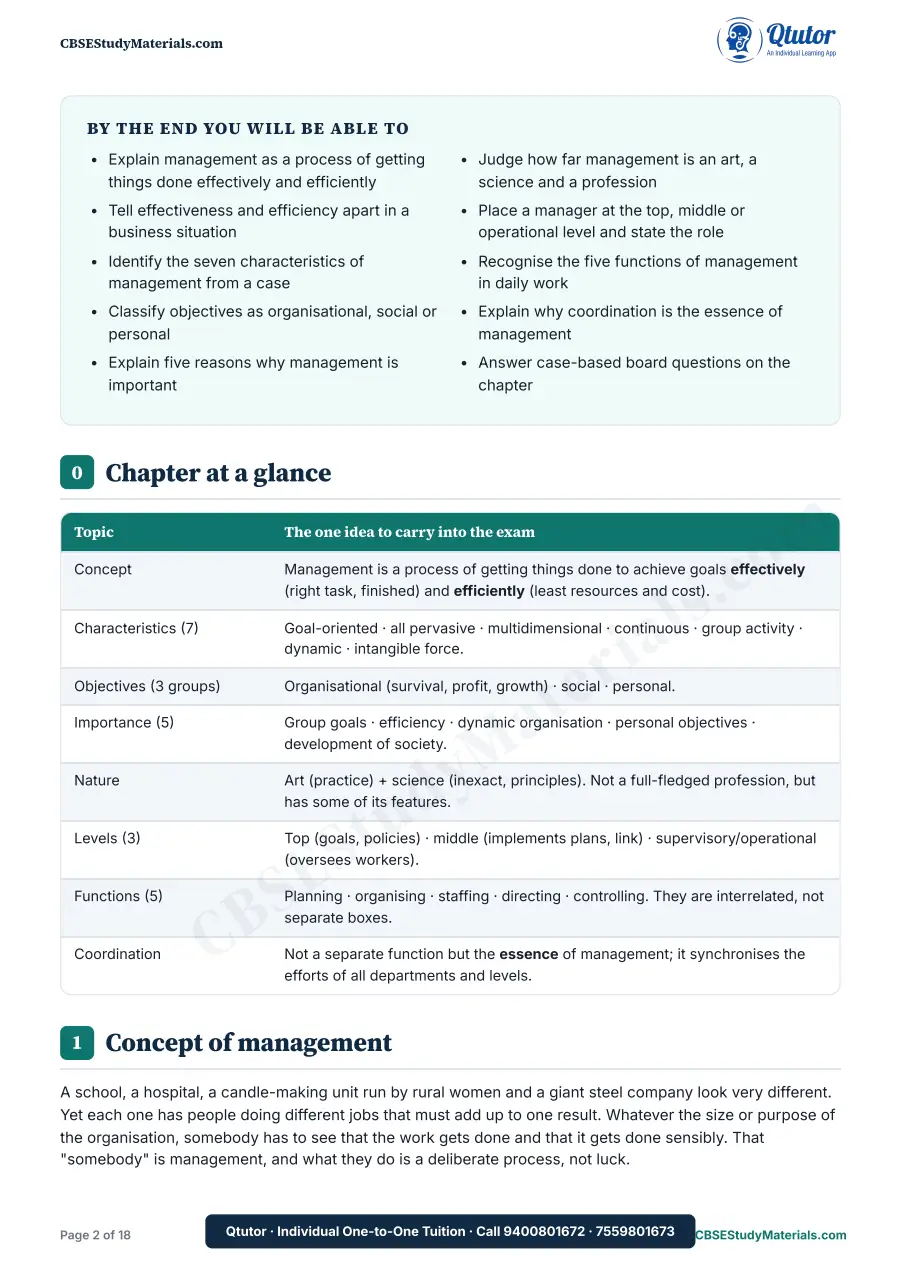
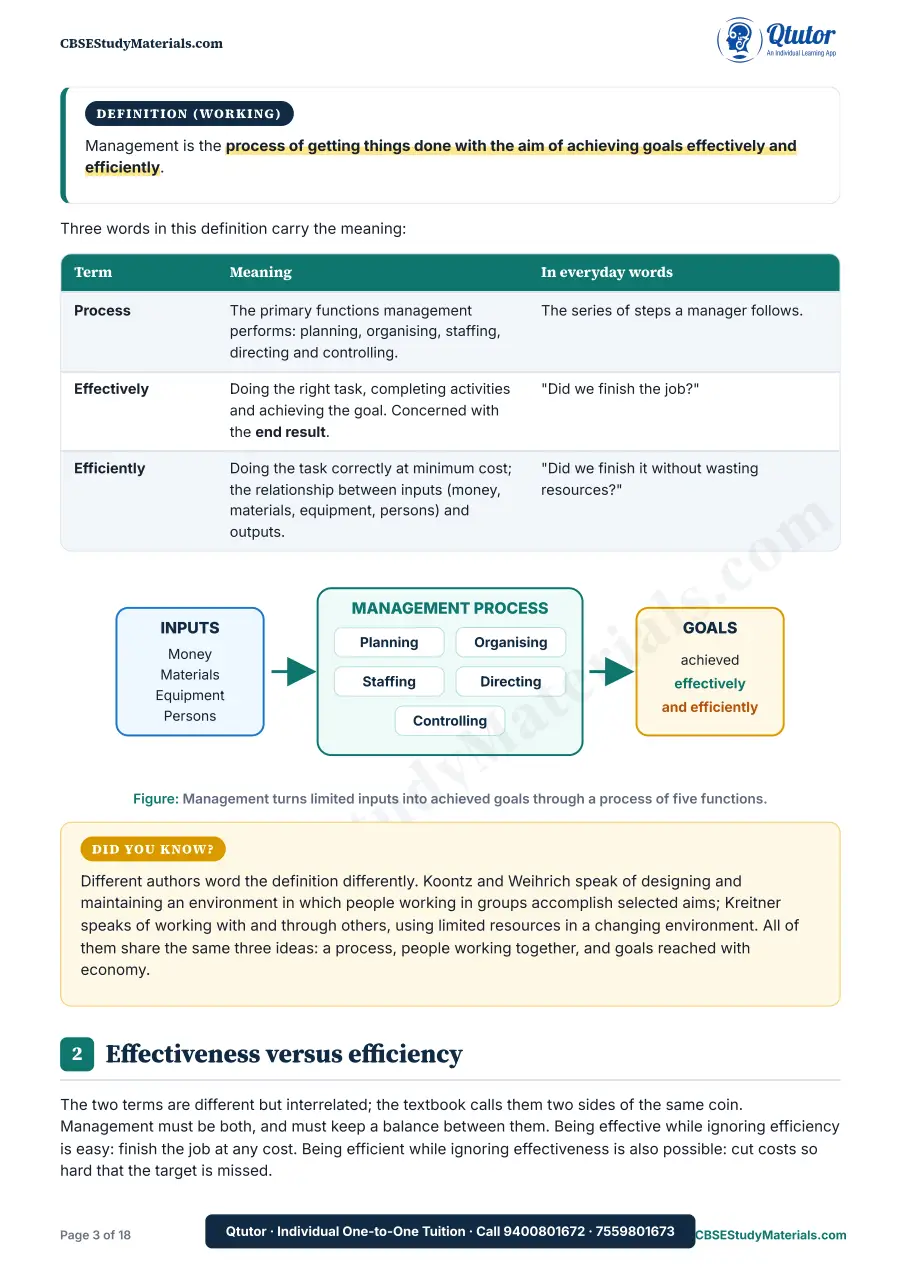
You are looking at pages 1 to 3 of 18. The full PDF is free to download.
Nature and Significance of Management is Class 12 Business Studies Chapter 1, and this free 18-page CBSE chapter notes PDF covers the whole NCERT chapter (Business Studies Part 1, 2026-27 reprint) in clear, exam-ready language. It is independent, NCERT based study material, not an official CBSE or NCERT publication, and it works both as full notes and as last-minute revision notes.
A canteen chain must supply 1,200 lunch boxes a day at ₹40 a box. One kitchen meets the target but spends ₹46 a box on overtime; another spends only ₹35 a box but makes just 1,000. Which one is effective, which one is efficient, and which one is well managed? That single worked example from the PDF is the idea the whole chapter is built on, and these notes carry it through every topic up to coordination, the essence of management.
Class 12 Business Studies Chapter 1 Nature and Significance of Management Notes: What Is Included
- A cover, ten learning objectives and a "chapter at a glance" table that works as a quick chapter summary
- Eleven numbered topic sections covering every heading of the NCERT chapter
- 9 original diagrams: the management process (inputs to goals), the effectiveness–efficiency grid, a seven-characteristics wheel, the three groups of objectives, an art–science–profession figure, a levels-of-management pyramid, the cycle of five functions with coordination at the centre, the "thread in a garland" figure and a full chapter mind map
- Comparison tables: effectiveness vs efficiency, features of art, science and profession checked against management, and the three levels with their roles and tasks
- Concept, definition, "did you know", real-life, common-mistake and "think deeper" boxes
- A 15-term key-terms grid
- A one-page summary of the entire chapter plus an "exam traps to avoid" box
- 12 important questions in the CBSE Class 12 Business Studies pattern, with an answer key written like a marking scheme
Structure of the Nature and Significance of Management Notes PDF
| Part | What you get |
|---|---|
| Cover, objectives, at a glance | All eight topics in one table |
| 1 Concept of management | Process, effectively, efficiently; process diagram |
| 2 Effectiveness vs efficiency | Comparison table, 2×2 grid, worked lunch-box example |
| 3 Characteristics | Seven features with meaning and clue words to spot them in a case |
| 4 Objectives | Organisational (survival, profit, growth), social, personal |
| 5 Importance | Five reasons, with a flow chart |
| 6 Nature | Management as an art, as an inexact science, and as a profession |
| 7 Levels | Top, middle and supervisory roles; pyramid diagram |
| 8 Functions | Planning, organising, staffing, directing, controlling |
| 9 Coordination | Essence of management, six characteristics, three reasons it is needed |
| Revision pages | Key terms, mind map, one-page summary, 12 questions with answers |
Nature and Significance of Management Class 12 Important Topics
- Concept of management as a process of getting things done effectively and efficiently
- Difference between effectiveness and efficiency, and why both must be balanced
- Seven characteristics: goal-oriented process, all pervasive, multidimensional (work, people, operations), continuous process, group activity, dynamic function, intangible force
- Objectives of management: organisational, social and personal
- Importance of management (five points)
- Nature of management: art, science (inexact) and profession, feature by feature
- Levels of management: top, middle, supervisory or operational
- Functions of management: planning, organising, staffing, directing, controlling
- Coordination: meaning, why it is the essence of management, characteristics and importance (growth in size, functional differentiation, specialisation)
Nature and Significance of Management Class 12 Important Questions (Sample)
The "Check yourself" section follows the board pattern: 1-mark MCQs including assertion-reason and a matching item, two 3-mark, two 4-mark and two 6-mark questions, with one full case study. Most are short business situations where you must identify the concept and then explain it. Two examples:
Assertion (A): Management is called an inexact science. Reason (R): Its principles deal with human behaviour, so the outcome of applying them cannot be accurately predicted or replicated. (Answer: both true, and R correctly explains A.)
3 marks: Meera and Kabir must each make 400 clay lamps with a budget of ₹60 a lamp. Meera makes 400 lamps for ₹22,000 in all; Kabir makes 360 lamps at ₹50 each. In the answer key, Meera's cost works out to 22000 ÷ 400 = ₹55 a lamp, so she is both effective and efficient, while Kabir is efficient but not effective because he is 40 lamps short.
A small sample of the comparison tables inside:
| Feature of a profession | Does management satisfy it? |
|---|---|
| Well-defined body of knowledge | Yes |
| Restricted entry | No: anyone can be appointed a manager |
| Professional association and code of conduct | Partly: AIMA exists, but membership is not compulsory |
How the Class 12 BST Chapter 1 Notes Help
- Each characteristic, objective and function comes with "clue words", so you can identify concepts quickly in case-based questions.
- Tables put art, science and profession side by side, the comparison that long-answer questions usually ask for.
- The common-mistake boxes flag the errors students make most often, such as calling coordination a separate function or listing growth as a social objective.
- The one-page summary and the mind map let you revise the full chapter in about ten minutes before a test.
- Answers follow the marking-scheme style (identify the concept, quote the line, explain), which is how Business Studies papers are marked.
Who Should Use It
- Class 12 Commerce students studying Business Studies for the CBSE 2026-27 board exam
- Students who want concise NCERT based notes and a chapter summary before unit tests or pre-boards
- Teachers and tutors who need a ready revision handout and a set of practice questions for Chapter 1
How to Download the Class 12 Nature and Significance of Management Notes PDF
The PDF is free. Use the download button below to save it; it prints well on A4 and reads comfortably on a phone or tablet.
Nature and Significance of Management - Class 12 BST Chapter 1 Notes (PDF · 18 pages · Free download)
Related Resources
- All study material for this chapter: Class 12 Business Studies Chapter 1 Nature and Significance of Management
- Every chapter of the subject: Class 12 Business Studies
FAQs on Class 12 Business Studies Chapter 1 Nature and Significance of Management
Where can I download Class 12 Business Studies Chapter 1 Nature and Significance of Management notes PDF? On this page. Click the download button to get the 18-page notes PDF free of cost.
What are the important topics in Nature and Significance of Management Class 12? Effectiveness vs efficiency, the seven characteristics, objectives, importance, management as an art, science and profession, the three levels, the five functions and coordination as the essence of management.
Is the Nature and Significance of Management notes PDF free? Yes. Chapter 1 notes are free to download.
Which book is Nature and Significance of Management Class 12 from? It is Chapter 1 of the NCERT textbook Business Studies Part 1 for Class 12, prescribed for CBSE.
Is management a profession according to Class 12 Business Studies Chapter 1? Not fully. Management has a well-defined body of knowledge, but entry is not restricted and membership of an association such as AIMA is not compulsory, so it is professional in character only to a large extent.
Why is coordination called the essence of management? Because it is not a separate function: it runs through planning, organising, staffing, directing and controlling, and synchronises the work of all departments towards common goals.
Are there important questions with answers in these notes? Yes. There are 12 board-pattern questions, including assertion-reason, a numerical on efficiency and effectiveness, and a 6-mark case study, each with marking points.
Study tip: for every case question in this chapter, first underline the clue words, name the concept, then quote the line and explain it in one sentence.