Magnifying Glass - Class 8 English Ch 14 NCERT Solutions (PDF · 11 pages · ₹49) Unlock the full PDF for ₹49
Free sample: pages 1 to 3 of 11. The full PDF costs ₹49.
Is it the poet or the round glass that makes "Magic talk"? That is one of the questions you answer in Class 8 English Chapter 14 Magnifying Glass, and these CBSE NCERT Solutions, based on the NCERT Poorvi textbook, answer every question of the chapter in an 11-page PDF.
This is a premium NCERT Solutions PDF (₹49) for Class 8 English, Chapter 14 "Magnifying Glass" by Walter de la Mare, from Unit 5 "Science and Curiosity" of the new NCERT Poorvi book (CBSE 2026-27). It is independent study material and is not an official CBSE or NCERT publication. All 22 textbook questions, with more than 65 blanks and sub-parts, are answered in the same order and numbering as the book, so the PDF works as a question answer guide and a homework checker.
Class 8 English Chapter 14 Magnifying Glass NCERT Solutions: What Is Included
- "The poem in one minute": a short retelling to refresh your memory
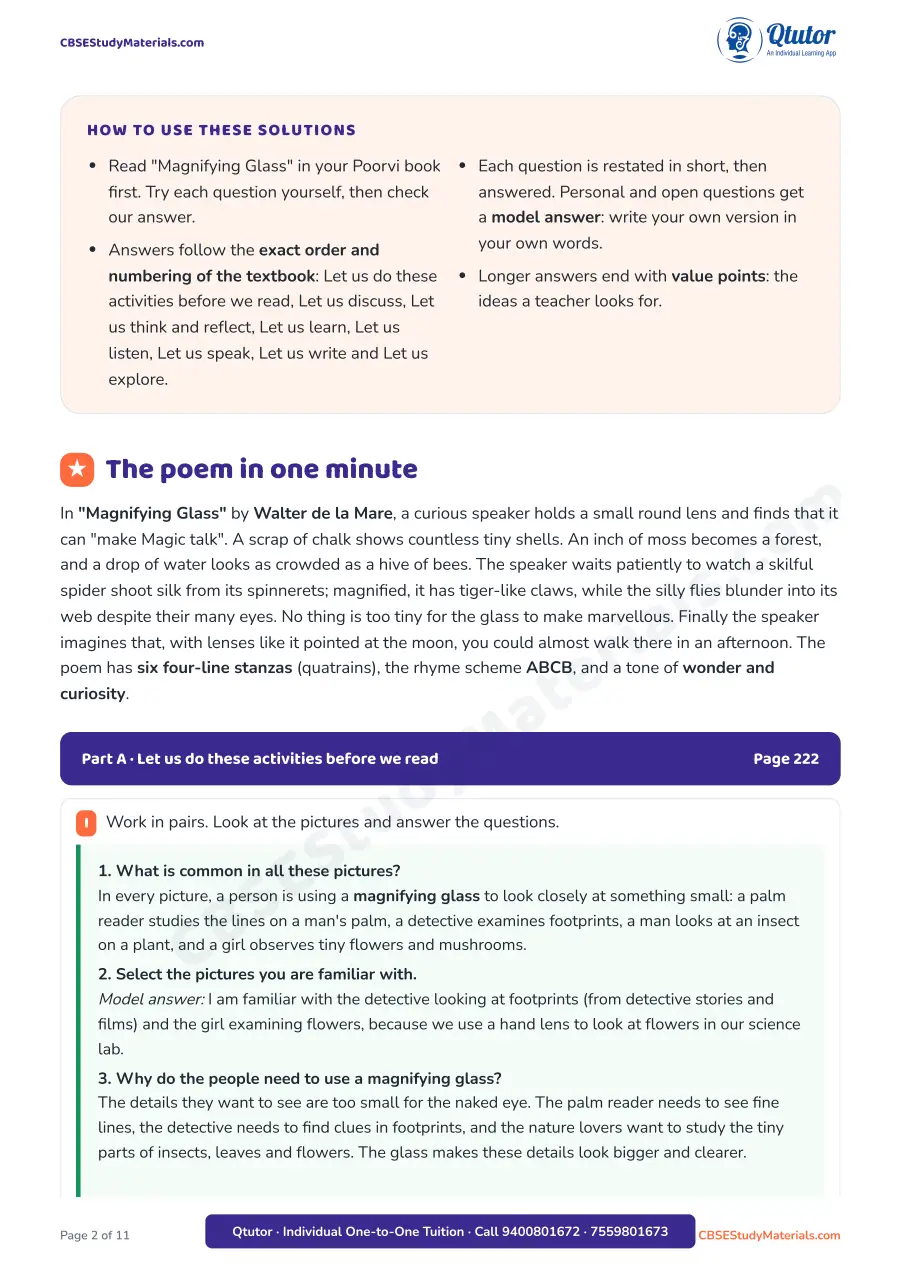
- Part A, Let us do these activities before we read: the picture questions and a model answer on using a magnifying glass
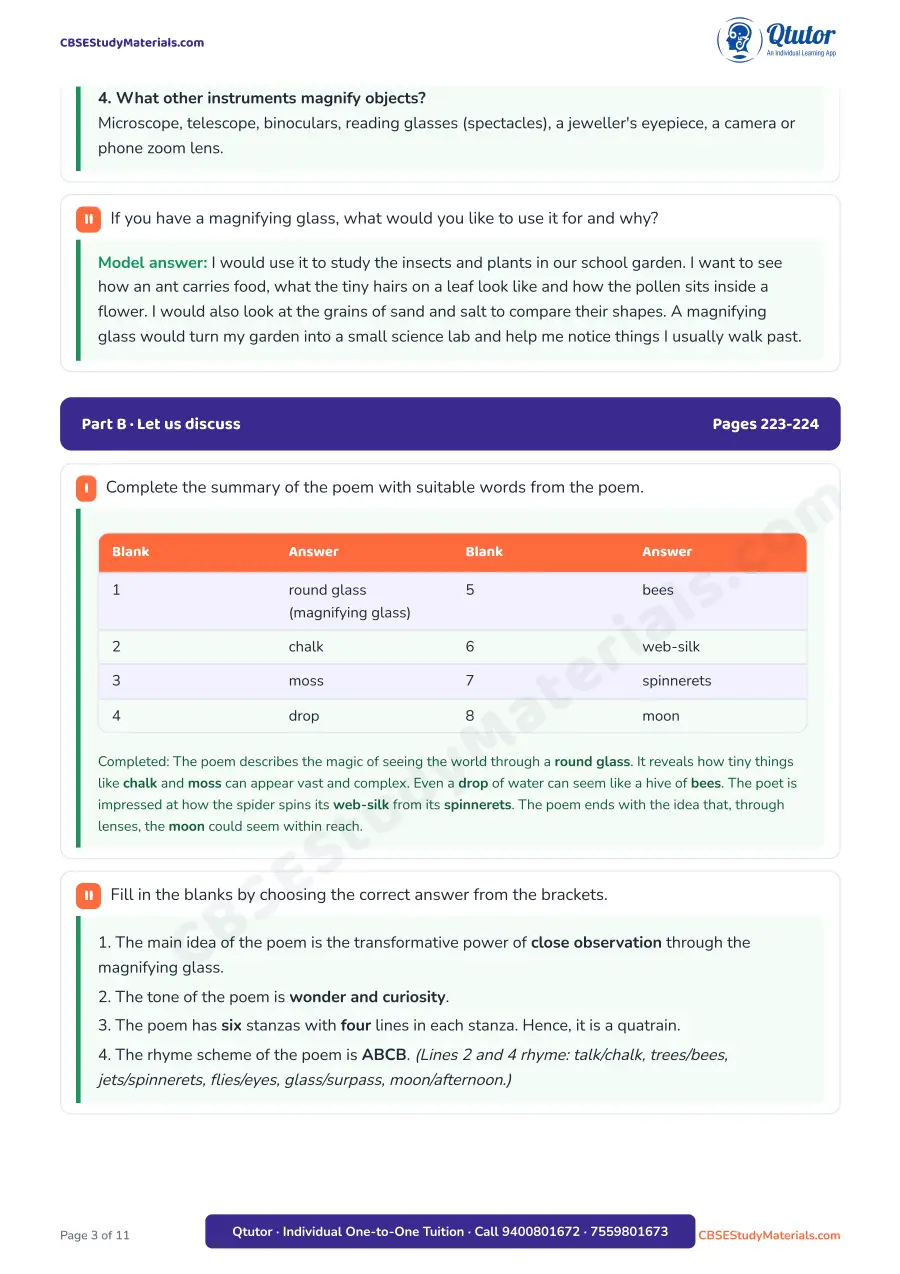
- Part B, Let us discuss: the filled-in summary (eight blanks), the bracket choices, examples of simile, alliteration and metaphor, the imagery sentences and all four "complete with a reason" sentences
- Part C, Let us think and reflect: the extract questions (true/false, line selection, meaning, MCQ) and five long answers, including a model answer for "Which is your favourite part of the poem?"
- Part D, Let us learn: the word-box passage, collective nouns, idioms with "eye" and the -ish suffix task
- Part E, Let us listen: the four true statements (1, 4, 5 and 6) and the two false ones, each with a reason from the conversation
- Part F, Let us speak: the /f/ and /v/ word table with practice tips, a model speech on travelling to space and a model "wonder invention" speech
- Part G, Let us write: a full model conversation between Deepa and Asma about their Science Fair model, with value points
- Part H, Let us explore: low-vision aids, the four observatories and telescopes, ancient Indian scholars and Jantar Mantar
- A "quick answers at a glance" table for last-minute revision
Structure of the PDF
| Part | Textbook section | What you get |
|---|---|---|
| A | Before we read | Picture questions and a model answer |
| B | Let us discuss | Summary blanks, form and rhyme, devices, imagery, reasons |
| C | Let us think and reflect | Extract set and five long answers |
| D | Let us learn | Word box, collective nouns, eye idioms, -ish adjectives |
| E-G | Listen, speak, write | Statements, model speeches, model conversation |
| H | Let us explore | Aids, telescopes, scholars, Jantar Mantar |
Magnifying Glass Class 8 Important Questions and Answers (Sample)
From "Let us discuss": the poem has six stanzas with four lines in each, so it is made of quatrains, and its rhyme scheme is ABCB. Its tone is one of wonder and curiosity, and its main idea is the transformative power of close observation.
From the word-box exercise in "Let us learn":
| Blank | Answer |
|---|---|
| 1 | marvellous |
| 2 | woven |
| 3 | deft |
| 4 | myriad |
| 5 | stumble |
| 6 | surpass |
From "Let us think and reflect", the question on why the poem ends with the moon is answered: the ending widens the poem from the very small to the very far, showing that lenses also bring distant objects near, so human curiosity has no limits.
Magnifying Glass Class 8 Important Topics Covered
- The six images of the poem: chalk, moss, a water drop, the spider, the flies and the moon
- Poetic devices with examples and reasons
- Collective nouns and idioms with "eye"
- The /f/ and /v/ sounds
- Writing a conversation with setting, tone, key points and brackets for feelings
- Telescopes, observatories and early Indian astronomy
How These NCERT Solutions Help
- Answers are written in simple, clear sentences that a Class 8 student can learn from
- Long answers end with value points, so you know what a teacher looks for
- Open questions get model answers that show the right length and style without being copied
- Short "Extra information" notes add useful background beyond the textbook
Who Should Use It
Class 8 students using the Poorvi English textbook, parents who help with homework, and tutors who want a clean answer key for Unit 5, Science and Curiosity. Read the poem in your book first, try each question on your own, and then compare.
How to Download the Class 8 Magnifying Glass NCERT Solutions PDF
This is a premium PDF priced at ₹49. Use the download button below to save all 11 pages on your phone or computer and print the pages you need.
Magnifying Glass - Class 8 English Ch 14 NCERT Solutions (PDF · 11 pages · ₹49)
Related Resources
- Magnifying Glass Class 8 notes: revision notes with the poem explained stanza by stanza, devices, word meanings, a mind map and a one-page summary
- Magnifying Glass Class 8 question bank: 48 extra important questions with a full answer key
- Chapter page: Magnifying Glass, Class 8 English
- Subject page: Class 8 English study material
- Previous chapter: Feathered Friend, Class 8 English
- Next chapter: Bibha Chowdhuri: The Beam of Light that Lit the Path for Women in Indian Science, Class 8 English
FAQs on Class 8 English Chapter 14 Magnifying Glass
Where can I download Class 8 English Chapter 14 Magnifying Glass NCERT Solutions PDF? On this page. Use the download button to get the 11-page premium PDF for ₹49 with every question of the chapter answered.
Does the PDF answer every question in the chapter? Yes. It covers all 22 questions from "Let us do these activities before we read" to "Let us explore", in the textbook's order and numbering.
What is the answer to the summary blanks in Magnifying Glass? Round glass, chalk, moss, drop, bees, web-silk, spinnerets and moon. The PDF shows the full completed summary.
Which poetic devices are used in Magnifying Glass? Simile (a drop of water like a hive of bees), metaphor (an inch of moss as a forest), personification (Magic talk), alliteration (wait and watch) and hyperbole (walking to the moon in an afternoon).
Which book is Magnifying Glass Class 8 from? It is from Poorvi, the NCERT English textbook for Class 8, Unit 5, Science and Curiosity. The poem is by Walter de la Mare.
Is this an official NCERT solutions PDF? No. It is our own study material based on the NCERT Poorvi chapter and is not an official CBSE or NCERT publication.
Study tip: answer each question aloud in one sentence before you read our answer; if you can say it, you can write it.