Try Again - Class 7 English Chapter 2 Notes (PDF · 15 pages · ₹49) Unlock the full PDF for ₹49
Free sample: pages 1 to 3 of 15. The full PDF costs ₹49.
Why would a king with a crown take advice from a spider dangling on a thread? Class 7 English Chapter 2 Try Again answers that question in verse, and these CBSE chapter notes, based on the NCERT Poorvi textbook, explain Eliza Cook's poem stanza by stanza in a colourful 15-page PDF.
This is a premium Chapter Notes PDF (₹49) for Class 7 English, Chapter 2 "Try Again", the poem in Unit 1 "Learning Together" of the new NCERT Poorvi book (Grade 7, CBSE 2026-27). It is independent study material and is not an official CBSE or NCERT publication. The notes retell the poem in short, simple sentences with a friendly guide called Jaal the spider, and they work as revision notes, a chapter summary and a complete study material for the poem in one place.
Class 7 English Chapter 2 Try Again Notes: What Is Included
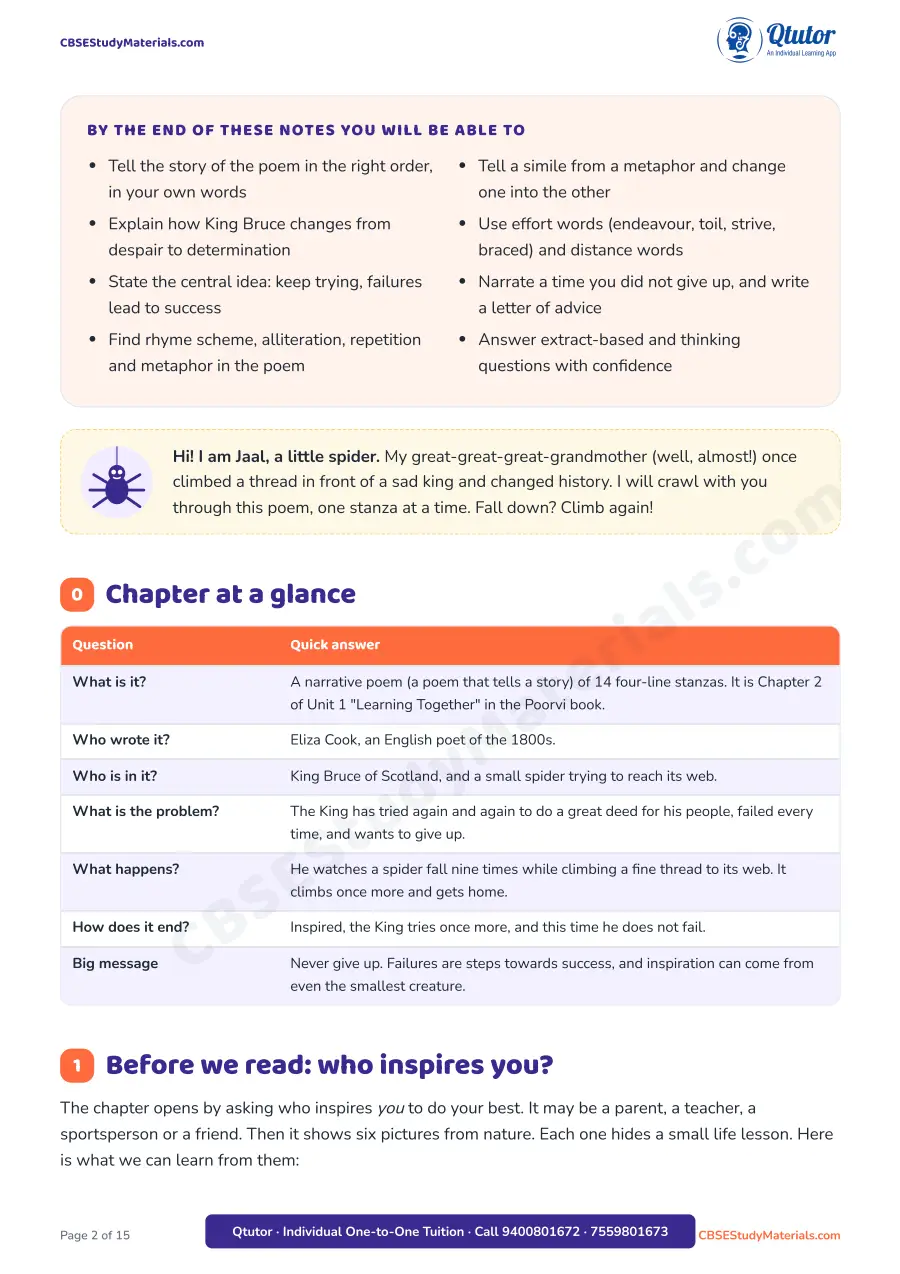
- Chapter at a glance: a quick table with the poet, the form, the characters, the problem, the turning point and the big message.
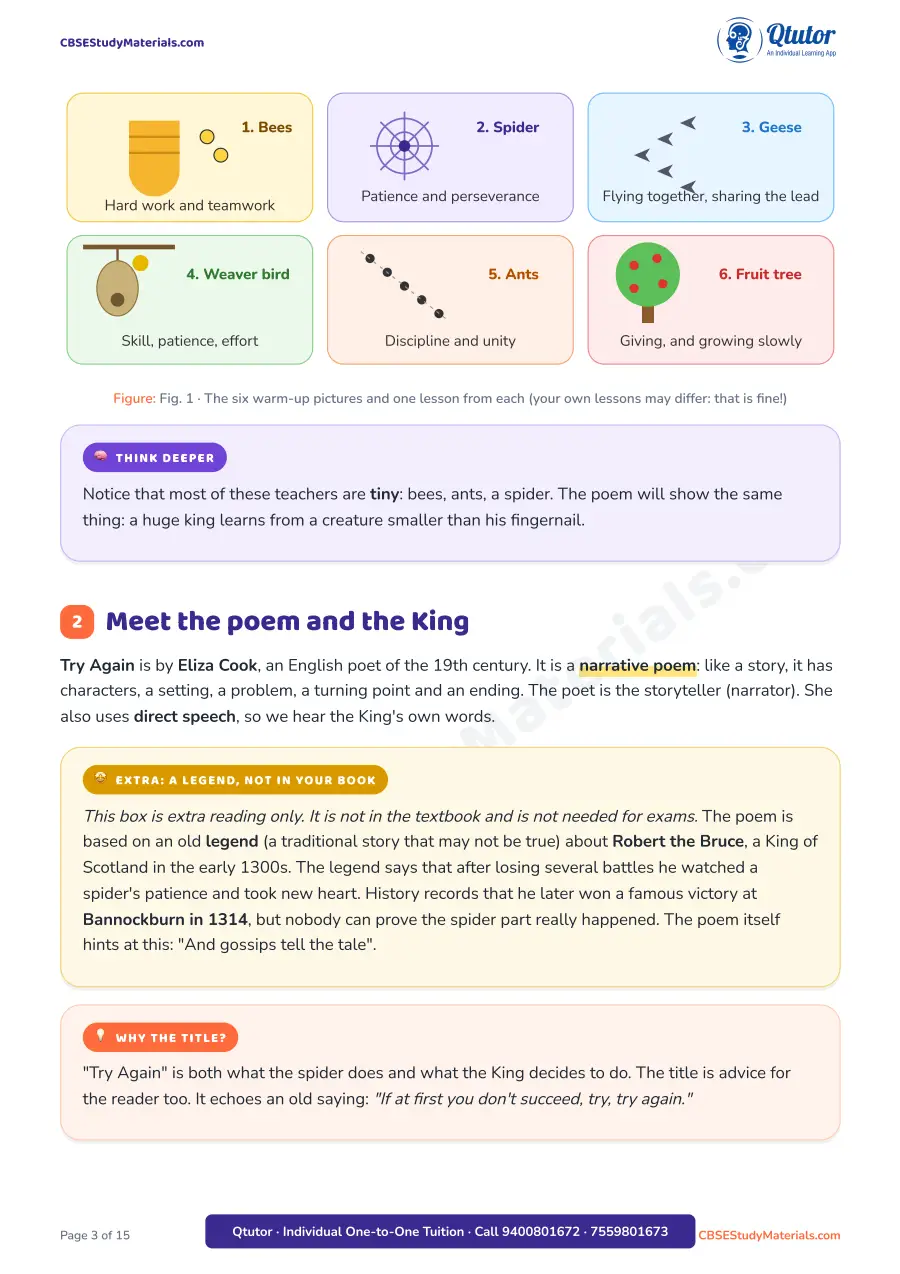
- Before we read: the six warm-up pictures (bees, spider, geese, weaver bird, ants, fruit tree) with one lesson from each, drawn as an original diagram.
- Meet the poem and the King: what a narrative poem is, and an extra box, clearly marked as beyond the textbook, on the legend of Robert the Bruce behind the poem.
- The poem part by part: all 14 stanzas grouped into five parts and retold in our own words, from "I'll give it all up" to the King's final success.
- The spider's climb: a diagram of the nine failed attempts and the successful climb, plus a "common mistake" box on counting the attempts.
- Characters: King Bruce, the spider, the poet as narrator and "the gossips", with traits, and a table of how the King's feelings change.
- Theme and message: perseverance, failures as stepping stones, and learning from anyone.
- Poetic devices: narrative style, rhyme scheme ABAB (with a colour-coded diagram), alliteration, repetition, metaphor, personification, interjection, rhetorical questions and the old contractions 'twas and 'tis.
- 24 word meanings, opposites from the poem, four effort words (endeavour, toil, strive, braced) and near/far distance words on a scale.
- Grammar: simile vs metaphor with a diagram, how to change one into the other, and interjections.
- Listening link: the ant-and-bird story compared with the poem in a table.
- Speaking and writing: a seven-step plan for narrating a personal experience and the format of an informal letter with transition words.
- Explore: spider vs ant (arachnid vs insect) diagram and the web-weaving activity.
- Mind map, 12 "Check yourself" questions with an answer key, and a one-page summary.
Structure of the PDF
| Part | What you will find | Pages |
|---|---|---|
| Cover, objectives, chapter at a glance | Quick overview table | 1-2 |
| Sections 1-4 | Warm-up pictures, poet, the poem in five parts, the spider's climb | 2-5 |
| Sections 5-7 | Characters, theme, poetic devices, rhyme scheme | 5-8 |
| Sections 8-10 | Word meanings, vocabulary, simile and metaphor | 8-10 |
| Sections 11-13 | Listening link, speaking and writing skills, spider vs ant | 10-12 |
| Mind map and Check yourself | 12 questions | 12-13 |
| Answer key and one-page summary | Full answers, revision page | 14-15 |
Try Again Class 7 Important Topics
- King Bruce's despair and his decision to give up
- The spider's nine brave attempts and its final success
- How King Bruce's attitude changes from despair to determination
- Central idea: perseverance, and failures as stepping stones to success
- Narrative style and rhyme scheme ABAB
- Alliteration, repetition, metaphor, personification and interjections in the poem
- Word meanings: despair, pondered, divine, endeavour, sprawl, strive, toil, defied, conquered, braced
- Simile vs metaphor, opposites and distance words
- Narrating a "never give up" experience and writing an informal letter of advice
Try Again Class 7 Important Questions (Sample)
Here are three real excerpts from the PDF.
From "Common mistake": Students often write that the spider succeeded in nine attempts. The poem counts nine attempts that failed; the spider wins when it goes up "once more".
From "How King Bruce changes":
| Stage | How he feels | Clue from the poem |
|---|---|---|
| Beginning | Lonely, sad, hopeless | "low despair", "I'll give it all up" |
| Middle | Curious, then doubtful | calls the spider "that foolish thing" |
| End | Determined and successful | "braced his mind", "did not fail" |
From "Check yourself", Q3 (assertion-reason): Assertion: The King calls the spider "that foolish thing". Reason: He believed the spider would never stop trying. Answer: A is true but R is false, because the King actually believed the spider would stop.
How These Revision Notes Help
The poem is short, but questions on it test many skills: understanding the story, reading lines closely, naming poetic devices, and using new words and grammar. These notes take each skill one at a time. The retellings make the old-fashioned language easy, the tables and diagrams make devices like rhyme scheme and metaphor visible, and the one-page summary lets you revise the whole chapter the night before a test. The "Check yourself" questions are mostly indirect and thinking-based, in the style of the NCERT book's own exercises, with a compact answer key.
Who Should Use These Notes
- Class 7 students studying the NCERT Poorvi English book in CBSE schools in 2026-27
- Students who find poems hard to understand and want a simple, stanza-by-stanza explanation
- Parents helping a child revise English at home
- Teachers looking for a ready summary, device table and mind map for a quick recap lesson
How to Download the Class 7 Try Again Notes PDF
Use the download button below to buy and download the premium 15-page PDF for ₹49. It opens on phones, tablets and computers and can be printed in colour or black and white.
Try Again - Class 7 English Chapter 2 Notes (PDF · 15 pages · ₹49)
Related Resources
- Chapter page: Try Again, Class 7 English Chapter 2
- Subject page: Class 7 English study material
- Try Again Class 7 NCERT Solutions: every textbook question answered in book order (13 pages)
- Try Again Class 7 question bank: 63 extra important questions with answers, grammar and writing practice (13 pages)
- Previous chapter: The Day the River Spoke, Class 7 English Chapter 1
- Next chapter: Three Days to See, Class 7 English Chapter 3
FAQs on Class 7 English Chapter 2 Try Again
Where can I download Class 7 English Chapter 2 Try Again notes PDF? On this page. Use the download button to get the premium 15-page notes PDF for ₹49.
What are the important topics in Try Again Class 7? The King's despair, the spider's nine failed attempts and final success, the change in the King's attitude, the central idea of perseverance, rhyme scheme ABAB, alliteration, repetition and metaphor, and the words endeavour, toil, strive and braced.
Who wrote the poem Try Again in Class 7 English? The poem is by Eliza Cook, an English poet of the 1800s. It retells the legend of King Bruce of Scotland and the spider.
Which book is Try Again Class 7 from? It is Chapter 2 of Poorvi, the NCERT English textbook for Class 7, in Unit 1 "Learning Together".
What is the central idea of Try Again? Never give up. The spider fails nine times but succeeds on the next try, and the King learns to keep trying too. Failures are stepping stones to success.
What is the rhyme scheme of Try Again? ABAB. In the first stanza, "down" rhymes with "crown" and "think" rhymes with "sink".
Are these notes NCERT based? Yes. They are written from the 2026-27 NCERT Poorvi book and cover only this chapter, in our own words.
Study tip: read the poem aloud once, then read our five-part retelling, and you will remember the whole story in order.