Electricity: Magnetic and Heating Effects - Class 8 Science Chapter Notes (PDF · 18 pages · ₹49) Unlock the full PDF for ₹49
Free sample: pages 1 to 3 of 18. The full PDF costs ₹49.
How can an iron nail with no magnet anywhere near it suddenly pick up paper clips, and then drop them the moment you open a switch? Class 8 Science Chapter 4, Electricity: Magnetic and Heating Effects, answers that question, and these premium NCERT based CBSE chapter notes explain the whole chapter in a colourful PDF, 18 pages long.
This is a premium Chapter Notes PDF (₹49) for Class 8 Science, Chapter 4 "Electricity: Magnetic and Heating Effects", written for the new NCERT Curiosity textbook (Grade 8, CBSE 2026-27). It is independent study material and is not an official CBSE or NCERT publication. The notes use short sentences, clear circuit diagrams and "think deeper" prompts, so a Class 8 student can revise on their own. The PDF works as revision notes, a chapter summary and a set of important questions with answers in one download.
Class 8 Science Chapter 4 Electricity Notes: What Is Included
- Learning objectives, the "Probe and ponder" questions and a "Chapter at a glance" table that answers the four big questions of the chapter in one line each
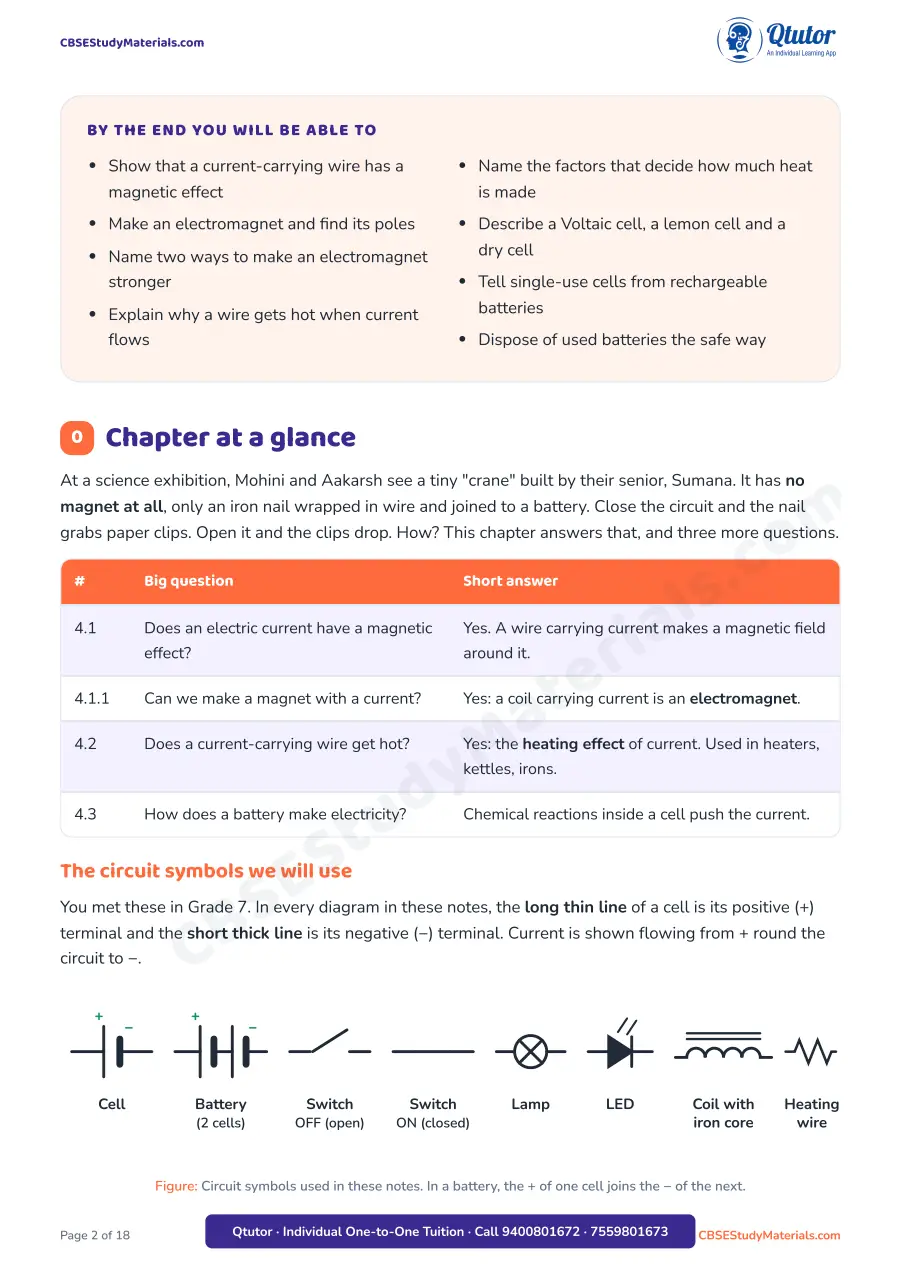
- A circuit-symbol key (cell, battery, switch ON and OFF, lamp, LED, coil with iron core, heating wire), with the long line of a cell always marked as the + terminal
- Four numbered topic sections that follow the textbook: magnetic effect of current, electromagnets, heating effect of current, and how a battery generates electricity
- Activity summaries for Activities 4.1 to 4.6, with what you do, what you see and why it happens
- Definition, big-idea, did-you-know, common-mistake, real-life and think-deeper cards on every topic
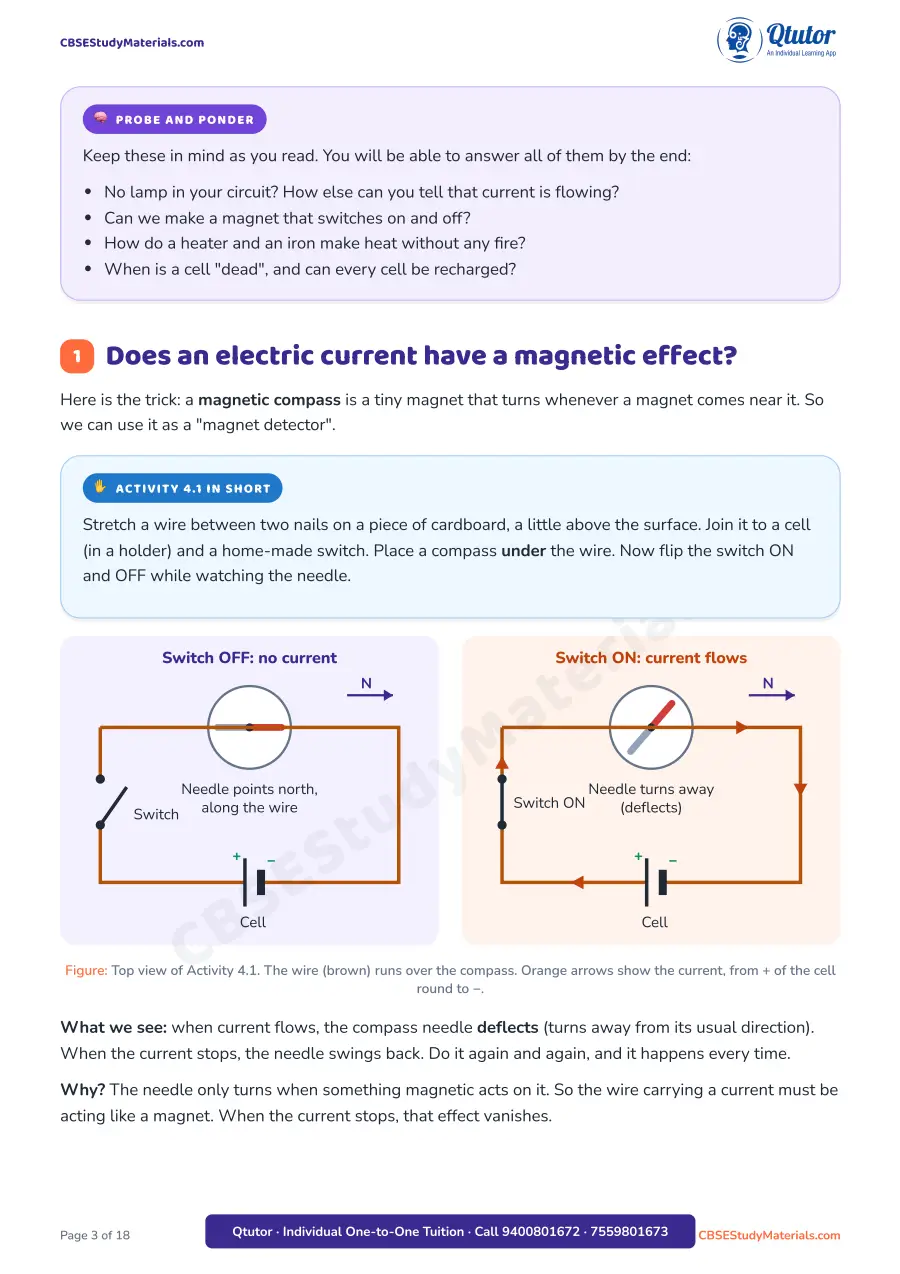
- Nine original diagrams: the circuit-symbol key, a compass under a current-carrying wire (switch OFF and ON), an electromagnet with its circuit diagram, finding the N and S poles of an electromagnet, the nichrome-wire heating circuit, a heating element inside a heater, a Voltaic cell, a five-lemon battery lighting an LED, and a cut-open dry cell
- Two photos: a home-made electromagnet lifting paper clips and an electric kettle
- Tables on what makes an electromagnet stronger and on dry cells versus rechargeable batteries
- A key-terms grid with 14 words and their meanings, and a colour mind map of the chapter
- 11 "Check yourself" important questions (MCQ, assertion-reason, data-based, HOTS and real-life) with an answer key
- A one-page summary at the end for quick revision
Structure of the PDF
| Part | What you get |
|---|---|
| Cover, objectives, chapter at a glance | The chapter in four big questions, plus the circuit-symbol key |
| Section 1 | Magnetic effect of current, magnetic field, Oersted's discovery |
| Section 2 | Electromagnets, iron core, poles, strength, lifting electromagnets, Earth's magnetic field |
| Section 3 | Heating effect, resistance, nichrome, factors for heat, appliances, unwanted heating |
| Section 4 | Voltaic cell, Galvani and Volta, lemon cell, dry cell, rechargeable and Li-ion batteries, e-waste |
| Revision pages | Key terms, mind map, 11 questions with answers, one-page summary |
Electricity: Magnetic and Heating Effects Class 8 Important Topics
- Magnetic effect of electric current: why a compass needle deflects when current flows and returns when it stops
- Magnetic field, and Hans Christian Oersted's 1820 discovery that electricity and magnetism are linked
- Electromagnets: a current-carrying coil that behaves as a magnet, and why an iron core makes it stronger
- Poles of an electromagnet and how reversing the current swaps them
- Two ways to make an electromagnet stronger: more current and more turns
- Lifting electromagnets on cranes in factories and scrap yards
- Why Earth behaves like a giant magnet
- Heating effect of electric current, resistance, and why nichrome is used for heating
- What the heat depends on: current, material, thickness, length and time
- Heating appliances (room heater, stove, kettle, iron, immersion rod, hair dryer), unwanted heating and safety
- Voltaic (Galvanic) cell, electrodes and electrolyte; the lemon cell with copper and iron electrodes
- Dry cell parts, rechargeable batteries, Li-ion and solid-state batteries, and safe disposal as e-waste
Class 8 Science Chapter 4 Important Questions (Sample)
What makes an electromagnet stronger, from the notes:
| Change | Effect on strength | Clue you can see |
|---|---|---|
| Use a battery of more cells (more current) | Stronger | Bigger needle deflection, more clips lifted |
| Wind more turns on the coil | Stronger | Bigger deflection |
| Reverse the current direction | Same strength | The poles swap |
A sample assertion-reason question from "Check yourself":
Assertion (A): Scrap yards use electromagnets, not permanent magnets, on their cranes. Reason (R): The magnetism of an electromagnet disappears when its current is switched off. Answer: Both are true and R explains A, because the crane can drop its load exactly where it is needed.
A sample "common mistake" card: many students think the needle in Activity 4.1 moves because the wire is magnetic. The wire is copper, which is not magnetic; the needle moves only while the current flows, so the current causes the effect.
How These Class 8 Electricity Notes Help
- Every activity in the chapter is explained as "do, see, why", so you can answer activity-based questions with confidence
- The diagrams use correct circuit symbols and show the current flowing from + to −, which helps when you draw your own diagrams
- Common-mistake cards clear up the usual confusions, such as which end of a dry cell is positive and whether reversing a battery weakens an electromagnet
- The important questions are mostly application and reasoning questions, the kind schools now set under CBSE 2026-27
- The mind map and one-page summary make last-minute revision quick
Who Should Use It
- Class 8 students using the NCERT Curiosity Science textbook who want clear, NCERT based study material for Chapter 4
- Students preparing for unit tests, half-yearly exams or class quizzes on electricity, electromagnets and cells
- Parents and tutors who want a ready chapter summary with important questions and answers
How to Download the Class 8 Electricity: Magnetic and Heating Effects Notes PDF
Use the download button on this page to get the premium PDF (₹49). You can read it on a phone or tablet, or print it.
Electricity: Magnetic and Heating Effects - Class 8 Science Chapter Notes (PDF · 18 pages · ₹49)
Related Resources
- Class 8 Science Chapter 4 NCERT Solutions
- Class 8 Science Chapter 4 Question Bank
- Electricity: Magnetic and Heating Effects chapter page
- All Class 8 Science chapters
- Previous chapter: Health: The Ultimate Treasure
- Next chapter: Exploring Forces
FAQs on Class 8 Science Chapter 4 Electricity: Magnetic and Heating Effects
Where can I download Class 8 Science Chapter 4 Electricity: Magnetic and Heating Effects notes PDF? You can download the premium notes PDF from this page using the download button. It is an 18-page PDF priced at ₹49.
What are the important topics in Class 8 Science Chapter 4? The magnetic effect of electric current, electromagnets and their poles and strength, the heating effect of current and heating appliances, and cells and batteries: the Voltaic cell, lemon cell, dry cell and rechargeable batteries.
What is the price of the Class 8 Electricity: Magnetic and Heating Effects notes PDF? It is a premium PDF priced at ₹49. It includes nine original diagrams, a mind map, a one-page summary and 11 important questions with answers.
Which book is Class 8 Science Chapter 4 Electricity: Magnetic and Heating Effects from? It is Chapter 4 of the NCERT Science textbook Curiosity for Grade 8, used in CBSE schools for 2026-27. These notes are based on that chapter.
What is an electromagnet in Class 8 Science? An electromagnet is a coil of wire that behaves like a magnet when electric current flows through it. Most electromagnets have an iron core to make them stronger, and the magnetism disappears when the current is switched off.
Why does a nichrome wire get hot when current flows through it? Every conductor offers some resistance to current, and this changes part of the electrical energy into heat. Nichrome offers more resistance than a copper wire of the same size, so it is used in heating elements.
Study tip: try Activity 4.2 at home with a nail, some insulated wire and one cell (for a few seconds only), then explain what you see in your own words.