Units and Measurement - Class 11 Physics Chapter 1 Notes (PDF · 17 pages · Free download) Download the full PDF free

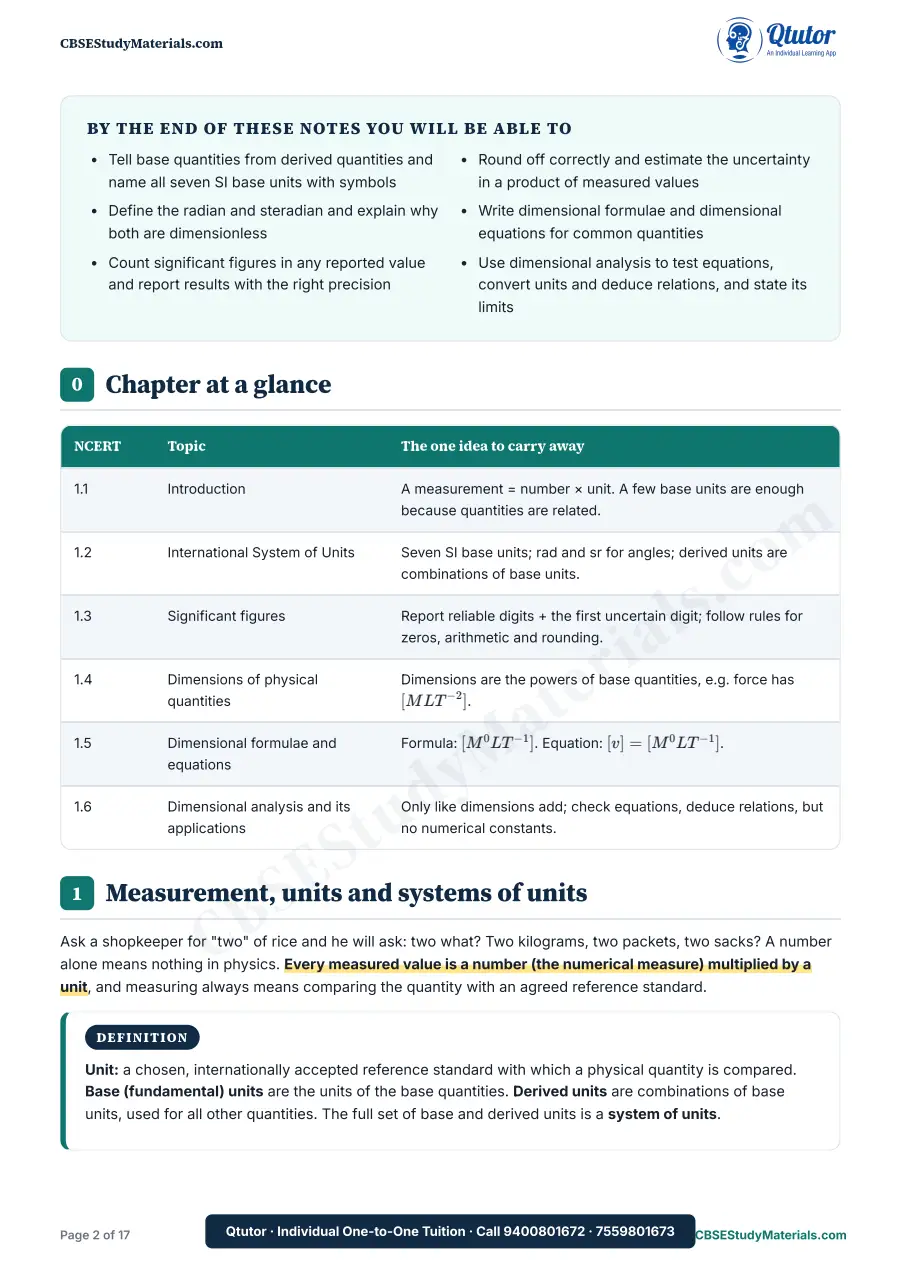
You are looking at pages 1 to 3 of 17. The full PDF is free to download.
These Units and Measurement notes for Class 11 Physics Chapter 1 (CBSE, NCERT Physics Part I, 2026-27) cover every idea in the rationalised chapter. If a reading is written as 4.700 m, is it the same as 4700 mm? Numerically yes, but the second form quietly loses two significant figures, and the notes explain why. This free 17-page chapter notes PDF is NCERT based study material prepared by our team; it is not an official CBSE or NCERT publication.
The notes move in the same order as the textbook: why every measurement is a number times a unit, the seven SI base units, the radian and steradian, significant figures and rounding off, the uncertainty in calculated results, and finally dimensions and dimensional analysis. Every rule comes with a worked example, and every number in the PDF has been recomputed.
Class 11 Physics Chapter 1 Units and Measurement Notes: What Is Included
- A cover, learning objectives and a "chapter at a glance" table that maps each NCERT section (1.1 to 1.6) to the one idea you must carry away
- 6 numbered topic sections with concept cards, definitions, "did you know" boxes, think-deeper prompts and common-mistake boxes
- 12 worked examples with full steps, from converting 54 km h⁻¹ to m s⁻¹ to showing that 1 J = 10⁷ erg
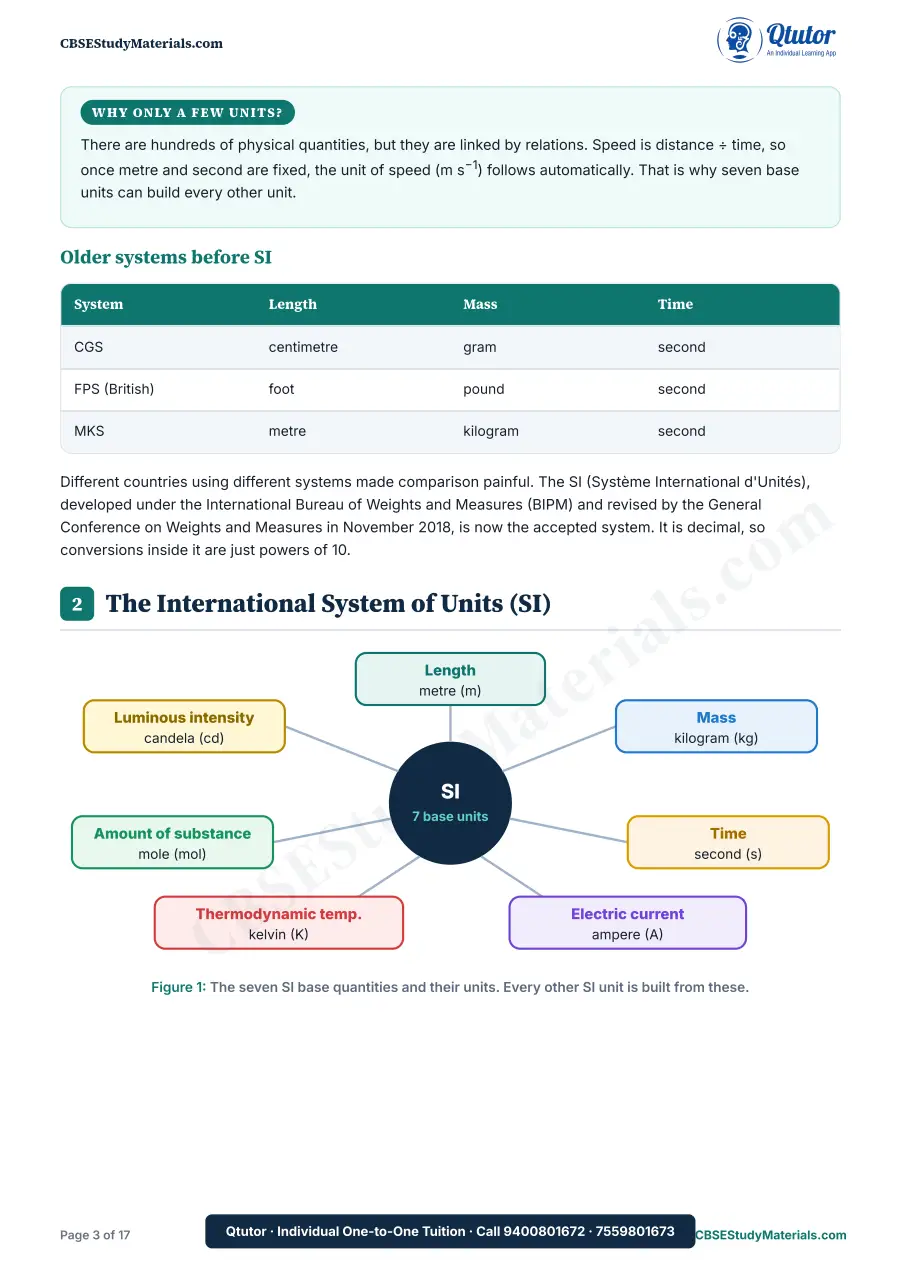
- 6 original labelled diagrams: the seven SI base quantities, plane angle and solid angle, reading a millimetre scale (certain and uncertain digits), a decision path for zeros in significant figures, a power-of-ten ladder for order of magnitude, and the four-step method of dimensions for a pendulum
- 3 photographs that connect the chapter to the lab: vernier callipers and a screw gauge, a measuring tape with a stopwatch, and a brass balance with weights
- A table of dimensional formulae and SI units for acceleration, density, force, momentum, energy, power, pressure, frequency and charge
- A key formulas table, a 15-term key-terms grid and a mind map of the whole chapter
- "Check yourself": 12 important questions (27 marks) in the board pattern, with an answer key that shows value points and step marks
- A one-page summary (chapter summary for quick revision) with a "when you see... do this" table
Structure of the Units and Measurement Notes PDF
| Part | What you get |
|---|---|
| Opening | Cover, objectives, chapter at a glance |
| Section 1 | Measurement, units, base and derived units, CGS, FPS and MKS systems |
| Section 2 | SI base units, radian and steradian, units outside SI, symbol rules, unit conversion |
| Section 3 | Significant figures, rules for zeros, scientific notation, order of magnitude |
| Section 4 | Arithmetic with significant figures, rounding off, uncertainty in results |
| Section 5 | Dimensions, dimensional formulae and dimensional equations |
| Section 6 | Dimensional analysis: consistency check, deducing relations, unit conversion, limitations |
| Revision | Key formulas, key terms, mind map |
| Practice | 12 board-pattern questions and the answer key |
| Last page | One-page summary |
Units and Measurement Class 11 Important Topics
- Base and derived units: why seven base units are enough for every quantity in physics.
- SI system: metre, kilogram, second, ampere, kelvin, mole and candela, and how the 2018 revision fixes each one through a constant of nature.
- Plane and solid angle: dθ = ds/r in radian and dΩ = dA/r2 in steradian, both dimensionless.
- Significant figures: reliable digits plus the first uncertain digit; rules for leading, trailing and in-between zeros; why a change of unit never changes the count.
- Order of magnitude: writing a value as a × 10b and rounding a to 1 or 10.
- Rules for arithmetic: fewest significant figures for multiplication and division, fewest decimal places for addition and subtraction.
- Rounding off: including the "exactly 5" rule based on whether the preceding digit is even or odd, and carrying one extra digit in multi-step work.
- Uncertainty: relative error and how percentage errors add in a product.
- Dimensions: dimensional formulae such as [M L T−2] for force, and dimensional equations.
- Dimensional analysis: checking equations with the principle of homogeneity, deducing relations, converting units, and its limitations.
Units and Measurement Class 11 Important Questions (Sample)
Worked example (significant figures). A cube of side 2.15 cm has mass 81.3 g. Keeping one extra digit, V = (2.15)3 = 9.938 cm³, so ρ = 81.3/9.938 = 8.18 g cm⁻³ (three significant figures).
Worked example (method of dimensions). If the force on a body moving in a circle depends on m, v and r, put F = k mx vy rz. Equating powers of M, L and T gives x = 1, y = 2, z = −1, so F = k mv2/r.
From the practice set (assertion-reason). Assertion: 15.46 cm − 15.4 cm should be reported as 0.1 cm. Reason: in subtraction the result keeps the fewest significant figures. The answer key explains why the assertion is true but the reason is false: subtraction follows decimal places.
| Quantity | Dimensional formula | SI unit |
|---|---|---|
| Force | [M L T−2] | N |
| Work, energy | [M L2 T−2] | J |
| Pressure | [M L−1 T−2] | Pa |
How These Revision Notes Help
The chapter is short, but board and school exams test it through precise rules: how many significant figures, which digit to round, whether an equation is dimensionally correct. The notes turn each rule into a picture or a table, then show it at work in an example. The practice set uses the same mix of MCQ, assertion-reason, short answer, case-based and long answer questions that you will meet in exams, and the answers show where each mark comes from.
Who Should Use the Class 11 Physics Chapter 1 Notes
- Class 11 students starting physics in the CBSE 2026-27 session
- Students who want a clear chapter summary before a unit test or a half-yearly exam
- Students preparing for competitive exams who need the significant-figure and dimension rules to be automatic
- Teachers and parents looking for a compact, NCERT based revision sheet
How to Download the Class 11 Units and Measurement Notes PDF
The PDF is free. Use the download button below to save it and study offline.
Units and Measurement - Class 11 Physics Chapter 1 Notes (PDF · 17 pages · Free download)
Related Resources
- Class 11 Physics Chapter 1 Units and Measurement: all study material for this chapter
- Class 11 Physics: every chapter of Class 11 Physics
- Next chapter: Motion in a Straight Line (coming soon)
FAQs on Class 11 Physics Chapter 1 Units and Measurement
Where can I download Class 11 Physics Chapter 1 Units and Measurement notes PDF? Use the download button on this page. The 17-page notes PDF is free.
Is the Units and Measurement notes PDF free? Yes. This chapter notes PDF costs nothing to download.
What are the important topics in Units and Measurement Class 11? SI base units, radian and steradian, significant figures and rounding off, uncertainty in calculated results, dimensional formulae and dimensional analysis with its limitations.
Which book is Units and Measurement Class 11 from? It is Chapter 1 of the NCERT Class 11 Physics textbook, Part I. These notes follow the rationalised 2026-27 reprint.
Does the PDF include important questions with answers? Yes. It has 12 board-pattern questions worth 27 marks, including assertion-reason and a case-based question, with value-point answers.
Are errors in measurement and vernier callipers covered? The notes follow the rationalised chapter, which covers the uncertainty in results of calculations and relative error. The older sections on types of errors and instruments are not part of the current chapter, so they are not taught here.
Study tip: whenever you write a measured value, ask "how many digits do I really know?" before you write the last one.